
Opening your dashboard
Class 6 Biology Chapter 1 The Leaf: Competency-Based Questions (CBQ)
40 questions on Chapter 1, each worked through on its own page with the AI tutor. Class 6 Biology, ICSE 2026-27.
40 questions
1–5 marks · Mixed difficulty
- 11 mark
Question 1
Cognitive domain: Application
Tara shifted a pea seedling to a bigger pot. She pulled it out roughly. The thick main root stayed whole, but most of the fine hair-like ends of the root branches broke off. She watered the plant well, yet it drooped for a few days. What is the most likely reason ?
- 21 mark
Question 2
Cognitive domain: Analysis
The figure shows a shoot of a hibiscus (china rose) plant growing in a school hedge. Four parts are numbered 1 to 4.
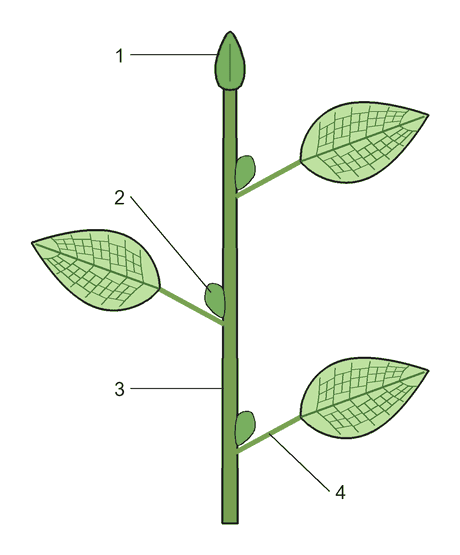
To keep the hedge low, the gardener cuts the shoot just below part 1. A few weeks later, new side branches come out of the shoot. Which numbered part grows into these new side branches ?
- 31 mark
Question 3
Cognitive domain: Application
At a wedding feast in Kerala, food is served on banana leaves. Arun notices that his leaf tears very easily into neat, straight strips running from the midrib towards the margin. Which feature of the banana leaf best explains this ?
- 41 mark
Question 4
Cognitive domain: Analysis
On a hot afternoon in May, Class 6 students of a school in Nagpur measured the air temperature at two shaded places in their playground.
Shaded place Temperature at 2 p.m. Under a tin shed Under a large neem tree Both places were in the shade, yet it was cooler under the tree. What best explains the extra cooling under the tree ?
- 51 mark
Question 5
Cognitive domain: Understanding
Assertion (A): A cactus can live in a hot, dry desert where a rose plant would soon dry up.
Reason (R): In a cactus, the leaves are modified into spines, which reduce the loss of water.
- 61 mark
Question 6
Cognitive domain: Analysis
Assertion (A): A fully grown mango leaf keeps on growing bigger every year, just as the stem of the mango tree keeps on growing taller.
Reason (R): The apical buds at the tip of the shoot are responsible for the vertical growth of the stem.
- 71 mark
Question 7
Cognitive domain: Understanding
Zoya soaked a peepal leaf in water for some days, changing the water every second day. When she rubbed the leaf gently, the soft green portion came off. A fine, lace-like net was left behind, and it still had the full shape of the peepal leaf.
Complete the sentence :
The net that was left behind is made up of the ______ of the leaf, and it kept the shape of the leaf because these give the leaf a supportive framework, like a skeleton.
- 81 mark
Question 8
Cognitive domain: Application
Neha plucked a small green stalk from a rose bush. It had five small green blades on it, so she said, "I have five leaves." Her teacher asked her to look for buds. Neha found a bud only at the place where the main stalk had been joined to the stem. There was no bud where each small blade joined the stalk.
Complete the sentence :
So Neha had plucked only one ______ leaf, and each small green blade on it is a ______.
- 91 mark
Question 9
Cognitive domain: Application
Lata cut one twig of jasmine and one twig of china rose from her garden. Each twig has 6 nodes, and no leaf has fallen off either twig. She counts the leaves on both.
Complete the sentence :
The jasmine twig has ______ more leaves than the china rose twig, because the leaves of jasmine are in the ______ arrangement while those of china rose are in the alternate arrangement.
- 102 marks
Question 10
Cognitive domain: Evaluation
It is a very hot summer and water is short in Anil's village. His uncle says, "Leaves only waste water. Let us pluck all the leaves off our young guava plants. Then the plants will grow better."
Do you agree with the uncle's decision ? Give two reasons for your answer.
- 112 marks
Question 11
Cognitive domain: Understanding
Sunita sowed sweet pea seeds next to a wire fence. Her cousin sowed the same seeds in the middle of an open plot with nothing near them. After a month, Sunita's plants were standing tall along the fence, but her cousin's plants were lying spread out on the ground.
Explain why the two sets of plants grew so differently.
- 122 marks
Question 12
Cognitive domain: Evaluation
Mohit finds a small plant growing near his school gate. Its leaves have veins that form a fine net. Without digging up the plant, he says, "This plant must have a bunch of thin roots, all of the same thickness, just like grass."
Is Mohit's claim likely to be correct ? Justify your answer using what the leaf tells you about the plant.
- 134 marks
Question 13
Cognitive domain: Application
Case: Mr Thapa runs a plant nursery near Shillong in Meghalaya. He grows two pitcher plants in the same kind of soil, which is poor in nitrates. Both get the same water and sunlight. One plant stands in the open. The other is kept inside a box made of very fine net, so that no insect can reach it. After some months, the plant inside the net is still green, but it is growing more poorly than the plant in the open.
(a) The plant inside the net catches no insects, yet it is still green and alive. How does it get its food ?
(b) An ant sits on the rim of a pitcher of the plant in the open. Describe what happens to the ant.
(c) Both plants get the same water and sunlight. Explain why the plant inside the net is growing more poorly than the plant in the open.
- 145 marks
Question 14
Cognitive domain: Analysis
Case: Riya took three well-watered potted balsam plants of the same size, each with 12 leaves. She left plant P as it was, removed 6 leaves from plant Q and removed all the leaves from plant R. She wrapped each pot, along with its soil, in polythene and tied it round the base of the stem. She weighed the three plants at 10 a.m., kept them in sunlight, and weighed them again at 4 p.m.
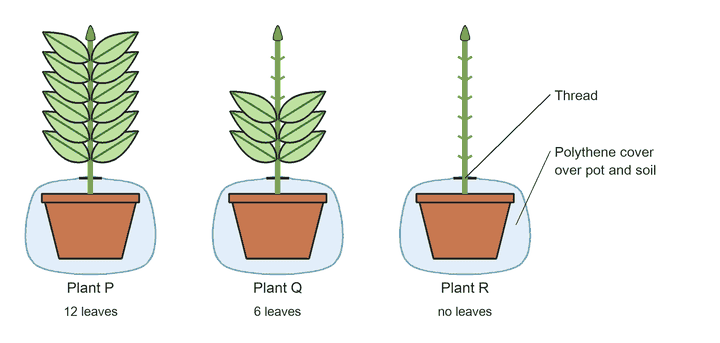
Plant Number of leaves Mass at 10 a.m. Mass at 4 p.m. P 12 850 g 826 g Q 6 846 g 833 g R 0 842 g 840 g The loss in mass of each plant is the mass of water it lost.
(a) Calculate the mass of water lost by each plant in these 6 hours.
(b) What do the results tell you about the leaves and the loss of water ? Name the process by which the plants lost this water.
(c) Plant R had no leaves, yet it lost a little water. From where was this water lost ?
(d) Why did Riya wrap the pot and the soil of each plant in polythene ?
- 155 marks
Question 15
Cognitive domain: Creativity
Case: The Eco Club of a school has one large Bryophyllum leaf with many buds growing along its margin. Isha, a club member, has read that these buds grow into new plants when they fall on moist soil. She wants to plan a simple experiment to find out whether the buds really need moist soil. She has two flower pots, dry garden soil, water and a pair of scissors.
(a) Describe how Isha should set up the two pots. What is the one thing that must be different between them ? Name two things that must be kept the same.
(b) What should Isha observe, and for how many days ? Draw a table in which she can record her observations.
(c) What result would show that the buds do need moist soil ? What is this method of getting new plants from a leaf called ?
- 161 mark
Question 16
Cognitive domain: Analysis
The figure shows a leaf with four parts numbered 1 to 4. The leaf is joined to the stem at a node.
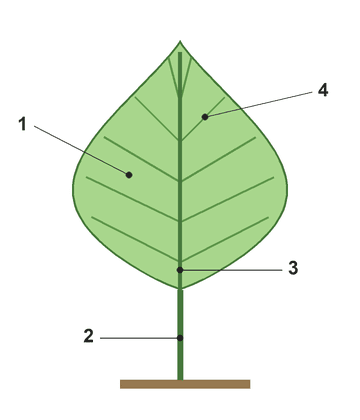
A gardener presses a strong clip on the stalk that joins the leaf to the stem, so that the tubes inside the stalk are squeezed shut. By evening the lamina droops, although it is still green. Which numbered part is under the clip, and what best explains why the lamina droops ?
- 171 mark
Question 17
Cognitive domain: Analysis
Rina picks a leaf of prickly poppy. Its lamina has deep cuts along the margin, and the margin bears spines. She says, "The lamina is cut into several pieces, so this is a compound leaf."
Which observation would show that Rina is wrong ?
- 181 mark
Question 18
Cognitive domain: Analysis
Three bare twigs, X, Y and Z, were collected from different trees in winter, when all their leaves had fallen. Each twig has four nodes. Each dark oval mark in the figure is a scar left where one leaf had been attached.
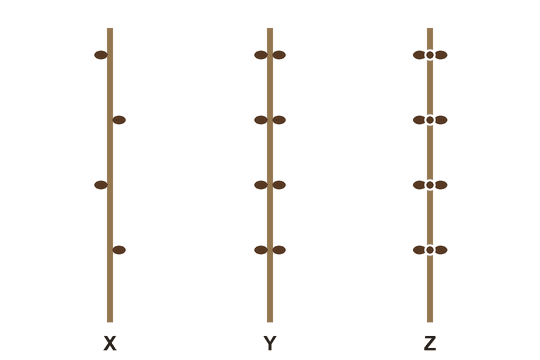
In how many of these three twigs did two or more leaves arise at the same node ?
- 191 mark
Question 19
Cognitive domain: Understanding
Assertion (A): An onion bulb kept in a dark cupboard can still put out a small shoot.
Reason (R): The thick, fleshy scale leaves of an onion store food, and the new shoot uses this food.
- 201 mark
Question 20
Cognitive domain: Analysis
Assertion (A): A green leaf kept in a dark cupboard for several days cannot make food.
Reason (R): The chlorophyll in a leaf can make food even without sunlight.
- 211 mark
Question 21
Cognitive domain: Analysis
Ayesha places a Hydrilla plant in a beaker of water and shines a lamp on it. She counts the tiny bubbles of oxygen that rise from the leaves in one minute. She repeats this with the lamp at different distances and then with the lamp switched off. (Hypothetical data.)
Position of the lamp Bubbles per minute 10 cm from the plant 36 20 cm from the plant 18 40 cm from the plant 9 Lamp switched off 0 Which conclusion is best supported by the table ?
- 221 mark
Question 22
Cognitive domain: Application
Mrs Rao keeps a small tank of pond water. She notices a floating plant with finely divided leaves that carry tiny bladder-like sacs. She sees a water flea swim into one sac, the entrance closes behind it, and over the next days the number of water fleas in the tank falls. (Hypothetical case.)
Which description of a leaf modification fits this plant ?
- 231 mark
Question 23
Cognitive domain: Application
Farmer Raju sowed seeds from an unlabelled packet in a nursery tray. The packet held seeds of only one crop. Two weeks later the young leaves are long and narrow, and their veins run side by side from the base of the leaf to its tip, without forming a network. (Hypothetical case.)
Which crop are the seeds most likely to be ?
- 241 mark
Question 24
Cognitive domain: Application
A twig of a guava plant has 5 nodes. At each node two leaves arise opposite each other, and no leaf has fallen off. The tip of the twig carries its terminal bud.
How many buds does the twig have in all ?
- 251 mark
Question 25
Cognitive domain: Understanding
Read the four statements about the leaf.
- Photosynthesis gives glucose and oxygen as its two end-products.
- Every leaf is attached to the stem by a petiole.
- The petiole, midrib, veins and veinlets conduct water and food.
- Transpiration is the loss of water from the roots into the soil.
Which statements are correct ?
- 262 marks
Question 26
Cognitive domain: Evaluation
Rohit has a leaf of a rose plant and a leaf of Bryophyllum. He says, "Any leaf pressed into moist soil will grow into a new plant, so I can get a rose bush from this rose leaf." (Hypothetical case.)
Is Rohit correct ? Give two reasons for your answer.
- 272 marks
Question 27
Cognitive domain: Understanding
Meena peels an onion layer by layer. The outer layers are thin, dry and papery. The inner layers are thick, fleshy and juicy. Both kinds of layers are scale leaves.
State what the thin dry scale leaves do, and what the thick fleshy scale leaves do.
- 282 marks
Question 28
Cognitive domain: Evaluation
Kiran says, "In whorled phyllotaxy, exactly three leaves arise at each node."
Is he correct ? Explain, and say how many leaves arise at a node in the alternate and the opposite arrangements.
- 292 marks
Question 29
Cognitive domain: Understanding
After a morning walk in a park full of trees, Mira says, "The air here feels so fresh."
(a) Name the gas that the leaves give out and the process in which it is made.
(b) State one way in which this gas is useful.
- 302 marks
Question 30
Cognitive domain: Application
A leafy twig of a white balsam plant with a few white flowers, which has no roots, is cut and placed in a jar of water to which a few drops of red ink were added. After a day, the veins of the leaves and the petals show red streaks. (Hypothetical case.)
Which part of the plant carried the red water upwards, and which function of this part does the observation show ?
- 312 marks
Question 31
Cognitive domain: Application
Priya lays a mango leaf flat and measures it with a ruler. From the point where the leaf joins the stem to the tip of the leaf, it is 21 cm long. The stalk at the base of the leaf is 3 cm long. (Hypothetical data.)
(a) Name the stalk of the leaf, and the part that continues it through the middle of the lamina. (1 mark)
(b) How long is the lamina, measured along this middle part from the base of the lamina to the leaf apex ? (1 mark)
- 323 marks
Question 32
Cognitive domain: Analysis
A teacher sets up four leaves to test what a leaf needs to make food. A variegated leaf has green parts and white parts. The results are in the table. (Hypothetical data.)
Set-up Sunlight Water Carbon dioxide Chlorophyll Food made A: Green leaf in sunlight, in ordinary air Yes Yes Yes Yes Yes B: Green leaf in a dark cupboard No Yes Yes Yes No C: Green leaf in sunlight, in air with no carbon dioxide Yes Yes No Yes No D: White part of a variegated leaf, in sunlight, in ordinary air Yes Yes Yes No No (a) Name the raw material that is missing in set-up C, and say where a leaf normally gets it from.
(b) Why did the white part (set-up D) fail to make food, although it had sunlight, water and carbon dioxide ?
(c) Write the word equation for the process that goes on in set-up A.
- 333 marks
Question 33
Cognitive domain: Creativity
The school herbarium needs a leaf identity card that any Class 6 student can fill in for a leaf that he or she collects.
(a) Name four boxes that the card should have.
(b) For each box, give the choices that a student can tick.
(c) Fill in the card for a peepal leaf.
- 343 marks
Question 34
Cognitive domain: Understanding
The sentences below describe the journey of water from the soil to the air through a plant. They are in the wrong order.
P: Water evaporates as vapour from the surface of the leaf into the air.
Q: Water moves up through the stem.
R: Roots absorb water from the soil.
S: Water passes through the petiole, midrib and veins into the lamina.
(a) Write the sentences in the correct order.
(b) Name the process in sentence P and define it.
(c) State two benefits of this process to the plant.
- 353 marks
Question 35
Cognitive domain: Application
A caterpillar ate every leaf of a young bean plant. A week later the stem is still soft and green, and the plant is alive, although it grows very slowly. (Hypothetical case.)
(a) State the extra function of a young, green stem that helps the plant to survive.
(b) Name the process, and the substance in the green stem that makes it possible.
(c) Why does the plant grow so slowly now ?
- 363 marks
Question 36
Cognitive domain: Evaluation
After a lesson on types of leaves, three classmates make these claims.
- Aditi: "Every leaf with a toothed (serrated) margin is a compound leaf."
- Bhanu: "Every simple leaf has a smooth, entire margin."
- Chetan: "A leaf is compound only when its lamina is divided into separate leaflets."
(a) Use one example from your book to show that Aditi's claim is wrong. (1 mark)
(b) Use one example from your book to show that Bhanu's claim is wrong. (1 mark)
(c) Is Chetan's claim correct ? Explain why the margin of a leaf cannot tell us whether the leaf is simple or compound. (1 mark)
- 374 marks
Question 37
Cognitive domain: Analysis
Case: A class makes three identical trays of soil and tilts them. Tray A has bare soil. Tray B has 20 grass plants, which have a fibrous root system. Tray C has 20 gram plants of the same age, which have a tap root system. The same amount of water is poured over each tray in the same way, and the soil that washes out of each tray is collected and weighed. (Hypothetical data.)
Tray Soil washed out A (bare soil) 120 g B (grass) 12 g C (gram) 30 g (a) Which tray lost the least soil ? Express its loss as a percentage of the loss from tray A.
(b) How much more soil was lost from tray C than from tray B ? Name the kind of root system in each tray.
(c) Which function of the roots do these results show ? Explain why the results of tray A are needed.
- 384 marks
Question 38
Cognitive domain: Analysis
Case: Students of Class 6 cut a large Bryophyllum leaf into four pieces and plant them in four pots, as the table shows. All the pots get the same light and the same warmth. After 12 days they count the plantlets in each pot. (Hypothetical data.)
Pot Leaf piece Soil Position of the bud Plantlets after 12 days 1 Has a growing bud Moist Just projecting out of the soil 1 2 Has a growing bud Moist Covered completely with soil 0 3 Taken from the middle of the leaf, no bud Moist Not applicable 0 4 Has a growing bud Dry Just projecting out of the soil 0 (a) In which pot did a plantlet grow ? Name the type of reproduction shown.
(b) Which two pots should be compared to show that a bud is needed ? Which two should be compared to show that moist soil is needed ?
(c) In pot 2 the bud was covered completely and no plantlet grew. State a suitable way of planting the piece, according to the chapter.
- 395 marks
Question 39
Cognitive domain: Analysis
Case: A potted plant with many leaves was kept in the open on a hot dry day. The water that it lost by transpiration was measured in six slots of 3 hours each, from 6 a.m. to midnight. The plant lost 100 g of water in all. The bar chart shows the result. (Hypothetical data.)
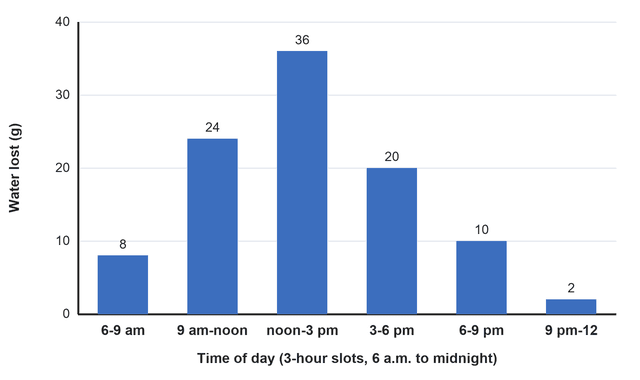
(a) In which slot did the plant lose the most water ? Read off the amount.
(b) What percentage of the day's water loss took place between 9 a.m. and 3 p.m. ?
(c) Explain why the loss is so large around noon and so small late at night. State one benefit of this loss to the plant.
- 405 marks
Question 40
Cognitive domain: Creativity
Case: For the school science fair, Hari's group has to build a stall named "Leaf Magic", with working models of three modified leaves. They have wire, green and brown paper, thread, cotton, foam balls, paper cups and card. (Hypothetical task.)
(a) Choose three leaf modifications from the chapter. For each, name a plant that shows it and state the job of the modified leaf.
(b) For each of the three, say which material you would use for the model, and what the model will show a visitor.
(c) Write one quiz question for visitors that compares two of your models, and give its answer.