
Opening your dashboard
Class 12 Physics Chapter 34: Communication Systems Solutions
90 textbook questions with step-by-step answers, free to read, for ISC 2026-27.
Get talked through Ch 34, not just shown the answer
Reading a finished solution is not the same as being able to do it. The AI tutor takes one question at a time and works it with you, in your own words, until you can.
- Ask it out loud, in your own words
- It gives you the next step, not the answer
- Stuck on part (ii)? Start there
90 questions with solutions
1–5 marks · Mixed difficulty
The first 72 solutions are on this page. This chapter is a long one, so the rest open on their own page to keep this one quick to load.
- 11 mark
Question 1
Audio signal cannot be transmitted because
Solve with AIAnswer
(A) the signal has more noise.
(B) the signal cannot be amplified for distance communication.
- Correct
(C) the transmitting antenna length is very large and impracticable.
(D) the signal is not radio signal.
Answer: (C) the transmitting antenna length is very large and impracticable.
Concept: An antenna radiates efficiently only if its length is comparable to the wavelength (at least ), and the power it radiates is proportional to .
Step 1 — Wavelength of an audio signal. For a 20 kHz audio signal
Step 2 — Antenna needed. A quarter-wave antenna for this wavelength would have to be this long:
Such an antenna is far too tall to build, and lower audio frequencies need even longer antennas.
Step 3 — Check the other options. Each of the other options fails for a definite reason:
- (A) Noise is added in the channel and receiver to any signal; the audio signal itself is not noisier than a radio signal.
- (B) Audio signals are amplified easily by ordinary audio amplifiers.
- (D) It is true that audio is not a radio-frequency signal, but that only restates the situation; the physical reason it cannot be radiated is the impracticably long antenna (and the tiny radiated power) its long wavelength would need.
Therefore, the answer is (C): an audio signal would need an impracticably long antenna.
- 21 mark
Question 2
In frequency modulation
Solve with AIAnswer
(A) the amplitude of the modulated wave varies as frequency of carrier wave.
- Correct
(B) the frequency of modulated wave varies as amplitude of modulating signal.
(C) the amplitude of modulated wave varies as amplitude of carrier wave.
(D) the frequency of modulated wave varies as frequency of modulating wave.
(E) the frequency of modulating wave varies as frequency of carrier wave.
Answer: (B) the frequency of modulated wave varies as amplitude of modulating signal.
Concept: In frequency modulation the instantaneous frequency of the carrier is changed in proportion to the instantaneous amplitude (value) of the modulating signal, , while the amplitude of the carrier stays constant. Here is the carrier's unmodulated angular frequency, and are the amplitude and angular frequency of the modulating signal, and is a constant of the modulator.
Step 1 — What changes. The frequency of the modulated wave rises when the signal voltage is positive and falls when it is negative; the size of the change depends on the signal's amplitude.
Step 2 — What stays the same. The amplitude of an FM wave is constant.
Step 3 — Check the other options. Each of the other options fails for a definite reason:
- (A) The amplitude of an FM wave does not vary at all.
- (C) This does not describe FM; in FM the amplitude stays at the carrier's constant value, and in AM the amplitude varies with the modulating signal, not with the carrier.
- (D) The signal's frequency only sets how many times per second the carrier frequency swings up and down; the size of the swing is set by the signal's amplitude.
- (E) The modulating wave is the message itself; modulation does not change its frequency.
Therefore, the answer is (B).
- 31 mark
Question 3
For sky wave propagation of a 10 MHz signal, what should be the minimum electron density in the ionosphere?
Solve with AIAnswer
- Correct
(A)
(B)
(C)
(D)
Answer: (A)
Concept: The highest frequency a layer can reflect when the wave is sent vertically is its critical frequency, (in Hz, with in ). For a 10 MHz wave to be reflected, must be at least 10 MHz.
Step 1 — Set the critical frequency equal to 10 MHz. The minimum electron density is the one that makes MHz:
Step 2 — Square both sides. We divide both sides by 9 and square them to find :
Step 3 — Check the other options. Each of the other options fails for a definite reason:
- (B) This density gives a critical frequency of only 9 kHz, far below 10 MHz.
- (C) This density gives a critical frequency of 90 MHz; it would reflect the wave, but it is not the minimum density.
- (D) This density gives a critical frequency of 900 GHz, again far more than needed.
Therefore, the answer is (A), about .
- 41 mark
Question 4
In which of the following, remote sensing is not used?
Solve with AIAnswer
(A) Forest density
(B) Pollution
(C) Wetland mapping
(D) Ground water survey
- Correct
(E) Medical treatment
Answer: (E) Medical treatment
Concept: Remote sensing collects information about the Earth's surface and atmosphere from a distance, usually with sensors on satellites or aircraft.
Step 1 — Look for the odd one. Forests, pollution, wetlands and underground water are all features of the Earth that can be studied from satellite images. Treating a patient is not a survey of the Earth from a distance.
Step 2 — Check the other options. Remote sensing is used in each of these:
- (A) Satellite images show the extent and density of forest cover.
- (B) Satellites monitor smoke, dust, aerosols and the quality of water bodies.
- (C) Wetlands are mapped and monitored from satellite images.
- (D) Satellite images of rock types, landforms and vegetation help to locate likely groundwater zones.
Note: The book's answer list gives "Wetland mapping" for this question and "from 2 MHz to 80 MHz" for the next one; these two entries appear to be interchanged, since remote sensing is widely used for wetland mapping.
Therefore, the answer is (E): remote sensing is not used in medical treatment.
- 51 mark
Question 5
The sky wave propagation is suitable for radio waves of frequency
Solve with AIAnswer
(A) up to 2 MHz
(B) from 2 MHz to 20 MHz
- Correct
(C) from 2 MHz to 30 MHz
(D) from 2 MHz to 50 MHz
(E) from 2 MHz to 80 MHz
Answer: (C) from 2 MHz to 30 MHz
Concept: Sky waves are radio waves bent back to the Earth by the ionosphere. The ionosphere returns waves from a few MHz up to about 30 MHz (at most about 40 MHz); higher frequencies pass through it.
Step 1 — Lower limit. Below about 2 MHz, waves are carried mainly as ground waves and are strongly absorbed in the lower ionosphere by day.
Step 2 — Upper limit. Above about 30 MHz the waves penetrate the ionosphere and escape.
Step 3 — Check the other options. Each of the other options fails for a definite reason:
- (A) Frequencies below 2 MHz are mainly ground-wave (medium-wave) frequencies, not the sky-wave band.
- (B) This range stops at 20 MHz and leaves out 20 MHz to 30 MHz, which is also reflected.
- (D) The band up to 50 MHz includes frequencies above about 40 MHz, which pass through the ionosphere.
- (E) Frequencies up to 80 MHz are even further above the limit and escape into space.
Note: The book's answer list gives "from 2 MHz to 80 MHz" here; its own hint for this chapter says sky waves are useful for 2 MHz to 30 MHz, and the entries for this question and the previous one appear interchanged.
Therefore, the answer is (C), 2 MHz to 30 MHz.
- 61 mark
Question 6
In short wave communication, waves of which of the following frequencies will be reflected back by the ionospheric layer having electron density ?
Solve with AIAnswer
- Correct
(A) 2 MHz
(B) 10 MHz
(C) 12 MHz
(D) 18 MHz
Answer: (A) 2 MHz
Concept: A layer reflects (sent vertically) only waves whose frequency is below its critical frequency .
Step 1 — Critical frequency of this layer. We substitute :
Step 2 — Compare. Only 2 MHz is below 2.85 MHz, so only the 2 MHz wave is reflected.
Step 3 — Check the other options. Each of the other options fails for a definite reason:
- (B) This frequency is above 2.85 MHz, so the 10 MHz wave passes through this layer.
- (C) This frequency is also above 2.85 MHz, so the 12 MHz wave passes through.
- (D) This frequency is far above 2.85 MHz, so the 18 MHz wave passes through.
Therefore, the answer is (A), 2 MHz.
- 71 mark
Question 7
For sky wave propagation of a 10 MHz signal, what should be the minimum electron density in ionosphere?
Solve with AIAnswer
- Correct
(A)
(B)
(C)
(D)
Answer: (A)
Concept: The critical frequency of an ionospheric layer is ; a wave sent up is reflected only if its frequency does not exceed , so the least electron density that reflects 10 MHz is the one with MHz.
Step 1 — Write the condition. We set the critical frequency equal to the signal frequency:
Step 2 — Solve. We divide both sides by 9 and then square them to find the electron density:
Step 3 — Check the other options. Each of the other options fails for a definite reason:
- (B) With the layer reflects only up to 9 kHz.
- (C) With the layer reflects up to 90 MHz; that is more than enough, so it is not the minimum.
- (D) With the layer would reflect up to 900 GHz; this is not the minimum either.
Therefore, the answer is (A).
- 81 mark
Question 8
When radio waves pass through ionosphere, phase difference between space current and capacitive displacement current is
Solve with AIAnswer
(A) 0 rad
(B) rad
(C) rad
- Correct
(D) rad
Answer: (D) rad
Concept: In the ionosphere the wave's electric field drives the free electrons, giving a "space" (conduction) current, and the changing field also gives a displacement current . Comparing their phases explains why the refractive index of the ionosphere is less than one.
Step 1 — Displacement current. Let the field be . We find the displacement current density by differentiating the field with respect to time.
Since , the displacement current leads the field by .
Step 2 — Space (electron) current. We apply Newton's second law to a free electron of mass and charge in this field.
Integrating with respect to time (for the steady oscillation, with no constant drift) gives the electron's velocity.
With electrons per unit volume the current density is , so we substitute this velocity.
Since , the electron current lags the field by .
Step 3 — Compare the two. One leads by and the other lags by , so they are opposite in sign at every instant: the phase difference is . The electron current partly cancels the displacement current, which makes the effective permittivity, and hence the refractive index, less than that of free space.
Step 4 — Check the other options. Each of the other options fails for a definite reason:
- (A) If the two currents were in phase they would add, the refractive index would exceed 1, and the waves would not bend back towards the Earth.
- (B) A phase difference of is three-quarters of a cycle; the two currents differ by exactly half a cycle.
- (C) A phase difference of is the one between each current and the field, not between the two currents.
Note: The book's answer list gives zero. That cannot be right: the chapter itself says the refractive index of the ionosphere decreases with height (it is less than one), which happens only because the two currents are opposite in phase.
Therefore, the answer is (D), rad.
- 91 mark
Question 9
Ozone layer is present in
Solve with AIAnswer
(A) troposphere
- Correct
(B) stratosphere
(C) ionosphere
(D) mesosphere
Answer: (B) stratosphere
Concept: The atmosphere is divided by height into the troposphere (up to about 10–12 km), the stratosphere (about 12–50 km), the mesosphere (about 50–85 km) and the thermosphere above; the ionised region from about 60 km upwards is called the ionosphere.
Step 1 — Height of the ozone layer. Most of the atmosphere's ozone lies between about 15 km and 35 km above the Earth.
Step 2 — Match the height. That height range lies in the stratosphere.
Step 3 — Check the other options. Each of the other options fails for a definite reason:
- (A) The troposphere is the lowest layer, where weather occurs; only a small fraction of the ozone is there.
- (C) The ionosphere starts at about 60 km, above the ozone layer.
- (D) The mesosphere (about 50–85 km) lies above the ozone layer.
Therefore, the answer is (B), the stratosphere.
- 101 mark
Question 10
Refractive index of ionosphere is
Solve with AIAnswer
(A) zero
(B) more than one
- Correct
(C) less than one
(D) one
Answer: (C) less than one
Concept: For a radio wave of frequency in a region with free electrons per cubic metre, the refractive index is (with in Hz).
This is the same relation that gives the critical frequency , where falls to zero.
Step 1 — Sign of the correction. and are positive, so is positive and .
Step 2 — Consequence. The refractive index of the ionosphere is less than one and decreases as the electron density increases with height, so an upward wave bends away from the normal and can be turned back towards the Earth.
Step 3 — Check the other options. Each of the other options fails for a definite reason:
- (A) The refractive index becomes zero only at the one level where , the height at which a vertically sent wave turns back; it is not the refractive index of the ionosphere as a whole.
- (B) A refractive index above one would bend upward waves towards the normal, so they could never return to the Earth.
- (D) A refractive index of one is the value for free space, with no free electrons.
Note: The book's answer list gives "zero". The refractive index reaches zero only at the single reflecting level; everywhere else in the layer it lies between 0 and 1, so "less than one" describes the ionosphere.
Therefore, the answer is (C), less than one.
- 111 mark
Question 11
Which of the following statements is wrong?
Solve with AIAnswer
(A) Ground wave propagation can be sustained at frequencies 500 kHz to 1500 kHz.
(B) Satellite communication is useful for the frequencies above 30 MHz.
(C) Space wave propagation takes place through tropospheric space.
- Correct
(D) Sky wave propagation is useful in the range of 30 to 40 MHz.
(E) The phenomenon involved in sky wave propagation is total internal reflection.
Answer: (D) Sky wave propagation is useful in the range of 30 to 40 MHz.
Concept: Sky waves work from a few MHz up to about 30 MHz (40 MHz at most); the ionosphere stops returning waves at about this upper limit.
Step 1 — Test statement (D). 30–40 MHz is the upper edge where the ionosphere stops reflecting; sky-wave communication is useful for about 2 MHz to 30 MHz, not "in the range of 30 to 40 MHz". So (D) is wrong.
Step 2 — Check the other options. Each of the other statements is correct:
- (A) Ground (surface) waves are used for medium-wave broadcasting, about 500 kHz to 1500 kHz.
- (B) Satellites use frequencies that pass through the ionosphere, which means above about 30–40 MHz (in practice microwaves of a few GHz).
- (C) Space waves travel in straight lines through the lowest part of the atmosphere, the troposphere.
- (E) In the ionosphere the refractive index falls gradually with height, so an upward wave bends more and more away from the normal until it is totally reflected; the chapter calls this total internal reflection.
Therefore, the wrong statement is (D).
- 121 mark
Question 12
A signal wave of frequency 12 kHz is modulated with a carrier wave of frequency 2.51 MHz. The upper and lower sideband frequencies are respectively
Solve with AIAnswer
(A) 2512 kHz and 2508 kHz
(B) 2522 kHz and 2488 kHz
(C) 2502 kHz and 2498 kHz
- Correct
(D) 2522 kHz and 2498 kHz
(E) 3512 kHz and 2488 kHz
Answer: (D) 2522 kHz and 2498 kHz
Concept: In AM the sidebands are at (upper) and (lower).
Step 1 — Use the same unit. In kilohertz the carrier frequency is kHz (2.51 MHz), and the signal frequency is kHz.
Step 2 — Upper sideband. The upper sideband lies above the carrier, so we add the signal frequency to the carrier frequency.
Step 3 — Lower sideband. The lower sideband lies below the carrier, so we subtract the signal frequency from the carrier frequency.
Step 4 — Check the other options. Each of the other options fails for a definite reason:
- (A) These two values are only 2 kHz from the carrier, not 12 kHz.
- (B) This pair has the right upper sideband, 2522 kHz, but 2488 kHz is 22 kHz below the carrier.
- (C) This pair has the right lower sideband, 2498 kHz, but 2502 kHz is below the carrier, so it cannot be the upper sideband.
- (E) This pair puts its upper value, 3512 kHz, 1002 kHz above the carrier, and 2488 kHz is 22 kHz below it.
Therefore, the answer is (D): 2522 kHz and 2498 kHz.
- 131 mark
Question 13
The maximum distance up to which TV transmission from a TV tower of height can be received is proportional to
Solve with AIAnswer
- Correct
(A)
(B)
(C)
(D)
Answer: (A)
Concept: The line-of-sight range of an antenna of height on the Earth (radius ) is .
Step 1 — Write the range. We use the line-of-sight formula:
Step 2 — Read off the dependence. is a constant, so .
Step 3 — Check the other options. Each of the other options fails for a definite reason:
- (B) It is the area covered, , that is proportional to , not the distance.
- (C) With , doubling the height would multiply the range by ; the formula has only under a square root, so the range grows by just .
- (D) With , doubling the height would make the range four times; in fact it becomes only times.
Note: The book's answer list gives ; that contradicts the chapter's own result .
Therefore, the answer is (A): .
- 141 mark
Question 14
When a low-lying aeroplane passes overhead, we sometimes notice a slight shaking of the picture on our TV screen. This is due to
 Solve with AI
Answer
(A) diffraction of the signal received from the antenna
- Correct
(B) interference of the direct signal received by the antenna with the weak signal reflected by the passing aircraft
(C) change of magnetic flux occurring due to the passage of aircraft
(D) vibrations created by the passage of aircraft
Answer: (B) interference of the direct signal received by the antenna with the weak signal reflected by the passing aircraft
Concept: Two waves of the same frequency reaching an antenna by different paths interfere; if the path difference keeps changing, the combined signal keeps getting stronger and weaker.
Step 1 — Two paths. The antenna receives the direct signal from the TV tower and also a weak signal reflected from the metal body of the aircraft.
Step 2 — Changing path difference. As the aircraft moves, the length of the reflected path changes continuously, so the two signals go in and out of step. The received signal fluctuates, and the picture shakes.
Step 3 — Check the other options. Each of the other options fails for a definite reason:
- (A) The way the signal from the tower spreads round obstacles does not change when an aircraft passes; the effect needs a second, reflected wave.
- (C) The aircraft is far away and produces no significant change of magnetic flux through the antenna.
- (D) Vibrations from the aircraft's noise are far too small to shift the antenna appreciably; the flutter follows the changing path difference of the reflected radio wave.
Therefore, the answer is (B).
- 151 mark
Question 15
What are the three basic units of a communication system?
Solve with AIWritten solution
Solution:
Concept: Every communication system has a sender, a path and a receiving end.
Step 1 — Name the units. The three basic units are the transmitter, the communication channel and the receiver.
Step 2 — Their jobs. The transmitter converts the message into a form suitable for sending, the channel (wire, cable, optical fibre or free space) carries it, and the receiver recovers the message from the received signal.
Therefore, the three basic units are a transmitter, a communication channel and a receiver.
- 161 mark
Question 16
What is an analog signal?
Solve with AIWritten solution
Solution:
Concept: Signals are classed as analog or digital according to the values they can take.
Step 1 — Definition. An analog signal is a current or voltage that varies continuously with time and can take any value within its range.
Step 2 — Example. The voltage from a microphone, which follows the sound wave smoothly, is an analog signal.
Therefore, a signal whose current or voltage varies continuously with time is called an analog signal.
- 171 mark
Question 17
What is a digital signal?
Solve with AIWritten solution
Solution:
Concept: A digital signal carries information as a sequence of separate (discrete) levels instead of a smoothly varying value.
Step 1 — Definition. A digital signal is a current or voltage that can take only discrete values. In the binary form used in computers there are only two values, low (0) and high (1).
Step 2 — Example. The pulses on a computer data line are a digital signal.
Therefore, a current or voltage signal that has only discrete values (in binary, just two: 0 and 1) is called a digital signal.
- 181 mark
Question 18
Define modulation.
Solve with AIWritten solution
Solution:
Concept: A low-frequency message cannot be radiated efficiently, so it is loaded onto a high-frequency carrier wave.
Step 1 — Definition. Modulation is the process of changing some characteristic of a high-frequency carrier wave (its amplitude, frequency or phase) in accordance with the instantaneous value of the message (modulating) signal.
Step 2 — Types. Changing the amplitude gives amplitude modulation, changing the frequency gives frequency modulation, and changing the phase gives phase modulation.
Therefore, modulation is the varying of the amplitude, frequency or phase of a high-frequency carrier wave in accordance with the message signal.
- 191 mark
Question 19
What is audio frequency range?
Solve with AIWritten solution
Solution:
Concept: Audio frequencies are the frequencies the human ear can hear.
Step 1 — State the range. The audio frequency range is from 20 Hz to 20 kHz.
Step 2 — Note. Speech needs much less of this range: telephones send about 300 Hz to 3400 Hz.
Therefore, the audio frequency range is 20 Hz to 20 000 Hz.
- 201 mark
Question 20
What is a modulating signal?
Solve with AIWritten solution
Solution:
Concept: In modulation, two signals take part: the high-frequency carrier and the low-frequency message.
Step 1 — Definition. The modulating signal is the message (information or baseband) signal whose instantaneous value is used to vary the amplitude, frequency or phase of the carrier wave.
Step 2 — Example. The audio voltage from a microphone in a radio station is the modulating signal.
Therefore, the modulating signal is the low-frequency message signal that controls (modulates) the carrier wave.
- 211 mark
Question 21
Define amplitude modulation.
Solve with AIWritten solution
Solution:
Concept: A carrier has an amplitude, a frequency and a phase; in AM only the amplitude is changed.
Step 1 — Definition. Amplitude modulation is the process in which the amplitude of the carrier wave is varied in accordance with the instantaneous amplitude (value) of the modulating signal, while the frequency and phase of the carrier remain constant.
Step 2 — Result. For a message of angular frequency , the modulated wave is , where is the modulation index (message amplitude divided by carrier amplitude). Its envelope has the shape of the message.
Therefore, in amplitude modulation the amplitude of the carrier is varied in accordance with the instantaneous value of the modulating signal, keeping its frequency constant.
- 221 mark
Question 22
What is bandwidth?
Solve with AIWritten solution
Solution:
Concept: Signals and channels are described by the range of frequencies they contain or pass.
Step 1 — Definition. Bandwidth is the range of frequencies occupied by a signal (or over which a channel or equipment works properly).
Step 2 — How it is found. It equals the highest frequency minus the lowest frequency of that range; for example, music from 20 Hz to 20 kHz has a bandwidth of about 20 kHz.
Therefore, bandwidth is the frequency range occupied by a signal or passed by a system: highest frequency minus lowest frequency.
- 231 mark
Question 23
Write an expression for the bandwidth of an AM transmission.
Solve with AIWritten solution
Solution:
Concept: An AM wave has sidebands from to , where is the highest frequency in the modulating signal.
Step 1 — Width of the band. The bandwidth is the difference between the highest and lowest frequencies:
Step 2 — Simplify. The carrier frequency cancels:
Therefore, bandwidth of AM = 2 × maximum frequency of the modulating signal.
- 241 mark
Question 24
Define frequency modulation.
Solve with AIWritten solution
Solution:
Concept: In FM the carrier's amplitude is left unchanged and its frequency is made to follow the message.
Step 1 — Definition. Frequency modulation is the process in which the frequency of the carrier wave is varied in accordance with the instantaneous amplitude (value) of the modulating signal, while the amplitude of the carrier remains constant.
Step 2 — Result. The carrier's frequency rises above its unmodulated value when the signal is positive and falls below when the signal is negative; the size of the swing follows the size of the signal.
Therefore, in frequency modulation the frequency of the carrier is varied in accordance with the instantaneous amplitude of the modulating signal, keeping its amplitude constant.
- 251 mark
Question 25
What does the term channel refer to?
Solve with AIWritten solution
Solution:
Concept: The word "channel" is used in two related senses in communication.
Step 1 — A station's channel. In broadcasting, a channel is the frequency range (band) allocated to a particular transmitting station, for example a 10 kHz band for an AM station.
Step 2 — The communication channel. In a communication system, the channel is also the physical medium that connects the transmitter to the receiver: wires, coaxial cable, optical fibre or free space.
Therefore, a channel is the frequency range allocated to a particular transmitting station; more generally, the communication channel is the medium joining the transmitter and the receiver.
- 261 mark
Question 26
Write down the bandwidth generally used for AM and FM radio transmission.
Solve with AIWritten solution
Solution:
Concept: The bandwidth a station needs depends on how widely its sidebands spread on either side of the carrier.
Step 1 — AM broadcasting. Audio is limited to about 5 kHz, so the bandwidth is .
Step 2 — FM broadcasting. The carrier frequency swings by up to kHz and the audio goes up to 15 kHz. We estimate the band needed by Carson's rule, , with frequency deviation kHz and highest audio frequency kHz.
This is why each FM station is given a channel about 200 kHz wide.
Note: The book gives 150 kHz for FM. That is the total swing of the carrier frequency ( kHz); the sidebands of the audio add to it, which is why each FM station is given about 200 kHz.
Therefore, AM radio uses about 10 kHz and FM radio about 200 kHz per station (of which 150 kHz is the carrier's frequency swing).
- 271 mark
Question 27
How does the effective power radiated by an antenna vary with wavelength?
Solve with AIWritten solution
Solution:
Concept: The power radiated by a linear antenna of length is proportional to .
Step 1 — Fix the antenna length. For a given antenna, is constant.
Step 2 — Dependence on wavelength. Then the power radiated varies as the inverse square of the wavelength, so halving the wavelength (doubling the frequency) makes the radiated power four times as large.
Therefore, power radiated by an antenna (more generally ).
- 281 mark
Question 28
What type of modulation is required for television broadcast?
Solve with AIWritten solution
Solution:
Concept: A TV programme has two parts, the picture (video) and the sound (audio), and in analog TV each was put on its own carrier.
Step 1 — Picture. In analog TV the video signal amplitude modulates its carrier (as vestigial-sideband AM, to save bandwidth).
Step 2 — Sound. The audio signal frequency modulates a separate sound carrier.
Note: In the mid-2020s terrestrial TV is mostly digital: the picture and sound are sent together as digital data on many closely spaced carriers (OFDM).
Therefore, AM is used for the video signal and FM for the sound (voice) signal in analog television broadcasting.
- 291 mark
Question 29
What type of modulation is required for commercial broadcast of voice signals?
Solve with AIWritten solution
Solution:
Concept: FM rejects most noise and allows a wider audio band, so it gives better sound quality than AM.
Step 1 — Quality. For high-quality voice and music, commercial stations use frequency modulation (the 88–108 MHz FM band).
Step 2 — Range. Amplitude modulation is also used commercially on medium and short waves, because those signals can travel much farther (by ground and sky waves).
Therefore, frequency modulation is used for good-quality commercial broadcasting of voice signals (AM is also used where long range matters).
- 301 mark
Question 30
What should be the frequency of carrier wave with reference to message signal for the process of modulation?
Solve with AIWritten solution
Solution:
Concept: The carrier must have a short wavelength (so the antenna is small and radiates well), and its sidebands must stay clear of the message band.
Step 1 — Requirement. The carrier frequency must be much higher than the highest frequency present in the message signal. It must at least be greater than twice that frequency.
Step 2 — Example. A medium-wave station uses a carrier of about 1 MHz for audio of up to 5 kHz — about 200 times as high.
Therefore, the carrier frequency must be much greater than the highest frequency in the message signal — certainly more than twice it, and in practice hundreds of times as high.
- 311 mark
Question 31
What is the cut off frequency beyond which the ionosphere does not reflect electromagnetic radiations?
Solve with AIWritten solution
Solution:
Concept: The ionosphere bends back waves only up to a limiting frequency set by its electron density; higher frequencies pass through it.
Step 1 — The limiting value. Waves of frequency above about 40 MHz are normally not reflected by the ionosphere (only rare, short-lived patches of dense ionisation return them).
Step 2 — Why it varies. The exact limit (usually 30–40 MHz) depends on the time of day, the season and solar activity, because these change the electron density.
Therefore, the cut-off frequency is about 40 MHz.
- 321 mark
Question 32
Name the type of radio wave propagation involved when TV signals broadcast by a tall antenna are intercepted directly by the receiver antenna.
Solve with AIWritten solution
Solution:
Concept: Radio waves reach a receiver in three ways: along the ground, by reflection from the ionosphere, or in a straight line through the lower atmosphere.
Step 1 — Identify the path. The signal goes in a straight line from the tall transmitting antenna to the receiving antenna, which can "see" it.
Step 2 — Name it. This is space wave propagation, also called line-of-sight (LOS) communication.
Therefore, it is space wave propagation (line-of-sight communication).
- 331 mark
Question 33
What is a ground wave?
Solve with AIWritten solution
Solution:
Concept: Low-frequency radio waves from a vertical antenna can glide along the Earth's surface, following its curvature.
Step 1 — Definition. A ground wave (surface wave) is a radio wave that travels from the transmitting antenna to the receiving antenna along the surface of the Earth, following its curvature.
Step 2 — Where it is used. It is useful up to about 1.5–2 MHz (medium-wave broadcasting), because the ground absorbs higher frequencies quickly.
Note: In older radio engineering the term "ground wave" also included the direct wave and the wave reflected from the ground, which is how the book's short answer is worded; in this chapter those two make up the space wave.
Therefore, a ground wave is a radio wave that travels from the transmitter to the receiver along the surface of the Earth.
- 341 mark
Question 34
What is a sky wave?
Solve with AIWritten solution
Solution:
Concept: The ionosphere can bend radio waves of a few MHz to about 30 MHz back towards the Earth.
Step 1 — Definition. A sky wave is a radio wave that goes up from the transmitting antenna and reaches the receiving antenna after being reflected (bent back) by the ionosphere.
Step 2 — Use. Sky waves make long-distance short-wave radio communication possible.
Therefore, a radio wave that reaches the receiving antenna after reflection from the ionosphere is called a sky wave.
- 351 mark
Question 35
What is IP address?
Solve with AIWritten solution
Solution:
Concept: Devices on the internet need addresses so that data packets can be delivered to the right place, just as letters need postal addresses.
Step 1 — Expansion. IP address stands for Internet Protocol address.
Step 2 — Meaning. It is a numerical label given to each device (computer, phone, printer) connected to a network that uses the Internet Protocol; it identifies the device and tells where it is on the network (for example, 192.168.1.10).
Therefore, an IP (Internet Protocol) address is the numerical label that identifies a device on a network using the internet.
- 361 mark
Question 36
What is a website?
Solve with AIWritten solution
Solution:
Concept: Information on the World Wide Web is stored as web pages, which are grouped into websites.
Step 1 — Definition. A website is a collection of related web pages (with images, text and other resources) that share a common theme, a common domain name, or both.
Step 2 — Example. A school's website may have pages for admissions, results and contact details, all under one domain name, opened with a web browser.
Therefore, a website is a set of related web pages with a common theme, a common domain name or both.
- 371 mark
Question 37
What is the speed of a GPS satellite?
Solve with AIWritten solution
Solution:
Concept: A GPS satellite moves in a nearly circular orbit about 20 200 km above the Earth and goes round once in about 12 hours (11 h 58 min), so its speed is the orbit's circumference divided by the period.
Step 1 — Radius of the orbit. Adding the Earth's radius (about 6370 km) to the height gives km.
Step 2 — Speed. The speed is
Therefore, a GPS satellite moves at about 14 000 km/h (about 3.9 km/s).
- 381 mark
Question 38
How many times each satellite in the GPS constellation rotates the Earth per day?
Solve with AIWritten solution
Solution:
Concept: GPS satellites are placed in orbits with a period of about 11 h 58 min, half of the time the Earth takes to turn once on its axis.
Step 1 — Compare with a day. In one day of about 24 hours, a satellite with a period of about 12 hours completes two orbits.
Step 2 — Result. So each satellite goes round the Earth twice a day.
Therefore, each GPS satellite revolves round the Earth twice a day.
- 391 mark
Question 39
What is a SIM card?
Solve with AIWritten solution
Solution:
Concept: A mobile network must know which subscriber is using a phone before it allows calls or data.
Step 1 — Expansion. SIM stands for Subscriber Identity Module.
Step 2 — What it does. It is a small chip card inserted in a mobile phone that stores the subscriber's identity number and security keys, so the network can identify and authenticate the user. (Many new phones also use an eSIM, the same function built into a chip.)
Therefore, a SIM card is a Subscriber Identity Module card that identifies the subscriber to the mobile network.
- 401 mark
Question 40
What is IMS?
Solve with AIWritten solution
Solution:
Concept: Every SIM carries a unique number by which the mobile network recognises the subscriber; the chapter calls it the international mobile subscriber identity and abbreviates it IMS.
Step 1 — Expansion as used in the chapter. IMS here stands for International Mobile Subscriber Identity, usually abbreviated IMSI.
Step 2 — What it is. It is a unique number (up to 15 digits) stored on the SIM card. It identifies the subscriber and the network (country code and network code) and lets the carrier allow the user to make calls.
Note: In mobile engineering, "IMS" on its own usually means the IP Multimedia Subsystem, the part of a 4G/5G network that carries voice and video calls as internet data.
Therefore, IMS (as used in this chapter) is the International Mobile Subscriber Identity — the unique number on a SIM card that identifies the subscriber to the network.
- 412 marks
Question 41
Which of the two between AM and FM (a) gives better quality transmission and (b) has a large coverage?
Solve with AIWritten solution
Solution:
Concept: Most noise changes the amplitude of a wave. FM carries the message in frequency changes, while AM broadcasting uses medium and short waves that travel far as ground and sky waves; FM broadcasting uses VHF waves that travel only in the line of sight.
Step 1 — (a) Quality. An FM receiver clips off amplitude changes, so noise is largely removed; FM channels are also wide enough for audio up to 15 kHz. FM therefore gives better quality.
Step 2 — (b) Coverage. AM stations on medium and short waves reach hundreds or thousands of kilometres by ground and sky waves, whereas an FM station (88–108 MHz) reaches only about its line-of-sight distance. AM therefore has the larger coverage.
Therefore, (a) FM gives better quality transmission and (b) AM has a larger coverage.
- 422 marks
Question 42
What is antenna? What role does it play in a communication system?
Solve with AIWritten solution
Solution:
Concept: An antenna is the link between the circuits of a transmitter or receiver and the free space through which radio waves travel.
Step 1 — Definition. An antenna is a metallic conductor (a wire, rod or dish arrangement) used to radiate or receive electromagnetic waves. For good efficiency its size is comparable to the wavelength, typically or .
Step 2 — Role at the transmitter. A transmitting antenna converts the high-frequency electric current supplied by the transmitter into electromagnetic waves that spread out into space.
Step 3 — Role at the receiver. A receiving antenna intercepts the electromagnetic waves and converts them back into a small electrical signal, which is fed into the receiver.
Therefore, an antenna is a metallic conductor that radiates (transmitting antenna) or picks up (receiving antenna) electromagnetic waves, converting high-frequency current into waves and waves back into an electrical signal.
- 432 marks
Question 43
What is a dipole antenna? What role does it play in the communication system?
Solve with AIWritten solution
Solution:
Concept: A dipole is the simplest antenna: two equal straight conductors in a line, fed at the centre. It radiates well only when its length is comparable to the wavelength, because the radiated power is proportional to .
Step 1 — What it is. A dipole antenna consists of two straight metal rods (or wires) placed end to end with a small gap at the centre, where the transmitter or receiver is connected.
Step 2 — Its length. The common half-wave dipole has a total length equal to , where is the wavelength of the carrier wave. At this length it is in resonance with the carrier.
Step 3 — Its role. As a transmitting antenna it converts the high-frequency current into electromagnetic waves, radiating most strongly at right angles to its length; as a receiving antenna it picks up waves of that wavelength and converts them into an electrical signal for the receiver.
Note: The book's answer also says the dipole is much shorter than the wavelength; in fact its length is comparable to the wavelength (), since a very short dipole radiates poorly.
Therefore, a dipole antenna is a centre-fed pair of straight conductors whose total length is usually ; it radiates (or receives) the carrier wave efficiently in a communication system.
- 442 marks
Question 44
What is ground wave propagation? Why does the energy of a ground wave decrease during its propagation along the Earth's surface?
Solve with AIWritten solution
Solution:
Concept: A ground (surface) wave is guided along the Earth's surface; the Earth is not a perfect conductor, so the wave's electric field drives currents in the ground and loses energy to it.
Step 1 — Definition. In ground wave propagation, radio waves travel from the transmitting antenna to the receiving antenna along the surface of the Earth, following its curvature. Vertical antennas are used, and it works up to about 1.5–2 MHz.
Step 2 — Why the energy decreases. As the wave glides over the ground it induces currents in the Earth. Energy is absorbed by the Earth (as heat) and the wave is weakened. This absorption increases rapidly with frequency. The energy also spreads over a larger and larger area as the wave moves out.
Therefore, ground wave propagation is the travel of radio waves along the Earth's surface; their energy decreases because the Earth absorbs it through the currents the wave induces (more so at higher frequencies), and because the wave spreads out.
- 452 marks
Question 45
What is meant by space wave propagation of waves?
Solve with AIWritten solution
Solution:
Concept: Waves above about 40 MHz are not bent back by the ionosphere and are absorbed by the ground, so they can be used only in straight lines.
Step 1 — Definition. In space wave propagation, radio waves travel in a straight line from the transmitting antenna to the receiving antenna through the lowest part of the atmosphere (the troposphere), either directly or after reflection from the ground.
Step 2 — Line of sight. Because the Earth is curved, the receiving antenna must be within the line of sight of the transmitting antenna, so tall towers are used. For a transmitting antenna of height and a receiving antenna of height on an Earth of radius , the line joining their tops just touches the Earth at when they are farthest apart. Each antenna reaches out to by and , so the maximum distance is , as the figure shows.

Step 3 — Uses. Television, FM radio, microwave links, mobile phones and satellite links use space waves.
Therefore, space wave propagation is the straight-line (line-of-sight) travel of radio waves from the transmitting antenna to the receiving antenna through the troposphere.
- 462 marks
Question 46
Mention the frequency at which TV signals are transmitted. Derive an expression for the range up to which signals transmitted by a TV tower can be received.
Solve with AIWritten solution
Solution:
Concept: TV signals are space waves that travel in straight lines, so a receiver gets them only if it lies within the line of sight of the antenna; the Earth's curvature sets the limit.
Step 1 — TV frequencies. TV signals are transmitted in the VHF and UHF bands, roughly 50 MHz to 900 MHz (the book quotes the VHF range of about 100–220 MHz).
Step 2 — Geometry. Let the antenna have height , the Earth have radius and centre , and let be the line from the top of the antenna that just touches the Earth at . Points beyond cannot receive the signal directly; is the matching tangent on the other side, touching the Earth at .
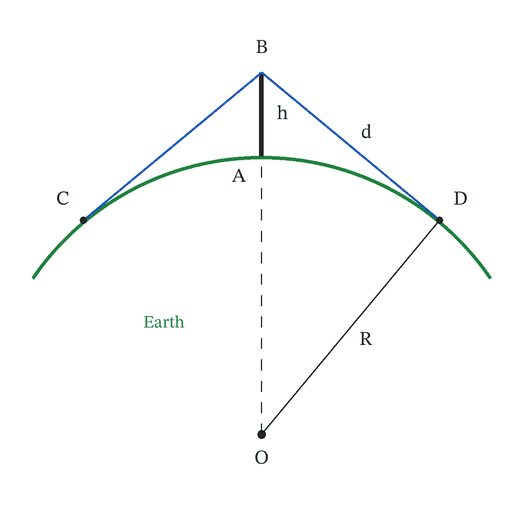
Step 3 — Apply Pythagoras. The tangent is perpendicular to the radius , with , and :
Step 4 — Expand. We expand the left side and then cancel , which appears on both sides.
Step 5 — Approximate. The height of the tower (a few hundred metres at most) is tiny compared with m, so and we drop .
Taking the square root gives the range of the tower.
Therefore, TV signals are sent at about 50–900 MHz (VHF and UHF), and the range of a TV tower of height is .
- 472 marks
Question 47
Sky waves are not used in transmitting TV signals. Why? State two factors by which the range of transmission of TV signals can be increased.
Solve with AIWritten solution
Solution:
Concept: The ionosphere bends back only waves below about 30–40 MHz; the line-of-sight range of a TV link is .
Step 1 — Why not sky waves. TV signals are transmitted in the VHF and UHF bands, roughly 50 MHz to 900 MHz (the book quotes the VHF range of about 100–220 MHz). All these frequencies are above the highest frequency the ionosphere can normally reflect, so the waves pass through it and are not returned to the Earth. Sky-wave transmission is therefore not possible.
Step 2 — Factor 1: height of the transmitting antenna. The range increases as , so a taller transmitting tower covers a larger distance.
Step 3 — Factor 2: satellites (or height of the receiving antenna). A geostationary satellite receives the signal and re-transmits it over a very large area. A taller receiving antenna also increases the range, by .
Therefore, sky waves are not used because TV frequencies (about 50–900 MHz) are normally not reflected by the ionosphere; the range can be increased by using a taller transmitting antenna and by using geostationary satellites (or a taller receiving antenna).
- 482 marks
Question 48
Why is short wave communication over long distance not possible by surface propagation?
Solve with AIWritten solution
Solution:
Concept: A surface wave induces currents in the Earth as it travels, and the energy lost in this way increases rapidly with the frequency of the wave.
Step 1 — Frequency of short waves. Short waves have frequencies from about 2 MHz to 30 MHz, much higher than the medium waves (about 0.5–1.5 MHz) that travel well along the ground.
Step 2 — Losses. At these frequencies the Earth absorbs the surface wave's energy very quickly, so the wave dies out within a short distance.
Step 3 — What is used instead. Short waves are therefore sent over long distances as sky waves, reflected by the ionosphere.
Therefore, short-wave communication over long distances is not possible by surface waves because the loss of energy to the Earth increases with frequency and the surface wave is quickly absorbed.
- 492 marks
Question 49
Name the type of communication systems according to the mode of the transmission.
Solve with AIWritten solution
Solution:
Concept: A message can be sent either as a continuously varying signal or as a coded sequence of discrete values.
Step 1 — Analog communication system. The message is transmitted as a continuously varying (analog) signal, for example AM and FM radio.
Step 2 — Digital communication system. The message is converted into discrete values (pulses of 0s and 1s) and transmitted in that form, for example mobile phones and the internet.
Note: By the way the message is shared, systems are also classed as point-to-point (one transmitter, one receiver, as in telephony) and broadcast (one transmitter, many receivers, as in radio and TV).
Therefore, the two types are (i) analog communication systems and (ii) digital communication systems.
- 502 marks
Question 50
What is meant by the term modulation?
Solve with AIWritten solution
Solution:
Concept: A low-frequency message cannot be sent far on its own, so it is carried by a high-frequency carrier wave.
Step 1 — Definition. Modulation is the process of changing some characteristic of a high-frequency carrier wave — its amplitude, frequency or phase — in accordance with the instantaneous value (intensity) of the message signal.
Step 2 — Types. Varying the amplitude gives amplitude modulation (AM), varying the frequency gives frequency modulation (FM), and varying the phase gives phase modulation (PM).
Therefore, modulation is the process of varying the amplitude, frequency or phase of a high-frequency carrier wave in accordance with the message signal.
- 512 marks
Question 51
Explain why high frequency carrier waves are needed for effective transmission of signals.
Solve with AIWritten solution
Solution:
Concept: An antenna radiates efficiently only if its length is comparable to the wavelength, and the power it radiates is proportional to .
Step 1 — Size of the antenna. The antenna should be at least long. For a 20 kHz audio signal km, so the antenna would be 3.75 km long — impossible to build. For a 1 MHz carrier m and a 75 m antenna is enough.
Step 2 — Power radiated. For a given antenna length, the radiated power is proportional to . A low-frequency (long-wavelength) signal would radiate very little power and could not travel far.
Step 3 — Mixing of signals. All audio signals lie in the same range, 20 Hz to 20 kHz. If many stations sent them directly, they would all mix and could not be separated. Giving each station its own carrier frequency keeps the signals apart.
Therefore, high-frequency carrier waves are needed so that antennas are of practical size, enough power is radiated, and signals from different stations do not get mixed up.
- 522 marks
Question 52
Define modulation index. Give its significance.
Solve with AIWritten solution
Solution:
Concept: In AM the amplitude of the carrier changes with the signal; the modulation index measures how large that change is compared with the carrier amplitude.
Step 1 — Definition. The modulation index is the ratio of the amplitude of the modulating signal to the amplitude of the carrier wave:
It can also be found from the largest and smallest amplitudes of the modulated wave, .
Step 2 — Significance. The modulation index determines the strength and the quality of the transmitted signal. A larger (up to 1) puts more power into the sidebands, which carry the message, so the received signal is louder and clearer. If (over-modulation), the envelope is distorted and the message cannot be recovered correctly, so is kept at or below 1.
Therefore, modulation index ; it determines the strength and quality of the transmitted signal and must not exceed 1.
- 532 marks
Question 53
What are the three frequencies contained in an amplitude modulated wave?
Solve with AIWritten solution
Solution:
Concept: Using , the AM wave splits into three sinusoidal parts. Here is the carrier amplitude, the modulation index, and and the angular frequencies of the carrier and the signal.
Step 1 — Expand the AM wave. We multiply out the bracket and split the product term with this identity:
Step 2 — Read off the frequencies. The three terms have frequencies (the carrier), (upper sideband) and (lower sideband), where is the signal frequency.
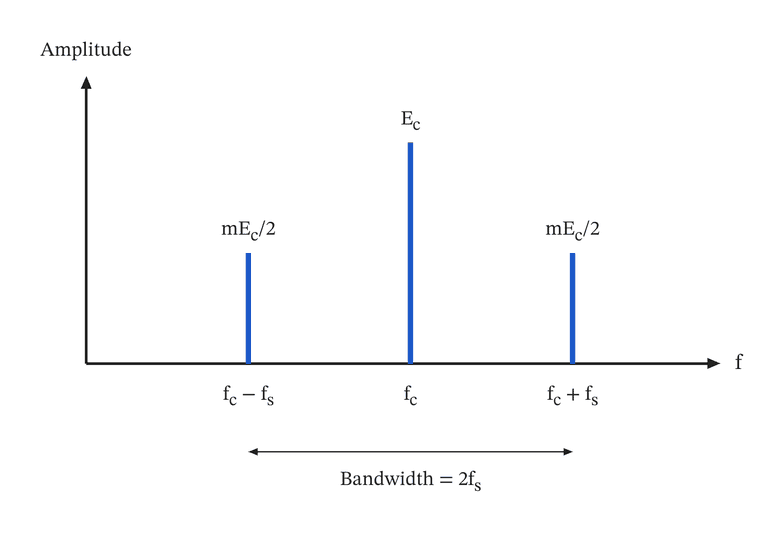
Therefore, an AM wave contains the carrier frequency , the upper sideband frequency and the lower sideband frequency .
- 542 marks
Question 54
Which is better for high fidelity reception?
Solve with AIWritten solution
Solution:
Concept: The question compares the two common ways of sending a radio programme, amplitude modulation (AM) and frequency modulation (FM). High fidelity means the sound received is a faithful copy of the original, with little noise and the full range of audio frequencies.
Step 1 — Noise. Noise mainly changes amplitude. FM carries the message in the frequency, and the receiver removes amplitude changes, so FM reception is almost noise-free.
Step 2 — Audio range. FM channels (about 200 kHz wide) can carry audio up to 15 kHz, while AM channels (10 kHz) carry only up to about 5 kHz.
Therefore, of AM and FM, FM is better for high fidelity reception.
- 552 marks
Question 55
Why is groundwave transmission of signals restricted to a frequency of 1500 kHz?
Solve with AIWritten solution
Solution:
Concept: A ground wave induces currents in the Earth's surface as it travels, and the energy lost to the Earth increases with frequency.
Step 1 — Loss of energy. As a ground wave travels along the surface, the Earth absorbs its energy, and the wave gets weaker.
Step 2 — Effect of frequency. This absorption grows rapidly as the frequency rises. Above about 1500 kHz the wave is weakened within a short distance, so ground waves can be sustained only up to about 1500 kHz.
Therefore, ground wave transmission is limited to about 1500 kHz because the absorption of the wave's energy by the Earth increases with frequency, and higher-frequency ground waves die out quickly.
- 562 marks
Question 56
Why are shortwave bands used for long distance transmission of signals?
Solve with AIWritten solution
Solution:
Concept: The ionosphere reflects (bends back) radio waves of a few MHz up to about 30 MHz.
Step 1 — Reflection by the ionosphere. Short waves (about 2–30 MHz) are reflected by the ionosphere back towards the Earth, so they can reach places far beyond the horizon.
Step 2 — Multiple hops. After returning to the Earth they can be reflected again by the ground and the ionosphere, travelling round the curve of the Earth in several hops, thousands of kilometres.
Therefore, shortwave bands are used for long-distance transmission because they are reflected by the ionosphere (sky waves) and can come back to the Earth far from the transmitter.
- 572 marks
Question 57
Why is the transmission of signals using sky waves restricted to frequencies up to 30 MHz?
Solve with AIWritten solution
Solution:
Concept: A wave is turned back by the ionosphere only if the electron density there is large enough; the critical frequency of a layer is , and waves sent at a slant can be returned up to a few times this value.
Step 1 — Limit set by the electron density. The electron density of the ionosphere is at most about , so its critical frequency is about
Step 2 — Highest usable frequency. Waves sent at a slant are returned up to roughly three to four times , that is about 30 MHz (occasionally 40 MHz).
Step 3 — Higher frequencies. Waves of higher frequency are bent too little; they penetrate the ionosphere and escape into space.
Therefore, sky-wave transmission is restricted to about 30 MHz because the ionosphere normally cannot reflect radiations of frequency much above about 30 MHz (40 MHz at most); they pass through it.
- 582 marks
Question 58
We do not choose to transmit an audio signal by just directly converting it into an electromagnetic wave of the same frequency. Give reasons for the same.
Solve with AIWritten solution
Solution:
Concept: Radiation from an antenna is efficient only when the antenna length is comparable to the wavelength, and the radiated power is proportional to .
Step 1 — Antenna of large height is needed. An audio wave of 20 kHz has a wavelength of 15 km, so even a antenna would be 3.75 km high, which is impracticable.
Step 2 — Very little energy is radiated. For any practical antenna length , the ratio is tiny at audio frequencies. The audio-frequency energy radiated is very low, so the signal dies out quickly.
Step 3 — Signals would mix. All stations' audio signals occupy the same range (20 Hz–20 kHz). If they were all sent directly, they would get mixed up and it would be impossible to separate them.
Therefore, an audio signal is not transmitted directly because (i) an impracticably tall antenna would be needed, (ii) very little power would be radiated, and (iii) signals from different stations would get mixed up.
- 592 marks
Question 59
What is ground wave propagation?
Solve with AIWritten solution
Solution:
Concept: Radio waves of low frequency from a vertical antenna can travel along the Earth's surface, following its curvature.
Step 1 — Definition. In ground wave propagation the radio wave travels from the transmitting antenna to the receiving antenna along (close to) the surface of the Earth; the wave glides over the surface.

Step 2 — Features. Vertical antennas are used, and the wave is vertically polarised. The Earth absorbs the wave's energy, more so at higher frequencies, so ground waves are used only up to about 1.5–2 MHz (medium-wave broadcasting), and their range depends on the frequency and the transmitted power.
Therefore, ground wave propagation is the mode in which radio waves travel from the transmitter to the receiver along the surface of the Earth; it is used for frequencies up to about 1500 kHz.
- 602 marks
Question 60
What is space wave propagation?
Solve with AIWritten solution
Solution:
Concept: Above about 40 MHz radio waves are neither guided by the ground nor reflected by the ionosphere, so they are used along straight lines.
Step 1 — Definition. In space wave propagation the radio wave travels in a straight line through the troposphere from the transmitting antenna to the receiving antenna (directly, or after reflection from the ground).
Step 2 — Range. The receiving antenna must be within the line of sight of the transmitting antenna. For antenna heights and the maximum distance is .
Step 3 — Uses. It is used for TV, FM radio, microwave links, mobile phones and satellite communication.
Therefore, space wave propagation is the straight-line (line-of-sight) travel of radio waves from the transmitting to the receiving antenna through the troposphere.
- 612 marks
Question 61
What is line of sight communication?
Solve with AIWritten solution
Solution:
Concept: Because the Earth is curved, a straight-line radio wave from an antenna can reach only those points from which the antenna is "visible".
Step 1 — Definition. Line-of-sight (LOS) communication is communication in which the radio waves travel in a straight line from the transmitting antenna to the receiving antenna, so the receiving antenna must be able to "see" (intercept) the transmitting antenna directly.
Step 2 — Range. The maximum LOS distance between antennas of heights and is ; this is why TV and microwave antennas are placed on tall towers.
Therefore, line-of-sight communication is space-wave communication in which the signal goes straight from the transmitting antenna to a receiving antenna within its line of sight.
- 622 marks
Question 62
What is sky wave propagation?
Solve with AIWritten solution
Solution:
Concept: The ionosphere (about 65 km to 400 km above the Earth) contains free electrons, and its refractive index decreases with height, so it can bend radio waves of a few MHz to about 30 MHz back towards the Earth.
Step 1 — Definition. In sky wave propagation the radio waves from the transmitting antenna travel up to the ionosphere and are reflected (bent back) by it to reach a distant receiving antenna.
Step 2 — How the bending happens. As the wave goes up, it meets regions of greater electron density and lower refractive index, so it bends more and more away from the normal until it is totally reflected and comes down again.
Step 3 — Use. It works for frequencies from about 2 MHz to 30 MHz and is used for long-distance short-wave radio communication.
Therefore, sky wave propagation is the mode in which radio waves reach the receiver after being reflected back to the Earth by the ionosphere; it is used for frequencies of about 2–30 MHz.
- 632 marks
Question 63
Suggest two methods by which range of TV transmission can be increased.
Solve with AIWritten solution
Solution:
Concept: The line-of-sight range between a TV transmitting antenna of height and a receiving antenna of height is .
Step 1 — Method 1: a taller TV tower. Increasing increases the first term, so the transmitting antenna covers a larger distance.
Step 2 — Method 2: a taller receiving antenna. Increasing increases the second term, so the receiving antenna can intercept the signal directly from a greater distance.
Step 3 — Other ways. Relay (repeater) stations and communication satellites can also be used to carry the programme further.
Therefore, the range of TV transmission can be increased (i) by increasing the height of the TV tower and (ii) by increasing the height of the receiving antenna so that it intercepts the signal directly.
- 642 marks
Question 64
Identify the parts and in the following block diagram of a generalised communication system.
 Solve with AI
Written solution
Solution:
Concept: A generalised communication system has an information source, a transmitter, a channel and a receiver, joined in that order.
Step 1 — Part X. comes before the transmitter and supplies the message to it, so is the information source.
Step 2 — Part Y. lies between the transmitter and the receiver and carries the signal from one to the other, so is the communication channel.
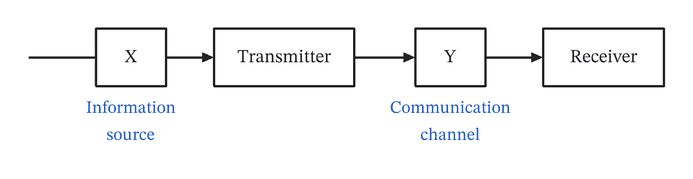
Therefore, is the information source and is the communication channel.
- 652 marks
Question 65
Define the term ‘critical frequency’ in relation to sky wave propagation of electromagnetic waves.
Solve with AIWritten solution
Solution:
Concept: An ionospheric layer turns back a vertically sent wave only if the layer's electron density is large enough for that frequency.
Step 1 — Definition. The critical frequency of a layer of the ionosphere is the maximum frequency of a radio wave which, when sent normally (vertically) towards that layer, is reflected back to the Earth.
Step 2 — Formula. It depends on the maximum electron density (per cubic metre) of the layer:
Waves of higher frequency sent vertically pass through the layer.
Therefore, critical frequency is the highest frequency that is reflected back to the Earth by an ionospheric layer when the wave is sent normally towards it; .
- 663 marks
Question 66
Using a block diagram, explain the basic elements of a communication system.
Solve with AIWritten solution
Solution:
Concept: Every communication system, whether a telephone call, a radio programme or an internet link, passes information from a source to a user through a transmitter, a channel and a receiver.
Step 1 — The block diagram. The basic elements are joined as shown below.

Step 2 — Information source. The source produces the message (speech, music, picture or data). A transducer, such as a microphone, converts it into an electrical message signal.
Step 3 — Transmitter. The transmitter processes the message signal into a form suitable for the channel. It modulates a high-frequency carrier with the message, amplifies it and feeds it to the antenna or cable.
Step 4 — Channel. The channel is the physical medium that connects the transmitter to the receiver: wires, coaxial cable, optical fibre or free space. In the channel the signal is weakened (attenuation) and unwanted noise is added to it.
Step 5 — Receiver. The receiver picks up the weak signal from the channel, amplifies it, and recovers the original message from the modulated carrier (demodulation).
Step 6 — User (destination). The recovered message is converted back into its original form, for example by a loudspeaker, and delivered to the user.
Therefore, a communication system consists of an information source, a transmitter, a channel (where noise is added) and a receiver that delivers the message to the user, as shown in the block diagram.
- 673 marks
Question 67
Explain (i) bandwidth of signals and (ii) bandwidth of transmission medium.
Solve with AIWritten solution
Solution:
Concept: Bandwidth is a range of frequencies. A signal needs a certain bandwidth to be sent without losing its information, and a medium can carry only a certain range of frequencies.
Step 1 — (i) Bandwidth of signals. The bandwidth of a signal is the range of frequencies it contains, which must be transmitted for the message to be reproduced satisfactorily.
- Speech: telephone speech uses about 300 Hz to 3400 Hz, a bandwidth of about 3.1 kHz.
- Music: it covers the whole audio range, 20 Hz to 20 kHz, a bandwidth of about 20 kHz.
- Video: a picture signal needs about 4.2 MHz; a TV channel, which carries picture and sound, is allotted 6 MHz to 8 MHz.
- Digital data: rectangular pulses are made of a fundamental frequency and its harmonics, so in principle they need a very large bandwidth; in practice the higher harmonics are dropped and the bandwidth needed depends on the data rate.
Step 2 — (ii) Bandwidth of transmission media. Different media carry different ranges of frequencies.
- Free space (radio): frequencies from about Hz to Hz and above (radio, TV, mobile and microwave links), shared among many services.
- Coaxial cable: it works up to a few GHz, with a bandwidth of about 750 MHz.
- Optical fibre: light of about Hz is used, and a single fibre can carry a bandwidth of 100 GHz or more.
Therefore, the bandwidth of a signal is the frequency range it occupies (speech ≈ 3 kHz, music ≈ 20 kHz, TV 6–8 MHz), and the bandwidth of a transmission medium is the range of frequencies it can carry (coaxial cable ≈ 750 MHz, optical fibre ≥ 100 GHz).
- 683 marks
Question 68
Explain space wave propagation. What is line of sight communication? Write down an expression for the maximum line of sight distance between the transmitting antenna and the receiving antenna.
Solve with AIWritten solution
Solution:
Concept: Above about 40 MHz radio waves are normally not reflected by the ionosphere and are absorbed quickly by the ground, so they are sent in straight lines; the curvature of the Earth then limits how far they can go.
Step 1 — Space wave propagation. In space wave propagation the radio waves travel in straight lines through the troposphere from the transmitting antenna to the receiving antenna, directly or after reflection from the ground. TV, FM radio, microwave links, mobile phones and satellite links use it.
Step 2 — Line-of-sight communication. The receiving antenna must be within the line of sight of the transmitting antenna; beyond the point where the straight line from the antenna touches the Earth, the signal is blocked. This is called line-of-sight (LOS) communication.
Step 3 — Distance to the horizon of the transmitting antenna. Let be the Earth's radius, the height of the transmitting antenna, and the distance from its top to the point where its line of sight touches the Earth. The radius at is perpendicular to the line of sight, so
We expand the left-hand side and then cancel from both sides:
Since , the term is very small compared with and can be neglected. This gives
We take the square root of both sides:
Step 4 — Receiving antenna. In the same way, a receiving antenna of height can see up to
Step 5 — Maximum distance. The two antennas can communicate as long as their lines of sight meet at , so
Therefore, space waves travel in straight lines through the troposphere (line-of-sight communication), and the maximum line-of-sight distance between the antennas is .
- 693 marks
Question 69
(a) Using diagrams, explain
(i) modulating signal,
(ii) carrier wave and
(iii) amplitude modulated wave.
(b) What is modulation index?
Solve with AIWritten solution
Solution:
Concept: In amplitude modulation the amplitude of a high-frequency carrier is varied by a low-frequency message.
The diagrams below use the carrier (amplitude , angular frequency ), the message (amplitude , angular frequency ) and the modulated wave , where is the modulation index, drawn with and (in practice is much higher still).
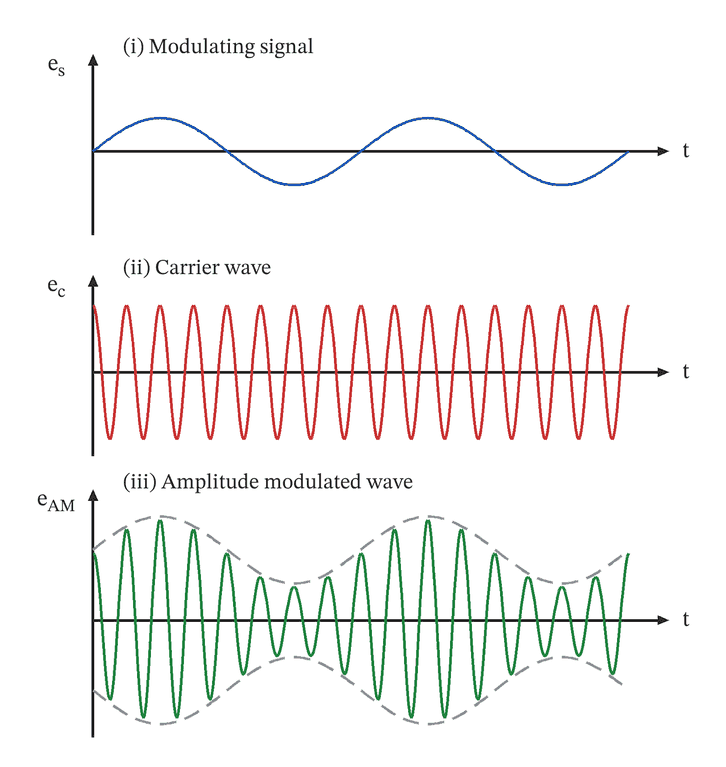
Step 1 — (a)(i) Modulating signal. The modulating signal is the low-frequency message (for example an audio signal) that is to be transmitted. In diagram (i) it is a sine wave of amplitude and frequency .
Step 2 — (a)(ii) Carrier wave. The carrier wave is a high-frequency sinusoidal wave of constant amplitude and frequency , shown in diagram (ii). It "carries" the message over long distances.
Step 3 — (a)(iii) Amplitude modulated wave. In the AM wave of diagram (iii), the frequency is still , but the amplitude rises and falls with the modulating signal. The dashed outline (the envelope) has the shape of the modulating signal: the amplitude is largest, , when the signal is at its positive peak, and smallest, , at its negative peak.
Step 4 — (b) Modulation index. The modulation index is the ratio of the maximum change in the amplitude of the carrier to the amplitude of the unmodulated carrier:
It is usually given as a percentage and is kept at or below 1 (100 per cent) to avoid distortion.
Therefore, (a) the modulating signal is the low-frequency message, the carrier is a high-frequency wave of constant amplitude, and the AM wave is the carrier whose amplitude follows the message (diagrams above); (b) the modulation index is .
- 703 marks
Question 70
(a) What is (i) web and (ii) HTML? What is IOT?
(b) Write a note on GPS.
(c) What are the advantages of mobile phones?
Solve with AIWritten solution
Solution:
Concept: The internet is the worldwide network of connected computers and devices; services such as the World Wide Web, GPS navigation and mobile phone networks are built on radio and network technology described in this chapter.
Step 1 — (a)(i) Web. The web (World Wide Web, WWW) is a collection of a huge number of web pages and websites, linked to one another by hyperlinks, that can be accessed through the internet with a web browser. Each page is identified by its address, called a URL. The web was invented by Tim Berners-Lee in 1989.
Step 2 — (a)(ii) HTML. HTML (HyperText Markup Language) is the language in which web pages are written. Its tags tell the browser how to show headings, paragraphs, pictures and links to other pages.
Step 3 — (a) IoT. The Internet of Things (IoT) is the network of everyday physical objects — appliances, meters, vehicles, wearable devices, sensors — that are connected to the internet so that they can collect and exchange data and be monitored or controlled remotely.
Step 4 — (b) Note on GPS. The Global Positioning System (GPS) is a satellite-based navigation system. In 2025 about 31 working satellites orbit at about 20 200 km in six orbital planes, each going round the Earth twice a day, so that at least four satellites are visible from any point. Each satellite broadcasts signals carrying its position and very accurate time. A GPS receiver measures the time the signals take to arrive from four or more satellites and works out its latitude, longitude, height and the time. GPS has three parts: the space segment (satellites), the control segment (ground stations that track and correct the satellites) and the user segment (receivers). It is used for navigation, maps, vehicle tracking, surveying and timing; it does not work well inside buildings, caves or under water, where the signals cannot reach.
Step 5 — (c) Advantages of mobile phones. A mobile phone lets us talk to anybody from almost anywhere; send and receive messages and e-mails; use the internet, maps and navigation; make video calls; take photographs; listen to music and watch videos; make payments; and call for help quickly in an emergency.
Therefore, (a) the web is the system of linked web pages reached through the internet, HTML is the language used to write web pages, and IoT is the network of everyday objects connected to the internet; (b) GPS is a satellite navigation system that finds a receiver's position from the signals of at least four satellites; (c) mobile phones give easy communication anywhere, internet access, navigation, entertainment and quick help in emergencies.
- 715 marks
Question 71
What is communication channel? Briefly describe the various communication channels employed in communication. On what factors does the quality of transmission depend in each case? How do we make the choice of communication channel?
Solve with AIWritten solution
Solution:
Concept: The channel is the link between the transmitter and the receiver. Every channel weakens the signal (attenuation), adds noise, and passes only a limited band of frequencies; these decide how good the received signal is.
Step 1 — Definition. A communication channel is the physical medium that connects the transmitter and the receiver and carries the signal from one to the other.
Step 2 — Line (guided) channels. In line channels the signal travels along a conducting path.
- Two-wire lines and twisted pairs (telephone lines): cheap and simple, but losses and pick-up of noise increase with frequency and length, so they suit low frequencies and short distances.
- Coaxial cable: a central wire inside a metal braid; the braid screens out noise, and it carries frequencies up to a few GHz (bandwidth about 750 MHz), as in cable TV.
- Optical fibre: light travels along a glass fibre by total internal reflection. The loss is very small, the bandwidth is enormous (100 GHz or more), and it is not affected by electrical noise; it carries most long-distance telephone and internet traffic, including undersea cables.
Step 3 — Space (wireless) channels. In space channels the signal travels as electromagnetic waves through the atmosphere or space, as ground waves (up to about 2 MHz), sky waves (about 2–30 MHz), space waves (line of sight, above about 40 MHz) and through satellites (microwaves of a few GHz).
Step 4 — Factors that decide the quality. In line channels quality depends on attenuation (which grows with length and frequency), noise picked up, the bandwidth of the line, and distortion; in optical fibres on fibre loss and on dispersion, which spreads the pulses. In wireless channels quality depends on the transmitted power and antenna heights, absorption by the ground and atmosphere, the state of the ionosphere (for sky waves), fading, interference from other stations, noise such as lightning, and, for microwaves, rain.
Step 5 — Choosing a channel. We choose a channel by considering:
- the bandwidth the signal needs (TV and data need wide bands, so cable, fibre or microwaves);
- the distance to be covered and whether the users move (mobile users need wireless);
- the noise and loss that can be accepted (fibre for very low loss);
- cost, ease of installation and security.
Therefore, a communication channel is the medium joining transmitter and receiver; line channels (wires, coaxial cable, optical fibre) and space channels (ground, sky, space waves and satellites) are used; quality depends on attenuation, noise, bandwidth, distortion and fading; and the channel is chosen to suit the bandwidth, distance, mobility, noise level and cost.
- 725 marks
Question 72
With the help of a labelled diagram, describe the three methods by which radio waves can propagate through the atmosphere.
Solve with AIWritten solution
Solution:
Concept: Depending on its frequency, a radio wave from a transmitter can reach a receiver in three ways: along the ground, by reflection from the ionosphere, or in a straight line through the lower atmosphere.
Step 1 — Ground (surface) wave propagation. The wave travels from the transmitting antenna to the receiving antenna along the surface of the Earth, following its curvature. Vertical antennas are used and the wave is vertically polarised. The Earth absorbs the wave's energy, and the loss increases rapidly with frequency, so this method is used only up to about 1.5–2 MHz, for example in medium-wave AM broadcasting. Its range depends on the frequency and the transmitter power.
Step 2 — Sky wave propagation. The wave goes up to the ionosphere (about 65 km to 400 km high), where the electron density increases and the refractive index decreases with height. The wave bends away from the normal more and more until it is totally reflected and comes back to a distant receiver . This works for about 2 MHz to 30 MHz (short waves) and gives long-distance communication, often in several hops. Higher frequencies pass through the ionosphere. The region between the end of the ground wave and the point where the sky wave first returns receives no signal (the skip zone).
Step 3 — Space wave propagation. Above about 40 MHz the wave travels in a straight line through the troposphere from the transmitting antenna to the receiving antenna (directly, or after reflection from the ground). The receiver must be within the line of sight. Let and be the heights of the transmitting and receiving antennas and the radius of the Earth. The greatest range is then
TV, FM radio, microwave links, mobile phones and satellite links use this method.
Therefore, radio waves propagate as ground waves (along the Earth's surface, up to about 2 MHz), sky waves (reflected by the ionosphere, about 2–30 MHz) and space waves (straight-line, line-of-sight, above about 40 MHz), as shown in the labelled diagram.
- 735 marks
Question 73
What is modulation? Distinguish between amplitude modulation and frequency modulation with suitable diagrams. What are the advantages of FM over AM?
- 745 marks
Question 74
What is amplitude modulation? Derive an expression for an amplitude modulated wave and obtain expressions for sideband frequencies and the bandwidth.
- 755 marks
Question 75
(a) What is internet? What are its applications?
(b) Describe GPS. Mention the function of each part.
(c) Explain the working of a cell phone.
- 763 marks
Question 76
Calculate the length of half wave dipole at (a) 30 MHz, (b) 300 MHz and (c) 3000 MHz. What inference do you draw from these results?
- 773 marks
Question 77
A radio can tune to any station in the 7.5 MHz to 12 MHz band. What is the corresponding wavelength band?
- 783 marks
Question 78
A TV tower has a height of 150 km. How much population does the TV broadcast cover, if the average population density around the tower is 1000 km? Radius of the Earth is m.
- 793 marks
Question 79
What is the wavelength of a TV station which transmits on 500 MHz?
- 803 marks
Question 80
The core of an optical fibre is made of glass with refractive index equal to 1.55 and cladding has refractive index 1.51. Calculate (a) the critical angle for total internal reflection and (b) maximum acceptance angle at the air–core interface.
- 813 marks
Question 81
Frequencies higher than 10 MHz are found not to be reflected by the ionosphere on a particular day at a place. Calculate the maximum electron density of the ionosphere.
- 823 marks
Question 82
A carrier wave of frequency 1000 kHz is modulated with an audio signal of frequency 5 kHz. Calculate the bandwidth.
- 833 marks
Question 83
A ground receiver station is receiving a signal at (a) 5 MHz and (b) 100 MHz, transmitted from a ground transmitter at a height of 300 m, located at a distance of 100 km from the receiver station. Identify whether the signal is coming in a space wave propagation or sky wave propagation or satellite transponder. Radius of the Earth m. of ionosphere .
- 843 marks
Question 84
A TV transmitting antenna is 125 m tall. How much service area can this transmitting antenna cover if the receiving antenna is at the ground level? Radius of the Earth is 6400 km.
- 853 marks
Question 85
What should be the height of a transmitting antenna if the TV telecast is to cover a radius of 128 km?
- 863 marks
Question 86
By what percentage will the transmission range of a TV tower be affected when the height of the tower is increased by 21%?
- 873 marks
Question 87
A message signal of 12 kHz and peak voltage 20 V is used to modulate a carrier wave of frequency 12 MHz and peak voltage 30 V. Calculate the modulation index and the sideband frequencies.
- 883 marks
Question 88
On a particular day, the maximum frequency reflected from the ionosphere is 10 MHz. On another day, it was found to decrease to 8 MHz. Calculate the ratio of the maximum electron densities of the ionosphere on the two days.
- 893 marks
Question 89
The maximum and minimum peak-to-peak voltage of an AM wave is 500 mV and 250 mV respectively. Find the modulation index.
- 903 marks
Question 90
A carrier wave of frequency 1000 kHz is used to modulate an audio signal frequency 2 kHz. Calculate the sideband frequencies and the bandwidth required.
What Class 12 Physics Ch 34 covers
The sections of the chapter, in the order the book takes them. Every question above comes from one of these.
- 01Elements of a Communication System
- 02Bandwidth of Signals and Transmission Medium
- 03Propagation of Electromagnetic Waves
- 04Satellite Communication
- 05Modulation and Its Need
More ways to study this chapter
The same chapter asked three other ways. Practise it, revise it, and see what the board has set on Ch 34 before.
- Competency-Based Questions (CBQ)Case study questions: a situation, and the part of the chapter that answers it.40questionsOpen
- Previous Year QuestionsQuestions that have actually appeared in board papers, each tagged with its year.3questionsOpen
- Practice QuestionsExtra questions per chapter, for when one attempt at a method is not enough.88questionsOpen
Ch 34 in past ISC papers
The same chapter as the board has actually asked it. These are worded differently from the textbook exercise, which is the point of reading them.
- 12 marks
Board paper question 1
In a communication system, what is meant by modulation? State any two types of modulation.
Solve with AIWritten solution
Solution:
Key idea: A message signal (such as speech or music) has a low frequency. To send it over long distances it is carried on a high-frequency wave called the carrier wave.
Step 1 — Define modulation.
Modulation is the process in which some property of a high-frequency carrier wave (its amplitude, frequency or phase) is varied in step with the instantaneous value of the low-frequency message (modulating) signal.
Step 2 — Say why it is used.
Modulation is needed because a low-frequency audio signal cannot be sent far directly. An antenna must be about a quarter of a wavelength long; for a audio signal the wavelength is , so the antenna would have to be about long. With a carrier the quarter wavelength is only . A high-frequency carrier is also radiated far more effectively, and different stations can use different carrier frequencies without mixing.
Step 3 — State two types.
Depending on which property of the carrier is varied, the two common types are amplitude modulation (AM), in which the amplitude of the carrier changes with the signal, and frequency modulation (FM), in which the frequency of the carrier changes with the signal. (A third type is phase modulation.)
Therefore, modulation is varying the amplitude, frequency or phase of a high-frequency carrier wave in accordance with the message signal; two types are amplitude modulation (AM) and frequency modulation (FM).
- 22 marks
Board paper question 2
Define frequency modulation and state any one advantage of frequency modulation (FM) over amplitude modulation (AM).
Solve with AIWritten solution
Solution:
Key idea: In modulation, one property of a high-frequency carrier wave is varied in step with the message signal. In frequency modulation that property is the frequency.
Step 1 — Define frequency modulation.
Frequency modulation (FM) is the type of modulation in which the frequency of the carrier wave is varied in accordance with the instantaneous value of the modulating (message) signal, while the amplitude of the carrier is kept constant. When the signal voltage is high the carrier frequency rises above its normal value, and when it is low the frequency falls below it.
Step 2 — State an advantage over AM.
Most electrical noise (from lightning, motors and other sources) changes the amplitude of a wave, not its frequency. In FM the information is carried by the frequency, so the receiver can clip off amplitude changes, and the noise goes with them. Hence FM reception is much less noisy than AM reception. (FM also gives better sound quality, because FM channels are given a wider bandwidth.)
Therefore, frequency modulation is varying the frequency of the carrier wave according to the message signal at constant amplitude; one advantage over AM is that FM is much less affected by noise.
- 32 marks
Board paper question 3
With reference to communication systems, what is meant by:
(i) Modulation?
(ii) Demodulation ?
Solve with AIWritten solution
Solution:
Key idea: At the transmitter the message is placed on a high-frequency carrier wave (modulation). At the receiver it must be taken off the carrier again (demodulation).
Step 1 — Part (i): define modulation.
Modulation is the process of varying a property (amplitude, frequency or phase) of a high-frequency carrier wave in accordance with the instantaneous value of the low-frequency message signal. It is done at the transmitter, so that the message can be radiated efficiently by an antenna of practical size and sent over long distances.
Step 2 — Part (ii): define demodulation.
Demodulation (also called detection) is the reverse process: recovering the original low-frequency message signal from the modulated carrier wave at the receiver. For an AM wave this is done, for example, by a diode detector followed by a filter that removes the carrier.
Therefore, (i) modulation is varying the amplitude, frequency or phase of a high-frequency carrier according to the message signal; (ii) demodulation is recovering the original message signal from the modulated wave at the receiver.
Class 12 Physics Ch 34 questions students ask
How many questions are there in Class 12 Physics Ch 34?
90 questions. Every one is solved step by step on this page.
Are these Class 12 Physics solutions free?
Yes. Every question and its full working is free to read, with no account needed.
Can I download the Class 12 Physics Ch 34 solutions as a PDF?
There is no PDF to download. Every solution is on this page instead, which means it is searchable, always the current syllabus, and readable on a phone. Use your browser's print option if you want it on paper.