
Opening your dashboard
Class 12 Physics Chapter 34 Communication Systems: Competency-Based Questions (CBQ)
40 questions on Chapter 34, each worked through on its own page with the AI tutor. Class 12 Physics, ICSE 2026-27.
40 questions
1–5 marks · Mixed difficulty
- 13 marks
Question 1
Competency: Application
A tsunami-warning station in the Bay of Bengal works like this. A pressure sensor on the sea floor, below the surface, measures the pressure of the water above it, which rises a little when a tsunami wave passes overhead. An acoustic modem beside the sensor sends each reading upwards as pulses of sound to a floating buoy, where a hydrophone (an underwater microphone) picks them up. A radio transmitter on the buoy then sends the data by way of a geostationary satellite to a warning centre on land; this radio part of the journey takes about . Take the speed of sound in sea water as . (Hypothetical data.)
(a) Name two transducers in this chain and state what each one converts.
(b) Explain why sound waves, and not radio waves, are used between the sea floor and the buoy.
(c) Find the time the sound pulses take to reach the buoy, and the total time for a reading to reach the warning centre (ignore the time spent processing the data). Which part of the chain causes most of the delay?
- 21 mark
Question 2
Competency: Analysis & Evaluation
A listener in a village receives a community radio station whose transmitter is away. There are no amplifiers or repeaters between them.
Assertion (A): The signal reaching the listener's radio is much weaker than the signal leaving the transmitter.
Reason (R): Noise from lightning, electric motors and other sources is added to the signal on its way.
- 33 marks
Question 3
Competency: Analysis & Evaluation
After floods cut the telephone lines, a ham radio operator tries to pass messages to a relief office. The operator's receiver uses a filter that lets through only a chosen band of frequencies. For speech the operator needs a filter wide; for Morse code (the carrier switched on and off in dots and dashes) a filter only wide is enough at the operator's sending speed. The noise picked up by the receiver is spread evenly over frequency, so the noise power that passes the filter is proportional to the filter's bandwidth. With the speech filter, the received speech signal has only times the power of the noise. The Morse signal arrives with the same power as the speech signal did. (Hypothetical data.)
(a) How many times as much noise power passes the speech filter as passes the Morse filter?
(b) Find the ratio of signal power to noise power for the Morse signal.
(c) Explain why Morse code can still be read when speech is lost in the noise, and state one disadvantage of Morse code for sending messages.
- 41 mark
Question 4
Competency: Analysis & Evaluation
Several submarine optical-fibre cables come ashore at Mumbai and Chennai, linking India with the Middle East, Europe and South-East Asia.
Assertion (A): Most of the internet data travelling between India and Europe today is carried by communication satellites.
Reason (R): An optical fibre can carry a much wider band of frequencies than a radio link through a satellite.
- 51 mark
Question 5
Competency: Application
During flood relief, a team sends a photograph of a damaged bridge by ham radio, using a method that fits the photograph's data into a speech channel wide; sending it takes . For a given signal-to-noise ratio, the greatest rate at which data can be sent through a channel is proportional to the channel's bandwidth. (Hypothetical data.)
If the same photograph is sent through a satellite data link wide, with the same signal-to-noise ratio, the least time it can take is about
- 61 mark
Question 6
Competency: Application
A family drives from a city into hilly country. Soon after the road passes behind the first range of hills, the car radio loses the city's FM station (about ), but it can still play an All India Radio medium-wave station (about ) broadcasting from the same city. The main reason is that
- 71 mark
Question 7
Competency: Analysis & Evaluation
In the daytime, people in towns around an All India Radio medium-wave transmitter (about to ) receive its programmes steadily.
Assertion (A): In the daytime, these medium-wave programmes reach the listeners mainly as ground waves.
Reason (R): The attenuation of ground waves becomes greater as their frequency is lowered.
- 83 marks
Question 8
Competency: Application
After a cyclone, a state's emergency radio network links its control room T with district offices. That night T must reach office D, away, and office F, away. D is too far away to receive T's ground wave, and hills block any line of sight. The operators can use either or . One of T's antennas sends waves almost straight up, so that the ionosphere returns them over the whole area round T ("near-vertical" sky waves). The reflecting layer is at a virtual height of about , and that night its greatest electron density is . The critical frequency of the layer is , in hertz with in electrons per cubic metre. (Hypothetical data.)
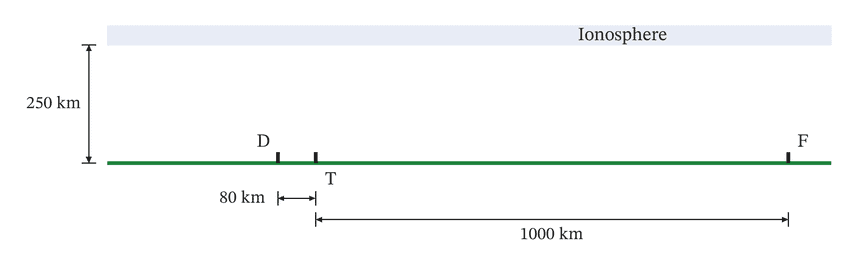
(a) Find the critical frequency of the layer that night.
(b) Which frequency should T use to reach D? Give a reason.
(c) T also has an antenna that sends waves out at low angles. That night F receives this signal clearly, yet D receives nothing on from either antenna. Explain why.
- 94 marks
Question 9
Competency: Analysis & Evaluation
A ham radio operator in Chennai wants to talk to a station about away by sky waves. Treat the reflecting layer of the ionosphere as a mirror at a height above the Earth, whose radius is . The longest single hop happens when the wave leaves the transmitter T along the horizon (just grazing the Earth's surface), is turned back at P on the layer, and reaches the receiver X along the horizon, as shown. O is the centre of the Earth. (Hypothetical data.)
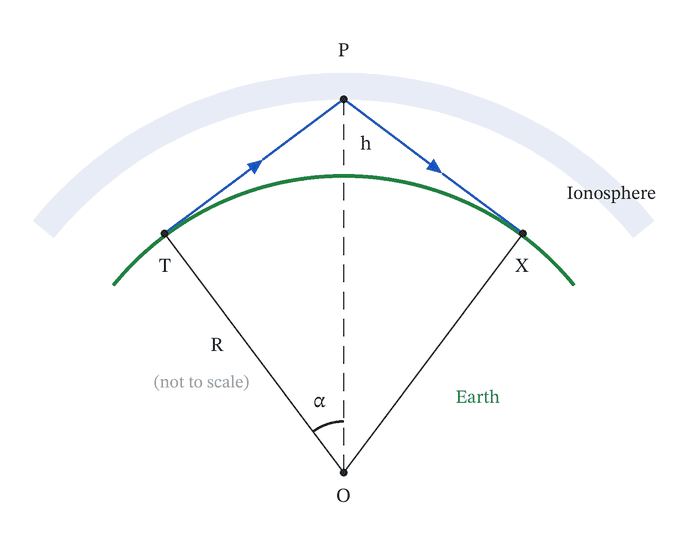
(a) Using the triangle OTP, show that , and find the angle .
(b) Find the distance , measured along the ground (the arc TX), covered by this single hop.
(c) Find the least number of hops needed for the contact, and explain why a more powerful transmitter cannot make one hop reach the station.
- 104 marks
Question 10
Competency: Application
A family in Delhi, at latitude N, sets up a DTH (direct-to-home) television dish. Assume that the DTH satellite S is geostationary at a height above the point A on the equator that has the same longitude as Delhi. The radius of the Earth is . In the figure, O is the centre of the Earth, P is Delhi, is the distance PS, and is the angle of elevation of the dish: the angle of PS above the local horizontal at P (the tangent to the Earth at P). (Hypothetical data.)

(a) Use the cosine rule in triangle OPS to find the distance from Delhi to the satellite.
(b) Use the sine rule in triangle OPS to find the angle of elevation . (The angle OPS equals , because OP is perpendicular to the local horizontal.)
(c) Explain why the dish, once set, never has to be turned to follow the satellite. Would a dish at a place on the same longitude but at latitude N (about the latitude of Chennai) point higher or lower in the sky?
- 111 mark
Question 11
Competency: Application
After an earthquake, the mobile towers and telephone cables in a hill town are broken. A disaster-response team can still call its headquarters with a satellite phone. The satellite phone works because
- 121 mark
Question 12
Competency: Analysis & Evaluation
A relief camp must keep in touch, day and night for several weeks, with the state capital away. The planners can use either a short-wave link that relies on sky waves, or a microwave link through a geostationary satellite. They choose the satellite link. The main physical reason is that
- 131 mark
Question 13
Competency: Analysis & Evaluation
A visitor to a medium-wave broadcasting station sees its antenna: a tall steel mast standing on an insulator.
Assertion (A): Medium-wave AM broadcasting stations use tall mast antennas, often more than high.
Reason (R): Medium waves can be reflected back to the Earth by the ionosphere at night.
- 143 marks
Question 14
Competency: Application
In a certain city, an AM medium-wave station broadcasts on a carrier of and sends audio frequencies up to . A new station wants to broadcast in the same city on a carrier of , also with audio up to . A receiver tuned to one station must not pick up any part of the other. (Hypothetical data.)
(a) Find the band of frequencies occupied by the station, and its bandwidth.
(b) Show that the bands of the two stations would overlap, and say what listeners would hear.
(c) The new station decides to limit its audio to . Find the lowest carrier frequency above that it could then use without any overlap.
- 151 mark
Question 15
Competency: Application
Many car remote keys send their security code by switching a carrier of about fully on for each 1 and fully off for each 0, without changing its frequency. This way of sending the code is a form of
- 161 mark
Question 16
Competency: Analysis & Evaluation
A music lover listens to the same song, first on a medium-wave AM station and then on an FM station, using the same good-quality radio.
Assertion (A): The song sounds duller, with less crisp high notes, on the AM station than on the FM station.
Reason (R): An AM broadcasting station uses a channel only about wide, so it can carry audio frequencies only up to about .
- 171 mark
Question 17
Competency: Analysis & Evaluation
Ham radio operators usually send speech on the short-wave bands by single sideband (SSB): their transmitters send out only one of the two sidebands of an AM wave and leave out the carrier.
Assertion (A): In SSB transmission, the speech can still be recovered at the receiver even though the carrier and one sideband are not sent.
Reason (R): In an AM wave the carrier carries no part of the message, and each sideband on its own carries the whole message.
- 181 mark
Question 18
Competency: Analysis & Evaluation
A medium-wave AM transmitter whose carrier amplitude is kept constant broadcasts a news bulletin; its modulation index changes with the loudness of the reader's voice. During a two-second silent pause in the bulletin, the transmitter radiates
- 193 marks
Question 19
Competency: Analysis & Evaluation
An FM radio station in a city tests its transmitter by modulating it with a steady tone. A monitoring receiver plots the instantaneous frequency of the transmitted wave against time, as shown. The amplitude of the wave stays constant throughout. (Hypothetical data.)
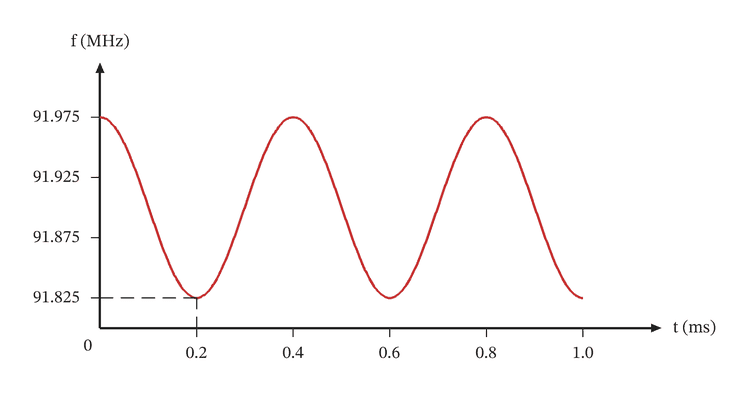
(a) Find the frequency of the unmodulated carrier and the peak frequency deviation .
(b) Find the frequency of the test tone.
(c) Carson's rule gives the bandwidth of an FM wave as . Find the bandwidth, and say whether the wave fits within the channel given to an FM station.
- 201 mark
Question 20
Competency: Analysis & Evaluation
In a laboratory FM transmitter, a test tone from a signal generator is fed straight to the frequency modulator.
Assertion (A): If the pitch (frequency) of the test tone is raised while its loudness (amplitude) is kept the same, the peak frequency deviation of the FM wave increases.
Reason (R): In frequency modulation, the change in the carrier's frequency at any instant is proportional to the instantaneous amplitude of the modulating signal.
- 211 mark
Question 21
Competency: Analysis & Evaluation
A city's fire-service walkie-talkies use FM with a peak deviation of about , in channels about wide. FM broadcasting stations use a peak deviation of , in channels about wide. The main reason for the small deviation of the fire-service radios is that
- 223 marks
Question 22
Competency: Application
A mobile-network tower in a small town has its antenna above the ground, and a phone is held above the ground. Take the radius of the Earth as and the ground as level. (Hypothetical data.)
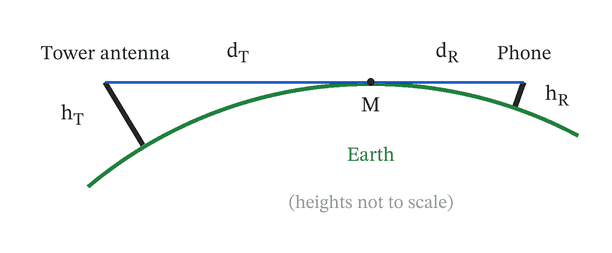
(a) Find the greatest distance at which the phone could still have a line of sight to the tower antenna.
(b) In open country the signal from the tower spreads out so that its intensity falls as . How many times as strong is the signal at a phone from the tower as at a phone away?
(c) In practice, the towers in the town stand only a few hundred metres to about a kilometre apart, far closer than your answer to (a). Using (b), explain why a phone far from a tower runs down its battery faster, and give one other reason why towers in a town are placed so close together.
- 231 mark
Question 23
Competency: Analysis & Evaluation
India's own satellite navigation system, NavIC, gives positions over India and the region around it, up to about beyond its borders.
Assertion (A): NavIC is designed to work with only seven satellites, while GPS, which covers the whole Earth, uses about 31 satellites.
Reason (R): NavIC's satellites are in geostationary and geosynchronous orbits that keep them above this one region, while GPS satellites, about up, circle the Earth twice a day and must be spread all round it.
- 241 mark
Question 24
Competency: Application
A trekker in a remote Himalayan valley sees "No service" on the phone: there is no mobile tower in range. Yet the phone's map app, using maps downloaded earlier, still shows the trekker's position correctly by GPS. This is possible because
- 253 marks
Question 25
Competency: Analysis & Evaluation
During a flood, a rescue team sets up a simple local positioning system for its boats. Three radio beacons stand at fixed points: B is east of A, and C is north of A, as shown. At the same instant, all three beacons send out a time signal. A receiver on a boat, with an accurate clock, picks up the signals from A, B and C after , and . Take the speed of radio waves as . (Hypothetical data.)

(a) Find the distance of the boat from each beacon.
(b) Take A as the origin, with measured east and north in kilometres. Use the distances from A and B to show that the boat must be at one of two points, and find both points.
(c) Use the distance from C to decide where the boat is. Name the satellite system that finds positions in the same way.
- 261 mark
Question 26
Competency: Application
In a college laboratory, a small AM transmitter sends out the wave volts, where is in seconds. A spectrum analyser connected to the receiving antenna shows each frequency present in the wave as a vertical line whose height gives the amplitude of that component. (Hypothetical data.) The lines that the analyser shows, scaled to the transmitter's output, are
- 271 mark
Question 27
Competency: Analysis
In the broadcast mode of communication, one transmitter sends the same signal to a large number of receivers, which only receive. In the point-to-point mode, communication takes place over a link between a single transmitter and a single receiver. A student lists some services used in a hill town. Which list contains only services that work in the broadcast mode?
- 281 mark
Question 28
Competency: Analysis
A student notices that terrestrial television transmitters use carrier frequencies of tens to hundreds of megahertz, while AM radio stations in the medium-wave band use carriers of about to .
Assertion (A): Television programmes are not broadcast on carriers in the medium-wave band.
Reason (R): A television channel needs a bandwidth of about , which is several times the width of the whole medium-wave band.
- 291 mark
Question 29
Competency: Evaluation
Agricultural scientists use satellite pictures to map the crops growing in individual fields across a state.
Assertion (A): Satellites that take such detailed crop pictures are placed in geostationary orbit, so that they can watch the same fields all the time.
Reason (R): For the same camera, a satellite a few hundred kilometres above the ground can see much finer detail than one about above it.
- 301 mark
Question 30
Competency: Evaluation
A disaster-response team wants a portable ground station that can send live video, needing a bandwidth of about , up to a geostationary satellite. Its dish antenna has a diameter . A dish sends out a beam that spreads over an angle of about radians, where is the wavelength, and to avoid disturbing neighbouring satellites the beam must be no wider than about . Take . (Hypothetical data.) The most suitable carrier frequency for the link is
- 311 mark
Question 31
Competency: Analysis
An FM test transmitter, modulated by a steady tone, sends out the wave volts. In this transmitter the peak frequency deviation is proportional to the amplitude of the tone. The modulation index is , where is the tone frequency, and Carson's rule gives the bandwidth as . (Hypothetical data.) If the amplitude of the tone is doubled and its frequency is halved, the new modulation index and bandwidth are
- 322 marks
Question 32
Competency: Analysis
A student builds a diode detector for a medium-wave AM station whose carrier frequency is and whose highest audio frequency is . The load is a resistor in parallel with a capacitor . For the output to follow the envelope of the AM wave, the time constant must be much longer than one period of the carrier but much shorter than one period of the highest audio frequency. (Hypothetical data.)
(a) Check the student's choice against both conditions and state what a listener will notice.
(b) Keeping the same resistor, suggest a suitable value of , and show that it meets both conditions.
- 332 marks
Question 33
Competency: Evaluation
The school's website stops opening one morning. Riya says, “The internet and the World Wide Web are the same thing, so the whole internet must be down today. Nobody can send an email either.”
(a) Evaluate Riya's claim.
(b) Name two services that use the internet but are not part of the World Wide Web.
- 342 marks
Question 34
Competency: Analysis
A coastal radio station sends out a ground wave, which ships receive reliably up to about out at sea. An identical transmitter in the Thar desert, sending the same frequency over dry sand, gives reliable reception only up to about . (Hypothetical data.)
(a) Explain why the ground wave travels so much farther over the sea.
(b) Predict, with a reason, how the range over the sea would change if the station used instead.
- 352 marks
Question 35
Competency: Application
A farmers' co-operative near Nashik places soil-moisture sensors in its vineyards. Each sensor sends one reading every minutes, through the mobile network and the internet, to a computer that controls the drip irrigation. Each reading travels as a packet of bytes. The co-operative's data plan allows ( bytes) in a -day month. (Hypothetical data.)
(a) Find the data sent by all the sensors in one day and in a -day month, and decide whether the plan is enough.
(b) What name is given to such a network of everyday devices that exchange data over the internet without a person operating them?
- 363 marks
Question 36
Competency: Creativity
A village of about people lies in a valley below a hill slope that has slid in heavy monsoon rain before. The panchayat wants an automatic warning: a rain gauge and a tilt sensor on the slope, up the valley, must sound a siren in the village within a minute whenever the rainfall or the ground movement crosses a set limit. There is no mobile network in the valley, but there is a clear line of sight between the slope and the village. Take . (Hypothetical data.)
(a) Design the chain from the slope to the siren: list its elements in order, state the job of each, and name the input and output transducers.
(b) Suggest two ways to stop electrical noise from setting off false alarms or hiding a real warning.
(c) The team can use a carrier of or . Taking the antenna to be one quarter of a wavelength long, find the antenna length for each and choose the carrier.
- 373 marks
Question 37
Competency: Analysis
At a telephone exchange, speech is first limited to the band to . It is then turned into a digital signal: the speech voltage is measured times every second, and each measurement is sent as a code of bits. The modem on the link can send at most bits per second for every hertz of bandwidth. (Hypothetical data.)
(a) Find the number of bits sent each second for one telephone call.
(b) Find the bandwidth needed for this digital speech, and compare it with the bandwidth of the analog speech signal.
(c) Digital speech needs more bandwidth, yet long-distance telephone links are digital. Give two reasons.
- 383 marks
Question 38
Competency: Evaluation
A district disaster-management cell must choose amplitude modulation (AM) or frequency modulation (FM) for each of three radio services. Speech needs audio frequencies up to about . An AM wave occupies a band twice as wide as the highest audio frequency, and Carson's rule gives the bandwidth of an FM wave as , where is the peak deviation and the highest audio frequency. (Hypothetical data.)
(i) A station broadcasting music and safety announcements to towns within about , on a carrier in the to band, where each station has a channel wide.
(ii) A speech link with a relief camp away, by sky waves near , where each user is allotted a channel only wide.
(iii) Cheap emergency receivers for households, whose only detector is a diode with a capacitor and resistor.
For each service, choose AM or FM and justify your choice.
- 395 marks
Question 39
Competency: Analysis & Evaluation
A space agency is planning a small rover to explore the Moon. The rover sends its camera pictures to a lander a few hundred metres away, and the lander sends them on to a large dish antenna on the Earth. Drivers on the Earth watch the pictures and send commands back the same way. The rover moves at . To judge the link, the engineers compare it with a satellite in geostationary orbit that uses the same transmitter and antenna. Take and ignore the short rover-to-lander link and all processing times. (Hypothetical data.)
Transmitter Distance from the Earth dish (km) Power sent out (W) Lander on the Moon Geostationary satellite (a) Find the time a picture takes to reach the Earth. A driver sees a rock in a picture and at once sends a stop command. How far does the rover move beyond the position shown in that picture before it stops?
(b) The intensity of the signal at the Earth falls as . How many times as strong as the lander's signal is the satellite's signal at the dish? State one way the dish can make up for this.
(c) A team member proposes a carrier of for the lander, “because lower frequencies travel farther”. Evaluate this proposal, and suggest a suitable kind of carrier.
- 404 marks
Question 40
Competency: Analysis & Evaluation
On a school sports day, a fitness app records a sprinter's position from the GPS receiver in the phone strapped to the sprinter's arm. The track is straight, and the app logs the position every , in metres east () and north () of the start. Each GPS position can be wrong by up to about in any direction, and the app works out speed only from the change of position between fixes. (Hypothetical data.)
Time (s) 0 4 8 12 (m) 0 16.8 35.4 54.0 (m) 0 22.4 47.2 72.0 (a) Find the distance covered in each interval and the average speed over the .
(b) The app can also show a speed every second, from fixes apart. Taking the true speed as , find the range of speeds such a reading could show, and compare it with the possible error in the average.
(c) The sprinter says, “For one second the app showed , so I touched .” Evaluate this claim.