
Competency: Application
After a cyclone, a state's emergency radio network links its control room T with district offices. That night T must reach office D, away, and office F, away. D is too far away to receive T's ground wave, and hills block any line of sight. The operators can use either or . One of T's antennas sends waves almost straight up, so that the ionosphere returns them over the whole area round T ("near-vertical" sky waves). The reflecting layer is at a virtual height of about , and that night its greatest electron density is . The critical frequency of the layer is , in hertz with in electrons per cubic metre. (Hypothetical data.)
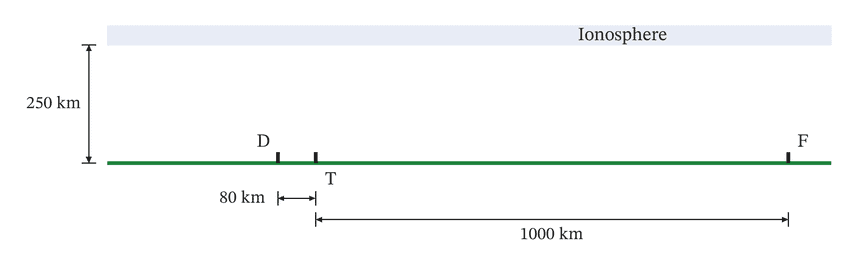
(a) Find the critical frequency of the layer that night.
(b) Which frequency should T use to reach D? Give a reason.
(c) T also has an antenna that sends waves out at low angles. That night F receives this signal clearly, yet D receives nothing on from either antenna. Explain why.