
Question 745 marksHard
What is amplitude modulation? Derive an expression for an amplitude modulated wave and obtain expressions for sideband frequencies and the bandwidth.
Confirming your payment
Sign up now and get 250 free tokens.
Communication Systems · Question 74 of 90
What is amplitude modulation? Derive an expression for an amplitude modulated wave and obtain expressions for sideband frequencies and the bandwidth.
Solution:
Concept: In amplitude modulation the amplitude of a high-frequency carrier is varied in step with the instantaneous value of the modulating signal, while the carrier's frequency stays constant. A product of two cosines can be written as a sum of two cosines, which brings out the new frequencies.
Step 1 — Definition. Amplitude modulation is the process in which the amplitude of the carrier wave is varied in accordance with the instantaneous value of the modulating signal, keeping the frequency and phase of the carrier constant.
Step 2 — Carrier and signal. Let the carrier have amplitude and angular frequency , and the modulating signal have amplitude and angular frequency , with . The two waves are
The modulation index is , so .
Step 3 — Amplitude of the AM wave. The amplitude of the carrier varies at the signal frequency:
Step 4 — The AM wave. The modulated wave is this amplitude times :
The shape of this wave, with the largest amplitude and the smallest , is shown below.

Step 5 — Split the product term. We use :
Step 6 — Sideband frequencies. The AM wave contains three frequencies: the carrier , the upper sideband and the lower sideband . Each sideband has amplitude .
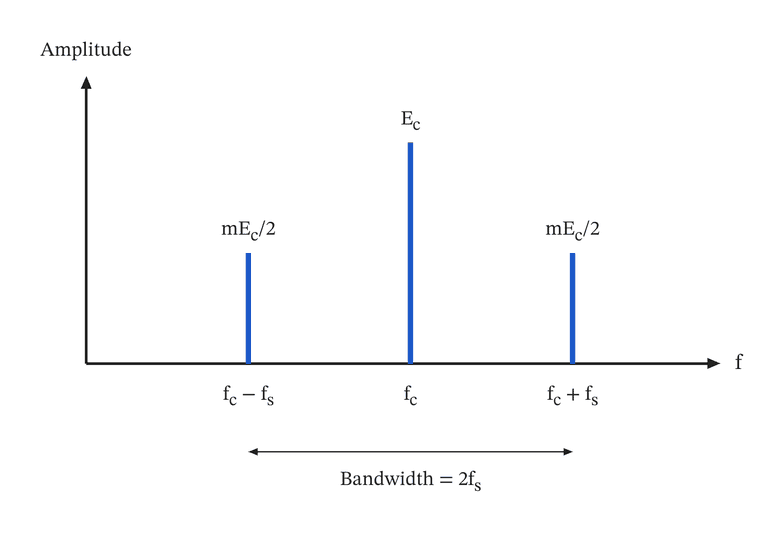
Step 7 — Bandwidth. The bandwidth is the difference between the highest and the lowest frequencies:
If the message contains many frequencies, the bandwidth is twice the highest of them.
Therefore, the AM wave is ; the sideband frequencies are and , and the bandwidth is .