
Question 693 marksMedium
(a) Using diagrams, explain
(i) modulating signal,
(ii) carrier wave and
(iii) amplitude modulated wave.
(b) What is modulation index?
Confirming your payment
Sign up now and get 250 free tokens.
Communication Systems · Question 69 of 90
(a) Using diagrams, explain
(i) modulating signal,
(ii) carrier wave and
(iii) amplitude modulated wave.
(b) What is modulation index?
Solution:
Concept: In amplitude modulation the amplitude of a high-frequency carrier is varied by a low-frequency message.
The diagrams below use the carrier (amplitude , angular frequency ), the message (amplitude , angular frequency ) and the modulated wave , where is the modulation index, drawn with and (in practice is much higher still).
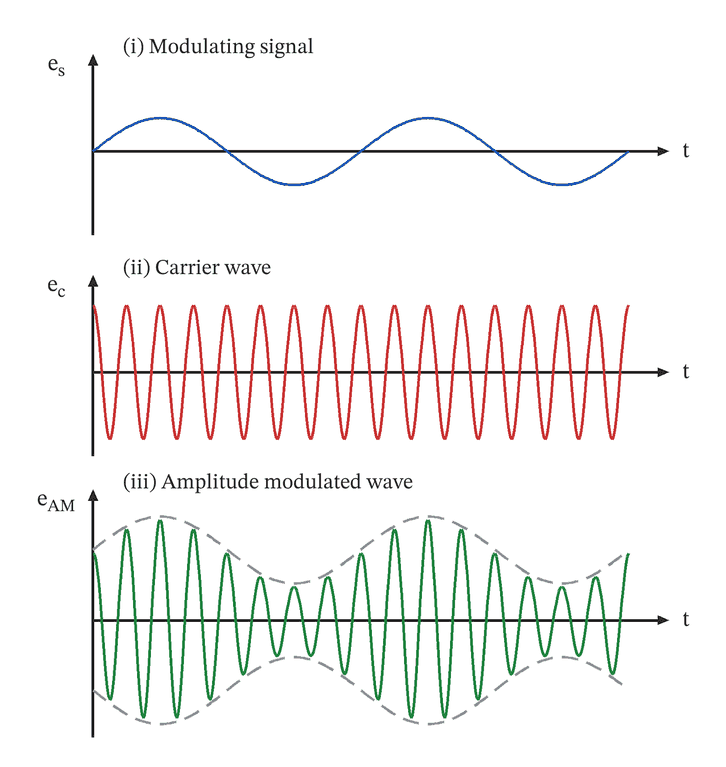
Step 1 — (a)(i) Modulating signal. The modulating signal is the low-frequency message (for example an audio signal) that is to be transmitted. In diagram (i) it is a sine wave of amplitude and frequency .
Step 2 — (a)(ii) Carrier wave. The carrier wave is a high-frequency sinusoidal wave of constant amplitude and frequency , shown in diagram (ii). It "carries" the message over long distances.
Step 3 — (a)(iii) Amplitude modulated wave. In the AM wave of diagram (iii), the frequency is still , but the amplitude rises and falls with the modulating signal. The dashed outline (the envelope) has the shape of the modulating signal: the amplitude is largest, , when the signal is at its positive peak, and smallest, , at its negative peak.
Step 4 — (b) Modulation index. The modulation index is the ratio of the maximum change in the amplitude of the carrier to the amplitude of the unmodulated carrier:
It is usually given as a percentage and is kept at or below 1 (100 per cent) to avoid distortion.
Therefore, (a) the modulating signal is the low-frequency message, the carrier is a high-frequency wave of constant amplitude, and the AM wave is the carrier whose amplitude follows the message (diagrams above); (b) the modulation index is .