
Opening your dashboard
Class 12 Physics Chapter 34 Communication Systems: Practice Questions
88 questions on Chapter 34, each worked through on its own page with the AI tutor. Class 12 Physics, ICSE 2026-27.
88 questions
1–4 marks · Mixed difficulty
- 11 mark
Question 1
An optical-fibre link long joins two cities, with a repeater about every along it. What does each repeater do?
- 23 marks
Question 2
(Hypothetical data.) The temperature sensor of a school weather station gives a voltage that changes smoothly with the temperature. A circuit measures this voltage 10 times every second and sends each reading to a computer as a code of 8 binary digits (bits); each bit is sent as a pulse at one of only two voltage levels.
(i) Is the sensor's output an analog or a digital signal? Is the signal sent to the computer analog or digital?
(ii) How many different values can one 8-bit code stand for?
(iii) The lowest code stands for and the highest code for , with equal steps between neighbouring codes. Find the smallest change in temperature that the coded signal can show.
- 33 marks
Question 3
(Hypothetical data.) At the antenna of a receiver, the wanted signal has a voltage of , and noise picked up in the channel adds . The first amplifier of the receiver has a voltage gain of 2000 and adds no noise of its own.
(i) Find the signal voltage and the noise voltage at the output of the amplifier.
(ii) Compare the ratio of signal voltage to noise voltage before and after the amplifier.
(iii) Explain why amplifying at the receiver cannot remove the noise picked up in the channel, and how repeaters placed along the channel help.
- 44 marks
Question 4
(Hypothetical data.) In a copper cable link, the power of the signal falls to half of its value in every of cable. The transmitter sends into the cable. The receiver, like any repeater, needs an input power of at least .
(i) Find the greatest length of cable that can be used without a repeater.
(ii) A link long is to be built with the fewest possible repeaters, equally spaced. How many repeaters are needed, and how far apart are they?
(iii) Each repeater restores the power to . Find the power gain (amplification) that each repeater must provide.
- 51 mark
Question 5
(Hypothetical data.) A signal of power is sent through three equal sections of a link. Each section passes on only one-quarter of the power that enters it. An amplifier with a power gain of 10 is placed between the second and the third sections. The power reaching the receiver at the end of the third section is
- 63 marks
Question 6
(Hypothetical data.) A digital link sends each bit as a pulse lasting : stands for the bit 0 and for the bit 1. The figure shows the signal reaching a repeater after noise in the channel has changed it by up to either way.
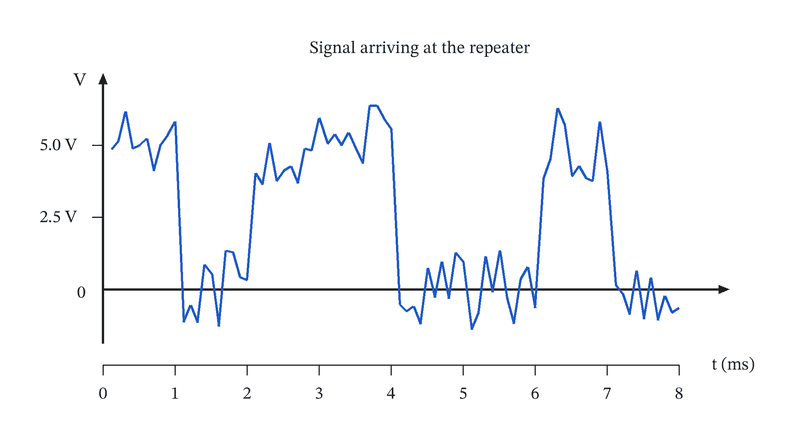
The repeater compares the signal with in each bit slot. It sends out a clean pulse wherever the signal is above , and wherever it is below.
(i) Write down the 8 bits carried by the signal.
(ii) Explain why the signal sent on by the repeater contains none of this noise, and why noise on an analog signal cannot be removed in this way.
(iii) Up to what size of noise voltage, either way, can this scheme still read every bit correctly?
- 71 mark
Question 7
An ordinary telephone line passes only frequencies from about to , although the human voice also contains frequencies below and well above . A telephone call is still easy to understand because
- 83 marks
Question 8
Long-distance optical-fibre links send light with wavelengths between and , a band in which silica fibre loses very little power. Take .
(i) Find the frequencies at the two ends of this wavelength band.
(ii) Find the width of the band in hertz, and how many times the bandwidth of a coaxial cable it is.
(iii) Express this bandwidth as a percentage of the middle frequency of the band. Find the bandwidth that the same percentage of a radio carrier would give, and say what this shows about the choice of carrier.
- 91 mark
Question 9
A square wave is made up of sine waves of frequencies , , , , and so on (the odd multiples of only). It is sent along a line that passes only frequencies up to . The number of its sine-wave components that reach the far end is
- 103 marks
Question 10
(Hypothetical data.) Two links, each long, are compared. A coaxial cable carrying signals of a few megahertz passes on only 70 per cent of the power entering each kilometre. A modern optical fibre carrying light of wavelength loses only about 4.5 per cent of its power in each kilometre, so it passes on 95.5 per cent of the power entering each kilometre.
(i) Find the fraction of the input power that reaches the end of each link.
(ii) How many times as large is the fraction delivered by the fibre?
(iii) Use your answers to explain why fibre links need far fewer repeaters.
- 111 mark
Question 11
An optical-fibre cable long joins two cities. Take the light pulses carrying the signal to travel along the fibre at , with and . The time taken by the signal to go from one end to the other is
- 122 marks
Question 12
(Hypothetical data.) A school wants to send a live video lecture, which needs a bandwidth of about , to a hall away. Three links are available: an old twisted-pair telephone line that passes frequencies only up to about over this distance, a coaxial cable with a bandwidth of about , and an optical fibre.
(i) Which of these links can carry the lecture? Give a reason for each.
(ii) Could the twisted pair carry just the sound of the lecture, sent as telephone-quality speech? Give a reason.
- 133 marks
Question 13
(Hypothetical data.) A coast radio station has its antenna on top of a mast high, and a ship's antenna is above the sea, as shown. Take the radius of the Earth as , and ignore any bending of the waves by the air.
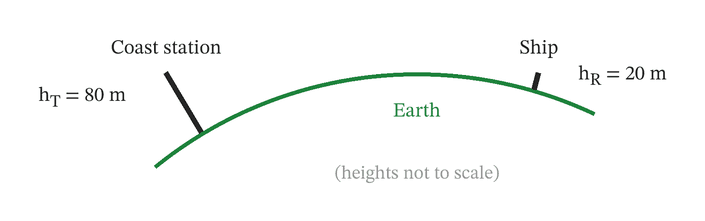
(i) Find the greatest distance between the station and the ship at which the ship can still receive the station's space wave directly.
(ii) A small boat has its antenna only above the sea. Find the greatest distance at which the boat can receive the station directly.
- 141 mark
Question 14
(Hypothetical data.) An aircraft flies at a height of and sends radio signals that travel in straight lines. The radius of the Earth is , and the ground antennas are of negligible height.
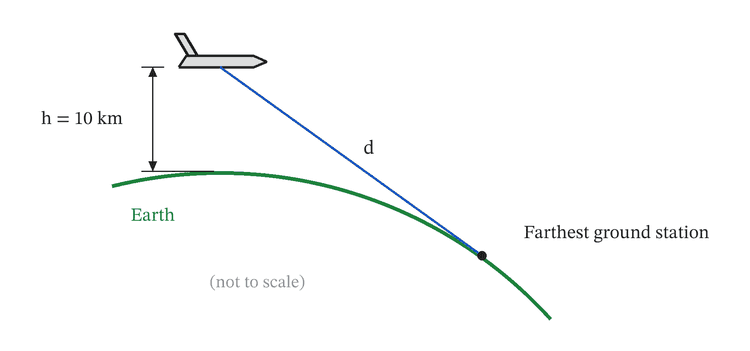
The greatest distance from the aircraft to a ground station that can receive its signal directly is about
- 154 marks
Question 15
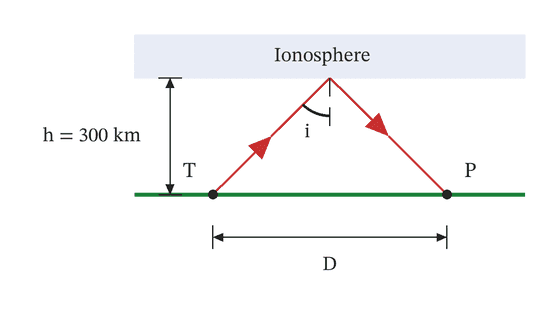
(Hypothetical data.) On a certain day the greatest electron density in the reflecting layer of the ionosphere is . Treat the layer as a flat mirror at a virtual height above a flat Earth, as shown. A wave that meets the layer at an angle of incidence is returned to the ground only if its frequency is not more than , where is the critical frequency of the layer (the highest frequency returned when a wave is sent straight up).
(i) Find the critical frequency of the layer, using .
(ii) Find the smallest angle of incidence at which a wave is returned.
(iii) Hence find the skip distance for the wave: the shortest distance from the transmitter at which its sky wave comes back to the ground.
- 161 mark
Question 16
On medium-wave AM radio (about to ), stations hundreds of kilometres away are often heard clearly at night but hardly at all around noon. The main reason is that
- 173 marks
Question 17
For a radio wave of frequency in a part of the ionosphere with free electrons per cubic metre, the refractive index is (with in hertz). Below the ionosphere . In a medium made of horizontal layers, stays the same all along a ray, where is the angle the ray makes with the vertical.
A wave of frequency enters the bottom of the ionosphere travelling at to the vertical. (Hypothetical data.) Above this point the electron density increases steadily with height.
(i) Find at the level where .
(ii) Find the angle the wave makes with the vertical at that level, and say whether the wave is bending towards or away from the vertical.
(iii) The wave turns back at the level where it travels horizontally. Find the electron density at that level.
- 183 marks
Question 18
(Hypothetical data.) An FM radio transmitter has its antenna above level ground. Listeners with antennas close to the ground find good reception up to about away. Take the radius of the Earth as .
(i) Find the line-of-sight range of the antenna.
(ii) Suggest why the observed range is larger than this.
(iii) Radio engineers allow for this effect by using, in the same formula, an effective Earth radius equal to of the true radius. Find the range this gives and compare it with the observation.
- 193 marks
Question 19
(Hypothetical data.) An ionospheric sounder sends short radio pulses straight up and times their echoes. At an echo returns after each pulse is sent. When the frequency is raised above , no echo returns at all.
(i) Taking the pulse to travel at all the way, find the height of the reflecting layer worked out from the echo time (its virtual height).
(ii) Why does no echo return above ?
(iii) Why is the true height at which the pulse turns back a little less than this virtual height?
- 204 marks
Question 20
A geostationary communication satellite stays above the same point of the equator. Take , the mass of the Earth and its radius .
(i) The Earth turns once on its axis, measured against the stars, in 23 h 56 min 4 s. Explain why this time, and not 24 h, is the period of a geostationary satellite.
(ii) Using Kepler's third law in the form , find the radius of its orbit.
(iii) Find its height above the surface of the Earth and its orbital speed.
- 211 mark
Question 21
A telephone call is routed through a geostationary satellite above the equator. Both ground stations are close to the point directly below the satellite, so each leg of the path is about as long as the satellite's height. Take . The time taken by the speech to travel from one ground station to the other is about
- 223 marks
Question 22
A geostationary satellite S is at a height above the point A on the equator. The radius of the Earth is . Lines from S touch the Earth at points such as T, as shown; places beyond T cannot see the satellite.
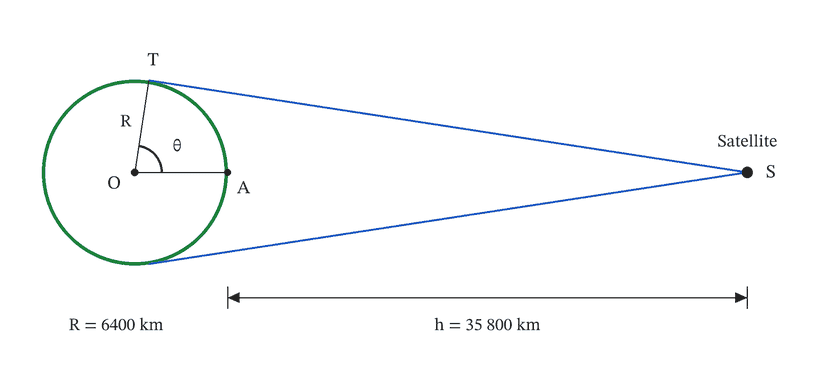
(i) Find the angle at the centre of the Earth.
(ii) A cap of the Earth's surface of half-angle has an area of . Find the fraction of the Earth's surface from which the satellite can be seen.
(iii) Explain why three such satellites, spaced equally round the equator, can link almost the whole Earth, and name the regions they cannot reach.
- 231 mark
Question 23
A geostationary satellite appears fixed in the sky to people on the ground. Why must its orbit lie in the plane of the Earth's equator?
- 243 marks
Question 24
(Hypothetical data.) A communication satellite in a low Earth orbit circles the Earth at a height of . A geostationary satellite circles at a radius of with a period of 23 h 56 min 4 s (). Take the radius of the Earth as and .
(i) Using Kepler's third law, , find the period of the low-orbit satellite in minutes.
(ii) Find the time a signal takes to go up to the low-orbit satellite and straight back down when the satellite is directly overhead. How many times as long is the delay for a geostationary satellite directly overhead, at a height of ?
(iii) Give one disadvantage of the low orbit for communication.
- 251 mark
Question 25
A communication satellite receives signals from the ground at about (the uplink) and sends them back down at about (the downlink). The main reason for using two different frequencies is that
- 261 mark
Question 26
A handheld walkie-talkie sends a voice tone of frequency on a carrier of frequency . Take the shortest antenna that radiates efficiently to be one quarter of the wavelength, and . The antenna length needed is about
- 273 marks
Question 27
A small transmitter has a vertical antenna long. (Hypothetical data.) For an antenna much shorter than the wavelength, the power it radiates for a given current is proportional to , where is the length of the antenna and the wavelength. The same current is fed to the antenna in two ways: (i) a audio signal on its own, with no carrier, and (ii) the same signal on a carrier of frequency . Take .
(a) Find the wavelength radiated in each case.
(b) How many times as much power is radiated in case (ii) as in case (i)?
(c) How long would a quarter-wave antenna for case (i) have to be? Comment on your answer.
- 281 mark
Question 28
In a city, three stations want to broadcast speech at the same time. Suppose each simply radiated its audio signal (frequencies from about to ) without any carrier. Apart from the problem of antenna size, the main difficulty for listeners would be that
- 293 marks
Question 29
A medium-wave AM signal, with carrier frequency modulated by a steady tone, is fed straight from the aerial to a small earphone, without any diode. The diaphragm of the earphone can follow vibrations only up to about . (Hypothetical data.)
(a) How many cycles of the carrier fit into one cycle of the tone?
(b) Explain why the tone is not heard.
(c) Explain how a diode followed by a capacitor and resistor (a detector) makes the tone audible.
- 301 mark
Question 30
A carrier is modulated by a message. On an oscilloscope the modulated wave always has a peak value of , but its frequency, found from the spacing of neighbouring cycles, changes smoothly between and . (Hypothetical data.) The wave is
- 313 marks
Question 31
A data signal contains frequencies from almost zero up to . An engineer wants to send it by amplitude modulation and considers two carriers: (i) and (ii) . (Hypothetical data.)
(a) For each carrier, find the band of frequencies, from to , that the modulated wave would need.
(b) Explain why carrier (i) cannot be used.
(c) For carrier (ii), express the bandwidth as a percentage of the carrier frequency.
- 321 mark
Question 32
The figure shows an amplitude modulated wave on an oscilloscope (far fewer carrier cycles are drawn than in reality). Its largest peak value is and its smallest peak value is . (Hypothetical data.)
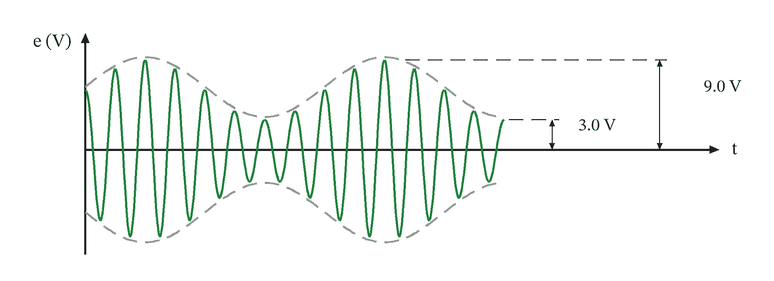
The amplitude of the modulating signal and the amplitude of the unmodulated carrier are
- 334 marks
Question 33
The frequency spectrum of an amplitude modulated wave, modulated by a single tone, is shown below. (Hypothetical data.)

(a) Find the carrier frequency and the frequency of the modulating tone.
(b) Find the bandwidth of the wave.
(c) Find the modulation index and the amplitude of the modulating signal.
(d) Find the largest and smallest peak values, and , of the modulated wave.
- 341 mark
Question 34
A medium-wave transmitter radiates a carrier power of when unmodulated. It is then amplitude modulated by a tone with modulation index . (Hypothetical data.) The total power of an AM wave is , where is the carrier power. The total power radiated is
- 353 marks
Question 35
A carrier of amplitude is amplitude modulated by a tone of amplitude . (Hypothetical data.)
(a) Find the modulation index.
(b) The amplitude of the modulated wave is . Find its largest and its least value.
(c) Explain what goes wrong, how the output of a diode detector differs from the tone, and how the fault can be put right.
- 361 mark
Question 36
A carrier of amplitude is amplitude modulated at the same time by two tones: of amplitude and of amplitude . (Hypothetical data.) The frequencies present in the modulated wave are
- 373 marks
Question 37
When a broadcast transmitter sends its carrier unmodulated, the current in its antenna is . When the carrier is amplitude modulated by a steady tone, the antenna current rises to . (Hypothetical data.) The radiated power is proportional to the square of the antenna current, and the total power of an AM wave is , where is the carrier power.
(a) Find the modulation index .
(b) What percentage of the total power is carried by the two sidebands?
(c) Explain why this shows that AM uses its power poorly.
- 381 mark
Question 38
A tone of fixed frequency amplitude modulates a carrier. The tone is made louder, so that the modulation index rises from to , while the carrier is unchanged. (The two sidebands together carry power , where is the carrier power.) Which statement is correct?
- 391 mark
Question 39
An FM radio station broadcasts on . On the loudest sounds its carrier frequency deviates from this value by at most either way. At those moments the instantaneous frequency of the carrier swings between
- 403 marks
Question 40
In a laboratory test, an FM transmitter is modulated by a steady tone of frequency , and the bandwidth of the FM wave is found to be . (Hypothetical data.) Use Carson's rule, , where is the peak frequency deviation, and the result that an FM wave with significant sidebands on each side of the carrier has .
(a) Find the peak frequency deviation .
(b) How many significant sidebands are there on each side of the carrier?
(c) What bandwidth would AM need for the same tone? How many times as wide is the FM wave?
- 411 mark
Question 41
During a thunderstorm, loud crackles from lightning are heard on a medium-wave AM station, but hardly at all on an FM station. The main reason is that
- 423 marks
Question 42
An unmodulated carrier of frequency is frequency modulated by the signal shown, whose peak value is . The modulator shifts the carrier frequency by for every volt of signal, raising it when the signal is positive. (Hypothetical data.)
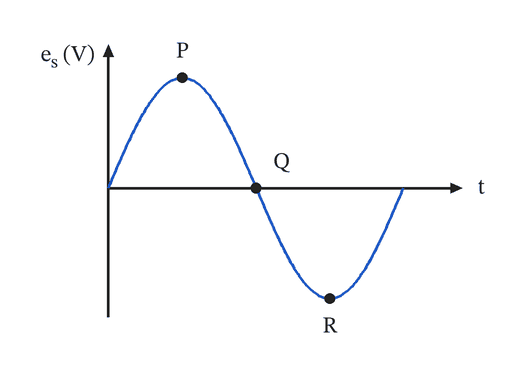
(a) Find the instantaneous frequency of the FM wave at the moments P (signal ), Q (signal ) and R (signal ).
(b) At which of these moments are the cycles of the FM wave closest together, and at which are they farthest apart?
(c) What happens to the amplitude of the FM wave meanwhile?
- 431 mark
Question 43
In FM broadcasting the largest frequency deviation allowed is . A tone produces this full deviation. The frequency modulation index , where is the peak frequency deviation and the tone frequency, is
- 442 marks
Question 44
Each FM broadcasting station needs a channel about wide, while an AM station needs about . The medium-wave band used for AM broadcasting runs from about to , and the band used for FM broadcasting runs from to .
(a) How many FM channels could fit into the medium-wave band, and how many fit into the – band?
(b) Use your answer to explain why FM broadcasting uses very high frequencies, and state one effect this has on the area an FM station covers.
- 453 marks
Question 45
A GPS satellite is directly above a receiver. Take the speed of the signal as and ignore delays in the atmosphere.
(a) How long does the satellite's signal take to reach the receiver?
(b) The receiver works out its distance from the satellite from this travel time. If the receiver's clock is wrong by only , by how much is the distance wrong?
(c) Explain why a receiver needs signals from at least four satellites to find its position.
- 463 marks
Question 46
A city covers about . A mobile network divides it into hexagonal cells like those in the figure, each with a tower at its centre and every corner from the tower (so each side of the hexagon is also ). The area of a regular hexagon of side is . (Hypothetical data.)
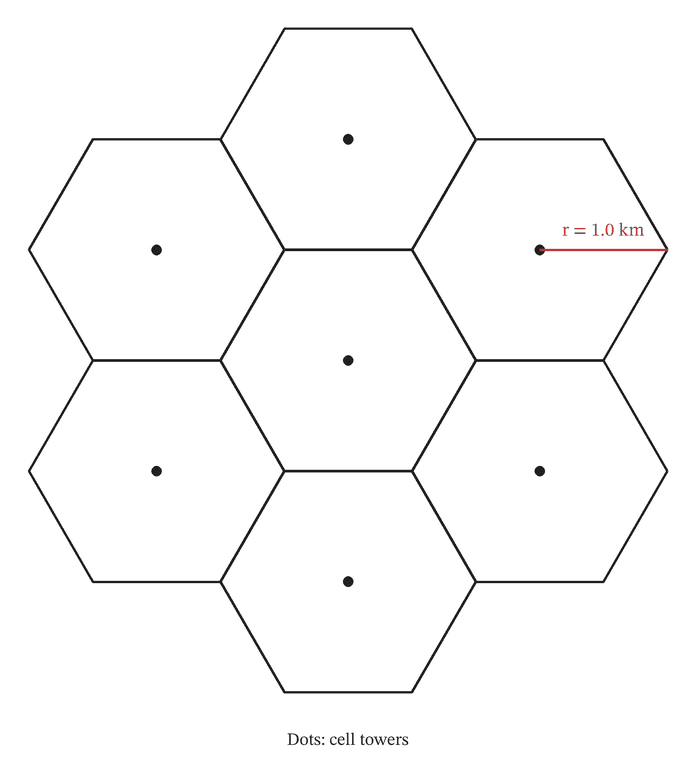
(a) About how many cells are needed to cover the city?
(b) The network has only a limited number of radio frequencies. Explain how using many small cells lets it serve many more callers at the same time.
(c) Why does a call not drop when a caller travels by car from one cell into the next?
- 473 marks
Question 47
A student emails a photo of size ( bytes). The internet sends data in small packets; suppose each packet carries bytes of the photo. (Hypothetical data.)
(a) How many packets are needed for the photo?
(b) Besides part of the photo, what does each packet carry, and why can different packets of the same photo travel by different routes?
(c) What happens if one of the packets is lost on the way?
- 483 marks
Question 48
A family downloads a film of size ( bytes; byte bits). On a 4G connection the download speed is , and on a 5G connection it is . (Hypothetical data.)
(a) How long does the download take on each connection?
(b) Explain in words two ways in which 5G networks achieve much higher data rates than 4G networks.
- 492 marks
Question 49
A food-delivery app follows a rider's position using the GPS receiver in the rider's phone. When the rider goes down into an underground car park, the GPS position stops updating, yet the map still shows the rider roughly in the right place.
(a) Explain why the phone cannot get a GPS position underground.
(b) Suggest how the phone can still show an approximate position.
- 503 marks
Question 50
Every device on the internet needs an IP address. The older system, IPv4, uses addresses that are bits long; the newer system, IPv6, uses -bit addresses. By 2025 more than billion "Internet of Things" devices (sensors, cameras, smart meters and so on) were connected, besides phones and computers.
(a) How many different IPv4 addresses are possible?
(b) Explain why IPv6 was introduced.
(c) How many different IPv6 addresses are possible, and how many times the number of IPv4 addresses is this?
- 511 mark
Question 51
What is a transducer?
- 521 mark
Question 52
What is modulation factor or modulation depth?
- 531 mark
Question 53
If is the carrier frequency and is the signal frequency, what is the frequency of (i) upper sideband and (ii) lower sideband in an amplitude modulated wave?
- 541 mark
Question 54
What is remote sensing?
- 551 mark
Question 55
What is meant by bandwidth?
- 561 mark
Question 56
What is the bandwidth in AM transmission?
- 572 marks
Question 57
Write down the equation for bandwidth in FM transmission.
- 581 mark
Question 58
What is noise?
- 592 marks
Question 59
Is it necessary to use satellites for long distance transmission? Why?
- 602 marks
Question 60
Greater the height of a TV transmitting antenna, greater is its coverage. Explain.
- 612 marks
Question 61
Why are sky waves not used in the transmission of TV signals?
- 622 marks
Question 62
In the process of modulation, any one quality of carrier is varied in accordance with message signal.
(a) Give the qualities or parameters that can be used to achieve modulation when one uses a sinusoidal wave as carrier.
(b) A simple AM demodulator consists of diode along with network. Give the function of network in the demodulator circuit.
(c) In what way the demodulation process is affected if ?
- 632 marks
Question 63
A radio station uses carrier wave of frequency 1450 kHz for amplitude modulated analog transmission.
(a) Which among the following are true?
(i) Carrier wave used is pulse.
(ii) Carrier wave used is sinusoidal.
(iii) Carrier wave used is a mixture of sinusoidal and pulse wave.
(iv) Carrier wave can be either sinusoidal or pulse.
(b) If the station uses an antenna of minimum length, estimate the range of transmission [Given radius of the Earth is m].
- 641 mark
Question 64
The range of frequency of audio signal is
- 651 mark
Question 65
In television transmission what type of modulation is used?
- 661 mark
Question 66
The waves used for line-of-sight (LOS) communication is
- 671 mark
Question 67
Through which mode of propagation, the radio waves can be sent from one place to another?
- 681 mark
Question 68
Broadcasting antennas are generally
(a) Omnidirectional type
(b) Vertical type
(c) Horizontal type
(d) None of these
- 691 mark
Question 69
For television broadcasting, the frequency employed is normally
- 701 mark
Question 70
The process of regaining of information from carrier wave at the receiver is termed as
- 711 mark
Question 71
The waves that are bent down by the ionosphere are
- 721 mark
Question 72
Amplitude modulation has
- 731 mark
Question 73
An example of point to point mode of communication is
- 741 mark
Question 74
A signal of 5 kHz frequency is amplitude modulated on a carrier wave of frequency 2 MHz. The frequencies of the resultant signal is/are
- 751 mark
Question 75
Audio signal cannot be transmitted because
- 761 mark
Question 76
Which of the following device is fully duplex?
- 771 mark
Question 77
1000 kHz carrier wave is amplitude modulated by the signal frequency 200–4000 Hz. The channel width of this case is
- 781 mark
Question 78
The distance of coverage of a transmitting antenna is 12.8 km. Then the height of the antenna is (given the radius of the Earth = 6400 km)
- 791 mark
Question 79
A modem is a
- 801 mark
Question 80
A radio station has two channels. One is AM at 1020 kHz and the other is FM at 89.5 MHz. For good results, you will use
- 811 mark
Question 81
In amplitude modulation, the bandwidth is
- 821 mark
Question 82
In amplitude modulation, sinusoidal carrier frequency used is denoted by and the signal frequency is denoted by . The bandwidth of the signal is such that . Which of the following frequency is not contained in the modulated wave?
- 831 mark
Question 83
A telephonic communication service is working at carrier frequency of 10 GHz. Only 10% of it is utilised for transmission. How many telephonic channels can be transmitted simultaneously if each channel requires a bandwidth of 5 kHz?
- 841 mark
Question 84
To double the covering range of a TV transmitting tower, its height should be multiplied by
- 851 mark
Question 85
In a line of sight radio communication, a distance of about 50 km is kept between the transmitting and receiving antennas. If the height of the receiving antenna is 70 m, then the minimum height of the transmitting antenna should be, (radius of the Earth m)
- 861 mark
Question 86
A 25 m long antenna is mounted on an antenna tower. The height of the antenna tower is 75 m. The wavelength (in metre) of the signal transmitted by this antenna would be
- 871 mark
Question 87
Two identical antennas mounted on identical towers are separated from each other by a distance of 45 km. What should nearly be the minimum height of receiving antenna to receive the signals in line of sight? [Assume radius of the Earth is 6400 km.]
- 881 mark
Question 88
An antenna is mounted on a 400 m tall building. What will be the wavelength of signal that can be radiated effectively by the transmission tower upto a range of 44 km?