
Question 463 marksMedium
A city covers about . A mobile network divides it into hexagonal cells like those in the figure, each with a tower at its centre and every corner from the tower (so each side of the hexagon is also ). The area of a regular hexagon of side is . (Hypothetical data.)
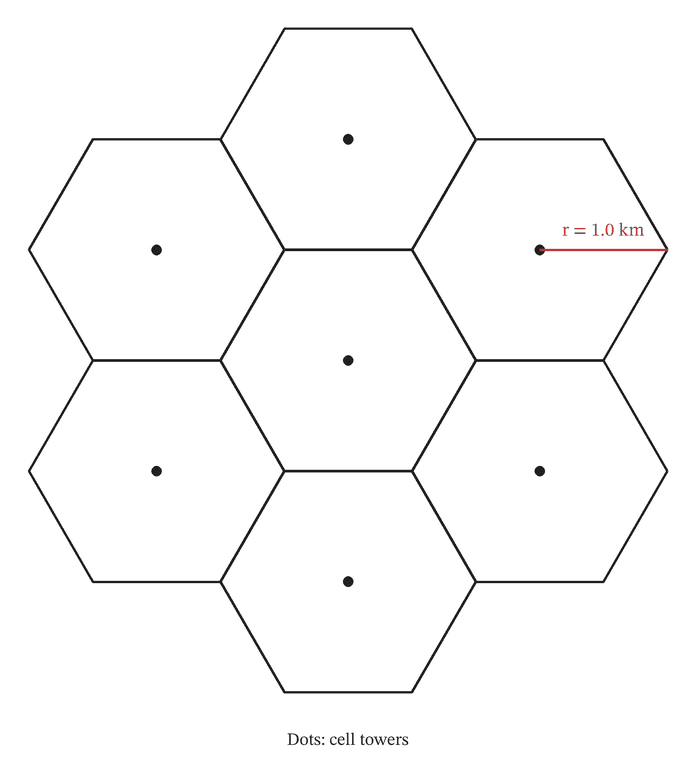
(a) About how many cells are needed to cover the city?
(b) The network has only a limited number of radio frequencies. Explain how using many small cells lets it serve many more callers at the same time.
(c) Why does a call not drop when a caller travels by car from one cell into the next?