
Opening your dashboard
Class 12 Maths Chapter 9: Application of Derivatives Solutions
64 textbook questions with step-by-step answers, free to read, for ISC 2026-27.
Get talked through Ch 9, not just shown the answer
Reading a finished solution is not the same as being able to do it. The AI tutor takes one question at a time and works it with you, in your own words, until you can.
- Ask it out loud, in your own words
- It gives you the next step, not the answer
- Stuck on part (ii)? Start there
64 questions with solutions
1–3 marks · Mixed difficulty
The first 7 solutions are on this page. This chapter is a long one, so the rest open on their own page to keep this one quick to load.
- 13 marks
Question 1
Find the slopes of the following curves:
(i) at the point
(ii) at
(iii) at
(iv) at
(v) at
Solve with AIWritten solution
Solution:
Key idea: The slope (gradient) of the curve at a point is the value of the derivative at that point. So in each part we differentiate first and then put in the given value of .
Step 1 — Part (i): find the slope of at .
We write as and use the power rule to differentiate it.
Now we put , the -coordinate of the given point.
So the slope in part (i) is .
Step 2 — Part (ii): find the slope of , where .
We differentiate term by term; the constant has derivative 0.
Putting gives the slope.
Step 3 — Part (iii): find the slope of , where .
We differentiate each term with the power rule.
Putting gives the slope.
A slope of 0 means the tangent at this point is horizontal.
Step 4 — Part (iv): find the slope of , where .
We use together with the power rule.
Putting and using gives the slope.
Step 5 — Part (v): find the slope of , where .
By the chain rule, , so we differentiate both terms.
Now we put , so that , and we use and .
Watch out: In part (v) the derivative of is , not ; the factor 3 comes from the chain rule.
Therefore, the slopes are (i) ; (ii) ; (iii) ; (iv) ; (v) .
- 23 marks
Question 2
Find the slope of the normal to the curve at the point whose -coordinate is 2.
Solve with AIWritten solution
Solution:
Key idea: The slope of the tangent at a point is the value of there. The normal is perpendicular to the tangent, and two perpendicular lines have slopes whose product is , so the slope of the normal is .
Step 1 — Differentiate the curve.
We differentiate with the power rule to get the slope of the tangent at any point.
Step 2 — Find the slope of the tangent at .
The point has -coordinate 2, so we put into the derivative.
Step 3 — Find the slope of the normal.
The normal is perpendicular to the tangent, so its slope is the negative reciprocal of 12.
Watch out: The slope of the normal is not ; we take the reciprocal and change the sign.
Therefore, the slope of the normal at the point where is .
- 33 marks
Question 3
Find the equation of the tangent and normal to the given curves at the points given:
(i) at the point .
(ii) , , at .
(iii) at the point whose abscissa is 3.
(iv) at
(v) at
Solve with AIWritten solution
Solution:
Key idea: If the slope of the tangent at the point of a curve is , then the tangent is the line . The normal passes through the same point and is perpendicular to the tangent, so (when ) it is the line .
Step 1 — Part (i): find the point and the slope for .
We first check which point of the curve has abscissa 1, by putting into the equation.
So the point of the curve with is . Next we differentiate to get the slope.
We put to find the slope of the tangent.
Note: The point printed in the question, , does not lie on this curve, because the curve passes through when . We therefore work at , the point of the curve with abscissa 1.
Step 2 — Part (i): write the tangent and the normal.
The tangent through with slope 1 is found from the point–slope form.
The normal has slope and passes through the same point.
Step 3 — Part (ii): find the point and the slope for , .
The curve is given in parametric form, so we differentiate both coordinates with respect to .
The slope is the ratio of these two rates.
At we have equal to 1, so the slope is . The point is .
Step 4 — Part (ii): write the tangent and the normal.
The tangent has slope through .
The normal has slope through the same point.
This makes sense: the curve is the unit circle, and the normal at any point of a circle passes through its centre .
Step 5 — Part (iii): find the point and the slope for .
The abscissa is 3, so we put to find the ordinate.
The point is . Now we differentiate and put .
Step 6 — Part (iii): write the tangent and the normal.
The tangent has slope 10 through .
The normal has slope , so we multiply through by 10 to clear the fraction.
Step 7 — Part (iv): find the slope for at .
First we check that the point lies on the curve: both and equal 4, so it does. Now we differentiate both sides with respect to , using the chain rule on the left and the quotient rule on the right.
We put and .
Step 8 — Part (iv): write the tangent and the normal.
The tangent has slope through .
The normal has slope , so we multiply through by 2.
Step 9 — Part (v): find the slope for .
We differentiate the hyperbola implicitly with respect to .
So at , with and , the slope of the tangent is .
Step 10 — Part (v): write the tangent.
We use the point–slope form and multiply both sides by .
Now we divide every term by .
Because lies on the hyperbola, the right-hand side equals 1.
Step 11 — Part (v): write the normal.
The normal has slope . We write its equation and clear the fraction by multiplying by .
Now we divide every term by .
Therefore, (i) at the tangent is and the normal is ; (ii) the tangent is and the normal is ; (iii) the tangent is and the normal is ; (iv) the tangent is and the normal is ; (v) the tangent is and the normal is .
- 43 marks
Question 4
Find the equation of the tangent and normal to the parabola at .
Solve with AIWritten solution
Solution:
Key idea: The tangent at with slope is , and the normal there has slope . For the parabola we find by implicit differentiation. Here is the parameter of the point, and we take (at the point is the vertex, where the tangent is the -axis).
Step 1 — Differentiate the parabola.
We differentiate both sides of with respect to , using the chain rule on .
Step 2 — Find the slope at .
At the given point , so we substitute it.
Step 3 — Write the tangent.
We use the point–slope form with slope and then multiply both sides by .
Step 4 — Write the normal.
The normal is perpendicular to the tangent, so its slope is .
Watch out: Check the answer by putting the point back in: in , the left side is and the right side is , so the point lies on the tangent.
Therefore, the tangent is and the normal is .
- 53 marks
Question 5
Find the equations to the tangent to the curve at the points where the curve cuts the -axis.
Solve with AIWritten solution
Solution:
Key idea: The curve cuts the -axis where . At each such point we find the slope and write the tangent as .
Step 1 — Find where the curve cuts the -axis.
We put and solve; a product is zero when one of its factors is zero.
So , or , and the points are , and .
Step 2 — Differentiate the curve.
We use the product rule on .
Step 3 — Find the slope at each point.
We put each -value into the derivative.
At the slope is:
At the slope is:
At the slope is:
Step 4 — Write the tangent at .
The slope is 6 and the point is .
Step 5 — Write the tangent at .
The slope is and the point is .
Step 6 — Write the tangent at .
The slope is 3 and the point is .
Therefore, the tangents are at , at and at .
- 63 marks
Question 6
Find the point on the curve at which the tangent is parallel to the -axis.
Solve with AIWritten solution
Solution:
Key idea: A line parallel to the -axis has slope 0. So the tangent is parallel to the -axis exactly where .
Step 1 — Differentiate the curve.
We differentiate term by term.
Step 2 — Set the slope equal to zero.
The tangent is horizontal where the slope is 0, so we solve for .
Step 3 — Find at .
We put into the equation of the curve, using .
Step 4 — Find at .
We put into the equation, using .
Watch out: Both roots of give a point; the question asks for "the point", but there are two such points.
Therefore, the tangent is parallel to the -axis at and at .
- 73 marks
Question 7
Find the points on the curve at which the slope is zero.
Solve with AIWritten solution
Solution:
Key idea: The slope of the curve at a point is there, so the slope is zero at the points where .
Step 1 — Differentiate the curve.
We differentiate term by term.
Step 2 — Set the slope equal to zero.
We solve for the values of where the slope is 0.
Step 3 — Find the -coordinates.
We put each value of into the equation of the curve.
At the -coordinate is:
At the -coordinate is:
Therefore, the slope is zero at the points and .
- 83 marks
Question 8
Find the points on the curve , the tangents at which are
(i) parallel to the -axis,
(ii) parallel to the -axis.
- 93 marks
Question 9
Find the point on the curve , the tangent at which is parallel to the straight line .
- 103 marks
Question 10
Find the equation of the tangent line to which is parallel to the line .
- 113 marks
Question 11
Find the equation of the normal line to which is parallel to the line .
- 123 marks
Question 12
Find a point on the curve where the tangent is parallel to the chord joining and .
- 133 marks
Question 13
On the curve , find the points at which the tangents to the curve are parallel to the -axis.
- 143 marks
Question 14
Find the equation of the tangent to the curve at .
- 153 marks
Question 15
The equation of tangent at on the curve is . Find the values of and .
- 163 marks
Question 16
Using differentials, find the approximate value of each of the following up to 3 places of decimal.
(i)
(ii)
(iii)
(iv)
(v)
(vi)
(vii)
- 171 mark
Question 17
If , then the approximate value of is
- 183 marks
Question 18
The volume of a sphere, radius cm is cm³. Find the approximate decrease in volume of a sphere when the radius decreases from 3 to 2.98 cm.
- 193 marks
Question 19
Find the approximate change in when , .
- 203 marks
Question 20
A sphere of radius 10 cm shrinks to radius 9.8 cm. Find approximately the decrease in
(i) volume, and
(ii) surface area.
- 213 marks
Question 21
A circular plate expands when heated from a radius of 5 cm to 5.06 cm. Find the approximate increase in area.
- 223 marks
Question 22
If the side of a cube is 10.01 cm, find approximately the volume of the cube.
- 233 marks
Question 23
The shape of a bowl is such that , where cm³ is the volume of water in the bowl and cm the depth of the water. If, when , an additional small volume cm³ of water is poured into the bowl, prove that the level of the water rises approximately cm.
- 243 marks
Question 24
A closed circular cylinder has height 16 cm, and radius cm. The total surface area is cm². Prove that . Hence, calculate an approximate increase in area if the radius increases from 4 to 4.02 cm, the height remaining constant (you may leave your answer in terms of ).
- 253 marks
Question 25
If , find the rate at which is changing with respect to , when .
- 263 marks
Question 26
If the radius of a circle increases from to cm, find the increase in the area.
- 273 marks
Question 27
The height of a right circular cylinder is cm and remains constant. The cylinder is closed at both ends. The radius cm of the base is decreasing at a constant rate of cm s. Find the rate at which the total surface is decreasing when the radius is cm, giving your answer correct to significant figures. (Take to be ).
- 283 marks
Question 28
A balloon contains a certain mass of gas whose volume is cm³ and whose pressure is newton per square centimetre, and it is known that and obey the law . If the volume increases at the rate of cm per minute, find the rate of change of when .
- 293 marks
Question 29
The stone dropped into still water produces a series of continually enlarging concentric circles; it is required to find the rate per second at which the area of one of them is enlarging when its diameter is cm supposing the wave to be then receding from the centre at the rate of cm s.
- 303 marks
Question 30
The volume of a cube is increasing at a constant rate. Prove that the increase in its surface area varies inversely as the length of the side.
- 313 marks
Question 31
In the function , what is the value of , when increases times as fast as .
- 323 marks
Question 32
A man m high walks at the rate of metres per minute away from a lamp which is m above the ground. How fast is the man's shadow lengthening?
- 333 marks
Question 33
If water is poured into an inverted hollow cone whose semi-vertical angle is , so that its depth (measured along the axis) increases at the rate of cm s, find the rate at which the volume of water is increasing when the depth is cm.
- 343 marks
Question 34
A spherical ball of salt is dissolving in water in such a manner that the rate of decrease of the volume at any instant is proportional to the surface. Prove that the radius is decreasing at a constant rate.
- 353 marks
Question 35
The area of a circle is increasing at the uniform rate of cm² per minute. Calculate the rate, in centimetre per minute, at which the radius is increasing when the circumference of the circle is cm.
- 363 marks
Question 36
A kite is metres above the ground and has metres string out. If the kite is travelling horizontally at m/s directly away from the boy who is flying it, at what rate is the string out?
- 373 marks
Question 37
A ladder, m long, standing on a horizontal floor, leans against a vertical wall. If the top of the ladder slides downwards at the rate of cm/s, then find the rate at which the angle between floor and ladder is decreasing when lower end of the ladder is m from the wall.
- 383 marks
Question 38
Water is dripping out from a conical funnel, at the uniform rate of cm³/s through a tiny hole at the vertex of the bottom. When the slant height of the water is cm, find the rate of decrease of the slant height of the water given that the vertical angle of the funnel is .
- 393 marks
Question 39
(i) The side of an equilateral triangle is cm long and is increasing at the rate of cm/h. How fast is the area increasing?
(ii) The sides of an equilateral triangle are increasing at the rate of cm/sec. Find the rate at which the area increases, when the side is cm.
- 403 marks
Question 40
The diameter and altitude of a right circular cylinder are found at a certain instant to be cm and cm respectively. If the diameter is increasing at the rate of cm per sec, what change in the altitude will keep the volume constant?
- 413 marks
Question 41
The radius of the base of a certain cone is increasing at the rate of cm per minute and the altitude is decreasing at the rate of cm per minute. Find the rate of change of total surface of the cone when the radius is cm and the altitude is cm.
- 423 marks
Question 42
Water is dripping out at the steady rate of c.c. per second through a tiny hole at the vertex of a conical vessel whose axis is vertical. When the slant height of the water in the filter is cm, find the rate of decrease of
(i) the slant height of water,
(ii) the area of the water surface, given that the vertical angle of the vessel is .
- 433 marks
Question 43
If the area of circle increases at a uniform rate, show that the rate of increase of the perimeter varies inversely as the radius.
- 443 marks
Question 44
Two men and start with velocities at the same time from the junction of two roads inclined at to each other. If they travel by different roads, then find the rate at which they are being separated.
- 453 marks
Question 45
Show that the function is decreasing for .
- 463 marks
Question 46
Show that the function , is increasing.
- 473 marks
Question 47
State when a function is said to be increasing function on . Test whether the function is increasing on .
- 483 marks
Question 48
Prove that the function is increasing on .
- 493 marks
Question 49
Determine the values of for which , is increasing or decreasing.
- 503 marks
Question 50
For which values of , the function is increasing and for which values of , it is decreasing?
- 513 marks
Question 51
Show that is an increasing function on .
- 523 marks
Question 52
Show that is a decreasing function on .
- 533 marks
Question 53
Show that is an increasing function on .
- 543 marks
Question 54
Find the intervals in which the following function is increasing or decreasing.
- 553 marks
Question 55
Find the intervals in which the following function is increasing or decreasing.
- 563 marks
Question 56
Find the intervals in which the following function is increasing or decreasing.
- 573 marks
Question 57
Find the intervals in which the following function is increasing or decreasing.
- 583 marks
Question 58
Find the intervals in which the following function is increasing or decreasing.
- 593 marks
Question 59
Find the intervals in which the following function is increasing or decreasing.
- 603 marks
Question 60
Find the intervals in which the following function is increasing or decreasing.
,
- 613 marks
Question 61
Determine the values of for which the function is increasing or decreasing. Also, find the coordinates of the point on the curve , where the normal is parallel to the line .
- 623 marks
Question 62
Show that the function is strictly decreasing in .
- 633 marks
Question 63
Find the intervals in which the function , is (i) increasing (ii) decreasing.
- 643 marks
Question 64
Find the intervals in which the following function is increasing or decreasing.
What Class 12 Maths Ch 9 covers
The sections of the chapter, in the order the book takes them. Every question above comes from one of these.
- 01Tangents and Normals
- 02Approximations
- 03Rate of Change
- 04Increasing and Decreasing Functions
More ways to study this chapter
The same chapter asked three other ways. Practise it, revise it, and see what the board has set on Ch 9 before.
- Competency-Based Questions (CBQ)Case study questions: a situation, and the part of the chapter that answers it.40questionsOpen
- Previous Year QuestionsQuestions that have actually appeared in board papers, each tagged with its year.19questionsOpen
- Practice QuestionsExtra questions per chapter, for when one attempt at a method is not enough.120questionsOpen
Ch 9 in past ISC papers
The same chapter as the board has actually asked it. These are worded differently from the textbook exercise, which is the point of reading them.
- 12 marks
Board paper question 1
Find the approximate change in the volume '' of a cube of side metres caused by decreasing the side by 1%.
Solve with AIWritten solution
Solution:
Concept: For a small change in , the change in is approximately .
Step 1 — Write the volume and its derivative.
A cube of side metres has volume , so
Step 2 — Write the change in the side.
Decreasing the side by means the side changes by one hundredth of , taken negative:
Step 3 — Find the approximate change in volume.
We multiply the derivative by the change in the side:
The minus sign shows the volume goes down. Since , this is a decrease of about of the volume.
Therefore, the volume decreases by approximately (about of ).
- 24 marks
Board paper question 2
Find the points on the curve at which the equation of the tangent is parallel to the x-axis.
Solve with AIWritten solution
Solution:
Concept: The slope of the tangent to is . A tangent parallel to the -axis has slope .
Step 1 — Find the slope of the tangent.
We differentiate :
Step 2 — Set the slope equal to zero.
We need the slope to be for a horizontal tangent:
Step 3 — Find at .
We substitute into the equation of the curve:
Step 4 — Find at .
Again we substitute into the curve:
Therefore, the tangent is parallel to the -axis at the points and .
- 34 marks
Board paper question 3
Water is dripping out from a conical funnel of semi-vertical angle at the uniform rate of 2 cm/sec in the surface, through a tiny hole at the vertex of the bottom. When the slant height of the water level is 4 cm, find the rate of decrease of the slant height of the water.
Solve with AIWritten solution
Solution:
Concept: A cone of slant height and semi-vertical angle has base radius and curved surface area . For related rates we write in terms of only and differentiate with respect to time .
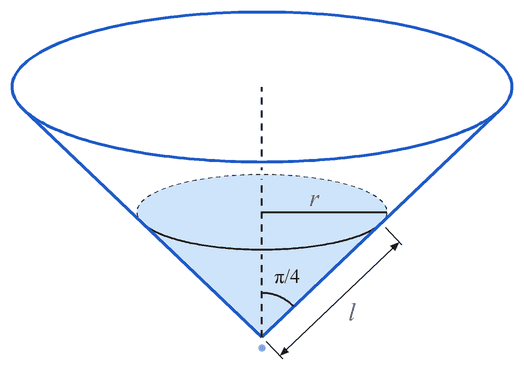
Step 1 — Decide which rate is given.
The rate is given in per second, so it is the rate of change of an area: the curved surface area of the cone of water in the funnel. Water drips out, so decreases:
Step 2 — Write the radius in terms of the slant height.
The water forms a cone with the same semi-vertical angle as the funnel, so
Step 3 — Write the curved surface area in terms of .
We substitute this radius into :
Step 4 — Differentiate with respect to time.
By the chain rule, the derivative of with respect to is :
Step 5 — Substitute the given values.
We put and :
Step 6 — Interpret the sign.
The minus sign means the slant height is decreasing. Its rate of decrease is , and since ,
Therefore, the slant height of the water is decreasing at (about ).
- 42 marks
Board paper question 4
Prove that the function is increasing on R.
Solve with AIWritten solution
Solution:
Concept: If for every and only at isolated points, then is increasing (in fact strictly increasing) on that interval.
Step 1 — Differentiate.
We differentiate term by term:
Step 2 — Write as a perfect square.
We take out the common factor ; the bracket left over is the perfect square :
Step 3 — Study the sign of .
A square is never negative, so for every real , and the derivative is zero only at the single point . A single point where the slope is zero does not make the graph go down anywhere.
Step 4 — Confirm with the cube form.
Expanding gives back , so . Since grows whenever grows, rises as rises, with no exception.
Therefore, is increasing on .
- 54 marks
Board paper question 5
A 13 m long ladder is leaning against the wall at a certain height from the ground level. The bottom of the ladder is pulled away from the wall, along the ground, at the rate of 2 m/s. How fast is the height on the wall decreasing when the foot of the ladder is 5 m from the wall?
Solve with AIWritten solution
Solution:
Concept: When two lengths are linked by an equation (here Pythagoras' theorem), differentiating that equation with respect to time links their rates of change.
Step 1 — Name the lengths.
Let metres be the distance of the foot of the ladder from the wall and metres the height of its top on the wall. The ladder, the wall and the ground form a right triangle with hypotenuse :
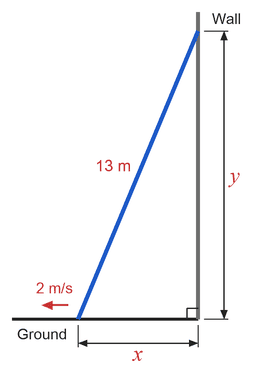
Step 2 — Differentiate with respect to time.
Both and change with time, so by the chain rule
Step 3 — Find the height at the moment asked.
When the foot is m from the wall, Pythagoras gives the height:
Step 4 — Substitute.
The foot moves away at m/s, so
Step 5 — Interpret the sign.
The minus sign shows that the height is decreasing, at m/s (about m/s).
Therefore, the height on the wall is decreasing at .
- 62 marks
Board paper question 6
The edge of a variable cube is increasing at rate of 10 cm/sec. How fast is the volume of the cube increasing where the edge 5cm long?
Solve with AIWritten solution
Solution:
Concept: If depends on and changes with time, the chain rule gives .
Step 1 — Write the volume and differentiate.
A cube of edge cm has volume , so
Step 2 — Substitute the given values.
We put and :
Therefore, the volume is increasing at .
All 19 board paper questions for this chapter, solved the same way.
Class 12 Maths Ch 9 questions students ask
How many questions are there in Class 12 Maths Ch 9?
64 questions. Every one is solved step by step on this page.
Are these Class 12 Maths solutions free?
Yes. Every question and its full working is free to read, with no account needed.
Can I download the Class 12 Maths Ch 9 solutions as a PDF?
There is no PDF to download. Every solution is on this page instead, which means it is searchable, always the current syllabus, and readable on a phone. Use your browser's print option if you want it on paper.