Solution:
Key idea: A closed cylinder has two circular ends, each of area πr2, and a curved surface of area 2πrh. For a small change Δr, the change in area is ΔA≈drdAΔr.
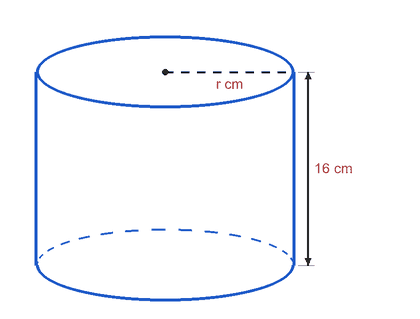
Step 1 — Write the total surface area.
We add the two ends and the curved surface, with the height h=16 cm.
A=2πr2+2πr×16
A=2πr2+32πr
Step 2 — Differentiate and prove the result.
The height is constant, so only r varies. We differentiate term by term.
drdA=4πr+32π
drdA=4π(r+8)
This is the required result.
Step 3 — Find the rate at r=4.
We put r=4 into the derivative.
drdA=4π(4+8)
drdA=48π
Step 4 — Find the change in radius.
The radius increases from 4 cm to 4.02 cm.
Δr=4.02−4
Δr=0.02 cm
Step 5 — Find the approximate increase in area.
We multiply the rate by Δr.
ΔA≈48π×0.02
ΔA≈0.96π cm2
As a fraction, 0.96π is 2524π, about 3.02 cm².
Therefore, drdA=4π(r+8), and the area increases by approximately 0.96π cm² (or 2524π cm²).
