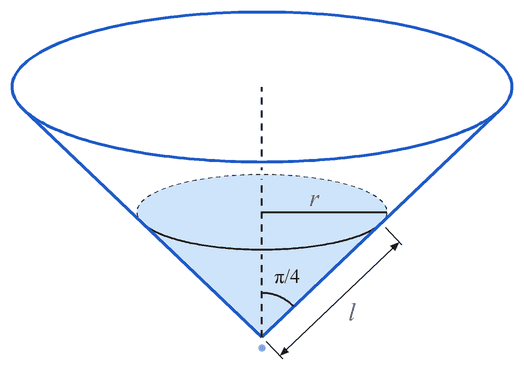
Water is dripping out from a conical funnel of semi-vertical angle π/4 at the uniform rate of 2 cm ² /sec in the…
Question 34 marksAsked 2018Medium
Water is dripping out from a conical funnel of semi-vertical angle 4π at the uniform rate of 2 cm2/sec in the surface, through a tiny hole at the vertex of the bottom. When the slant height of the water level is 4 cm, find the rate of decrease of the slant height of the water.
Solution:
Concept: A cone of slant height l and semi-vertical angle α has base radius r=lsinα and curved surface area S=πrl. For related rates we write S in terms of l only and differentiate with respect to time t.
Step 1 — Decide which rate is given.
The rate is given in cm2 per second, so it is the rate of change of an area: the curved surface area S of the cone of water in the funnel. Water drips out, so S decreases:
dtdS=−2
Step 2 — Write the radius in terms of the slant height.
The water forms a cone with the same semi-vertical angle 4π as the funnel, so
r=lsin4πr=2l
Step 3 — Write the curved surface area in terms of l.
We substitute this radius into S=πrl:
S=2πl2
Step 4 — Differentiate with respect to time.
By the chain rule, the derivative of l2 with respect to t is 2ldtdl:
dtdS=22πldtdldtdS=2πldtdl
Step 5 — Substitute the given values.
We put dtdS=−2 and l=4:
−2=42πdtdldtdl=−42π2dtdl=−4π2
Step 6 — Interpret the sign.
The minus sign means the slant height is decreasing. Its rate of decrease is 4π2, and since π≈3.1416,
4π2≈0.113
Therefore, the slant height of the water is decreasing at 4π2cm/s (about 0.113cm/s).