
Opening your dashboard
Class 12 Maths Chapter 9 Application of Derivatives: Previous Year Questions
19 questions on Chapter 9, each solved step by step. Class 12 Maths, ICSE 2026-27.
19 questions with solutions
1–4 marks · Mixed difficulty
The first 15 solutions are on this page. This chapter is a long one, so the rest open on their own page to keep this one quick to load.
- 12 marks
Question 1
Find the approximate change in the volume '' of a cube of side metres caused by decreasing the side by 1%.
Solve with AIWritten solution
Solution:
Concept: For a small change in , the change in is approximately .
Step 1 — Write the volume and its derivative.
A cube of side metres has volume , so
Step 2 — Write the change in the side.
Decreasing the side by means the side changes by one hundredth of , taken negative:
Step 3 — Find the approximate change in volume.
We multiply the derivative by the change in the side:
The minus sign shows the volume goes down. Since , this is a decrease of about of the volume.
Therefore, the volume decreases by approximately (about of ).
- 24 marks
Question 2
Find the points on the curve at which the equation of the tangent is parallel to the x-axis.
Solve with AIWritten solution
Solution:
Concept: The slope of the tangent to is . A tangent parallel to the -axis has slope .
Step 1 — Find the slope of the tangent.
We differentiate :
Step 2 — Set the slope equal to zero.
We need the slope to be for a horizontal tangent:
Step 3 — Find at .
We substitute into the equation of the curve:
Step 4 — Find at .
Again we substitute into the curve:
Therefore, the tangent is parallel to the -axis at the points and .
- 34 marks
Question 3
Water is dripping out from a conical funnel of semi-vertical angle at the uniform rate of 2 cm/sec in the surface, through a tiny hole at the vertex of the bottom. When the slant height of the water level is 4 cm, find the rate of decrease of the slant height of the water.
Solve with AIWritten solution
Solution:
Concept: A cone of slant height and semi-vertical angle has base radius and curved surface area . For related rates we write in terms of only and differentiate with respect to time .
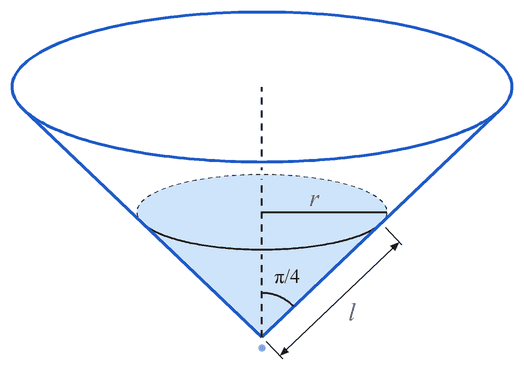
Step 1 — Decide which rate is given.
The rate is given in per second, so it is the rate of change of an area: the curved surface area of the cone of water in the funnel. Water drips out, so decreases:
Step 2 — Write the radius in terms of the slant height.
The water forms a cone with the same semi-vertical angle as the funnel, so
Step 3 — Write the curved surface area in terms of .
We substitute this radius into :
Step 4 — Differentiate with respect to time.
By the chain rule, the derivative of with respect to is :
Step 5 — Substitute the given values.
We put and :
Step 6 — Interpret the sign.
The minus sign means the slant height is decreasing. Its rate of decrease is , and since ,
Therefore, the slant height of the water is decreasing at (about ).
- 42 marks
Question 4
Prove that the function is increasing on R.
Solve with AIWritten solution
Solution:
Concept: If for every and only at isolated points, then is increasing (in fact strictly increasing) on that interval.
Step 1 — Differentiate.
We differentiate term by term:
Step 2 — Write as a perfect square.
We take out the common factor ; the bracket left over is the perfect square :
Step 3 — Study the sign of .
A square is never negative, so for every real , and the derivative is zero only at the single point . A single point where the slope is zero does not make the graph go down anywhere.
Step 4 — Confirm with the cube form.
Expanding gives back , so . Since grows whenever grows, rises as rises, with no exception.
Therefore, is increasing on .
- 54 marks
Question 5
A 13 m long ladder is leaning against the wall at a certain height from the ground level. The bottom of the ladder is pulled away from the wall, along the ground, at the rate of 2 m/s. How fast is the height on the wall decreasing when the foot of the ladder is 5 m from the wall?
Solve with AIWritten solution
Solution:
Concept: When two lengths are linked by an equation (here Pythagoras' theorem), differentiating that equation with respect to time links their rates of change.
Step 1 — Name the lengths.
Let metres be the distance of the foot of the ladder from the wall and metres the height of its top on the wall. The ladder, the wall and the ground form a right triangle with hypotenuse :
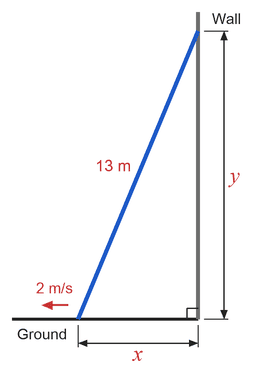
Step 2 — Differentiate with respect to time.
Both and change with time, so by the chain rule
Step 3 — Find the height at the moment asked.
When the foot is m from the wall, Pythagoras gives the height:
Step 4 — Substitute.
The foot moves away at m/s, so
Step 5 — Interpret the sign.
The minus sign shows that the height is decreasing, at m/s (about m/s).
Therefore, the height on the wall is decreasing at .
- 62 marks
Question 6
The edge of a variable cube is increasing at rate of 10 cm/sec. How fast is the volume of the cube increasing where the edge 5cm long?
Solve with AIWritten solution
Solution:
Concept: If depends on and changes with time, the chain rule gives .
Step 1 — Write the volume and differentiate.
A cube of edge cm has volume , so
Step 2 — Substitute the given values.
We put and :
Therefore, the volume is increasing at .
- 74 marks
Question 7
The equation of tangent at (2, 3) on the curve is . Find the values of 'p' and 'q'.
Solve with AIWritten solution
Solution:
Concept: The slope of the tangent at a point is the value of there. A point lies on a curve when its coordinates satisfy the curve's equation.
Step 1 — Use the point on the curve.
The point lies on , so its coordinates satisfy the equation:
Step 2 — Find the slope of the tangent.
We differentiate implicitly:
At the slope is
Step 3 — Match with the slope of the given tangent.
The line has slope , so
Step 4 — Find .
We put into the equation of Step 1:
Note: The point is not actually on the printed line, since gives , not ; the tangent at with slope is . Our method uses only the slope and the fact that is on the curve, so the answer is the same with either line.
Therefore, and .
- 81 mark
Question 8
An edge of a variable cube is increasing at the rate of 10cm/sec. How fast will the volume of the cube increase if the edge is 5 cm long?
Solve with AIAnswer
(A)
- Correct
(B)
(C)
(D)
Answer: (B)
Concept: For a cube of edge , the volume is , and the chain rule gives .
Step 1 — Write the rate of change of volume.
We differentiate with respect to time:
Step 2 — Substitute and .
We put the given values into the formula:
Why the others are wrong:
- (A) This is alone; it forgets to multiply by the rate .
- (C) This multiplies by , using the rate twice.
- (D) This is , which skips differentiating .
Therefore, the volume increases at , option (B).
- 91 mark
Question 9
For the curve , the slope of the normal at is:
Solve with AIAnswer
(A)
(B)
(C)
- Correct
(D)
Answer: (D)
Concept: The slope of the tangent is at the point. The normal is perpendicular to the tangent, so its slope is .
Step 1 — Check the point is on the curve.
We substitute into both sides of the equation:
Both sides give , so the point lies on the curve.
Step 2 — Find the slope of the tangent.
We differentiate implicitly:
At :
Step 3 — Find the slope of the normal.
We take the negative reciprocal of :
Why the others are wrong:
- (A) This is the slope of the tangent, not of the normal.
- (B) This takes the reciprocal of the tangent's slope but forgets the minus sign.
- (C) This changes the sign of the tangent's slope but does not take the reciprocal.
Therefore, the slope of the normal at is , option (D).
- 101 mark
Question 10
The interval in which the function increases will be:
Solve with AIAnswer
- Correct
(A)
(B)
(C)
(D)
Answer: (A)
Concept: A differentiable function increases where its derivative is positive and decreases where its derivative is negative.
Step 1 — Differentiate.
We differentiate :
Step 2 — Find where .
We solve the inequality:
So increases on . For the derivative is negative, so decreases there.
Why the others are wrong:
- (B) On we have , so decreases there, not increases.
- (C) It is true that increases on , but that is only part of the answer: also increases for every , so the full interval is .
- (D) This is written with the larger end first, so it is not a proper interval; even read as the numbers between and , it is only a small part of the interval where increases.
Note: Some answer lists give for this item, but there , so the function decreases on that interval.
Therefore, increases in , option (A).
- 111 mark
Question 11
In which one of the following intervals is the function increasing?
Solve with AIAnswer
(A)
- Correct
(B)
(C)
(D)
Answer: (B)
Concept: A differentiable function increases where and decreases where .
Step 1 — Differentiate and factorise.
We differentiate and factorise the result:
Step 2 — Find where .
The product is positive when both factors have the same sign, that is when or when . Between and the factors have opposite signs, so there.
Why the others are wrong:
- (A) On we have , so decreases there.
- (C) This interval contains , where decreases.
- (D) This interval also contains , where decreases.
Therefore, is increasing in , option (B).
- 121 mark
Question 12
Given that
and y decreases at a rate of , find the rate of change of x when cm and cm.
Solve with AIWritten solution
Solution:
Concept: When two quantities are linked by an equation, differentiating the equation with respect to time links their rates; by the chain rule, .
Step 1 — Differentiate the relation with respect to time.
We differentiate both sides of ; the right side is a constant, so its derivative is :
Step 2 — Make the subject.
We move the term across and multiply by :
Step 3 — Substitute the given values.
Since decreases at cm/s, we take ; we also put and :
Step 4 — Interpret the sign.
The rate is positive, so is increasing.
Note: The paper's values and do not satisfy the given relation, because gives , not . We follow the paper and use them in the differentiated relation of Step 2, which needs only the values of , and at that instant.
Therefore, is increasing at the rate of .
- 132 marks
Question 13
Find a point on the curve at which the tangent is parallel to the chord joining the points and .
Solve with AIWritten solution
Solution:
Concept: Parallel lines have equal slopes. The slope of the tangent to at a point is , and the slope of the chord through and is .
Step 1 — Find the slope of the chord.
We use the two given points and :
Step 2 — Find the slope of the tangent.
We differentiate by the chain rule:
Step 3 — Equate the slopes.
The tangent is parallel to the chord, so its slope must also be :
Step 4 — Find the -coordinate.
We substitute into the curve:
The point lies between the ends of the chord (), as the mean value theorem leads us to expect.
Therefore, the required point is .
- 141 mark
Question 14
Consider the graph of the function shown below:
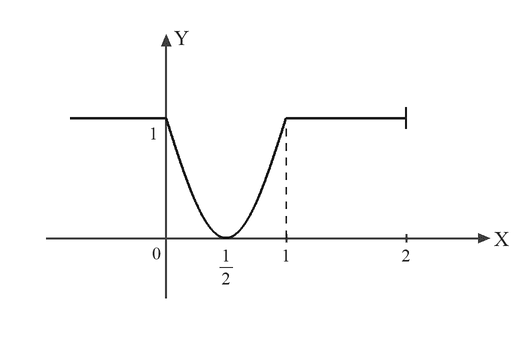
Statement 1: The function is increasing in .
Statement 2: The function is strictly increasing in .
Which of the following is correct with respect to the above statements?
Solve with AIAnswer
(A) Statement 1 is true and Statement 2 is false.
(B) Statement 2 is true and Statement 1 is false.
- Correct
(C) Both the statements are true.
(D) Both the statements are false.
Answer: (C) Both the statements are true.
Concept: A function is increasing on an interval if gives (the graph never goes down), and strictly increasing if gives (the graph always goes up).
Step 1 — Read the graph on .
Between and on the -axis, the graph rises from height to height , going up all the time.
Step 2 — Read the graph on .
Between and on the -axis, the graph is a level line at height ; it neither rises nor falls.
Step 3 — Judge Statement 1.
On the whole interval the graph first rises and then stays level, so it never goes down. By the definition above, is increasing there, and Statement 1 is true.
Step 4 — Judge Statement 2.
On the graph goes up all the time, so is strictly increasing there, and Statement 2 is true.
Watch out: Statement 1 says increasing, not strictly increasing; the level part on does not spoil an increasing function, but it would spoil a strictly increasing one.
Why the others are wrong:
- (A) Statement 2 is also true: the graph rises all the way between and .
- (B) Statement 1 is also true: a level part does not stop a function from being increasing.
- (D) Both statements hold, as Steps 3 and 4 show.
Therefore, both statements are true, option (C).
- 151 mark
Question 15
A cylindrical popcorn tub of radius is being filled with popcorns at the rate of per minute. The level of the popcorns in the tub is increasing at the rate of:
Solve with AIAnswer
- Correct
(A) 1 cm/minute
(B) 0.1 cm/minute
(C) 1.1 cm/minute
(D) 0.5 cm/minute
Answer: (A) 1 cm/minute
Concept: A cylinder of radius filled to height holds volume . With fixed, .
Step 1 — Write the rate equation.
The radius stays cm, so and
Step 2 — Substitute the filling rate.
We put and solve for :
Step 3 — Evaluate.
The number is chosen to go with , so and
With the more exact value , the rate is about cm per minute, which still rounds to .
Why the others are wrong:
- (B) This comes from dividing by (the value of ) instead of (the value of ).
- (C) This is more than the correct rate ; no correct working gives it.
- (D) This comes from dividing by (the value of ) instead of .
Therefore, the level rises at cm per minute, option (A).
- 162 marks
Question 16
Find the point on the curve at which the tangent is parallel to the -axis.
- 171 mark
Question 17
Observe the graph given below and answer the question that follows.
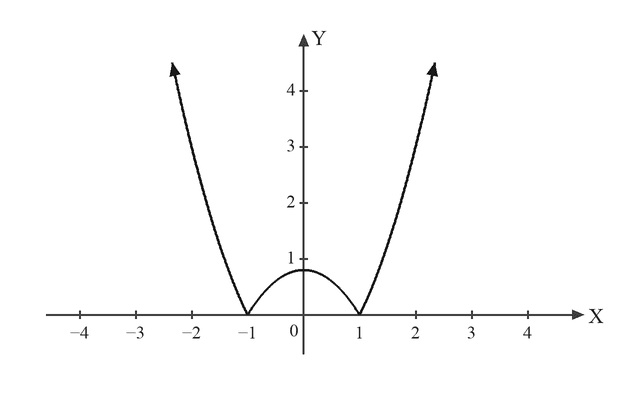
Statement 1: increases in and
Statement 2: decreases in and
Which one of the following is correct?
- 182 marks
Question 18
The surface of a spherical balloon is increasing at the rate of . Find the rate of change of volume when its radius is .
- 192 marks
Question 19
Find the equation of the normal at to the curve .