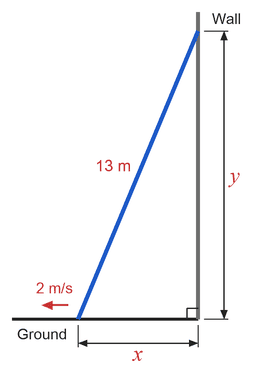
A 13 m long ladder is leaning against the wall at a certain height from the ground level.
Question 54 marksAsked 2019Medium
A 13 m long ladder is leaning against the wall at a certain height from the ground level. The bottom of the ladder is pulled away from the wall, along the ground, at the rate of 2 m/s. How fast is the height on the wall decreasing when the foot of the ladder is 5 m from the wall?
Solution:
Concept: When two lengths are linked by an equation (here Pythagoras' theorem), differentiating that equation with respect to time t links their rates of change.
Step 1 — Name the lengths.
Let x metres be the distance of the foot of the ladder from the wall and y metres the height of its top on the wall. The ladder, the wall and the ground form a right triangle with hypotenuse 13:
x2+y2=169
Step 2 — Differentiate with respect to time.
Both x and y change with time, so by the chain rule
2xdtdx+2ydtdy=0dtdy=−yxdtdx
Step 3 — Find the height at the moment asked.
When the foot is 5 m from the wall, Pythagoras gives the height:
y=169−25y=12
Step 4 — Substitute.
The foot moves away at dtdx=2 m/s, so
dtdy=−125×2dtdy=−65
Step 5 — Interpret the sign.
The minus sign shows that the height is decreasing, at 65 m/s (about 0.83 m/s).
Therefore, the height on the wall is decreasing at 65m/s.