
Opening your dashboard
Class 12 Chemistry Chapter 9: Coordination Compounds Solutions
115 textbook questions with step-by-step answers, free to read, for ISC 2026-27.
Get talked through Ch 9, not just shown the answer
Reading a finished solution is not the same as being able to do it. The AI tutor takes one question at a time and works it with you, in your own words, until you can.
- Ask it out loud, in your own words
- It gives you the next step, not the answer
- Stuck on part (ii)? Start there
115 questions with solutions
1–5 marks · Mixed difficulty
The first 19 solutions are on this page. This chapter is a long one, so the rest open on their own page to keep this one quick to load.
- 11 mark
Question 1
The correct name for is
Solve with AIAnswer
- Correct
(A) hexaamminechromium(III) chloride
(B) hexaamminechromium(II) chloride
(C) hexaammoniachromium(III) chloride
(D) chromium(III) hexaammine chloride
Answer: (A) hexaamminechromium(III) chloride
Key idea: In the name of a coordination compound the cation is named first and the anion second. Inside the complex the ligands come first and then the metal, with the oxidation state of the metal in Roman numerals. as a ligand is called "ammine".
Step 1 — Find the oxidation state of chromium.
Three ions outside the bracket balance the complex cation, so the cation is . Ammonia is neutral. Let the oxidation state of chromium be .
Step 2 — Name the complex cation.
Six ammine ligands give "hexaammine", and the cation keeps the plain metal name, so the cation is hexaamminechromium(III).
Step 3 — Add the anion.
The three chloride ions are named last as "chloride"; their number is not shown because the charges fix it. The full name is hexaamminechromium(III) chloride.
Why the other options are wrong:
- (B) is wrong: The three chloride ions outside the bracket balance a +3 charge, so chromium is +3, not +2.
- (C) is wrong: In a complex, is named "ammine", not "ammonia".
- (D) is wrong: The ligands must be named before the metal (hexaammine, then chromium), not after it.
Therefore, [Cr(NH₃)₆]Cl₃ is hexaamminechromium(III) chloride: option (A).
- 21 mark
Question 2
Which would exhibit coordination isomerism?
Solve with AIAnswer
- Correct
(A)
(B)
(C)
(D)
Answer: (A)
Key idea: Coordination isomerism occurs when both the cation and the anion are complex ions, so that ligands can be exchanged between the two metal centres.
Step 1 — Check option (A).
In the cation and the anion are both complex ions. The ligands can be distributed the other way round between the two metals.
Step 2 — Write a coordination isomer.
Exchanging all the ligands between the metals gives , which has the same formula but different complex ions. So option (A) shows coordination isomerism.
Why the other options are wrong:
- (B) is wrong: There is only one complex ion here, , so there is no second metal to exchange ligands with; it shows geometrical (cis/trans) and optical isomerism instead.
- (C) is wrong: In only the cation is a complex; the chloride ions are simple ions, so no ligands can be swapped between two metals.
- (D) is wrong: There is again only one complex ion, ; like (B) it shows geometrical and optical isomerism, not coordination isomerism.
Therefore, [Cr(NH₃)₆][Co(CN)₆] shows coordination isomerism: option (A).
- 31 mark
Question 3
Which of the following is not a complex compound?
Solve with AIAnswer
(A) Potassium ferrocyanide
(B) Potassium ferricyanide
- Correct
(C) Ferrous ammonium sulphate
(D) Cuprammonium sulphate
Answer: (C) Ferrous ammonium sulphate
Key idea: A double salt exists only in the solid state; in water it breaks up completely into its simple ions. A complex compound keeps its complex ion intact in solution, so the metal does not give its usual simple-ion tests.
Step 1 — Look at ferrous ammonium sulphate.
Ferrous ammonium sulphate (Mohr's salt) is . In water it gives , and ions, and each of these gives its usual test.
Step 2 — Decide its type.
Since it breaks up fully into simple ions, Mohr's salt is a double salt, not a complex compound.
Why the other options are wrong:
- (A) is wrong: This salt, , contains the complex ion , which stays intact in water and does not give the tests of or .
- (B) is wrong: This salt, , contains the complex ion , which does not give the tests of or .
- (D) is wrong: This salt, , contains the deep blue complex ion .
Therefore, ferrous ammonium sulphate (Mohr's salt) is a double salt, not a complex compound: option (C).
- 41 mark
Question 4
In the formation of , the hybridisation involved is
Solve with AIAnswer
(A)
- Correct
(B)
(C)
(D)
Answer: (B)
Key idea: In valence bond theory a strong-field ligand can make the metal's 3d electrons pair up. If two 3d orbitals are then empty, they join one 4s and three 4p orbitals to form six hybrid orbitals (an inner orbital, octahedral complex).
Step 1 — Find the oxidation state of iron.
Four ions balance the complex, so the complex ion is , and each carries −1. Let the oxidation state of iron be .
Iron (Z = 26) is [Ar] , so is [Ar] .
Step 2 — Pair the 3d electrons.
Cyanide, , is a strong-field ligand, so the six 3d electrons pair up in three 3d orbitals, and two 3d orbitals are left empty.
Step 3 — Form the hybrid orbitals.
The two empty 3d orbitals, one 4s and three 4p orbitals mix to give six hybrid orbitals. These take the six electron pairs from the six ions, so the complex is octahedral, inner orbital and diamagnetic.
Why the other options are wrong:
- (A) is wrong: Mixing one s and two p orbitals gives only three hybrid orbitals (trigonal planar), but six ligands need six orbitals.
- (C) is wrong: An octahedral complex uses only the two d orbitals that point along the axes ( and ), as in or ; a set would need a third d orbital, which points between the axes, so it is not used for octahedral complexes.
- (D) is wrong: One d, one s and two p orbitals give only four hybrid orbitals and a square planar shape, as in , but there are six ligands.
Therefore, iron in K₄[Fe(CN)₆] is d²sp³ hybridised: option (B).
- 51 mark
Question 5
An octahedral complex is formed, when hybrid orbitals of the following type are involved.
Solve with AIAnswer
(A)
(B)
- Correct
(C)
(D)
Answer: (C)
Key idea: An octahedral complex has six ligands, so it needs six hybrid orbitals pointing to the corners of an octahedron. Two sets do this: (inner orbital, using (n − 1)d) and (outer orbital, using nd).
Step 1 — Count the orbitals in each option.
We add the s, p and d orbitals in each set: has 4, has 4, has 6 and has 4.
Step 2 — Choose the octahedral set.
Only gives six orbitals, and these point to the six corners of an octahedron. It is the hybridisation of outer orbital octahedral complexes such as .
Why the other options are wrong:
- (A) is wrong: One s and three p orbitals give only four hybrid orbitals, pointing to the corners of a tetrahedron, as in .
- (B) is wrong: One d, one s and two p orbitals give only four hybrid orbitals in one plane, pointing to the corners of a square, as in .
- (D) is wrong: One s, two p and one d orbital again give only four hybrid orbitals, in a square planar arrangement, not the six an octahedron needs.
Therefore, an octahedral complex can be formed with sp³d² hybrid orbitals: option (C).
- 61 mark
Question 6
According to crystal field theory, five -orbitals of an octahedral complex split to give
Solve with AIAnswer
(A) two orbitals with lower energy and three orbitals with higher energy
- Correct
(B) three orbitals with lower energy and two orbitals with higher energy
(C) one orbital with lower energy and four orbitals with higher energy
(D) four orbitals with lower energy and one orbital with higher energy
Answer: (B) three orbitals with lower energy and two orbitals with higher energy
Key idea: In crystal field theory the ligands are treated as negative point charges. d orbitals that point at the ligands are repelled more and rise in energy; d orbitals that point between the ligands are repelled less and fall in energy.
Step 1 — Place the ligands.
In an octahedral complex the six ligands approach the metal along the +x, −x, +y, −y, +z and −z axes.
Step 2 — Find the orbitals that rise.
The and orbitals have their lobes along the axes, pointing straight at the ligands. They are repelled most and are raised in energy. These two orbitals form the set.
Step 3 — Find the orbitals that fall.
The , and orbitals have their lobes between the axes, so they are repelled less and are lowered in energy. These three orbitals form the set.
Why the other options are wrong:
- (A) is wrong: Two lower and three higher is the splitting in a tetrahedral field ( below, above), where the ligands lie between the axes.
- (C) is wrong: For four orbitals to rise, four would have to point at the ligands; in an octahedral field only two ( and ) do.
- (D) is wrong: In an octahedral field two orbitals () rise, not one, and three fall, not four.
Therefore, in an octahedral field the five d orbitals split into three lower (t₂g) and two higher (e_g) orbitals: option (B).
- 71 mark
Question 7
Which of the following statement is correct? (CFSE = Crystal Field Splitting Energy)
Solve with AIAnswer
(A) Lower CFSE favours formation of low spin complex
(B) Higher CFSE favours formation of high spin complex
(C) A particular metal ion in a particular oxidation state can form either diamagnetic complexes only or paramagnetic complexes only
- Correct
(D) orbitals are three-fold degenerate while orbitals are two-fold degenerate
Answer: (D) orbitals are three-fold degenerate while orbitals are two-fold degenerate
Key idea: In an octahedral field the five d orbitals split into a lower set of three () and a higher set of two (), separated by the splitting energy . Whether a complex is high spin or low spin depends on whether is smaller or larger than the pairing energy .
Step 1 — Check statement (D).
The set contains , and , which have equal energy, so it is three-fold degenerate. The set contains and , which have equal energy, so it is two-fold degenerate. Statement (D) is correct.
Step 2 — Connect the splitting with the spin state.
When the splitting is smaller than , electrons enter the orbitals singly before pairing (high spin). When it is larger than , electrons pair in first (low spin). This rule is used to test options (A) and (B).
Note: The stem uses "CFSE" for the crystal field splitting energy, . More often CFSE means crystal field stabilisation energy, the energy gained by the d electrons from the splitting; the options are judged here with the stem's meaning.
Why the other options are wrong:
- (A) is wrong: A small splitting (less than ) lets electrons go up into unpaired, which gives a high spin complex, not a low spin one.
- (B) is wrong: A large splitting (more than ) makes electrons pair in , which gives a low spin complex, not a high spin one.
- (C) is wrong: The same metal ion in the same oxidation state can form both kinds: gives paramagnetic (weak field, high spin) and diamagnetic (strong field, low spin).
Therefore, the correct statement is that t₂g orbitals are three-fold degenerate and e_g orbitals two-fold degenerate: option (D).
- 81 mark
Question 8
Amongst the following ions which one has the highest paramagnetism?
Solve with AIAnswer
(A)
- Correct
(B)
(C)
(D)
Answer: (B)
Key idea: Paramagnetism increases with the number of unpaired electrons ( BM). Water is a weak-field ligand, so in these aqua complexes the d electrons stay unpaired as far as possible (high spin).
Step 1 — Find the d count of each metal ion.
Each complex has six neutral water ligands, so the charge on the complex is the oxidation state of the metal. Removing electrons (4s first, then 3d) gives the d counts in the table.
Ion d electrons unpaired electrons 3 4 1 0 Step 2 — Explain the count for iron(II).
In the weak field of water, the six d electrons of are arranged high spin as . One orbital holds a pair, and the other four electrons are unpaired.
Step 3 — Calculate the spin-only moment of the iron(II) ion.
We put into the spin-only formula.
This is the largest moment of the four ions, so is the most paramagnetic.
Why the other options are wrong:
- (A) is wrong: Chromium(III) has only 3 unpaired electrons (about 3.87 BM), fewer than the 4 of iron(II).
- (C) is wrong: Copper(II) () has only 1 unpaired electron (about 1.73 BM).
- (D) is wrong: Zinc(II) has a full set with no unpaired electrons, so it is diamagnetic, not paramagnetic at all.
Therefore, [Fe(H₂O)₆]²⁺, with 4 unpaired electrons, has the highest paramagnetism: option (B).
- 91 mark
Question 9
The oxidation number of cobalt in is
Solve with AIAnswer
(A) +1
(B) +3
- Correct
(C) −1
(D) −3
Answer: (C) −1
Key idea: The oxidation number of the central metal comes from a charge balance: the oxidation number of the metal plus the charges of all the ligands equals the charge of the complex ion. Carbonyl (CO) is a neutral ligand, so it adds nothing to the sum.
Step 1 — Find the charge of the complex ion.
Potassium is always present as , outside the square brackets. The whole compound is neutral, so the complex ion must carry a charge of −1, that is, it is .
Step 2 — Write the charge balance for the complex ion.
We let the oxidation number of cobalt be . Each of the four CO ligands has a charge of 0, so the sum must equal the charge of the ion.
Step 3 — Check the result with the 18-electron rule.
Cobalt has 9 valence electrons (), so Co(−1) has 10. Each CO gives one electron pair, so we add the electrons around cobalt.
This is the stable 18-electron count found in metal carbonyls, which supports cobalt in the −1 state.
Why the other options are wrong:
- (A) is wrong: It takes the +1 charge of the potassium ion as cobalt's oxidation number; but sits outside the brackets, and the complex ion itself carries −1.
- (B) is wrong: Cobalt is often +3 in complexes such as , but here all four ligands are neutral, so cobalt's oxidation number must equal the charge of the ion, −1.
- (D) is wrong: An oxidation number of −3 would need a complex ion of charge −3, balanced by three ions; the formula has only one .
Therefore, the oxidation number of cobalt in is −1: option (C).
- 101 mark
Question 10
Which of the following is paramagnetic?
Solve with AIAnswer
(A)
(B)
(C)
- Correct
(D)
Answer: (D)
Key idea: A complex is paramagnetic when it has at least one unpaired electron. In valence bond theory a strong-field ligand (such as or CO, or with ) makes the metal's d electrons pair up, while a weak-field ligand such as leaves them unpaired.
Step 1 — Find the oxidation state of nickel in .
Each chloride ligand has a charge of −1 and the ion has a charge of −2, so we let nickel be and balance the charges.
Nickel (Z = 28) is [Ar] , so is [Ar] .
Step 2 — Decide the hybridisation and count the unpaired electrons.
The chloride ion is a weak-field ligand, so the eight 3d electrons stay as three pairs and two unpaired electrons. The four ligand electron pairs go into the empty 4s orbital and three 4p orbitals. So the hybridisation is , the ion is tetrahedral, and it has 2 unpaired electrons.
Step 3 — Find the spin-only magnetic moment.
We put the two unpaired electrons into the spin-only formula.
A non-zero moment means the ion is paramagnetic.
Note: Option (A) is printed as ; the familiar nickel carbonyl is the neutral molecule . Neither form has an unpaired electron, so the answer is the same.
Why the other options are wrong:
- (A) is wrong: As printed, the ion would hold () with CO, the strongest-field ligand, which pairs all eight electrons (). The real compound, , has Ni(0): its 4s electrons pair up in 3d to give , and it is tetrahedral. Either way there is no unpaired electron, so it is diamagnetic.
- (B) is wrong: Cobalt here is +3 (), and with it is low spin: all six electrons pair in three 3d orbitals (), so the ion is diamagnetic.
- (C) is wrong: Nickel here is +2 (), but strong-field makes the two unpaired electrons pair up, leaving one 3d orbital empty for (square planar); with no unpaired electron the ion is diamagnetic.
Therefore, the paramagnetic complex is , with two unpaired electrons: option (D).
- 111 mark
Question 11
The oxidation state of Fe in the brown ring complex is
Solve with AIAnswer
- Correct
(A) +1
(B) +2
(C) +3
(D) +4
Answer: (A) +1
Key idea: The oxidation state of the metal comes from a charge balance over the complex ion. In the textbook model of the brown-ring complex, the NO ligand is counted as the nitrosonium ion, (charge +1), and each water molecule is neutral.
Step 1 — Find the charge of the complex ion.
One sulphate ion, , lies outside the brackets and the compound is neutral, so the complex ion is .
Step 2 — Write the charge balance.
We let the oxidation state of iron be , count five neutral water molecules and one , and set the sum equal to +2.
Step 3 — See how iron reaches +1 in this model.
The test starts with iron(II) sulphate. In the textbook model, the NO molecule passes one electron to : NO becomes , and iron is reduced from +2 to +1.
Note: Magnetic measurements show that the brown complex has three unpaired electrons (about 3.9 BM), and modern spectroscopic studies describe it as iron(III) bound to . The Fe(+1) with assignment is the textbook model this question uses, and it gives the answer +1.
Why the other options are wrong:
- (B) is wrong: +2 is the state of iron in the added for the test, and it is what you get by counting NO as a neutral ligand; in the textbook model NO passes one electron to iron, so iron ends at +1.
- (C) is wrong: In the textbook model, iron at +3 plus +1 for would give the ion a charge of +4, not +2. Iron is +3 only if the ligand is counted as , the modern description given in the note, which is not the model this question uses.
- (D) is wrong: Whatever charge NO is given (+1, 0 or −1), iron comes out between +1 and +3, so +4 cannot arise for an ion of charge +2 with five neutral water ligands.
Therefore, in the textbook model of the brown ring complex iron is in the +1 oxidation state, with NO as : option (A).
- 121 mark
Question 12
The total number of possible isomers for the complex compound are
Solve with AIAnswer
(A) 3
(B) 6
(C) 5
- Correct
(D) 4
Answer: (D) 4
Key idea: When both the cation and the anion of a salt are complexes, the ligands can be shared between the two metal ions in different ways. This is coordination isomerism. Every isomer has the same overall formula and is still a salt made of a complex cation and a complex anion.
Step 1 — Write the ways of sharing the ligands.
Cu(II) and Pt(II) are each four-coordinate here, and there are four and four in all. If copper holds ammonia molecules, it holds chloride ions, and platinum holds the other ammonia molecules and chloride ions.
Step 2 — Find the charge of each complex.
Each metal is +2 and each chloride is −1, so we subtract the chlorides from +2 for each metal.
The table lists the five possible values of .
Copper complex Platinum complex 4 3 2 1 0 Step 3 — Keep only the salts.
For both complexes are neutral molecules, so they do not form a salt and are not isomers of this compound. The other four rows ( = 4, 3, 1, 0) are cation–anion salts with the same formula. None of these ions shows geometrical isomerism, because a square planar ion with three identical ligands and one different ligand has only one arrangement.
Step 4 — Count the isomers.
The four salts include the given compound () itself, so the compound has 4 coordination isomers.
Why the other options are wrong:
- (A) is wrong: A count of 3 includes only the three new salts and leaves out the given compound, which is itself one of the isomers.
- (B) is wrong: The ligands can be shared between the two metals in only five ways ( = 0 to 4), and one of these gives neutral molecules, so no count of salts can reach 6.
- (C) is wrong: A count of 5 includes the case, which gives two neutral molecules, and , rather than a cation–anion salt.
Therefore, has 4 coordination isomers: option (D).
- 131 mark
Question 13
A co-ordination complex compound of cobalt has the molecular formula containing five ammonia molecules, one nitro group and two chlorine atoms for one cobalt atom. One mole of this compound produces three mole ions in an aqueous solution. On reacting this solution with excess of solution, we get two moles of AgCl precipitate. The formula for this complex would be
Solve with AIAnswer
(A)
(B)
- Correct
(C)
(D)
Answer: (C)
Key idea: In Werner's theory, the ions written outside the square brackets are ionisable (they satisfy the primary valence) and are free in solution, so free ions precipitate as AgCl with . Groups inside the brackets are bonded to the metal and are not released. Cobalt(III) has a coordination number of 6.
Step 1 — Use the silver chloride result.
One mole of the compound gives two moles of AgCl, so two ions per formula unit are outside the coordination sphere.
Step 2 — Use the number of ions.
One mole gives three moles of ions. These are one complex cation and the two free ions.
Step 3 — Fill the coordination sphere.
The five molecules and the one group must be inside the brackets, which gives six donor atoms, the coordination number of cobalt(III). We check cobalt's oxidation state from the cation's charge of +2.
The compound dissolves as follows.
Why the other options are wrong:
- (A) is wrong: It puts only four on cobalt and builds an "" unit, which is not a real ion; with at most one free chloride it could not give two moles of AgCl.
- (B) is wrong: It has only one molecule, not the five in the stated composition, and its "" unit is not a real ion.
- (D) is wrong: It contains two nitro groups instead of one, and with every group inside the brackets it would be a non-electrolyte that gives no AgCl at all.
Therefore, the complex is : option (C).
- 141 mark
Question 14
Which one of the following ligands forms a chelate:
Solve with AIAnswer
(A) Acetate
- Correct
(B) Oxalate
(C) Cyanide
(D) Ammonia
Answer: (B) Oxalate
Key idea: A chelate forms when one ligand binds the same metal ion through two or more donor atoms and so closes a ring that contains the metal. Five- and six-membered rings are the most stable.
Step 1 — Look at the donor atoms of oxalate.
The oxalate ion, , has two negatively charged oxygen atoms, one on each carbon of the C–C unit. Both of them can bind the same metal ion at the same time, so oxalate is a bidentate ligand.
Step 2 — Find the size of the ring.
The ring contains the metal, an oxygen atom, two carbon atoms and the second oxygen atom. A five-membered ring has almost no strain, so oxalate forms a stable chelate, for example in .
Why the other options are wrong:
- (A) is wrong: Usually it binds through one oxygen atom or bridges two metal ions. If both of its oxygen atoms bind one metal, the ring has only four atoms (M, O, C, O) and is strained, so acetate is not the chelating ligand here.
- (C) is wrong: Its donor atoms (C and N) sit at opposite ends of a linear ion, so both ends cannot reach the same metal ion; cyanide binds one metal through one atom and forms no ring.
- (D) is wrong: With only one donor atom (N, with one lone pair), ammonia is monodentate and cannot close a ring.
Therefore, the ligand that forms a chelate is oxalate: option (B).
- 151 mark
Question 15
In nitroprusside ion, iron and NO exist as Fe (II) and rather than Fe (III) and NO. These forms can be differentiated by
Solve with AIAnswer
(A) estimating the concentration of iron
(B) measuring the concentration of
- Correct
(C) measuring the solid state magnetic moment
(D) thermally decomposing the compound.
Answer: (C) measuring the solid state magnetic moment
Key idea: The magnetic moment of a substance depends on how many unpaired electrons it has. Two descriptions of the same compound that share the electrons differently between the metal and a ligand can be told apart if they give different numbers of unpaired electrons.
Step 1 — Count the unpaired electrons for Fe(II) with .
The ion is , and with five strong-field ligands it is low spin, , with no unpaired electron. has the same number of electrons as CO, all of them paired. So this description predicts a diamagnetic compound.
Step 2 — Count the unpaired electrons for Fe(III) with NO.
Low-spin is , , with one unpaired electron. A neutral NO molecule has an odd number of electrons (15), so it also has one unpaired electron. Taken as separate centres this gives two unpaired electrons, so this description predicts a paramagnetic compound.
Step 3 — Compare with the measurement.
Solid sodium nitroprusside is found to be diamagnetic, which supports the Fe(II) and description. Measuring the solid-state magnetic moment therefore tells the two forms apart.
Why the other options are wrong:
- (A) is wrong: Both descriptions contain one iron atom per formula unit, so the amount of iron is the same and cannot tell them apart.
- (B) is wrong: Both descriptions have five ions per iron, so the cyanide content is the same in each.
- (D) is wrong: Heating breaks the compound down; the products show how much of each element is present, not how the electrons were shared between Fe and NO in the ion.
Therefore, the two descriptions are told apart by measuring the solid-state magnetic moment: option (C).
- 161 mark
Question 16
In the separation of and in 2nd group of qualitative analysis of cations, tetraamminecopper(II) sulphate and tetramminecadmium(II) sulphate react with KCN to form the corresponding cyano complexes. Which one of the following pairs of the complexes and their relative stability enables the separation of and ?
Solve with AIAnswer
- Correct
(A) : more stable and : less stable
(B) : less stable and : more stable
(C) : more stable and : less stable
(D) : less stable and : more stable
Answer: (A) : more stable and : less stable
Key idea: A metal ion held in a very stable complex leaves almost no free metal ions in solution, so its sulphide may not precipitate when is passed. A less stable complex releases enough free metal ions for the sulphide to precipitate.
Step 1 — Find the copper complex formed with excess cyanide.
Copper(II) oxidises cyanide to cyanogen, , and is itself reduced to copper(I), which is then held as a tetracyanido complex.
We check the oxidation state of copper in the complex ion, whose charge is −3.
So the potassium salt is .
Step 2 — Find the cadmium complex.
Cadmium is not reduced and stays +2, so its complex ion has a charge of −2.
So the potassium salt is .
Step 3 — See how separates the two ions.
The ion is very stable, so the free copper(I) ions are too few for copper(I) sulphide to precipitate. is less stable and releases enough ions to give a yellow precipitate of CdS.
Cadmium is removed as CdS while copper stays in solution, so the two ions are separated.
Watch out: Potassium cyanide and hydrogen sulphide are both highly poisonous. Cyanide solutions must never be acidified, because this releases hydrogen cyanide gas; such work is done only in a fume cupboard under supervision.
Why the other options are wrong:
- (B) is wrong: It writes copper as Cu(II) in , but cyanide reduces Cu(II) to Cu(I); it also calls the copper complex the less stable one, which would let copper sulphide precipitate along with CdS.
- (C) is wrong: The stability order is right, but the copper complex is wrong: contains Cu(II), while excess cyanide gives the Cu(I) complex .
- (D) is wrong: The formulas are right but the stabilities are reversed: if the copper complex were the less stable one, copper sulphide would precipitate together with CdS, and no separation would take place.
Therefore, the separation works because is more stable and is less stable: option (A).
- 171 mark
Question 17
Which one of the following complexes will have four isomers?
(en = ethylenediamine)
Solve with AIAnswer
- Correct
(A)
(B)
(C)
(D)
Answer: (A)
Key idea: To count the isomers of a complex, first find its different geometrical arrangements, then check which of them are chiral; each chiral arrangement adds its mirror image as one more isomer. In an octahedral complex, an en ligand () always spans two cis positions.
Step 1 — Describe the complex in option (A).
The complex ion is , with one outside. We check the oxidation state of cobalt from the ion's charge of +1.
Cobalt(III) is six-coordinate: the en ring gives two donor atoms, and the two and two Cl ligands give four more. The complex is of the type .
Step 2 — Find the geometrical arrangements.
With en fixed on two cis positions, the remaining four positions hold two and two Cl. There are three different arrangements:
- the two trans to each other, with the two Cl cis;
- the two Cl trans to each other, with the two cis;
- the two cis and the two Cl cis.
Step 3 — Check each arrangement for chirality.
Arrangements 1 and 2 each have a mirror plane, so they are not chiral. Arrangement 3 has no mirror plane, so it exists as a pair of non-superimposable mirror images. We add up the isomers.
Note: The book's answer gives , but that complex has only three stereoisomers (six if its ionisation isomers, , are also counted), so it cannot have four. The complex with four isomers is .
Why the other options are wrong:
- (B) is wrong: This ion is of the type : it has five geometrical isomers, one of which (all three pairs cis) is chiral, so it has 6 stereoisomers, not 4.
- (C) is wrong: Its single geometrical arrangement is chiral, so this complex has just 2 isomers (a pair of optical isomers).
- (D) is wrong: Its achiral trans form and chiral cis pair make only 3 stereoisomers; counting the ionisation isomers too gives 6, so neither count is 4.
Therefore, the complex with four isomers is : option (A).
- 181 mark
Question 18
The correct structure of is
Solve with AIAnswer
(A) octahedral
(B) tetrahedral
(C) square pyramidal
- Correct
(D) trigonal bipyramidal
Answer: (D) trigonal bipyramidal
Key idea: In valence bond theory, the metal forms one hybrid orbital for each ligand electron pair it accepts, and the hybrid orbitals point to the corners of a definite shape. Five hybrid orbitals point to the corners of a trigonal bipyramid. Simple metal carbonyls also obey the 18-electron rule.
Step 1 — Count the electrons around iron.
CO is neutral, so iron is Fe(0), [Ar] , with 8 valence electrons. Each of the five CO ligands gives one electron pair, so we add these to the metal's electrons.
Step 2 — Find the hybridisation.
The eight valence electrons of Fe(0) pair up in four of the 3d orbitals, leaving one 3d orbital empty. This 3d orbital, the 4s orbital and the three 4p orbitals mix to give five hybrid orbitals, which accept the five CO electron pairs. All the electrons are paired, so is diamagnetic.
Step 3 — Give the shape.
Five hybrid orbitals point to the corners of a trigonal bipyramid: three CO groups lie in a plane at 120° to one another, and two lie on the axis at 90° to that plane. Structural studies of confirm this shape.
Why the other options are wrong:
- (A) is wrong: An octahedron needs six ligand electron pairs (), as in ; has only five.
- (B) is wrong: A tetrahedron needs four ligand electron pairs (), as in ; has five.
- (C) is wrong: Although also a five-coordinate shape, square pyramidal does not fit , which is found to have three equatorial CO groups at 120° and two axial ones, which is the trigonal bipyramid.
Therefore, is trigonal bipyramidal: option (D).
- 191 mark
Question 19
Which of the following will give maximum number of isomers?
Solve with AIAnswer
(A)
(B)
(C)
- Correct
(D)
Answer: (D)
Key idea: The total number of isomers includes structural isomers (such as linkage isomers, which need an ambidentate ligand) and stereoisomers (cis/trans and optical). When these choices are independent, the counts multiply.
Step 1 — Find the ambidentate ligand in option (D).
The thiocyanate ion, , can bind through sulphur (thiocyanato) or through nitrogen (isothiocyanato). With two such ligands there are three bonding combinations: both through S, one through S and one through N, and both through N.
Step 2 — Count the geometrical forms for each combination.
In each combination the complex has four and two thiocyanate ligands, so the two thiocyanate ligands can be cis or trans to each other. None of these forms is chiral, so each combination gives 2 isomers.
Step 3 — Find the total.
We multiply the three bonding combinations by the two geometrical forms.
Note: Option (C) is printed with a 2− charge. With , one and two neutral en ligands, the complex is actually neutral, ; the charge does not change its number of isomers.
Why the other options are wrong:
- (A) is wrong: As a complex of the type , it has only cis and trans forms, 2 isomers.
- (B) is wrong: In the en spans two cis positions and the other four positions all hold , so every arrangement is the same: it shows no isomerism.
- (C) is wrong: Its three chelate rings (one oxalate and two en) can be arranged in only one geometrical way, and that arrangement is chiral, so it has just 2 optical isomers.
Therefore, , with 6 isomers, gives the maximum number: option (D).
- 201 mark
Question 20
Which of the following organometallic compound is and -bonded?
- 211 mark
Question 21
The complex which has no '' electrons in the central metal atom is
- 221 mark
Question 22
Among the following, the most stable complex is
- 231 mark
Question 23
Both geometrical and optical isomerism are shown by
- 241 mark
Question 24
The most stable complex among the following is
- 251 mark
Question 25
According to IUPAC nomenclature, sodium nitroprusside is named as
- 261 mark
Question 26
Which one of the following octahedral complexes does not show geometric isomerism? (A and B are monodentate ligands)
- 271 mark
Question 27
What is the coordination number of metal in ?
- 281 mark
Question 28
The complex used as an anticancer agent is
- 291 mark
Question 29
One mole of complex compound gives 3 moles of ions on dissolution in water. One mole of the same complex reacts with two moles of solution to yield two moles of AgCl(s). The structure of the complex is
- 301 mark
Question 30
In the spectrochemical series, the magnitude of the crystal field splitting is maximum for which ion?
- 311 mark
Question 31
The pair of compounds in which both the metals are in the highest possible oxidation state is
- 321 mark
Question 32
Which of the following has largest number of isomers?
(R = alkyl group, en = ethylene diamine)
- 331 mark
Question 33
Which one of the following is an outer orbital complex?
(Atomic nos. Mn = 25, Fe = 26, Co = 27, Ni = 28)
- 341 mark
Question 34
The correct order for the wavelength of absorption in the visible region is
- 351 mark
Question 35
(at. no. of Cr = 24) has a magnetic moment of 3.83 BM, the correct distribution of electrons in the chromium of the complex is:
- 361 mark
Question 36
Among the following the ambidentate ligand is
- 371 mark
Question 37
The -electron configurations of , , and are , , and respectively. Which of the following is least paramagnetic.
(At. no. Cr = 24, Mn = 25, Fe = 26, Ni = 28)
- 381 mark
Question 38
A solution containing 2.675 g of (molar mass = 267.5 g mol⁻¹) is passed through a cation exchanger. The chloride ions obtained in solution were treated with excess of to give 4.78 g of AgCl (molar mass = 143.5 g mol⁻¹). The formula of the complex is:
- 391 mark
Question 39
Which one of the following has an optical isomer?
- 401 mark
Question 40
Crystal field stabilisation energy for high spin octahedral complex is:
- 411 mark
Question 41
In an octahedral complex with metal ion configuration, the CFSE value is ______.
- 421 mark
Question 42
The arrangement of ligands in order of their crystal field splitting energies is called ______.
- 431 mark
Question 43
Octahedral complexes involving hybridisation are called ______ complexes whereas those involving hybridisation are called ______.
- 441 mark
Question 44
and are ______ isomers as well as ______.
- 451 mark
Question 45
In a tetrahedral crystal field, the -orbitals split into ______ orbitals collectively called ______, and ______ orbitals collectively called ______.
- 461 mark
Question 46
The metal present in chlorophyll is ______ and the metal present in vitamin is ______.
- 471 mark
Question 47
The cis form of the complex is called ______ isomer whereas its trans form is called ______ isomer.
- 481 mark
Question 48
is a ______ ligand on the basis of its denticity.
- 491 mark
Question 49
The brown ring formed in the test of nitrates with solution and concentrated has the formula ______
- 501 mark
Question 50
The average energy level of the perturbed d-orbitals in the crystal field for which the energy is taken as zero is called ______.
- 511 mark
Question 51
If represents CFSE in a tetrahedral crystal field, ______ the barycentre and lies ______ the barycentre.
- 521 mark
Question 52
The ligand linked to the metal atom through S is called ______ whereas when linked through N, it is called ______.
- 531 mark
Question 53
The metal atom and the ligands enclosed in the square brackets is called ______.
- 541 mark
Question 54
Two compounds with the formula exist. One of them has violet colour whereas the other has green colour. One of them is ______ isomer whereas the other is ______ isomer.
- 551 mark
Question 55
The solution of the compound, will not give the tests of ______ and ______ ions.
- 561 mark
Question 56
When a ligand forms a closed ring with the metal atom, the complex formed is called ______.
- 571 mark
Question 57
The formula of sodium nitroprusside is ______ and its IUPAC name is ______.
- 581 mark
Question 58
The C — O bond length in C ≡ O ______ (decreases or increases or remains unchanged) when metal carbonyls are formed.
- 591 mark
Question 59
The number of coordinate bonds formed by the ligands with the central metal atom is called its ______.
- 601 mark
Question 60
In an octahedral crystal field, -orbitals split into ______ orbitals collectively called ______, and ______ orbitals collectively called ______.
- 611 mark
Question 61
The formula of sodium cobaltinitrite is ______ and its IUPAC name is ______.
- 621 mark
Question 62
complex has the shape ______ and is ______ in terms of magnetic nature whereas those involving hybridisation are called ______.
- 631 mark
Question 63
If CFSE () is less than pairing energy (P), the ligand is a ______ ligand and the complex formed is a ______ complex.
- 641 mark
Question 64
If represents CFSE in an octahedral field, orbitals lie ______ the barycentre and orbitals lie ______ the barycentre.
- 651 mark
Question 65
Define complex ion. Give example.
- 661 mark
Question 66
How many ions are formed by in aqueous solution?
- 671 mark
Question 67
Define a 'ligand'. Give an example also.
- 681 mark
Question 68
What is the name of the bidentate ligand 'dmg'?
- 691 mark
Question 69
What is oxidation state and coordination number of central metal ion in
(a)
(b)
- 701 mark
Question 70
What is the oxidation state of Ni in ?
- 711 mark
Question 71
Write the IUPAC name of the linkage isomer of .
- 721 mark
Question 72
Write the IUPAC name of .
- 731 mark
Question 73
Write the structural formula of .
- 741 mark
Question 74
Write the formula for dichlorotetraamine platinum(IV) ion.
- 751 mark
Question 75
Name the ionization isomer of .
- 761 mark
Question 76
Write the name of the coordination isomer of the complex .
- 771 mark
Question 77
(i) What is the use of the compound
(ii) What is the co-ordination number of Fe in .
- 781 mark
Question 78
Name the ionization isomer of .
- 791 mark
Question 79
Specify which out of the following complex structures exhibit geometrical isomerism:
(a) linear
(b) square-planar
(c) tetrahedral
(d) octahedral.
- 801 mark
Question 80
How many isomers are there for the octahedral complex ?
- 811 mark
Question 81
Which type of isomerism is possible in ?
- 821 mark
Question 82
Which isomer of does not show optical isomerism?
- 831 mark
Question 83
Illustrate the geometrical isomers of .
- 841 mark
Question 84
In the formula Fe (η⁵–C₅H₅) what does the prefix η⁵ denote?
- 851 mark
Question 85
Give the names of the two complexes which are used in medicines.
- 861 mark
Question 86
Name the central atom present in haemoglobin, chlorophyll and vitamin-B₁₂.
- 871 mark
Question 87
Write the name of an organometallic compound which is used as a homogeneous catalyst.
- 881 mark
Question 88
Give an example of the role of coordination compounds in biological system.
- 891 mark
Question 89
Draw structures of (i) Zeise's salt anion, (ii) .
- 902 marks
Question 90
When a co-ordination compound is mixed with , 2 moles of AgCl are precipitated per mole of the compound. Write
(i) Structural formula of the complex.
(ii) IUPAC name of the complex.
- 912 marks
Question 91
Write the state of hybridisation, shape and IUPAC name of the complex .
- 922 marks
Question 92
What type of isomerism is exhibited by the complex ?
- 932 marks
Question 93
Name the following coordination entities and describe their structures:
(i) (ii) (iii)
- 942 marks
Question 94
Write the IUPAC name of the complex . What type of isomerism does it exhibit?
- 952 marks
Question 95
What type of isomerism is shown by each of the following complexes:
(i) (ii)
- 962 marks
Question 96
(i) Draw the geometrical isomers of complex .
(ii) Write the hybridization and magnetic behaviour of the complex .
- 972 marks
Question 97
Write the types of isomerism exhibited by the following complexes:
(i) (ii)
(iii)
- 982 marks
Question 98
For the complex , write the hybridisation type, magnetic character and spin nature of the complex. (Atomic number: Fe = 26).
- 992 marks
Question 99
A complex has empirical formula, . When ground with , it gives and an insoluble solid was also obtained. Name and mention the structure of the complex.
- 1002 marks
Question 100
Arrange the following complexes in the increasing order of conductivity of their solution: , , , .
- 1012 marks
Question 101
Write the correct formulae for the following co-ordination compounds:
(a) (violet, with 3 chloride ions/unit formula)
(b) (light green colour, with 2 chloride ions/unit formula)
(c) (dark green colour, with 1 chloride ion/unit formula).
- 1022 marks
Question 102
A coordination compound precipitates silver chloride when treated with silver nitrate. The molar conductance of its solution corresponds to a total of two ions. Write structural formula of the compound and name it.
- 1032 marks
Question 103
Name the type of isomerism when ambidentate ligands are attached to central metal ion. Give two examples of ambidentate ligands.
- 1042 marks
Question 104
Why the two complexes and do not give precipitate of AgCl with solution?
- 1052 marks
Question 105
What is the coordination number of central metal ion in blue vitriol?
- 1062 marks
Question 106
What is a π-acid ligand? Give example.
- 1075 marks
Question 107
Differentiate between double salts and co-ordination compounds.
- 1085 marks
Question 108
exists in two isomeric forms 'A' and 'B'. Isomer 'A' reacts with solution to give white precipitate but does not react with solution. Isomer 'B' gives white precipitate with solution but does not react with solution. Answer the following questions:
(i) Identify 'A' and 'B' and write their structural formulas.
(ii) Name the type of isomerism involved.
(iii) Give the IUPAC names of 'A' and 'B'.
- 1095 marks
Question 109
Give a chemical test to distinguish between and . What kind of isomerism do they exhibit?
- 1105 marks
Question 110
Arrange the following complexes in the increasing order of conductivity order of their solution:
, , , .
- 1115 marks
Question 111
Designate the co-ordination entities and counter ions in the co-ordination compounds:
, , , ,
- 1125 marks
Question 112
The molar conductance of in water corresponds to a total of three ions. Write its structure on the basis of Werner's theory and also write its IUPAC name.
- 1135 marks
Question 113
Write formula of the following compounds:
(i) dichloridobis(ethane-1,2-diamine)cobalt(III) ion
(ii) sodium (ethane-1,2-diaminetetraacetato)nickelate(II)
(iii) hexaammineplatinum(IV)chloride
(iv) chloridotriphenylphosphinepalladium(II)-μ-dichloridochloridotriphenylphosphinepalladium(II)
- 1145 marks
Question 114
On the basis of VBT explain the shape and magnetic behavior of and complexes.
- 1155 marks
Question 115
Explain the following.
(i) Some square planar complexes of Ni(II) are diamagnetic while others are paramagnetic
(ii) Tetrahedral Ni(II) complexes are paramagnetic but square planar Ni(II) complexes are diamagnetic.
(iii) is blue in colour while is colourless.
(iv) The molecular shape of is not the same as that of
(v) Geometrical isomerism is not shown by complexes have C.N. 2, 3 and 4 (tetrahedral only) whereas optical isomerism is not shown by C.N. 4 (square planar complexes).
(vi) Tetrahedral complexes are always high spin complexes?
(vii) Metals are complexed in biological systems?
(viii) Ammonia readily form a complex whereas ammonium ion does not?
(ix) although possesses two electron pairs for donation but does not act as chelating ligand.
(x) possesses tetrahedral geometry while is square planar.
(xi) is diamagnetic.
What Class 12 Chemistry Ch 9 covers
The sections of the chapter, in the order the book takes them. Every question above comes from one of these.
- 01Double Salts and Coordination Compounds: Basic Terms
- 02Werner's Theory
- 03Ligands, Coordination Number and Denticity
- 04IUPAC Nomenclature of Coordination Compounds
- 05Isomerism in Coordination Compounds
- 06Valence Bond Theory
- 07Crystal Field Theory, Colour and Magnetic Properties
More ways to study this chapter
The same chapter asked three other ways. Practise it, revise it, and see what the board has set on Ch 9 before.
- Competency-Based Questions (CBQ)Case study questions: a situation, and the part of the chapter that answers it.46questionsOpen
- Previous Year QuestionsQuestions that have actually appeared in board papers, each tagged with its year.31questionsOpen
- Practice QuestionsExtra questions per chapter, for when one attempt at a method is not enough.134questionsOpen
Ch 9 in past ISC papers
The same chapter as the board has actually asked it. These are worded differently from the textbook exercise, which is the point of reading them.
- 11 mark
Board paper question 1
Complete the following statements by selecting the correct alternative from the choices given:
In the complexes and the respective oxidation numbers of central metal atoms are :
Solve with AIAnswer
- Correct
(A) and
(B) and
(C) and
(D) and
Answer: (A) +3 and +4
Key idea: The oxidation number of the central metal is found from the charge of the complex: plus the charges of all the ligands equals the overall charge. Neutral ligands (en, ) count 0; , and count −1 each.
Step 1 — Find the oxidation number of iron in .
Six cyanide ions, each −1, are attached and the ion carries a charge of −3:
Step 2 — Find the oxidation number of platinum in .
The en and the two water molecules are neutral; nitrite and chloride are −1 each; the ion carries +2:
Why the others are wrong:
- (B) The value +6 is the number of cyanide ligands (the coordination number of iron), not its oxidation number, which is +3.
- (C) The +6 again confuses the coordination number with the oxidation number, and +3 for platinum comes from treating the nitrite ligand as neutral.
- (D) The value for iron is right, but +3 for platinum comes from leaving out the −1 charge of the nitrite ligand; the correct value is +4.
Therefore, the oxidation numbers are +3 and +4 respectively, option (A).
- 21 mark
Board paper question 2
Write the IUPAC names of the following coordination compounds:
(i)
(ii)
Solve with AIWritten solution
Solution:
Key idea: In an IUPAC name the cation is named before the anion. Inside a complex the ligands are named first, in alphabetical order (ignoring the prefixes di-, tetra-), then the metal with its oxidation number in Roman numerals. A complex anion takes the ending -ate.
Step 1 — Part (i): find the oxidation number of chromium.
Ammonia and water are neutral, and there are three chloride counter ions, so the complex ion is :
Step 2 — Part (i): write the name.
The ligands in alphabetical order are ammine (a) and aqua (a-q); "ammine" comes first because m comes before q. Four ammonia molecules are "tetraammine" and two water molecules are "diaqua". The complex is a cation, so the metal keeps its plain name. So the name of part (i) is tetraamminediaquachromium(III) chloride.
Step 3 — Part (ii): find the oxidation number of each platinum.
The compound is made of a complex cation and a complex anion. For the cation :
For the anion :
Step 4 — Part (ii): write the name.
The cation is named first: ammine before chlorido, so tetraamminedichloridoplatinum(IV). The anion ends in -ate: tetrachloridoplatinate(II).
Therefore, (i) tetraamminediaquachromium(III) chloride and (ii) tetraamminedichloridoplatinum(IV) tetrachloridoplatinate(II) (older names: tetraamminedichloroplatinum(IV) tetrachloroplatinate(II)).
- 31 mark
Board paper question 3
State the hybridization and magnetic property of ion according to the valence bond theory.
Solve with AIWritten solution
Solution:
Key idea: In valence bond theory, a strong field ligand such as forces the metal's d electrons to pair up. If two inner 3d orbitals become empty, they mix with the 4s and three 4p orbitals to give six hybrid orbitals (an inner orbital, octahedral complex).
Step 1 — Find the oxidation state and configuration of iron.
The charge balance gives , so iron is +3. Iron has atomic number 26 ([Ar] 3d⁶ 4s²), so is [Ar] 3d⁵, with five unpaired electrons in the free ion.
Step 2 — Apply the effect of the cyanide ligands.
Cyanide is a strong field ligand. It pairs the five 3d electrons into three 3d orbitals (2 + 2 + 1), which leaves two 3d orbitals empty.
Step 3 — State the hybridisation.
The two empty 3d orbitals, the 4s orbital and the three 4p orbitals mix to give six hybrid orbitals. Each accepts a lone pair from one ion, so the ion is octahedral.
Step 4 — State the magnetic property.
One 3d electron is still unpaired, so the ion is paramagnetic. Its spin-only magnetic moment is:
Therefore, is hybridised (inner orbital, octahedral) and paramagnetic, with one unpaired electron.
- 42 marks
Board paper question 4
What type of isomers are and ? Give a chemical test to distinguish between them.
Solve with AIWritten solution
Solution:
Key idea: Ionisation isomers have the same formula but exchange an ion between the coordination sphere and the outside. They therefore give different ions in solution, which can be detected by precipitation tests.
Step 1 — Name the type of isomerism.
In the bromide is inside the coordination sphere and sulphate is the counter ion. In the two have changed places. Both have the formula , so they are ionisation isomers.
Step 2 — Write the ions each gives in water.
Only the ions outside the square brackets are free in solution:
Step 3 — Test with barium chloride solution.
Barium chloride gives a white precipitate of barium sulphate with free sulphate ions. So gives a white precipitate of , while gives none, because its sulphate is bound to cobalt.
Step 4 — Confirm with silver nitrate solution.
Silver nitrate gives a pale yellow precipitate of silver bromide with free bromide ions. So gives a pale yellow precipitate of AgBr, while gives none.
Therefore, the two compounds are ionisation isomers; gives a white precipitate with solution, while gives a pale yellow precipitate with solution.
- 51 mark
Board paper question 5
Write the structures of optical isomers of the complex ion
Solve with AIWritten solution
Solution:
Key idea: An octahedral complex of the type (AA = a bidentate ligand such as en) is optically active only in its cis form, where the two B groups are next to each other. The cis form has no plane of symmetry, so it exists as two mirror images that cannot be superimposed.
Step 1 — Decide which form is optically active.
In the trans form the two Cl atoms are opposite each other; a plane through both Cl atoms and cobalt is a plane of symmetry, so the trans form is optically inactive. In the cis form the two Cl atoms are at 90° to each other and there is no plane of symmetry.
Step 2 — Draw the two optical isomers.
The cis form and its mirror image are the two optical isomers (the d- and l-forms, or enantiomers). Each en joins two neighbouring positions.
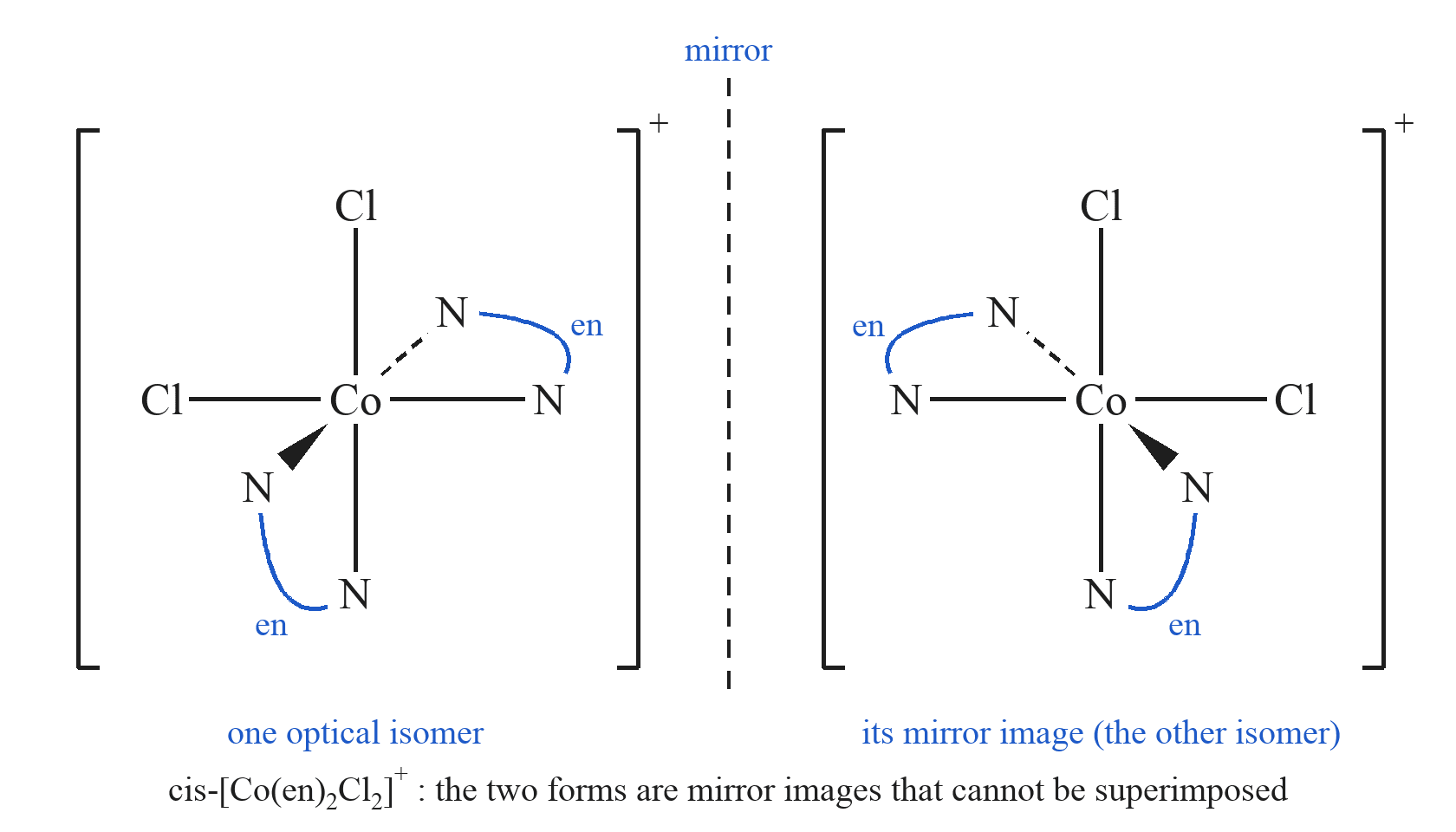
Step 3 — Check that they are different.
No rotation of the right-hand ion brings every Cl and every en onto the positions of the left-hand ion, just as a left hand cannot be placed exactly on a right hand. So the two are non-superimposable mirror images, and each rotates plane-polarised light in the opposite direction.
Therefore, the optical isomers of are the two mirror-image forms of the cis isomer shown in the figure; the trans isomer is optically inactive.
- 61 mark
Board paper question 6
Complete the following statements by selecting the correct alternative from the choices given:
The complex ion is:
Solve with AIAnswer
- Correct
(A) Square planar and diamagnetic
(B) Tetrahedral and paramagnetic
(C) Square planar and paramagnetic
(D) Tetrahedral and diamagnetic
Answer: (A) Square planar and diamagnetic
Key idea: A strong field ligand such as makes the d electrons of a d⁸ ion pair up, leaving one 3d orbital empty. That 3d orbital mixes with the 4s and two 4p orbitals to give four hybrid orbitals, which point to the corners of a square.
Step 1 — Find the oxidation state and configuration of nickel.
The charge balance gives , so nickel is +2. Nickel has atomic number 28, so is [Ar] 3d⁸, with two unpaired electrons in the free ion.
Step 2 — Apply the effect of the cyanide ligands.
Cyanide pairs the eight 3d electrons into four 3d orbitals, so one 3d orbital is empty. It mixes with the 4s and two 4p orbitals to give hybrid orbitals, so the ion is square planar.
Step 3 — Decide the magnetic behaviour.
All eight 3d electrons are paired, so there is no unpaired electron and the ion is diamagnetic.
Why the others are wrong:
- (B) Tetrahedral and paramagnetic describes , where the weak field leaves two unpaired electrons and nickel uses ; cyanide pairs the electrons instead.
- (C) A square planar nickel(II) complex needs an empty 3d orbital, which is only free when all eight 3d electrons are paired, so it cannot be paramagnetic.
- (D) A tetrahedral nickel(II) ion uses and keeps two unpaired 3d electrons, so it would be paramagnetic; a tetrahedral, diamagnetic nickel complex is , where nickel is in the zero state.
Therefore, is square planar and diamagnetic, option (A).
All 31 board paper questions for this chapter, solved the same way.
Class 12 Chemistry Ch 9 questions students ask
How many questions are there in Class 12 Chemistry Ch 9?
115 questions. Every one is solved step by step on this page.
Are these Class 12 Chemistry solutions free?
Yes. Every question and its full working is free to read, with no account needed.
Can I download the Class 12 Chemistry Ch 9 solutions as a PDF?
There is no PDF to download. Every solution is on this page instead, which means it is searchable, always the current syllabus, and readable on a phone. Use your browser's print option if you want it on paper.