
Question 51 markAsked 2015Medium
Write the structures of optical isomers of the complex ion
Confirming your payment
Sign up now and get 250 free tokens.
Previous Year Questions · Question 5 of 31
Write the structures of optical isomers of the complex ion
Solution:
Key idea: An octahedral complex of the type (AA = a bidentate ligand such as en) is optically active only in its cis form, where the two B groups are next to each other. The cis form has no plane of symmetry, so it exists as two mirror images that cannot be superimposed.
Step 1 — Decide which form is optically active.
In the trans form the two Cl atoms are opposite each other; a plane through both Cl atoms and cobalt is a plane of symmetry, so the trans form is optically inactive. In the cis form the two Cl atoms are at 90° to each other and there is no plane of symmetry.
Step 2 — Draw the two optical isomers.
The cis form and its mirror image are the two optical isomers (the d- and l-forms, or enantiomers). Each en joins two neighbouring positions.
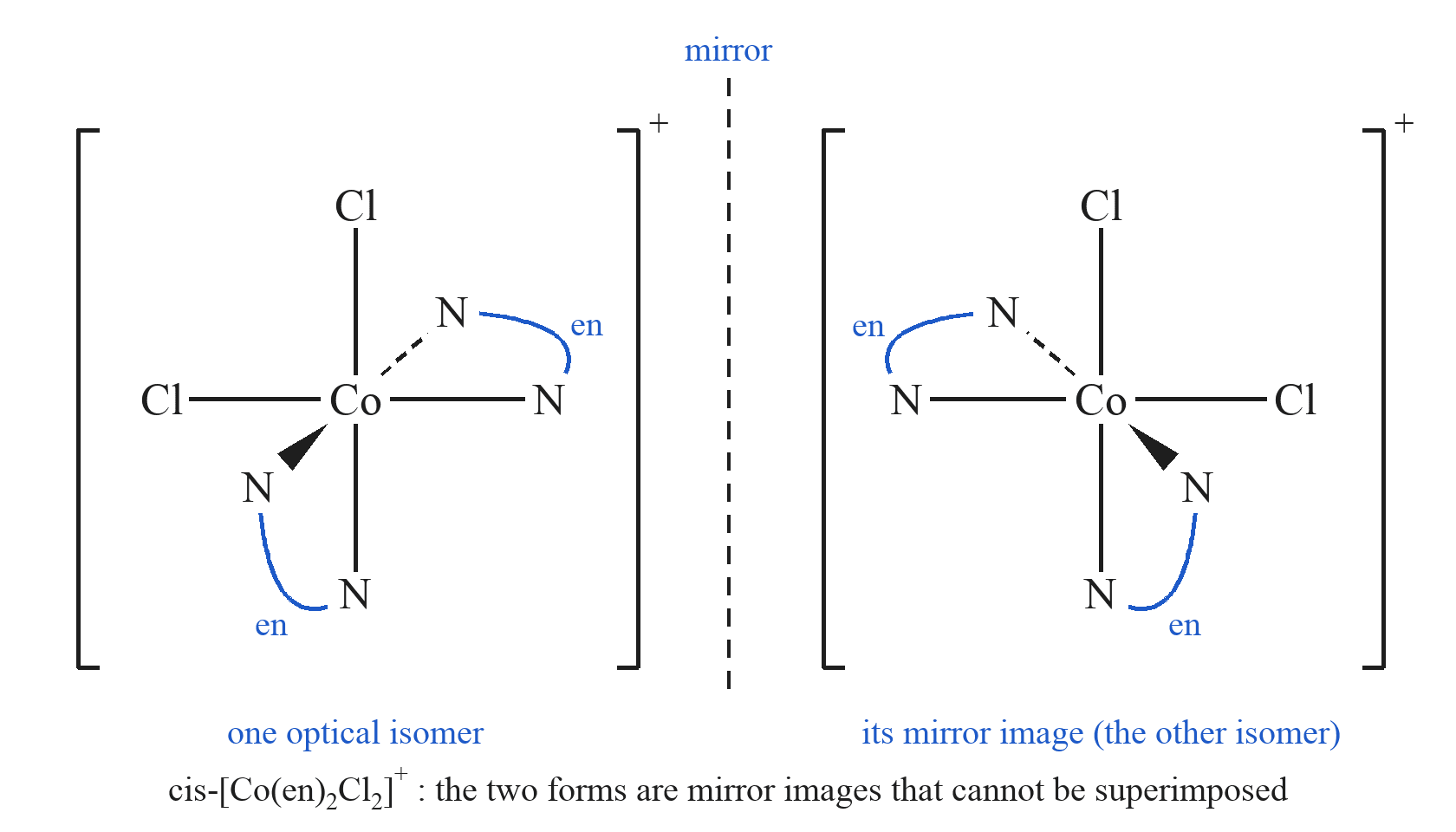
Step 3 — Check that they are different.
No rotation of the right-hand ion brings every Cl and every en onto the positions of the left-hand ion, just as a left hand cannot be placed exactly on a right hand. So the two are non-superimposable mirror images, and each rotates plane-polarised light in the opposite direction.
Therefore, the optical isomers of are the two mirror-image forms of the cis isomer shown in the figure; the trans isomer is optically inactive.