
Opening your dashboard
Class 12 Chemistry Chapter 9 Coordination Compounds: Previous Year Questions
31 questions on Chapter 9, each solved step by step. Class 12 Chemistry, ICSE 2026-27.
31 questions with solutions
1–5 marks · Mixed difficulty
- 11 mark
Question 1
Complete the following statements by selecting the correct alternative from the choices given:
In the complexes and the respective oxidation numbers of central metal atoms are :
Solve with AIAnswer
- Correct
(A) and
(B) and
(C) and
(D) and
Answer: (A) +3 and +4
Key idea: The oxidation number of the central metal is found from the charge of the complex: plus the charges of all the ligands equals the overall charge. Neutral ligands (en, ) count 0; , and count −1 each.
Step 1 — Find the oxidation number of iron in .
Six cyanide ions, each −1, are attached and the ion carries a charge of −3:
Step 2 — Find the oxidation number of platinum in .
The en and the two water molecules are neutral; nitrite and chloride are −1 each; the ion carries +2:
Why the others are wrong:
- (B) The value +6 is the number of cyanide ligands (the coordination number of iron), not its oxidation number, which is +3.
- (C) The +6 again confuses the coordination number with the oxidation number, and +3 for platinum comes from treating the nitrite ligand as neutral.
- (D) The value for iron is right, but +3 for platinum comes from leaving out the −1 charge of the nitrite ligand; the correct value is +4.
Therefore, the oxidation numbers are +3 and +4 respectively, option (A).
- 21 mark
Question 2
Write the IUPAC names of the following coordination compounds:
(i)
(ii)
Solve with AIWritten solution
Solution:
Key idea: In an IUPAC name the cation is named before the anion. Inside a complex the ligands are named first, in alphabetical order (ignoring the prefixes di-, tetra-), then the metal with its oxidation number in Roman numerals. A complex anion takes the ending -ate.
Step 1 — Part (i): find the oxidation number of chromium.
Ammonia and water are neutral, and there are three chloride counter ions, so the complex ion is :
Step 2 — Part (i): write the name.
The ligands in alphabetical order are ammine (a) and aqua (a-q); "ammine" comes first because m comes before q. Four ammonia molecules are "tetraammine" and two water molecules are "diaqua". The complex is a cation, so the metal keeps its plain name. So the name of part (i) is tetraamminediaquachromium(III) chloride.
Step 3 — Part (ii): find the oxidation number of each platinum.
The compound is made of a complex cation and a complex anion. For the cation :
For the anion :
Step 4 — Part (ii): write the name.
The cation is named first: ammine before chlorido, so tetraamminedichloridoplatinum(IV). The anion ends in -ate: tetrachloridoplatinate(II).
Therefore, (i) tetraamminediaquachromium(III) chloride and (ii) tetraamminedichloridoplatinum(IV) tetrachloridoplatinate(II) (older names: tetraamminedichloroplatinum(IV) tetrachloroplatinate(II)).
- 31 mark
Question 3
State the hybridization and magnetic property of ion according to the valence bond theory.
Solve with AIWritten solution
Solution:
Key idea: In valence bond theory, a strong field ligand such as forces the metal's d electrons to pair up. If two inner 3d orbitals become empty, they mix with the 4s and three 4p orbitals to give six hybrid orbitals (an inner orbital, octahedral complex).
Step 1 — Find the oxidation state and configuration of iron.
The charge balance gives , so iron is +3. Iron has atomic number 26 ([Ar] 3d⁶ 4s²), so is [Ar] 3d⁵, with five unpaired electrons in the free ion.
Step 2 — Apply the effect of the cyanide ligands.
Cyanide is a strong field ligand. It pairs the five 3d electrons into three 3d orbitals (2 + 2 + 1), which leaves two 3d orbitals empty.
Step 3 — State the hybridisation.
The two empty 3d orbitals, the 4s orbital and the three 4p orbitals mix to give six hybrid orbitals. Each accepts a lone pair from one ion, so the ion is octahedral.
Step 4 — State the magnetic property.
One 3d electron is still unpaired, so the ion is paramagnetic. Its spin-only magnetic moment is:
Therefore, is hybridised (inner orbital, octahedral) and paramagnetic, with one unpaired electron.
- 42 marks
Question 4
What type of isomers are and ? Give a chemical test to distinguish between them.
Solve with AIWritten solution
Solution:
Key idea: Ionisation isomers have the same formula but exchange an ion between the coordination sphere and the outside. They therefore give different ions in solution, which can be detected by precipitation tests.
Step 1 — Name the type of isomerism.
In the bromide is inside the coordination sphere and sulphate is the counter ion. In the two have changed places. Both have the formula , so they are ionisation isomers.
Step 2 — Write the ions each gives in water.
Only the ions outside the square brackets are free in solution:
Step 3 — Test with barium chloride solution.
Barium chloride gives a white precipitate of barium sulphate with free sulphate ions. So gives a white precipitate of , while gives none, because its sulphate is bound to cobalt.
Step 4 — Confirm with silver nitrate solution.
Silver nitrate gives a pale yellow precipitate of silver bromide with free bromide ions. So gives a pale yellow precipitate of AgBr, while gives none.
Therefore, the two compounds are ionisation isomers; gives a white precipitate with solution, while gives a pale yellow precipitate with solution.
- 51 mark
Question 5
Write the structures of optical isomers of the complex ion
Solve with AIWritten solution
Solution:
Key idea: An octahedral complex of the type (AA = a bidentate ligand such as en) is optically active only in its cis form, where the two B groups are next to each other. The cis form has no plane of symmetry, so it exists as two mirror images that cannot be superimposed.
Step 1 — Decide which form is optically active.
In the trans form the two Cl atoms are opposite each other; a plane through both Cl atoms and cobalt is a plane of symmetry, so the trans form is optically inactive. In the cis form the two Cl atoms are at 90° to each other and there is no plane of symmetry.
Step 2 — Draw the two optical isomers.
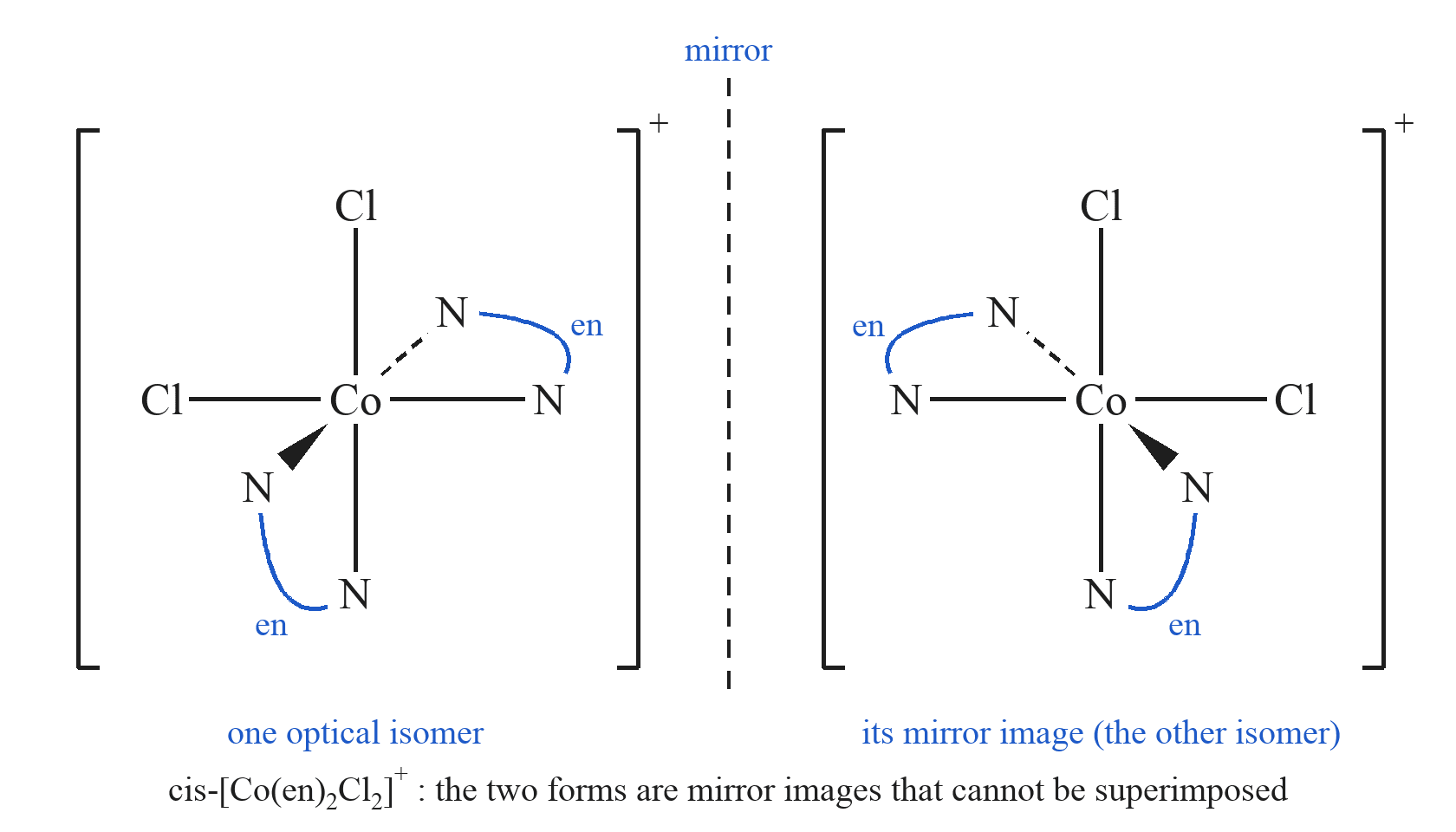
The cis form and its mirror image are the two optical isomers (the d- and l-forms, or enantiomers). Each en joins two neighbouring positions.
Step 3 — Check that they are different.
No rotation of the right-hand ion brings every Cl and every en onto the positions of the left-hand ion, just as a left hand cannot be placed exactly on a right hand. So the two are non-superimposable mirror images, and each rotates plane-polarised light in the opposite direction.
Therefore, the optical isomers of are the two mirror-image forms of the cis isomer shown in the figure; the trans isomer is optically inactive.
- 61 mark
Question 6
Complete the following statements by selecting the correct alternative from the choices given:
The complex ion is:
Solve with AIAnswer
- Correct
(A) Square planar and diamagnetic
(B) Tetrahedral and paramagnetic
(C) Square planar and paramagnetic
(D) Tetrahedral and diamagnetic
Answer: (A) Square planar and diamagnetic
Key idea: A strong field ligand such as makes the d electrons of a d⁸ ion pair up, leaving one 3d orbital empty. That 3d orbital mixes with the 4s and two 4p orbitals to give four hybrid orbitals, which point to the corners of a square.
Step 1 — Find the oxidation state and configuration of nickel.
The charge balance gives , so nickel is +2. Nickel has atomic number 28, so is [Ar] 3d⁸, with two unpaired electrons in the free ion.
Step 2 — Apply the effect of the cyanide ligands.
Cyanide pairs the eight 3d electrons into four 3d orbitals, so one 3d orbital is empty. It mixes with the 4s and two 4p orbitals to give hybrid orbitals, so the ion is square planar.
Step 3 — Decide the magnetic behaviour.
All eight 3d electrons are paired, so there is no unpaired electron and the ion is diamagnetic.
Why the others are wrong:
- (B) Tetrahedral and paramagnetic describes , where the weak field leaves two unpaired electrons and nickel uses ; cyanide pairs the electrons instead.
- (C) A square planar nickel(II) complex needs an empty 3d orbital, which is only free when all eight 3d electrons are paired, so it cannot be paramagnetic.
- (D) A tetrahedral nickel(II) ion uses and keeps two unpaired 3d electrons, so it would be paramagnetic; a tetrahedral, diamagnetic nickel complex is , where nickel is in the zero state.
Therefore, is square planar and diamagnetic, option (A).
- 72 marks
Question 7
Write the IUPAC names of the following:
(i)
(ii)
Solve with AIWritten solution
Solution:
Key idea: Name the cation first and the anion second. Inside the complex, ligands go in alphabetical order before the metal, and the metal's oxidation number follows in Roman numerals; a complex anion ends in -ate (platinum → platinate).
Step 1 — Part (i): find the oxidation number of cobalt.
Nitrate is the counter ion, so the complex ion is . Ammonia is neutral and sulphate is −2:
Step 2 — Part (i): write the name.
The ligands in alphabetical order are ammine (a) and sulphato (s): tetraamminesulphatocobalt(III). The anion, nitrate, is named last.
Step 3 — Part (ii): find the oxidation number of platinum.
Potassium is +1, so the complex ion is :
Step 4 — Part (ii): write the name.
The cation potassium comes first. In the complex anion, ammine (a) comes before chlorido (c), and the metal name ends in -ate: amminetrichloridoplatinate(II).
Therefore, (i) tetraamminesulphatocobalt(III) nitrate and (ii) potassium amminetrichloridoplatinate(II) (older name: potassium amminetrichloroplatinate(II)).
- 81 mark
Question 8
What type of isomerism is exhibited by the following pairs of compounds:
(i) and
(ii) and
Solve with AIWritten solution
Solution:
Key idea: Ionisation isomers exchange an ion between the coordination sphere and the outside. Linkage isomers contain an ambidentate ligand (one that can bind through two different atoms) attached through a different donor atom.
Step 1 — Part (i): compare the two compounds.
In chloride is bonded to platinum and bromide is outside; in the two halides have changed places. The formula is the same, but they give different ions in water ( in one, in the other). This is ionisation isomerism.
Step 2 — Part (ii): compare the two compounds.
The thiocyanate ion is ambidentate. In it is bonded to chromium through sulphur (Cr–SCN), and in through nitrogen (Cr–NCS). This is linkage isomerism.
Therefore, (i) shows ionisation isomerism and (ii) shows linkage isomerism.
- 92 marks
Question 9
How does get ionised when dissolved in water? Will it form precipitate when solution is added to it? Give a reason for your answer.
Solve with AIWritten solution
Solution:
Key idea: When a coordination compound dissolves, only the ions outside the square brackets are set free. Ligands inside the coordination sphere stay bonded to the metal and do not behave as free ions.
Step 1 — Write how the compound ionises.
The two potassium ions are outside the bracket, so they separate; the complex anion stays whole. One formula unit gives three ions:
Step 2 — Decide what silver nitrate does.
Silver nitrate precipitates silver chloride only with free chloride ions. Here all four chlorine atoms are bonded to platinum(II) inside the stable complex ion , so there are no free ions in the solution.
Step 3 — State the result.
So no white precipitate of silver chloride forms when solution is added.
Note: This holds for a freshly made solution. On standing, slowly exchanges some of its chloride ligands for water molecules, so an old solution can give a little AgCl.
Therefore, ionises into and ; it does not give a precipitate of AgCl with , because its chloride ions are bound to platinum inside the complex ion and are not free in solution.
- 102 marks
Question 10
Write the formula of the following compounds:
(i) Potassium trioxalatoaluminate (III).
(ii) Hexaaquairon (II) sulphate.
Solve with AIWritten solution
Solution:
Key idea: To write a formula from a name, put the metal first inside square brackets, then the ligands, and use the oxidation number to work out the charge of the complex ion. The counter ions balance that charge.
Step 1 — Part (i): work out the charge of the complex anion.
Aluminium is +3 and each oxalate ion, , is −2. Three oxalates give:
So the complex anion is , and three potassium ions balance it.
Step 2 — Part (ii): work out the charge of the complex cation.
Iron is +2 and water is neutral, so the cation is . One sulphate ion, , balances it.
Therefore, (i) potassium trioxalatoaluminate(III) is and (ii) hexaaquairon(II) sulphate is .
- 111 mark
Question 11
Name the types of isomerism shown by the following pairs of compounds:
(i) and
(ii) and
Solve with AIWritten solution
Solution:
Key idea: Coordination isomers have both a complex cation and a complex anion, and the ligands are distributed differently between the two metals. Ligand isomerism arises when the ligands themselves are isomers of each other.
Step 1 — Part (i): compare the two compounds.
In the ammonia is on copper and the chloride on platinum; in the ligands have changed metals. The overall formula is the same, so this is coordination isomerism.
Step 2 — Part (ii): compare the ligands.
Here pn is propane-1,2-diamine, (), and en is ethane-1,2-diamine, ().
The paper prints en here. Since en has one group fewer than pn, the two complexes as printed have different formulae and are not isomers at all. The usual pair for this kind of isomerism is and , where tn is propane-1,3-diamine, , which also has the formula .
Step 3 — Part (ii): name the isomerism.
Since pn and tn are isomers of each other, complexes that differ only in carrying pn or tn show ligand isomerism.
Therefore, (i) shows coordination isomerism and (ii) is meant to show ligand isomerism (pn and its isomer tn); as printed, with en, the two ions are not isomers.
- 122 marks
Question 12
For the coordination complex ion
(i) Give the IUPAC name of the complexion.
(ii) What is the oxidation number of cobalt in the complexion?
(iii) State the type of hybridisation of the complexion.
(iv) State the magnetic behaviour of the complexion.
Solve with AIWritten solution
Solution:
Key idea: Ammonia acts as a strong field ligand towards cobalt(III), so the six 3d electrons pair up in three 3d orbitals and two inner 3d orbitals are left free for hybridisation.
Step 1 — Part (i): write the IUPAC name.
Six ammonia ligands are "hexaammine"; the complex is a cation, so cobalt keeps its name, followed by its oxidation number. The name is hexaamminecobalt(III) ion.
Step 2 — Part (ii): find the oxidation number of cobalt.
Ammonia is neutral and the ion carries +3:
Step 3 — Part (iii): find the hybridisation.
Cobalt has atomic number 27 ([Ar] 3d⁷ 4s²), so is [Ar] 3d⁶. Ammonia pairs the six electrons in three 3d orbitals, leaving two 3d orbitals empty. These, with the 4s and three 4p orbitals, give six hybrid orbitals (octahedral, inner orbital complex).
Step 4 — Part (iv): state the magnetic behaviour.
All six 3d electrons are paired, so the ion has no unpaired electron and is diamagnetic.
Therefore, (i) hexaamminecobalt(III) ion, (ii) +3, (iii) and (iv) diamagnetic.
- 132 marks
Question 13
Answer the following questions:
What type of isomerism is shown by the following coordination compounds:
and
Write their IUPAC names.
Solve with AIWritten solution
Solution:
Key idea: Ionisation isomers have the same formula but exchange an ion between the coordination sphere and the outside, so they give different ions in solution.
Step 1 — Name the type of isomerism.
In the first compound chloride is bonded to platinum and bromide is outside; in the second the two halides have changed places. The first gives ions in water and the second gives ions, so the pair shows ionisation isomerism.
Step 2 — Find the oxidation number of platinum.
In each cation, four neutral ammonia ligands and two halide ions (−1 each) are bonded to platinum, and the cation carries +2:
Step 3 — Write the IUPAC names.
Ligands go in alphabetical order (ammine before bromido or chlorido), then platinum(IV), then the counter ion.
Therefore, they are ionisation isomers: is tetraamminedichloridoplatinum(IV) bromide and is tetraamminedibromidoplatinum(IV) chloride (older names: tetraamminedichloroplatinum(IV) bromide and tetraamminedibromoplatinum(IV) chloride).
- 143 marks
Question 14
For the complex ion , state :
(i) the type of hybridisation
(ii) the magnetic behaviour
(iii) the oxidation number of the central metal atom
Solve with AIWritten solution
Solution:
Key idea: In valence bond theory, the strong field ligand pairs the 3d electrons of the metal ion. When two 3d orbitals are left empty, the metal uses hybrid orbitals.
Step 1 — Find the oxidation number of iron first.
The hybridisation and magnetic behaviour depend on the number of d electrons, so we first work out the charge on iron. Six cyanide ions, each −1, and an overall charge of −3 give:
Step 2 — Part (i): find the hybridisation.
Iron has atomic number 26, so is [Ar] 3d⁵. Cyanide pairs the five electrons into three 3d orbitals (2 + 2 + 1), leaving two 3d orbitals empty. These two 3d orbitals, the 4s orbital and the three 4p orbitals mix to give six hybrid orbitals, so the ion is octahedral (an inner orbital complex).
Step 3 — Part (ii): find the magnetic behaviour.
One electron remains unpaired, so the ion is paramagnetic. Its spin-only magnetic moment is:
Step 4 — Part (iii): state the oxidation number.
From Step 1, the oxidation number of the central iron atom is +3.
Therefore, for : (i) hybridisation, (ii) paramagnetic (one unpaired electron) and (iii) oxidation number +3.
- 153 marks
Question 15
Write the IUPAC name of ion and draw the structures of its geometrical isomers.
Solve with AIWritten solution
Solution:
Key idea: An octahedral complex shows geometrical isomerism: the two B groups can be next to each other (cis, 90°) or opposite each other (trans, 180°).
Step 1 — Find the oxidation number of cobalt.
Each en is neutral and each chloride is −1; the ion carries +1:
Step 2 — Write the IUPAC name.
The ligands go in alphabetical order: chlorido (c) before ethane-1,2-diamine (e). Since the ligand name ethane-1,2-diamine already contains a number prefix, "bis" is used instead of "di" and the name is put in brackets. The name is dichloridobis(ethane-1,2-diamine)cobalt(III) ion (older name: dichlorobis(ethylenediamine)cobalt(III) ion).
Step 3 — Draw the geometrical isomers.
Each en spans two neighbouring positions of the octahedron. In the cis isomer the two Cl atoms are at 90° to each other; in the trans isomer they are opposite each other, at 180°.
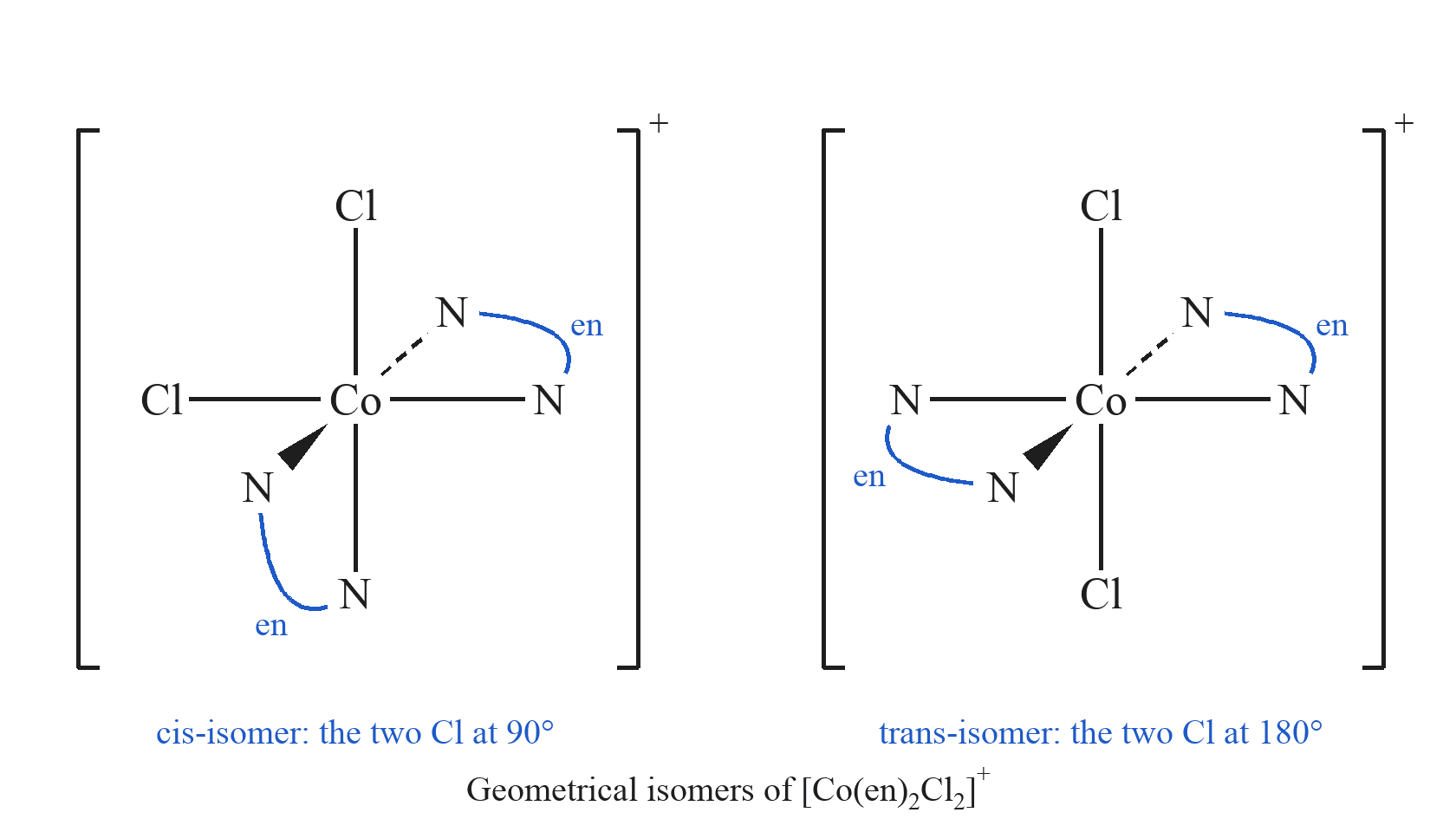
The cis isomer has no plane of symmetry, so it is also optically active (it exists as a pair of mirror images); the trans isomer is optically inactive.
Therefore, the ion is dichloridobis(ethane-1,2-diamine)cobalt(III), and its geometrical isomers are the cis form (Cl–Co–Cl = 90°) and the trans form (Cl–Co–Cl = 180°) shown in the figure.
- 161 mark
Question 16
Fill in the blanks by choosing the appropriate word/words from those given in the brackets:
(iodoform, volume, mass, haloform, gram equivalent, chloroform, carbylmine, , high, coke, , low, gram mole, carbon monoxide.
Outer orbital complexes involve ______ hybridization and are ______ spin complexes.
Solve with AIWritten solution
Solution:
Key idea: An outer orbital complex uses the outer 4d orbitals (with 4s and 4p) for hybridisation, because the weak field ligands do not pair the inner 3d electrons.
Step 1 — Fill the first blank.
When the 3d electrons stay unpaired, no inner 3d orbital is free. The metal then uses one 4s, three 4p and two 4d orbitals, which gives hybridisation (octahedral).
Step 2 — Fill the second blank.
Since the 3d electrons stay unpaired, the complex has the largest possible number of unpaired electrons, so it is a high spin complex. An example is , with four unpaired electrons.
Therefore, outer orbital complexes involve hybridization and are high spin complexes.
- 175 marks
Question 17
(i) Write the IUPAC names of the following complexes:
(1)
(2)
(3)
(ii) With reference to the coordination complex ion answer the following: (at. No. of Fe=26)
(1) Give the IUPAC name of the complex ion.
(2) What is the oxidation number of the central metal ion?
(3) How many unpaired electrons are there in the complex ion?
(4) State The type of hybridisation of the complex ion.
Solve with AIWritten solution
Solution:
Key idea: For each name, find the metal's oxidation number from the charges, list the ligands alphabetically before the metal and add -ate for a complex anion. For the aqua complex, water is a weak field ligand, so the 3d electrons of iron(II) stay unpaired.
Step 1 — Part (i)(1): name .
Sulphate (−2) balances the cation , and ammonia is neutral, so copper is +2. The name is tetraamminecopper(II) sulphate.
Step 2 — Part (i)(2): name as printed.
The paper prints this complex as neutral. Then:
Chlorido (c) comes before ethane-1,2-diamine (e), and "bis" is used with the bracketed ligand name: dichloridobis(ethane-1,2-diamine)cobalt(II).
This complex is usually met as the cation , with cobalt +3; its name is dichloridobis(ethane-1,2-diamine)cobalt(III) ion (older name: dichlorobis(ethylenediamine)cobalt(III) ion).
Step 3 — Part (i)(3): name .
The complex anion is ; with three oxalate ions (−2 each), aluminium is +3. The anion ends in -ate: potassium trioxalatoaluminate(III).
Step 4 — Part (ii)(1) and (2): name the ion and find the oxidation number.
Water is neutral and the ion carries +2:
The name is hexaaquairon(II) ion.
Step 5 — Part (ii)(3): count the unpaired electrons.
Iron (Z = 26) is [Ar] 3d⁶ 4s², so is [Ar] 3d⁶. Water is a weak field ligand, so the electrons spread over all five 3d orbitals before pairing: one orbital holds a pair and four hold one electron each. So there are 4 unpaired electrons.
Step 6 — Part (ii)(4): state the hybridisation.
No inner 3d orbital is empty, so iron uses one 4s, three 4p and two 4d orbitals: hybridisation (octahedral, outer orbital, high spin complex).
Therefore, (i) (1) tetraamminecopper(II) sulphate, (2) dichloridobis(ethane-1,2-diamine)cobalt(II) as printed, (3) potassium trioxalatoaluminate(III); (ii) (1) hexaaquairon(II) ion, (2) +2, (3) 4 unpaired electrons, (4) .
- 185 marks
Question 18
(i) Name of the type of isomerism exhibited by the following pairs of compounds:
(1) and
(2) and
(3) and
(ii) Using the valence bond approach, predict the shape, hybridisation and magnetic behaviour of . (at. no. of Ni=28)
Solve with AIWritten solution
Solution:
Key idea: Linkage isomers bind an ambidentate ligand through different atoms; hydrate isomers differ in how many water molecules are ligands and how many are water of crystallisation; coordination isomers exchange ligands between a complex cation and a complex anion. In , the strong field CO ligands pair the nickel electrons.
Step 1 — Part (i)(1): compare the pair.
The nitrite ion is ambidentate. In it binds through oxygen (nitrito) and in through nitrogen (nitro). This is linkage isomerism.
Step 2 — Part (i)(2): compare the pair.
In the first compound four water molecules are ligands and two are water of crystallisation; in the second five are ligands and one is outside. One chloride also moves between the coordination sphere and the outside. Isomers that differ in the number of water molecules inside the coordination sphere show hydrate (solvate) isomerism.
Step 3 — Part (i)(3): compare the pair.
Both compounds have a complex cation and a complex anion. Ammonia is on cobalt and cyanide on chromium in the first, and the other way round in the second. This is coordination isomerism.
Step 4 — Part (ii): find the configuration of nickel.
Nickel (Z = 28) in is in the zero oxidation state: [Ar] 3d⁸ 4s². CO is a strong field ligand, so the two 4s electrons are pushed into the 3d orbitals and paired, giving 3d¹⁰ with the 4s and 4p orbitals empty.
Step 5 — Part (ii): state the hybridisation and shape.
The empty 4s orbital and three 4p orbitals mix to give four hybrid orbitals. Each accepts a lone pair from the carbon atom of a CO molecule, so the molecule is tetrahedral.
Step 6 — Part (ii): state the magnetic behaviour.
All ten 3d electrons are paired, so there are no unpaired electrons and is diamagnetic.
Therefore, (i) (1) linkage isomerism, (2) hydrate isomerism, (3) coordination isomerism; (ii) is tetrahedral, hybridised and diamagnetic.
- 191 mark
Question 19
Fill in the blanks by choosing the appropriate word(s) from those given in the brackets:
[stable, low, aldehyde, unstable, 6, 4, ethane, Clemmensen's, 2, 3, carboxylic acid, high, propane, Rosenmund's]
The coordination number and oxidation state of the complex are ______ and ______ respectively.
Solve with AIWritten solution
Solution:
Key idea: The coordination number is the number of donor atoms bonded to the metal. The oxidation state is found by making the charges add up to the charge of the complex ion.
Step 1 — Find the coordination number.
Six cyanide ions are bonded to iron, each through its carbon atom, so the coordination number is 6.
Step 2 — Find the oxidation state.
The four potassium ions (+1 each) balance the charge of the complex ion :
Therefore, the coordination number and oxidation state of the complex are 6 and 2 (+2) respectively.
- 205 marks
Question 20
(i) Name the type of isomerism exhibited by the following pairs of compounds.
(a) and
(b) and
(c) and
(ii) Write the IUPAC names of the following complexes:
(a)
(b)
Solve with AIWritten solution
Solution:
Key idea: Linkage isomers bind an ambidentate ligand through different atoms; hydrate isomers differ in the number of water molecules inside the coordination sphere; ionisation isomers exchange an ion between the coordination sphere and the outside. Names list ligands alphabetically, then the metal with its oxidation number; a complex anion ends in -ate.
Step 1 — Part (i)(a): compare the pair.
The nitrite ion binds through oxygen (–ONO, nitrito) in the first compound and through nitrogen (–NO₂, nitro) in the second. This is linkage isomerism.
Step 2 — Part (i)(b): compare the pair.
The first compound has five water ligands and one water of crystallisation; the second has four water ligands and two waters of crystallisation (a chloride also moves into or out of the sphere). This is hydrate isomerism.
Step 3 — Part (i)(c): compare the pair.
Chloride is bonded to platinum and bromide is outside in the first; the second has them the other way round, so the two give different ions in water. This is ionisation isomerism.
Step 4 — Part (ii)(a): name .
Three chloride counter ions balance ; both ligands are neutral, so cobalt is +3. Ammine comes before aqua: tetraamminediaquacobalt(III) chloride.
Step 5 — Part (ii)(b): name .
Two potassium ions balance :
The complex is an anion, so nickel becomes "nickelate": potassium tetracyanidonickelate(II).
Therefore, (i) (a) linkage, (b) hydrate and (c) ionisation isomerism; (ii) (a) tetraamminediaquacobalt(III) chloride and (b) potassium tetracyanidonickelate(II) (older name: potassium tetracyanonickelate(II)).
- 211 mark
Question 21
Fill in the blanks by choosing the appropriate words(s) from those given below in the options:
- lead poisoning
- zero
- phosgene
- dependent
- cancer
- independent
- diethyl ether
- first
- ethyl carbonate
- ethene
EDTA is used in the treatment of ______ while Cis platin is used in the treatment of ______.
Solve with AIWritten solution
Solution:
Key idea: Chelating ligands and platinum complexes are used in medicine: EDTA holds metal ions very tightly in soluble complexes, and cisplatin binds to DNA in dividing cells.
Step 1 — Fill the first blank.
EDTA forms a very stable, water-soluble chelate with lead ions, which is then excreted in urine. So EDTA (given as its calcium salt) is used to treat lead poisoning.
Step 2 — Fill the second blank.
Cisplatin, cis-, binds to DNA and stops cancer cells from dividing. So it is used in the treatment of cancer.
Therefore, EDTA is used in the treatment of lead poisoning while cisplatin is used in the treatment of cancer.
- 221 mark
Question 22
Select and write the correct alternative from the choices given below.
The metal complex ion that is paramagnetic is ______.
(Atomic number of Fe = 26, Cu = 29, Co = 27 and Ni = 28)
Solve with AIAnswer
(A)
(B)
(C)
- Correct
(D)
Answer: (D)
Key idea: A complex is paramagnetic if it has at least one unpaired electron. An ion with an odd number of d electrons always has at least one unpaired electron.
Step 1 — Find the configuration of copper.
Ammonia is neutral, so copper is +2. Copper (Z = 29) is [Ar] 3d¹⁰ 4s¹, so is [Ar] 3d⁹.
Step 2 — Decide the magnetic behaviour.
Nine electrons in five 3d orbitals give four pairs and one unpaired electron. So is paramagnetic, with a spin-only moment of about 1.73 BM.
The paper prints option (A) as , which is not a known complex ion; it stands for the familiar ion . Option (C) is printed with a misplaced bracket and means .
Why the others are wrong:
- (A) The intended ion contains (3d⁶); the strong field cyanide pairs all six electrons, so it is diamagnetic.
- (B) contains (3d⁶); ammonia pairs all six electrons (, low spin), so it is diamagnetic.
- (C) contains (3d⁸); cyanide pairs all eight electrons (, square planar), so it is diamagnetic.
Therefore, the paramagnetic complex ion is , option (D).
- 235 marks
Question 23
(a) A coordination compound has the formula . It precipitates silver ions as AgCl and its molar conductance corresponds to a total of two ions.
Based on this information, answer the following question:
a. Deduce the structural formula of the complex compound.
b. Write the IUPAC name of the complex compound.
c. Draw the geometrical isomers of the complex compound.
(b) Give a chemical test to show that and are ionisation isomers.
Solve with AIWritten solution
Solution:
Key idea: In Werner's theory, only the ions outside the coordination sphere are free in solution. Chloride ions precipitated by silver nitrate and the number of ions shown by molar conductance tell us which groups are outside the square brackets.
Step 1 — Part (a)a: count the ions.
Cobalt(III) has a coordination number of 6. The molar conductance shows two ions per formula unit: one complex cation and one chloride ion. So only one of the three chlorides is outside the coordination sphere, and it is this chloride that silver nitrate precipitates as AgCl.
Step 2 — Part (a)a: write the structural formula.
The four ammonia molecules and the other two chlorides are bonded to cobalt, which makes six ligands:
Step 3 — Part (a)b: write the IUPAC name.
Ammonia is neutral and the two chlorides are −1 each, with a charge of +1 on the complex:
Ammine (a) comes before chlorido (c): tetraamminedichloridocobalt(III) chloride (older name: tetraamminedichlorocobalt(III) chloride).
Step 4 — Part (a)c: draw the geometrical isomers.
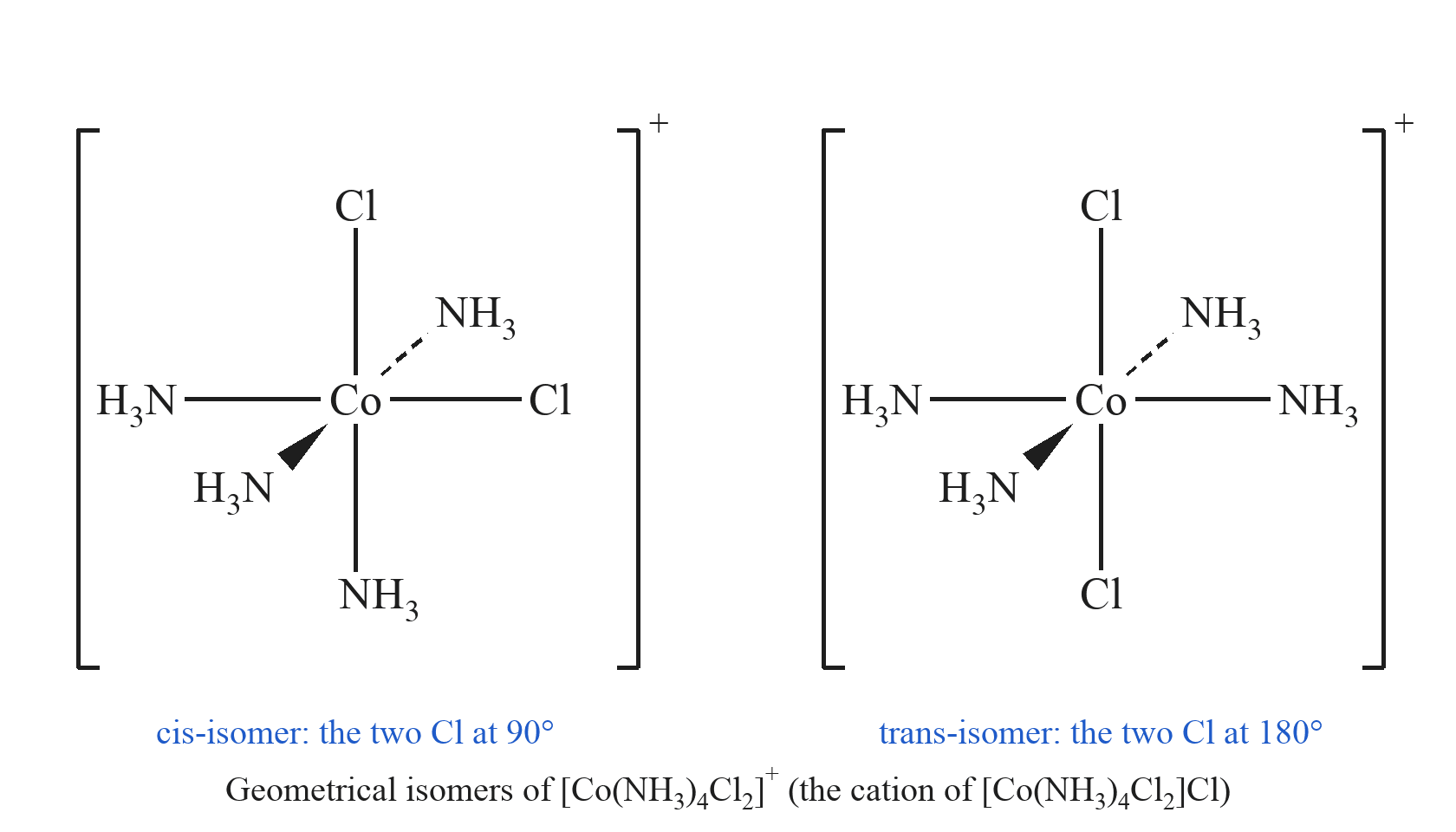
The cation is octahedral, of the type . The two Cl atoms can be next to each other (cis, 90°) or opposite each other (trans, 180°).
Step 5 — Part (b): plan the test.
The two compounds have the same formula, but different ions are outside the coordination sphere. gives free sulphate ions; gives free chloride ions.
Step 6 — Part (b): describe the test.
Add barium chloride solution to a solution of each. gives a white precipitate of barium sulphate; gives none.
Add silver nitrate solution to fresh samples. gives a white precipitate of silver chloride; gives none. Since each compound gives a different ion in solution, they are ionisation isomers.
Therefore, (a) the compound is , tetraamminedichloridocobalt(III) chloride, with cis and trans geometrical isomers as shown; (b) gives a white precipitate with and gives a white precipitate with .
- 241 mark
Question 24
Fill in the blanks by choosing the appropriate word(s) from those given in the brackets:
[+2, ethane, tetrahedral, square planar, zero dry cell, nickel–cadmium cell, propane, Wolff–Kishner, Stephen, completely filled, incompletely filled, paramagnetic, diamagnetic]
The complex compound is __________ in shape and nickel is in __________ oxidation state in this complex compound.
Solve with AIWritten solution
Solution:
Key idea: CO is a neutral ligand, so the oxidation state of nickel in equals the charge of the complex, zero. CO is a strong field ligand, which pairs the nickel electrons.
Step 1 — Find the oxidation state.
Four neutral CO ligands and an overall charge of zero give:
Step 2 — Find the shape.
Nickel (Z = 28) is [Ar] 3d⁸ 4s². CO pushes the two 4s electrons into the 3d orbitals (3d¹⁰), so the 4s and three 4p orbitals are free and form four hybrid orbitals. Four orbitals point to the corners of a tetrahedron.
Therefore, the complex compound is tetrahedral in shape and nickel is in zero oxidation state in this complex compound.
- 251 mark
Question 25
Select and write the correct alternative from the choices given below.
The coordination number and the oxidation state of the central metal 'D' in the complex are:
Solve with AIAnswer
(A) 6 and 2, respectively
(B) 4 and 2, respectively
(C) 3 and 6, respectively
- Correct
(D) 6 and 3, respectively
Answer: (D) 6 and 3, respectively
Key idea: The coordination number counts donor atoms, not ligands: each ethane-1,2-diamine (en) is bidentate and bonds through two nitrogen atoms. The oxidation state makes the charges add up to the charge of the complex ion.
Step 1 — Find the coordination number.
Two en ligands give 2 × 2 = 4 donor atoms, and the two water molecules give 2 more:
Step 2 — Find the oxidation state.
Three chloride counter ions show that the complex ion is . Both ligands are neutral:
Why the others are wrong:
- (A) The coordination number 6 is right, but +2 does not match the three chloride ions outside the bracket, which make the complex ion 3+.
- (B) The value 4 counts each en as one donor (2 + 2), but each en bonds through two nitrogen atoms; the oxidation state is also +3, not +2.
- (C) The two numbers are swapped: the coordination number is 6 and the oxidation state is +3.
Therefore, the coordination number is 6 and the oxidation state of D is +3, option (D).
- 262 marks
Question 26
While conducting an experiment on coordination compounds, Shirin observed a white precipitate when solution was added to the aqueous solution of the complex .
How can the ionisation isomer of this complex be detected by a chemical test? Write the structure and the IUPAC name of the ionisation isomer.
Solve with AIWritten solution
Solution:
Key idea: Ionisation isomers exchange an ion between the coordination sphere and the outside. The ion outside the square brackets is free in solution and can be detected by a precipitation test.
Step 1 — Explain Shirin's observation.
In the chloride is outside the bracket, so it is free in water and gives a white precipitate of silver chloride with silver nitrate:
Step 2 — Write the ionisation isomer.
In the ionisation isomer, chloride and sulphate change places: chloride is bonded to cobalt and sulphate is the counter ion. Its structure is : cobalt is octahedral, bonded to three , one en (through both N atoms) and one Cl, and the sulphate ion lies outside the coordination sphere. In water:
Step 3 — Give the test that detects it.
Add barium chloride solution: the isomer gives a white precipitate of barium sulphate, because its sulphate ions are free. With silver nitrate it gives no precipitate, because its chloride is bonded to cobalt.
Step 4 — Find the oxidation number of cobalt.
In , ammonia and en are neutral and chloride is −1:
Step 5 — Write the IUPAC name.
The ligands in alphabetical order are ammine (a), chlorido (c) and ethane-1,2-diamine (e); the counter ion is sulphate. So the name is triamminechlorido(ethane-1,2-diamine)cobalt(III) sulphate (older name: triamminechloro(ethylenediamine)cobalt(III) sulphate).
Therefore, the ionisation isomer is , triamminechlorido(ethane-1,2-diamine)cobalt(III) sulphate; it gives a white precipitate of with solution and no precipitate with .
- 273 marks
Question 27
According to Crystal-Field Theory, the electronic configuration of complex compound [A] is and that of complex compound [B] is .
(i) Which of the two complex compounds, [A] or [B], is a low spin complex?
(ii) Write the number of unpaired electrons in complex compounds [A] and [B].
(iii) Does complex [A] have strong field ligands or weak field ligands? Give a reason.
Solve with AIWritten solution
Solution:
Key idea: In an octahedral field the five d orbitals split into three lower orbitals and two higher orbitals, separated by . With weak field ligands ( smaller than the pairing energy P) electrons enter before pairing (high spin); with strong field ligands () they pair in first (low spin).
Step 1 — Part (i): identify the low spin complex.
Both complexes have 4 + 2 = 6 and 6 + 0 = 6 d electrons, so both are d⁶. In [B] all six electrons are paired in the orbitals and is empty, so pairing happened before any electron entered . That is the low spin arrangement, so [B] is the low spin complex.
Step 2 — Part (ii): count the unpaired electrons in [A].
In [A], means three orbitals hold four electrons: one pair and two single electrons. means the two orbitals hold one electron each. So [A] has 2 + 2 = 4 unpaired electrons.
Step 3 — Part (ii): count the unpaired electrons in [B].
In [B], means all three orbitals hold a pair and is empty, so [B] has 0 unpaired electrons.
Step 4 — Part (iii): decide the ligand strength in [A].
In [A] two electrons went into the higher orbitals while a place was still available for pairing. This happens only when is smaller than the pairing energy, which means the ligands produce only a small splitting.
Therefore, (i) [B] is the low spin complex, (ii) [A] has 4 and [B] has 0 unpaired electrons, and (iii) [A] has weak field ligands, because , so electrons occupy the orbitals instead of pairing in .
- 281 mark
Question 28
Select and write the correct alternative from the choices given below.
Which one of the following is a tetrahedral complex as well as diamagnetic in nature?
Solve with AIAnswer
(A)
(B)
(C)
- Correct
(D)
Answer: (D)
Key idea: A tetrahedral complex uses hybrid orbitals. It is diamagnetic only if all its d electrons are paired.
Step 1 — Find the configuration of nickel.
CO is neutral, so nickel is in the zero oxidation state: [Ar] 3d⁸ 4s². CO is a strong field ligand; it pushes the two 4s electrons into 3d, giving 3d¹⁰ with all electrons paired.
Step 2 — Find the shape and magnetic behaviour.
The empty 4s and three 4p orbitals form four hybrid orbitals, so the molecule is tetrahedral. With no unpaired electrons, it is diamagnetic.
Why the others are wrong:
- (A) is diamagnetic, but cyanide pairs the eight 3d electrons of and leaves one 3d orbital for hybridisation, so it is square planar, not tetrahedral.
- (B) is tetrahedral (), but the weak field chloride leaves two unpaired electrons on (3d⁸), so it is paramagnetic.
- (C) contains (3d⁹) with one unpaired electron, so it is paramagnetic; it is also square planar.
Therefore, is the tetrahedral, diamagnetic complex, option (D).
- 292 marks
Question 29
Write the IUPAC names of the following complex compounds:
(i)
(ii)
Solve with AIWritten solution
Solution:
Key idea: Name the cation first and the anion second. Ligands go alphabetically before the metal, the oxidation number follows in Roman numerals, and a complex anion ends in -ate.
Step 1 — Part (i): find the oxidation number of platinum.
Sulphate (−2) is the counter ion, so the complex ion is :
Step 2 — Part (i): write the name.
Ammine (a) comes before chlorido (c), and the counter ion is sulphate: tetraamminedichloridoplatinum(IV) sulphate.
Step 3 — Part (ii): find the oxidation number of nickel.
Two potassium ions balance :
Step 4 — Part (ii): write the name.
The complex is an anion, so nickel becomes "nickelate": potassium tetracyanidonickelate(II).
Therefore, (i) tetraamminedichloridoplatinum(IV) sulphate and (ii) potassium tetracyanidonickelate(II) (older names: tetraamminedichloroplatinum(IV) sulphate and potassium tetracyanonickelate(II)).
- 305 marks
Question 30
(a) With reference to Valence Bond Theory (VBT), answer the following questions regarding the complex ion .
(1) What is the oxidation number of chromium in the complex?
(2) State the magnetic behaviour of the complex.
(3) How many unpaired electrons are there in the complex?
(4) State the type of hybridisation of the central metal atom.
(b) The coordination complex exists in two isomeric forms 'P' and 'Q'. Isomer 'P' reacts with solution to give white precipitate whereas 'Q' does not give any precipitate with solution.
(1) Write the structural formula of isomers 'P' and 'Q'.
(2) Name the type of isomerism involved.
(c) Explain why an aqueous solution of potassium hexacyanidoferrate(II) does not give the test of ferrous ion.
Solve with AIWritten solution
Solution:
Key idea: In valence bond theory, a metal ion whose d electrons leave two inner 3d orbitals empty uses hybrid orbitals. Ionisation isomers exchange an ion between the coordination sphere and the outside, and only ions outside the square brackets react with precipitating reagents.
Step 1 — Part (a)(1): find the oxidation number of chromium.
Ammonia is neutral and the ion carries +3:
Step 2 — Part (a)(2): state the magnetic behaviour.
Chromium (Z = 24) is [Ar] 3d⁵ 4s¹, so is [Ar] 3d³. By Hund's rule the three electrons occupy three separate 3d orbitals, so the ion has unpaired electrons and is paramagnetic. Its spin-only magnetic moment is:
Step 3 — Part (a)(3): count the unpaired electrons.
Each of the three 3d electrons is alone in its orbital, so there are 3 unpaired electrons.
Step 4 — Part (a)(4): state the hybridisation.
Only three of the five 3d orbitals are used by the electrons, so two inner 3d orbitals are empty. They mix with the 4s and three 4p orbitals to give six hybrid orbitals (octahedral, inner orbital complex).
Step 5 — Part (b)(1): write the structural formulae of P and Q.
Cobalt(III) has a coordination number of 6, so five and one more group are bonded to it. In P, chloride is outside the bracket, so it gives a white precipitate of AgCl: P is . In Q, chloride is bonded to cobalt and nitrite is outside, so no AgCl forms: Q is .
Step 6 — Part (b)(2): name the isomerism.
P and Q have the same formula but exchange and between the coordination sphere and the outside, so they give different ions in solution. This is ionisation isomerism.
Step 7 — Part (c): explain the missing ferrous ion test.
Potassium hexacyanidoferrate(II) ionises only into potassium ions and the complex ion:
The complex ion is very stable, because iron is held strongly by the six cyanide ligands. It dissociates to such a tiny extent that the solution contains far too few free ions to detect. Tests for the ferrous ion need free ions, so the solution does not give them.
Therefore, (a) (1) +3, (2) paramagnetic, (3) 3 unpaired electrons, (4) ; (b) P is and Q is , which are ionisation isomers; (c) the very stable complex ion releases practically no free ions in solution.
- 315 marks
Question 31
(a) Write the electronic configuration of the following:
(1) (high spin octahedral)
(2) (low spin octahedral)
(b) Based on the above configuration, calculate the value of Crystal Field Splitting Energy (CFSE). (Ignore pairing energy)
(c) Name the type of isomerism exhibited by the following pairs of coordination compounds.
(1) and
(2) and
(d) Which of the following coordination complexes is an outer orbital complex? Explain.
or
Solve with AIWritten solution
Solution:
Key idea: In an octahedral field each electron in a orbital lowers the energy by and each electron in an orbital raises it by , so CFSE . High spin fills before pairing; low spin pairs in first.
Step 1 — Part (a)(1): configuration of d⁴, high spin.
In a high spin complex the four electrons go into separate orbitals: three in and the fourth in . The configuration is .
Step 2 — Part (a)(2): configuration of d⁶, low spin.
In a low spin complex all six electrons pair in the three orbitals and stays empty. The configuration is .
Step 3 — Part (b): CFSE of .
Three electrons in and one in give:
Step 4 — Part (b): CFSE of .
Six electrons in and none in give, ignoring the pairing energy:
Step 5 — Part (c)(1): compare the pair.
The nitrite ion binds through oxygen (–ONO, nitrito) in the first compound and through nitrogen (–NO₂, nitro) in the second. This is linkage isomerism.
Step 6 — Part (c)(2): compare the pair.
Chloride is bonded to platinum and bromide is outside in the first; the second has them the other way round. This is ionisation isomerism.
Step 7 — Part (d): identify the outer orbital complex.
Both contain (3d⁶). Water is a weak field ligand, so in the 3d electrons stay unpaired (four unpaired electrons) and no inner 3d orbital is free. Iron then uses one 4s, three 4p and two outer 4d orbitals: , an outer orbital (high spin) complex. Cyanide is a strong field ligand, so in the six electrons pair in three 3d orbitals, two inner 3d orbitals are free, and iron uses : an inner orbital (low spin, diamagnetic) complex.
Therefore, (a) d⁴ high spin is and d⁶ low spin is ; (b) their CFSE values are and ; (c) (1) linkage and (2) ionisation isomerism; (d) is the outer orbital complex (, weak field ).