Solution:
Key idea: In Werner's theory, only the ions outside the coordination sphere are free in solution. Chloride ions precipitated by silver nitrate and the number of ions shown by molar conductance tell us which groups are outside the square brackets.
Step 1 — Part (a)a: count the ions.
Cobalt(III) has a coordination number of 6. The molar conductance shows two ions per formula unit: one complex cation and one chloride ion. So only one of the three chlorides is outside the coordination sphere, and it is this chloride that silver nitrate precipitates as AgCl.
Step 2 — Part (a)a: write the structural formula.
The four ammonia molecules and the other two chlorides are bonded to cobalt, which makes six ligands:
[Co(NH3)4Cl2]Cl→[Co(NH3)4Cl2]++Cl−
Ag++Cl−→AgCl
Step 3 — Part (a)b: write the IUPAC name.
Ammonia is neutral and the two chlorides are −1 each, with a charge of +1 on the complex:
x+4(0)+2(−1)=+1
x=+3
Ammine (a) comes before chlorido (c): tetraamminedichloridocobalt(III) chloride (older name: tetraamminedichlorocobalt(III) chloride).
Step 4 — Part (a)c: draw the geometrical isomers.
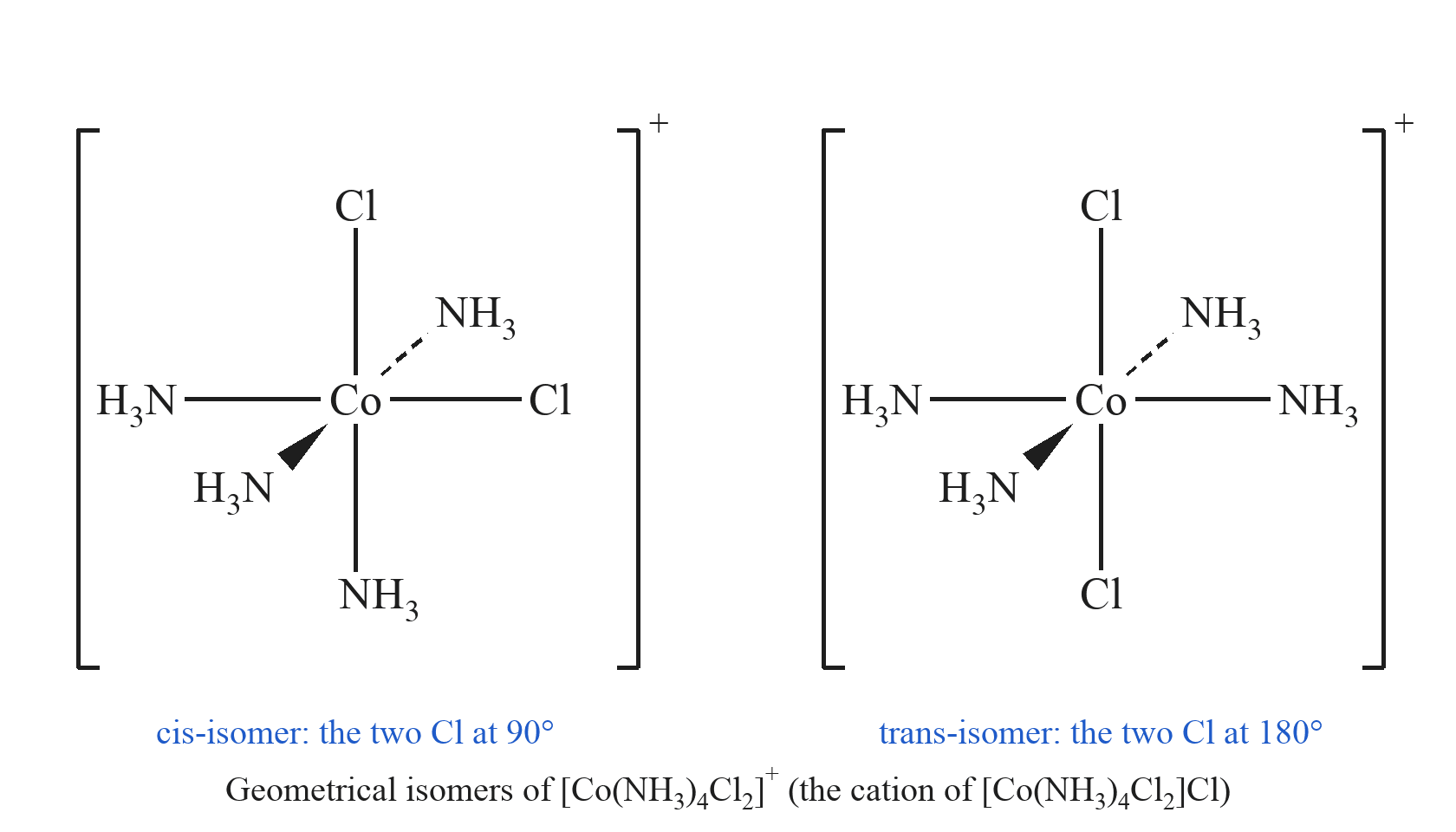
The cation is octahedral, of the type [MA4B2]. The two Cl atoms can be next to each other (cis, 90°) or opposite each other (trans, 180°).
Step 5 — Part (b): plan the test.
The two compounds have the same formula, but different ions are outside the coordination sphere. [Co(NH3)5Cl]SO4 gives free sulphate ions; [Co(NH3)5SO4]Cl gives free chloride ions.
Step 6 — Part (b): describe the test.
Add barium chloride solution to a solution of each. [Co(NH3)5Cl]SO4 gives a white precipitate of barium sulphate; [Co(NH3)5SO4]Cl gives none.
Ba2++SO42−→BaSO4
Add silver nitrate solution to fresh samples. [Co(NH3)5SO4]Cl gives a white precipitate of silver chloride; [Co(NH3)5Cl]SO4 gives none. Since each compound gives a different ion in solution, they are ionisation isomers.
Therefore, (a) the compound is [Co(NH3)4Cl2]Cl, tetraamminedichloridocobalt(III) chloride, with cis and trans geometrical isomers as shown; (b) [Co(NH3)5Cl]SO4 gives a white precipitate with BaCl2 and [Co(NH3)5SO4]Cl gives a white precipitate with AgNO3.
