
Question 891 markMedium
Draw structures of (i) Zeise's salt anion, (ii) .
Confirming your payment
Sign up now and get 250 free tokens.
Coordination Compounds · Question 89 of 115
Draw structures of (i) Zeise's salt anion, (ii) .
Solution:
Key idea: Zeise's salt, , is a π-bonded organometallic compound of platinum(II). Trimethylaluminium is electron-deficient and exists as the dimer , held together by bridging methyl groups.
Step 1 — Find the oxidation state and shape of Pt in (i).
The anion has a charge of , each chloride is and ethene is neutral. Let be the oxidation state of platinum.
Pt(II) is and forms four bonds, so the anion is square planar.
Step 2 — Describe how ethene is bonded in (i).
Ethene occupies the fourth corner of the square. It bonds side-on () through its C=C π electrons, and platinum donates electrons back into the empty orbital of ethene. The C=C axis is perpendicular to the plane.
Step 3 — Explain why trimethylaluminium dimerises in (ii).
In monomeric aluminium has only six valence electrons. Two molecules join so that two methyl groups bridge the two Al atoms, each through a three-centre two-electron Al–C–Al bond.
Step 4 — Describe the structure in (ii).
Each Al atom is bonded to two bridging and two terminal groups, so each Al is roughly tetrahedral. The bridging Al–C bonds are longer than the terminal ones. In the sketch the two middle groups are the bridging ones.
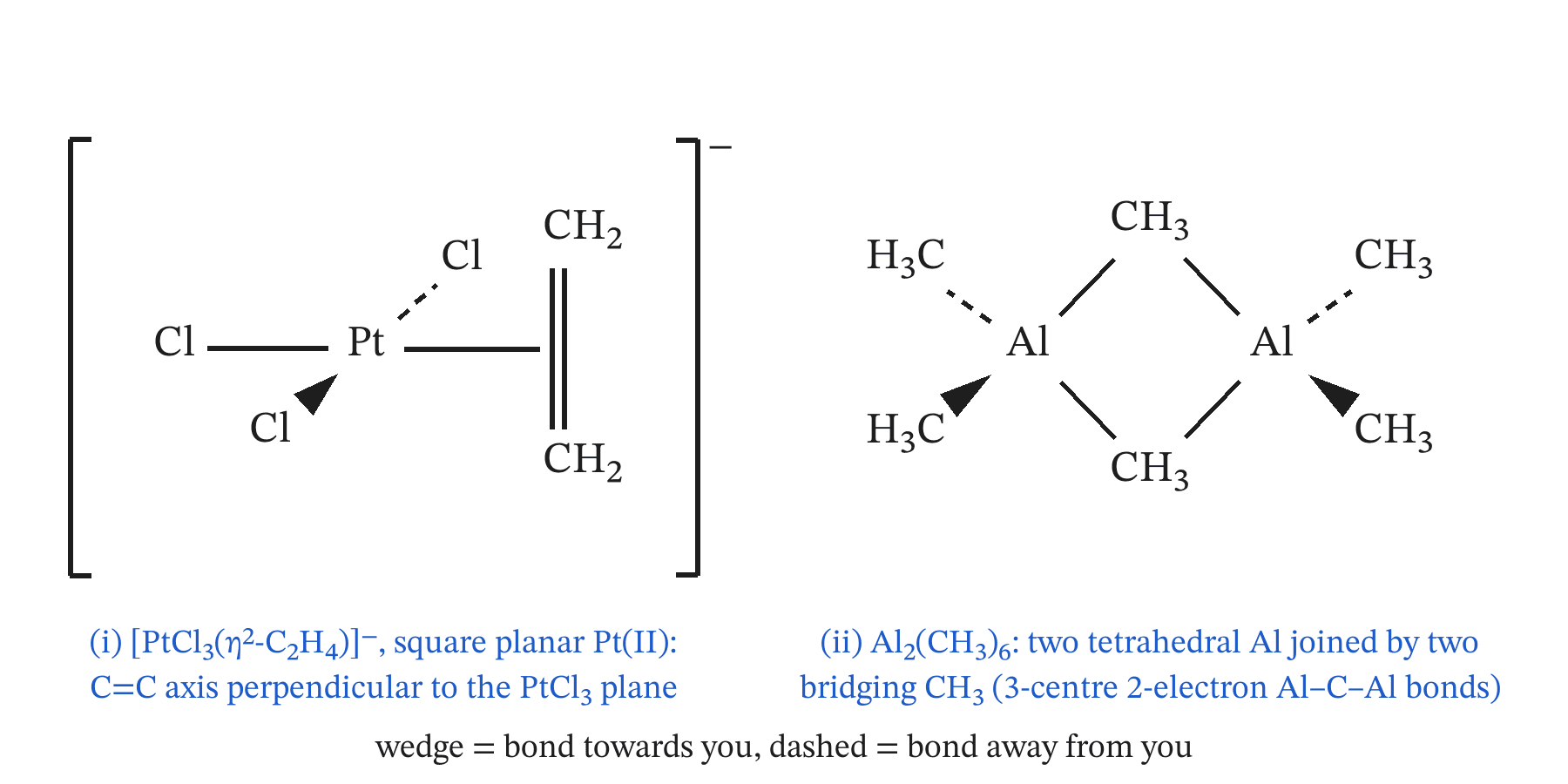
Therefore, (i) the Zeise's salt anion [PtCl₃(C₂H₄)]⁻ is square planar about Pt(II), with three Cl and one ethene bonded side-on through its C=C π bond perpendicular to the PtCl₃ plane, and (ii) [Al(CH₃)₃]₂ has two tetrahedral Al atoms joined by two bridging CH₃ groups (three-centre two-electron bonds), each Al also carrying two terminal CH₃ groups.