
Opening your dashboard
Class 11 Chemistry Chapter 15: Environmental Chemistry Solutions
122 textbook questions with step-by-step answers, free to read, for ISC 2026-27.
Get talked through Ch 15, not just shown the answer
Reading a finished solution is not the same as being able to do it. The AI tutor takes one question at a time and works it with you, in your own words, until you can.
- Ask it out loud, in your own words
- It gives you the next step, not the answer
- Stuck on part (ii)? Start there
122 questions with solutions
1–5 marks · Mixed difficulty
The first 115 solutions are on this page. This chapter is a long one, so the rest open on their own page to keep this one quick to load.
- 11 mark
Question 1
The smog is essentially caused by the presence of
Solve with AIAnswer
- Correct
(A) oxides of sulphur and nitrogen
(B) and
(C) and
(D) and
Answer: (A) oxides of sulphur and nitrogen
Key idea: There are two kinds of smog. Classical (London) smog forms in cool, humid winter mornings from smoke, fog and sulphur dioxide; it is reducing in nature. Photochemical (Los Angeles) smog forms on warm, dry, sunny days when sunlight acts on nitrogen oxides and hydrocarbons from vehicle exhausts; it contains ozone, , PAN and aldehydes and is oxidising in nature.
Step 1 — Look at what both kinds of smog need. Classical smog needs sulphur dioxide (with smoke and fog), and photochemical smog starts from nitrogen oxides (with hydrocarbons and sunlight).
Step 2 — Pick the option that names these pollutants. Only option (A) names the oxides of sulphur and nitrogen, which are the pollutants behind smog.
Why the other options are wrong:
- (B) Oxygen and nitrogen are the normal main gases of clean air (about 21 % and 78 %); they are present everywhere, so they cannot be the cause of smog.
- (C) Oxygen is a normal part of air, and ozone is a product formed inside photochemical smog, not the pollutant that starts it.
- (D) Nitrogen is the harmless main gas of air, and ozone is formed inside photochemical smog rather than being its cause.
Note: the book prints this question again as MCQ Q20, with the options in a different order.
Therefore, smog is essentially caused by oxides of sulphur and nitrogen.
- 21 mark
Question 2
The greenhouse effect is because of the
Solve with AIAnswer
- Correct
(A) presence of gases, which in general are strong infrared absorbers, in the atmosphere
(B) presence of only in the atmosphere
(C) presence of and in the atmosphere
(D) and chlorofluorohydrocarbons in the atmosphere
Answer: (A) presence of gases, which in general are strong infrared absorbers, in the atmosphere
Key idea: The earth's surface, warmed by sunlight, gives out long-wave infrared radiation. Gases that absorb infrared radiation (greenhouse gases) take up part of this heat and send it back towards the earth, keeping the surface warm.
Step 1 — Name the greenhouse gases. Water vapour, carbon dioxide, methane, nitrous oxide, ozone and CFCs all absorb infrared radiation, so the effect comes from a whole group of gases.
Step 2 — Choose the option that describes this whole group. Option (A) says the effect is due to gases that are strong infrared absorbers, which covers every greenhouse gas.
Why the other options are wrong:
- (B) Carbon dioxide is an important greenhouse gas, but the word 'only' makes this false: water vapour, methane, nitrous oxide, ozone and CFCs trap heat too.
- (C) Ozone and methane are greenhouse gases, but they are only two of them; this option leaves out water vapour and carbon dioxide, which matter most.
- (D) Nitrous oxide and CFCs do trap heat, but they are minor contributors compared with water vapour and carbon dioxide, so they do not explain the effect as a whole.
Note: option (C) is printed as 'pressure of'; it is read here as 'presence of'.
Therefore, the greenhouse effect is due to gases in the atmosphere that are strong absorbers of infrared radiation.
- 31 mark
Question 3
Which of the following is/are the hazardous pollutant(s) present in automobile exhaust gases?
P.
Q. CO
R.
S. Oxides of nitrogen
Solve with AIAnswer
(A) Q and R
(B) P and Q
- Correct
(C) Q and S
(D) P and R
Answer: (C) Q and S
Key idea: Petrol and diesel engines burn fuel in air at a high temperature. Incomplete burning gives carbon monoxide, and the hot engine makes nitrogen and oxygen of the air combine to give nitrogen oxides. Both are poisonous.
Step 1 — Judge each item. P, nitrogen, is the harmless main gas of air that passes through the engine. Q, carbon monoxide, is a poisonous gas that blocks the oxygen-carrying haemoglobin of blood. R, methane, is non-toxic; it is a greenhouse gas but not a hazard to health in exhaust. S, the oxides of nitrogen, harm the lungs and start photochemical smog and acid rain.
Step 2 — Pick the pair. The hazardous pollutants are therefore Q and S.
Why the other options are wrong:
- (A) This pair includes R, methane, which is non-toxic; unburnt hydrocarbons do add to smog, but methane is the least reactive of them and is not counted as a hazardous exhaust pollutant.
- (B) This pair includes P, nitrogen, which is the harmless main gas of air.
- (D) Neither P (nitrogen) nor R (methane) is poisonous, so this pair contains no hazardous pollutant at all.
Therefore, the hazardous pollutants in automobile exhaust are carbon monoxide and oxides of nitrogen (Q and S).
- 41 mark
Question 4
Green chemistry means such reactions which
Solve with AIAnswer
(A) produce colour during reactions
- Correct
(B) reduce the use and production of hazardous chemicals
(C) are related to the depletion of ozone layer
(D) study the reactions in plants
Answer: (B) reduce the use and production of hazardous chemicals
Key idea: Green chemistry is a way of thinking about chemistry that designs products and processes so as to reduce or remove the use and production of hazardous substances, using existing knowledge to cut pollution at its source.
Step 1 — Recall the aim of green chemistry. Its aim is to prevent pollution by choosing safer starting materials, solvents and routes, so that harmful chemicals are neither used nor formed.
Step 2 — Match the aim with an option. Option (B) states exactly this aim.
Why the other options are wrong:
- (A) The word 'green' does not refer to colour; colour changes in a reaction have nothing to do with green chemistry.
- (C) Ozone depletion is caused by chemicals such as CFCs; green chemistry tries to replace such chemicals, but it is not defined as reactions related to ozone depletion.
- (D) Reactions in plants are studied in plant physiology and biochemistry, not in green chemistry.
Note: this question appears twice in the book (MCQ Q4 and MCQ Q31).
Therefore, green chemistry means reactions that reduce the use and production of hazardous chemicals.
- 51 mark
Question 5
Select the false statement
Solve with AIAnswer
(A) Photochemical smog is oxidising in nature.
(B) Photochemical smog contains and which are formed during sequence of reaction.
(C) Greenhouse effect was observed in homes used to grow plants.
- Correct
(D) The houses in which greenhouse effect was observed are made of green glass.
Answer: (D) The houses in which greenhouse effect was observed are made of green glass.
Key idea: A greenhouse (glasshouse) is a building with walls and roof of ordinary clear glass. Sunlight passes in and warms the soil and plants; the heat given out cannot easily escape, so the inside stays warm. The warming of the earth by certain gases was named after it.
Step 1 — Check statement D. Greenhouses are made of clear glass so that as much sunlight as possible reaches the plants; tinted green glass would cut out light. The 'green' in greenhouse refers to the plants grown in it, so statement D is false.
Step 2 — Check the other statements. Statement A is true: photochemical smog contains ozone, and PAN, which are oxidising. Statement C is true: the effect was first noticed in glasshouses used to grow plants.
Why the other options are wrong:
- (A) This statement is true, because ozone, nitrogen dioxide and PAN in photochemical smog are strong oxidising agents.
- (B) The intended point is true: nitrogen dioxide is formed in the chain of reactions in photochemical smog (from NO), so this statement is taken as correct, although its mention of carbon dioxide is loose wording.
- (C) This statement is true, because the warming effect was first observed in glasshouses used for growing plants.
Note: statement (B) is loosely worded: the characteristic products of photochemical smog are ozone, , PAN and aldehydes; carbon dioxide is present in all air and is not a typical smog product. The printed answer, (D), is kept because (D) is plainly false.
Therefore, the false statement is that greenhouses are made of green glass.
- 61 mark
Question 6
Select the correct statement(s)
(a) pH of acid rain is less than 5.6
(b) as well as oxides of N and S dissolve in to form acid rain
(c) is one of the important greenhouse gases.
(d) is largely produced by the combustion of fossil fuels like coal, natural gas, petroleum.
Solve with AIWritten solution
Solution:
Key idea: Normal rain is slightly acidic (pH about 5.6) because it dissolves carbon dioxide; rain with a pH below 5.6 is called acid rain. Carbon dioxide also traps infrared radiation, so it is a greenhouse gas.
Step 1 — Check statement (a). Rain in contact with the carbon dioxide of air has a pH of about 5.6, so acid rain is defined as rain with a pH below 5.6. Statement (a) is correct.
Step 2 — Check statement (b). Carbon dioxide dissolves to give carbonic acid, and the oxides of sulphur and nitrogen give sulphuric and nitric acids; together these make up the acid in acid rain. Statement (b) is correct.
Step 3 — Check statement (c). Carbon dioxide absorbs infrared radiation from the earth's surface and is the most important greenhouse gas released by human activity. Statement (c) is correct.
Step 4 — Check statement (d). Burning coal, natural gas and petroleum products is the largest human source of carbon dioxide. Statement (d) is correct.
Note: this item has more than one correct choice; all four statements are correct.
Therefore, all four statements (a), (b), (c) and (d) are correct.
- 71 mark
Question 7
Select the correct statements.
(a) If BOD level of in a reservoir is less than 5 ppm, water is highly polluted.
(b) High BOD means low activity of bacteria in
(c) , , , and chlorofluorocarbons (CFCs) are called greenhouse gases
(d) Acid rain contains , , and small amount of HCl.
Solve with AIWritten solution
Solution:
Key idea: Biochemical oxygen demand (BOD) is the amount of oxygen used by bacteria to break down the organic matter in a sample of water. Clean water has a BOD below 5 ppm; highly polluted water has a BOD of 17 ppm or more.
Step 1 — Check statement (a). A BOD below 5 ppm means there is little organic matter for bacteria to break down, so the water is clean, not polluted. Statement (a) is wrong.
Step 2 — Check statement (b). A high BOD means bacteria are using a lot of oxygen, because they are very active in breaking down a large amount of organic waste. Statement (b) is wrong.
Step 3 — Check statement (c). Carbon dioxide, methane, nitrous oxide, ozone and CFCs all absorb infrared radiation, so all are greenhouse gases. Statement (c) is correct.
Step 4 — Check statement (d). Acid rain contains mainly sulphuric acid and nitric acid, with carbonic acid from dissolved carbon dioxide and a little hydrochloric acid. Statement (d) is correct.
Note: this item has more than one correct choice; statements (c) and (d) are both correct.
Therefore, the correct statements are (c) and (d).
- 81 mark
Question 8
Select the incorrect statement.
Solve with AIAnswer
- Correct
(A) London smog is oxidising in nature
(B) Photochemical smog is oxidising in nature
(C) COD of can be measured in a few minutes but the measurement of BOD requires at least 5 days.
(D) NO and freons are the main compounds which cause damage to layer.
Answer: (A) London smog is oxidising in nature
Key idea: There are two kinds of smog. Classical (London) smog forms in cool, humid winter mornings from smoke, fog and sulphur dioxide; it is reducing in nature. Photochemical (Los Angeles) smog forms on warm, dry, sunny days when sunlight acts on nitrogen oxides and hydrocarbons from vehicle exhausts; it contains ozone, , PAN and aldehydes and is oxidising in nature.
Step 1 — Check statement A. London (classical) smog contains sulphur dioxide and soot; sulphur dioxide is a reducing agent, so London smog is reducing, not oxidising. Statement A is incorrect.
Step 2 — Check the remaining statements. Statement B is correct, as photochemical smog contains ozone, and PAN. Statement D is correct: nitric oxide (from supersonic jets) and freons (CFCs) destroy ozone. Statement C is broadly correct, because COD is measured in hours while BOD needs 5 days.
Why the other options are wrong:
- (B) This statement is correct, because the ozone, nitrogen dioxide and PAN in photochemical smog are oxidising agents.
- (C) This statement is broadly correct: COD is found by heating the sample with acidified potassium dichromate, which takes a few hours, while BOD needs 5 days of incubation.
- (D) This statement is correct, because nitric oxide and freons (CFCs) both destroy ozone in the stratosphere.
Note: the standard COD test takes about 2 to 3 hours rather than a few minutes, but it is still far quicker than the 5-day BOD test, so statement (C) is taken as correct.
Therefore, the incorrect statement is that London smog is oxidising in nature.
- 91 mark
Question 9
Dinitrogen and dioxygen are main constituents of air but these do not react with each other to form oxides of nitrogen because ________ .
Solve with AIAnswer
- Correct
(A) the reaction is endothermic and requires very high temperature.
(B) the reaction can be initiated only in presence of a catalyst.
(C) oxides of nitrogen are unstable
(D) and are unreactive.
Answer: (A) the reaction is endothermic and requires very high temperature.
Key idea: Nitrogen and oxygen combine to give nitric oxide only when much energy is supplied, because the reaction is endothermic and the very strong triple bond must be broken first.
Step 1 — Write the reaction. Nitrogen and oxygen give nitric oxide.
This reaction absorbs about 180 kJ of heat for every mole of nitrogen that reacts.
Step 2 — See when it happens. Because it takes in so much energy, it occurs only at very high temperatures, such as in a lightning flash, in furnaces and in car engines, where the gas is heated well above 1000 °C. At the ordinary temperature of air it does not take place.
Why the other options are wrong:
- (B) No catalyst is needed: in lightning and hot engines the two gases combine directly, simply because the temperature is high enough.
- (C) Nitric oxide is indeed thermodynamically unstable at room temperature, but that is just another way of saying the forming reaction is endothermic; option (A) gives the actual reason, which also explains why it forms at high temperature.
- (D) Only nitrogen is unreactive; oxygen is a very reactive gas that supports burning and combines with most elements.
Therefore, nitrogen and oxygen do not combine in air because the reaction is endothermic and needs a very high temperature.
- 101 mark
Question 10
Which of the following is the coldest region?
Solve with AIAnswer
(A) Troposphere
- Correct
(B) Mesosphere
(C) Stratosphere
(D) Thermosphere
Answer: (B) Mesosphere
Key idea: The atmosphere is divided by height into the troposphere (from the ground up to about 10–11 km), the stratosphere (up to about 50 km), the mesosphere (about 50–85 km), the thermosphere (85 km to a few hundred km) and the outermost exosphere.
Step 1 — Follow the temperature with height. In the troposphere the temperature falls from about 15 °C to about −56 °C; in the stratosphere it rises again to about −2 °C because ozone absorbs UV light; in the mesosphere it falls to about −92 °C; in the thermosphere it rises to over 1000 °C.
Step 2 — Find the lowest temperature. The lowest temperature, about −92 °C, is reached at the top of the mesosphere.
Why the other options are wrong:
- (A) The troposphere cools only to about −56 °C at its top, which is much warmer than the top of the mesosphere.
- (C) The stratosphere warms with height, from about −56 °C to about −2 °C, because ozone absorbs ultraviolet light.
- (D) The thermosphere is the hottest layer, reaching over 1000 °C, because its thin gas absorbs high-energy radiation from the sun.
Therefore, the mesosphere is the coldest region of the atmosphere.
- 111 mark
Question 11
Which of the following is the uppermost region of the atmosphere?
Solve with AIAnswer
(A) Stratosphere
(B) Troposphere
- Correct
(C) Exosphere
(D) Ionosphere
Answer: (C) Exosphere
Key idea: The atmosphere is divided by height into the troposphere (from the ground up to about 10–11 km), the stratosphere (up to about 50 km), the mesosphere (about 50–85 km), the thermosphere (85 km to a few hundred km) and the outermost exosphere.
Step 1 — Place the layers in order. From the ground upwards the layers are troposphere, stratosphere, mesosphere, thermosphere and exosphere.
Step 2 — Pick the top layer. The exosphere is the outermost layer, from which the lightest gas particles can escape into space.
Why the other options are wrong:
- (A) The stratosphere is only the second layer from the ground (about 10–50 km).
- (B) The troposphere is the lowest layer, in which we live and weather occurs.
- (D) The ionosphere is the ionised part of the upper atmosphere lying within the mesosphere and thermosphere; the exosphere lies above it.
Therefore, the exosphere is the uppermost region of the atmosphere.
- 121 mark
Question 12
The gaseous envelope around the earth is known as atmosphere. The lowest layer of this is extended upto 10 km from sea level. This layer is ________
Solve with AIAnswer
(A) Stratosphere
- Correct
(B) Troposphere
(C) Mesosphere
(D) Hydrosphere
Answer: (B) Troposphere
Key idea: The atmosphere is divided by height into the troposphere (from the ground up to about 10–11 km), the stratosphere (up to about 50 km), the mesosphere (about 50–85 km), the thermosphere (85 km to a few hundred km) and the outermost exosphere.
Step 1 — Identify the lowest layer. The layer next to the ground, reaching to about 10 km (8–18 km depending on latitude), is the troposphere; it holds water vapour, clouds and nearly all the air we breathe.
Step 2 — Match it with the options. Option (B) names this layer.
Why the other options are wrong:
- (A) The stratosphere lies above the troposphere, from about 10 km to 50 km, and contains the ozone layer.
- (C) The mesosphere lies higher still, at about 50–85 km.
- (D) The hydrosphere is the water part of the earth (oceans, rivers, lakes), not a layer of the atmosphere.
Therefore, the lowest layer of the atmosphere is the troposphere.
- 131 mark
Question 13
The pollutants which come directly in the air from sources are called primary pollutants. Primary pollutants are sometimes converted into secondary pollutants. Which of the following belongs to secondary air pollutants?
Solve with AIAnswer
(A) CO
(B) Hydrocarbon
- Correct
(C) Peroxyacetyl nitrate
(D) NO
Answer: (C) Peroxyacetyl nitrate
Key idea: A primary pollutant enters the air directly from its source (for example CO, NO, , hydrocarbons). A secondary pollutant is formed in the air by reactions between primary pollutants, often with sunlight (for example ozone, PAN, droplets).
Step 1 — Decide how each one reaches the air. Carbon monoxide, hydrocarbons and nitric oxide all come straight out of exhausts and chimneys, so they are primary.
Step 2 — Identify the secondary one. Peroxyacetyl nitrate (PAN) is not emitted by any source; it forms in the air when hydrocarbons react with nitrogen oxides in sunlight, so it is a secondary pollutant.
Why the other options are wrong:
- (A) Carbon monoxide comes directly from incomplete burning of fuels, so it is a primary pollutant.
- (B) Hydrocarbons are released directly as unburnt fuel and vapour, so they are primary pollutants.
- (D) Nitric oxide is formed in hot engines and furnaces and released directly, so it is a primary pollutant.
Therefore, peroxyacetyl nitrate (PAN) is a secondary air pollutant.
- 141 mark
Question 14
The aromatic compounds present as particulates are
Solve with AIAnswer
(A) Benzene
(B) Toluene
(C) Nitrobenzene
- Correct
(D) Polycyclic hydrocarbons
Answer: (D) Polycyclic hydrocarbons
Key idea: Particulates are tiny solid particles or liquid droplets suspended in air. Large, non-volatile organic molecules such as polycyclic aromatic hydrocarbons (PAH), formed when fuels burn incompletely, stick to soot particles and travel as particulates.
Step 1 — Look at volatility. Benzene, toluene and nitrobenzene are small molecules that evaporate easily, so in air they are present as vapours (gases), not as particles.
Step 2 — Identify the particulate form. Polycyclic aromatic hydrocarbons, such as benzopyrene, have several fused rings, are solids and are adsorbed on soot, so they are present as particulates; many of them cause cancer.
Why the other options are wrong:
- (A) Benzene is a volatile liquid (boiling point 80 °C) and is present in air as a vapour, not as a particulate.
- (B) Toluene is also a volatile liquid (boiling point 111 °C) and is present in air as a vapour.
- (C) Nitrobenzene is a liquid that enters air mainly as vapour; it is not the typical aromatic particulate.
Therefore, the aromatic compounds present as particulates are the polycyclic (aromatic) hydrocarbons.
- 151 mark
Question 15
Which of the following is a secondary pollutant?
Solve with AIAnswer
(A)
(B)
(C)
- Correct
(D) PAN
Answer: (D) PAN
Key idea: A primary pollutant enters the air directly from its source (for example CO, NO, , hydrocarbons). A secondary pollutant is formed in the air by reactions between primary pollutants, often with sunlight (for example ozone, PAN, droplets).
Step 1 — Sort the options. Carbon dioxide, nitrous oxide and sulphur dioxide are all released directly by burning, by soil bacteria or by volcanoes, so they are primary.
Step 2 — Identify the secondary one. PAN (peroxyacetyl nitrate) is formed in the air by photochemical reactions between hydrocarbons and nitrogen oxides, so it is secondary.
Why the other options are wrong:
- (A) Carbon dioxide comes directly from burning fuels and from respiration, so it is primary.
- (B) Nitrous oxide is given out directly by bacteria in soil and from fertilised fields, so it is primary.
- (C) Sulphur dioxide comes directly from burning coal and oil and from volcanoes, so it is primary.
Therefore, PAN is the secondary pollutant.
- 161 mark
Question 16
The size of particulates of fog lies in the range
Solve with AIAnswer
(A) 5–100 nm
(B) 100–500 nm
- Correct
(C) 500–1000 nm
(D) 1000–10000 nm
Answer: (C) 500–1000 nm
Key idea: Particulates range in diameter from about 5 nm (soot) to about 500,000 nm (fly ash). Sulphuric acid and nitric acid form droplets when oxides of sulphur and nitrogen meet moisture, and these droplets lie in the range 500–1000 nm.
Step 1 — Recall how sulphuric acid fog forms. Sulphur dioxide is oxidised and combines with water vapour, giving tiny droplets of sulphuric acid.
Step 2 — Recall the droplet size. These droplets have diameters of 500–1000 nm (0.5–1 μm). Droplets of this size scatter light strongly and form a haze.
Why the other options are wrong:
- (A) Particles of 5–100 nm are the finest particulates, such as fresh soot (about 5 nm); acid droplets are much bigger.
- (B) The range 100–500 nm is smaller than the acid droplets the chapter describes.
- (D) Particles of 1000–10000 nm (1–10 μm) are larger dust and ash particles, bigger than the acid fog droplets.
Therefore, sulphuric acid fog particulates lie in the range 500–1000 nm.
- 171 mark
Question 17
All are primary pollutants except
Solve with AIAnswer
(A)
- Correct
(B)
(C)
(D) Particulate matter
Answer: (B)
Key idea: A primary pollutant enters the air directly from its source (for example CO, NO, , hydrocarbons). A secondary pollutant is formed in the air by reactions between primary pollutants, often with sunlight (for example ozone, PAN, droplets).
Step 1 — Check how sulphuric acid reaches the air. Sulphuric acid is not emitted; it forms in the air when sulphur dioxide is oxidised to sulphur trioxide and dissolves in water droplets.
Step 2 — Classify it. Because it is formed from another pollutant in the air, sulphuric acid is a secondary pollutant; the other options are emitted directly.
Why the other options are wrong:
- (A) Sulphur dioxide comes directly from burning sulphur-containing fuels, so it is a primary pollutant.
- (C) Nitrogen dioxide is listed among the primary pollutants because it is emitted directly from combustion, although more of it also forms in the air from nitric oxide.
- (D) Most particulate matter, such as soot, fly ash and dust, is released directly from its source, so it is counted as a primary pollutant.
Therefore, sulphuric acid is the one that is not a primary pollutant.
- 181 mark
Question 18
Which oxide of nitrogen is not a common pollutant introduced into the atmosphere both due to natural and human activity?
Solve with AIAnswer
(A)
(B)
- Correct
(C)
(D) NO
Answer: (C)
Key idea: The common nitrogen oxides in air are NO, and . Each has natural sources (lightning, soil bacteria) and human sources (combustion, fertilisers).
Step 1 — Check the sources of the common oxides. Nitric oxide and nitrogen dioxide come from lightning in nature and from engines and furnaces made by people. Nitrous oxide comes from soil bacteria in nature and from fertilised farmland and industry made by people.
Step 2 — Find the odd one. Dinitrogen pentoxide is not emitted by any natural or human source; it forms only in tiny amounts in the night air from and ozone, and quickly reacts with water to give nitric acid. It is not a common pollutant.
Why the other options are wrong:
- (A) Nitrous oxide is a common pollutant with both natural sources (soil bacteria) and human sources (fertilisers).
- (B) Nitrogen dioxide is a common pollutant from lightning and from fuel burning.
- (D) Nitric oxide is a common pollutant from lightning and from hot engines and furnaces.
Therefore, dinitrogen pentoxide is not a common pollutant from natural and human activity.
- 191 mark
Question 19
Which of the following is not considered to be a pollutant?
Solve with AIAnswer
(A)
- Correct
(B)
(C)
(D)
Answer: (B)
Key idea: A pollutant is a substance present in the environment in a harmful amount. Carbon dioxide is a natural, normal part of air (needed by plants for photosynthesis), so in the usual classification it is not treated as a pollutant, unlike the others.
Step 1 — Look at each gas. Nitrogen dioxide, ground-level ozone and hydrocarbons are harmful to health even at low concentrations and help to form smog, so they are pollutants.
Step 2 — Identify the exception. Carbon dioxide is a normal component of clean air and is not poisonous at its usual level, so it is the one not usually listed as a pollutant.
Why the other options are wrong:
- (A) Nitrogen dioxide is poisonous, irritates the lungs and forms acid rain and smog, so it is a pollutant.
- (C) Ozone near the ground is a poisonous secondary pollutant found in photochemical smog.
- (D) Hydrocarbons from unburnt fuel are pollutants: they take part in forming photochemical smog, and some are carcinogenic.
Note: Excess carbon dioxide is now regarded as a pollutant because it drives global warming; its level has risen from about 280 ppm before the Industrial Revolution to about 425 ppm (2025 average).
Therefore, carbon dioxide is the one not usually considered a pollutant.
- 201 mark
Question 20
The smog is essentially caused by the presence of
Solve with AIAnswer
(A) and
(B) and
- Correct
(C) Oxides of sulphur and nitrogen
(D) and
Answer: (C) Oxides of sulphur and nitrogen
Key idea: There are two kinds of smog. Classical (London) smog forms in cool, humid winter mornings from smoke, fog and sulphur dioxide; it is reducing in nature. Photochemical (Los Angeles) smog forms on warm, dry, sunny days when sunlight acts on nitrogen oxides and hydrocarbons from vehicle exhausts; it contains ozone, , PAN and aldehydes and is oxidising in nature.
Step 1 — Look at what both kinds of smog need. Classical smog needs sulphur dioxide (with smoke and fog), and photochemical smog starts from nitrogen oxides (with hydrocarbons and sunlight).
Step 2 — Pick the option that names these pollutants. Only option (C) names the oxides of sulphur and nitrogen.
Why the other options are wrong:
- (A) Oxygen is a normal part of air, and ozone is formed inside photochemical smog rather than being the cause of it.
- (B) Oxygen and nitrogen are the normal main gases of clean air, so they cannot be the cause of smog.
- (D) Nitrogen is the harmless main gas of air, and ozone is a product of photochemical smog, not its cause.
Note: this is the same question as MCQ Q1, with the options in a different order.
Therefore, smog is essentially caused by oxides of sulphur and nitrogen.
- 211 mark
Question 21
London smog is found in
Solve with AIAnswer
(A) Summer during day time
(B) Summer during morning time
- Correct
(C) Winter during morning time
(D) Summer during day time
Answer: (C) Winter during morning time
Key idea: There are two kinds of smog. Classical (London) smog forms in cool, humid winter mornings from smoke, fog and sulphur dioxide; it is reducing in nature. Photochemical (Los Angeles) smog forms on warm, dry, sunny days when sunlight acts on nitrogen oxides and hydrocarbons from vehicle exhausts; it contains ozone, , PAN and aldehydes and is oxidising in nature.
Step 1 — Recall the conditions for London smog. London smog needs fog, which forms in cool, damp air; smoke and sulphur dioxide from burning coal are trapped in this fog.
Step 2 — Choose the season and time. Such cold, foggy, still air is found on winter mornings, when the temperature is lowest.
Why the other options are wrong:
- (A) Summer days are warm and dry, with little fog, which suits photochemical smog, not London smog.
- (B) Summer mornings are too warm for the thick fog that London smog needs.
- (D) This option is printed twice; summer day time is the setting of photochemical smog, not London smog.
Note: options (A) and (D) are printed identically ('Summer during day time').
Therefore, London smog is found on winter mornings.
- 221 mark
Question 22
Photochemical smog is formed in
Solve with AIAnswer
(A) Summer during morning time
- Correct
(B) Summer during day time
(C) Winter during morning time
(D) Winter during day time
Answer: (B) Summer during day time
Key idea: There are two kinds of smog. Classical (London) smog forms in cool, humid winter mornings from smoke, fog and sulphur dioxide; it is reducing in nature. Photochemical (Los Angeles) smog forms on warm, dry, sunny days when sunlight acts on nitrogen oxides and hydrocarbons from vehicle exhausts; it contains ozone, , PAN and aldehydes and is oxidising in nature.
Step 1 — Recall what photochemical smog needs. It needs strong sunlight to split , plus nitrogen oxides and hydrocarbons from morning traffic, in warm, dry air.
Step 2 — Choose the season and time. Sunlight is strongest on summer days, so the smog builds up during the day, especially in the afternoon.
Why the other options are wrong:
- (A) On summer mornings the exhaust gases are building up but the sunlight is not yet strong enough; the smog peaks later in the day.
- (C) Winter mornings are cold, damp and dim, which suits London smog, not photochemical smog.
- (D) Winter sunlight is weak, so the photochemical reactions are slow and little of this smog forms.
Therefore, photochemical smog is formed during the day in summer.
- 231 mark
Question 23
Which of the following is true about photochemical smog?
Solve with AIAnswer
(A) It is reducing in nature
(B) It is formed in winter
(C) It is a mixture of smoke and fog
- Correct
(D) It causes irritation in eyes
Answer: (D) It causes irritation in eyes
Key idea: There are two kinds of smog. Classical (London) smog forms in cool, humid winter mornings from smoke, fog and sulphur dioxide; it is reducing in nature. Photochemical (Los Angeles) smog forms on warm, dry, sunny days when sunlight acts on nitrogen oxides and hydrocarbons from vehicle exhausts; it contains ozone, , PAN and aldehydes and is oxidising in nature.
Step 1 — Recall its effects. Ozone, PAN, acrolein and formaldehyde in photochemical smog are strong irritants, so it makes the eyes water and sting and irritates the nose and throat.
Step 2 — Choose the true statement. Option (D) states this effect.
Why the other options are wrong:
- (A) Photochemical smog is oxidising, because of ozone, nitrogen dioxide and PAN; reducing smog is the London type.
- (B) Photochemical smog forms in warm, sunny weather (summer), not in winter.
- (C) A mixture of smoke and fog describes classical (London) smog; photochemical smog contains no real smoke or fog.
Therefore, photochemical smog causes irritation in the eyes.
- 241 mark
Question 24
Which of the following is not involved in formation of photochemical smog?
Solve with AIAnswer
(A) NO
(B)
(C)
- Correct
(D)
Answer: (D)
Key idea: There are two kinds of smog. Classical (London) smog forms in cool, humid winter mornings from smoke, fog and sulphur dioxide; it is reducing in nature. Photochemical (Los Angeles) smog forms on warm, dry, sunny days when sunlight acts on nitrogen oxides and hydrocarbons from vehicle exhausts; it contains ozone, , PAN and aldehydes and is oxidising in nature.
Step 1 — Recall the reactions. Sunlight splits into NO and an oxygen atom, which gives ozone; ozone and NO react, and hydrocarbons react with these to give PAN and aldehydes.
Step 2 — Find the gas that is not part of this cycle. Sulphur dioxide takes no part in these reactions; it is the key gas of London (classical) smog.
Why the other options are wrong:
- (A) Nitric oxide is involved: it is emitted by vehicles and is oxidised to , which starts the reactions.
- (B) Ozone is involved: it is formed in the smog and reacts with nitric oxide and with hydrocarbons.
- (C) Hydrocarbons are involved: they react with ozone and nitrogen oxides to form PAN, formaldehyde and acrolein.
Therefore, sulphur dioxide is not involved in forming photochemical smog.
- 251 mark
Question 25
Photochemical smog occurs in warm, dry and sunny climate. One of the following is not amongst the components of photochemical smog. Identify it.
Solve with AIAnswer
(A)
(B)
- Correct
(C)
(D) Unsaturated hydrocarbons
Answer: (C)
Key idea: There are two kinds of smog. Classical (London) smog forms in cool, humid winter mornings from smoke, fog and sulphur dioxide; it is reducing in nature. Photochemical (Los Angeles) smog forms on warm, dry, sunny days when sunlight acts on nitrogen oxides and hydrocarbons from vehicle exhausts; it contains ozone, , PAN and aldehydes and is oxidising in nature.
Step 1 — List the components of photochemical smog. It contains nitrogen oxides, ozone, unburnt (including unsaturated) hydrocarbons and their products PAN, formaldehyde and acrolein.
Step 2 — Find the gas that does not belong. Sulphur dioxide is a component of London smog, not of photochemical smog.
Why the other options are wrong:
- (A) Nitrogen dioxide is a component: it is the gas whose splitting by sunlight starts the smog.
- (B) Ozone is a main component and is responsible for much of the smog's oxidising power.
- (D) Unsaturated hydrocarbons from exhausts are present and react with ozone to form aldehydes and PAN.
Therefore, sulphur dioxide is not a component of photochemical smog.
- 261 mark
Question 26
Which one of the following statement is false?
Solve with AIAnswer
(A) Photochemical smog causes irritation in eyes
(B) London smog is a mixture of smoke and fog
(C) Photochemical smog results in the formation of PAN
- Correct
(D) London smog is oxidising in nature.
Answer: (D) London smog is oxidising in nature.
Key idea: There are two kinds of smog. Classical (London) smog forms in cool, humid winter mornings from smoke, fog and sulphur dioxide; it is reducing in nature. Photochemical (Los Angeles) smog forms on warm, dry, sunny days when sunlight acts on nitrogen oxides and hydrocarbons from vehicle exhausts; it contains ozone, , PAN and aldehydes and is oxidising in nature.
Step 1 — Check statement D. London smog contains sulphur dioxide and soot; sulphur dioxide is a reducing agent, so London smog is reducing. Statement D is false.
Step 2 — Check the others. Statements A, B and C are all true descriptions of the two kinds of smog.
Why the other options are wrong:
- (A) This statement is true, because ozone, PAN and aldehydes in photochemical smog irritate the eyes.
- (B) This statement is true: the word smog itself comes from smoke and fog, which make up London smog.
- (C) This statement is true, because hydrocarbons react with nitrogen oxides in sunlight to give PAN.
Therefore, the false statement is that London smog is oxidising in nature.
- 271 mark
Question 27
Which of the following statements about photochemical smog is wrong?
Solve with AIAnswer
(A) It has high concentration of oxidising agents.
- Correct
(B) It has low concentration of oxidising agent.
(C) It can be controlled by controlling the release of , hydrocarbons, ozone, etc.
(D) Plantation of some plants like pinus helps in controlling photochemical smog.
Answer: (B) It has low concentration of oxidising agent.
Key idea: There are two kinds of smog. Classical (London) smog forms in cool, humid winter mornings from smoke, fog and sulphur dioxide; it is reducing in nature. Photochemical (Los Angeles) smog forms on warm, dry, sunny days when sunlight acts on nitrogen oxides and hydrocarbons from vehicle exhausts; it contains ozone, , PAN and aldehydes and is oxidising in nature.
Step 1 — Check statements A and B. Photochemical smog is rich in ozone, and PAN, which are oxidising agents, so A is right and B, which says the opposite, is wrong.
Step 2 — Check statements C and D. Cutting the release of the starting pollutants, for example with catalytic converters, controls the smog, so C is right. Plants such as Pinus, Juniperus, Quercus, Pyrus and Vitis can take up nitrogen oxides, so planting them helps, and D is right.
Why the other options are wrong:
- (A) This statement is correct, because ozone, nitrogen dioxide and PAN make the smog strongly oxidising.
- (C) This statement is correct: catalytic converters and cleaner fuels cut the nitrogen oxides and hydrocarbons that start the smog. Ozone itself is not emitted directly, but it falls when these starting pollutants are cut.
- (D) This statement is correct, because these plants can metabolise nitrogen oxides and so lower their level in the air.
Therefore, the wrong statement is that photochemical smog has a low concentration of oxidising agents.
- 281 mark
Question 28
Which of the following statements is not true about classical smog?
Solve with AIAnswer
- Correct
(A) Its main components are produced by the action of sunlight on emissions of automobiles and factories.
(B) Produced in cold and humid climate.
(C) It contains compounds of reducing nature.
(D) It contains smoke, fog and sulphur dioxide.
Answer: (A) Its main components are produced by the action of sunlight on emissions of automobiles and factories.
Key idea: There are two kinds of smog. Classical (London) smog forms in cool, humid winter mornings from smoke, fog and sulphur dioxide; it is reducing in nature. Photochemical (Los Angeles) smog forms on warm, dry, sunny days when sunlight acts on nitrogen oxides and hydrocarbons from vehicle exhausts; it contains ozone, , PAN and aldehydes and is oxidising in nature.
Step 1 — Check statement A. Formation by the action of sunlight on automobile exhausts describes photochemical smog. Classical smog forms from smoke and sulphur dioxide trapped in fog and does not need sunlight, so A is not true of it.
Step 2 — Check the others. Classical smog forms in cold, humid weather (B), is reducing because of sulphur dioxide (C), and consists of smoke, fog and sulphur dioxide (D); all three are true.
Why the other options are wrong:
- (B) This is true of classical smog, which forms in cold, damp, foggy weather.
- (C) This is true, because sulphur dioxide and soot in classical smog are reducing in nature.
- (D) This is true: smoke, fog and sulphur dioxide are the main components of classical smog.
Therefore, the statement not true about classical smog is that it is formed by the action of sunlight on emissions.
- 291 mark
Question 29
Green chemistry deals with
Solve with AIAnswer
(A) study of plant physiology
(B) study of extraction of natural products from plants
(C) detailed study of reaction involved in the synthesis of chlorophyll
- Correct
(D) utilization of existing knowledge base for reducing the chemical hazards along with developmental activities
Answer: (D) utilization of existing knowledge base for reducing the chemical hazards along with developmental activities
Key idea: Green chemistry is a way of thinking about chemistry that designs products and processes so as to reduce or remove the use and production of hazardous substances, using existing knowledge to cut pollution at its source.
Step 1 — Recall the definition. Green chemistry uses what chemists already know to design products and processes that cut down chemical hazards, while still allowing industry and development to go on.
Step 2 — Match it with an option. Option (D) states this definition.
Why the other options are wrong:
- (A) Plant physiology is a branch of biology about how plants work; the word 'green' in green chemistry does not refer to plants.
- (B) Extracting natural products from plants is part of natural-product chemistry; it is not what green chemistry is about.
- (C) The synthesis of chlorophyll is studied in plant biochemistry, not in green chemistry.
Therefore, green chemistry deals with using existing knowledge to reduce chemical hazards along with development.
- 301 mark
Question 30
Which of the following practices will not come under green chemistry?
Solve with AIAnswer
(A) If possible, making use of soap made of vegetable oils instead of using synthetic detergents.
(B) Using for bleaching purpose instead of using chlorine based bleaching agents.
(C) Using bicycle for travelling small distances instead of using petrol/diesel based vehicles.
- Correct
(D) Using plastic cans for neatly storing substances.
Answer: (D) Using plastic cans for neatly storing substances.
Key idea: Green chemistry is a way of thinking about chemistry that designs products and processes so as to reduce or remove the use and production of hazardous substances, using existing knowledge to cut pollution at its source.
Step 1 — Test each practice against the aim. Soap from vegetable oils is made from renewable material and is biodegradable; hydrogen peroxide bleaches and leaves only water, unlike chlorine, which forms harmful chlorinated compounds; cycling burns no fuel. All three reduce pollution.
Step 2 — Identify the odd one. Storing substances in plastic cans does nothing to reduce hazardous chemicals; most plastics are made from petroleum and are not biodegradable, so this practice does not come under green chemistry.
Why the other options are wrong:
- (A) This is a green practice, because soap from vegetable oils comes from a renewable source and is biodegradable.
- (B) This is a green practice, because hydrogen peroxide gives only water and oxygen, while chlorine bleaches can form toxic chlorinated organic compounds.
- (C) This is a green practice, because a bicycle uses no fuel and gives out no exhaust gases.
Therefore, using plastic cans for storing substances does not come under green chemistry.
- 311 mark
Question 31
Green chemistry means such reactions which
Solve with AIAnswer
(A) produce colour during reactions
- Correct
(B) reduce the use and production of hazardous chemicals
(C) are related to the depletion of ozone layer
(D) study the reactions in plants
Answer: (B) reduce the use and production of hazardous chemicals
Key idea: Green chemistry is a way of thinking about chemistry that designs products and processes so as to reduce or remove the use and production of hazardous substances, using existing knowledge to cut pollution at its source.
Step 1 — Recall the aim of green chemistry. Its aim is to prevent pollution by choosing safer starting materials, solvents and routes, so that harmful chemicals are neither used nor formed.
Step 2 — Match the aim with an option. Option (B) states exactly this aim.
Why the other options are wrong:
- (A) The word 'green' does not refer to colour; colour changes in a reaction have nothing to do with green chemistry.
- (C) Ozone depletion is caused by chemicals such as CFCs; green chemistry tries to replace such chemicals, but it is not defined as reactions related to ozone depletion.
- (D) Reactions in plants are studied in plant physiology and biochemistry, not in green chemistry.
Note: this question appears twice in the book (MCQ Q4 and MCQ Q31).
Therefore, green chemistry means reactions that reduce the use and production of hazardous chemicals.
- 321 mark
Question 32
The ozone layer is depleted by
(a) NO
(b)
(c)
(d) CFCs
Solve with AIWritten solution
Solution:
Key idea: Ozone in the stratosphere absorbs harmful ultraviolet (UV) radiation from the sun. It is destroyed by chlorine atoms set free from CFCs (freons) by UV light and by nitric oxide; each chlorine atom destroys thousands of ozone molecules in a chain reaction.
Step 1 — Check (a), nitric oxide. Nitric oxide from supersonic jets reacts with ozone, so it depletes the ozone layer. Choice (a) is correct.
Step 2 — Check (b), sulphur dioxide. Sulphur dioxide causes acid rain and London smog, but it does not destroy stratospheric ozone. Choice (b) is wrong.
Step 3 — Check (c), hydrocarbons. Hydrocarbons take part in photochemical smog near the ground, where they actually help form ozone; they do not deplete the ozone layer. Choice (c) is wrong.
Step 4 — Check (d), CFCs. Ultraviolet light breaks CFCs in the stratosphere, releasing chlorine atoms that destroy ozone in a chain reaction. Choice (d) is correct.
Note: this item has more than one correct choice; both (a) and (d) are correct.
Therefore, the ozone layer is depleted by (a) NO and (d) CFCs.
- 331 mark
Question 33
Ozone in the stratosphere is depleted by
Solve with AIAnswer
- Correct
(A)
(B)
(C)
(D)
Answer: (A)
Key idea: Ozone in the stratosphere absorbs harmful ultraviolet (UV) radiation from the sun. It is destroyed by chlorine atoms set free from CFCs (freons) by UV light and by nitric oxide; each chlorine atom destroys thousands of ozone molecules in a chain reaction.
Step 1 — Find the compound that releases chlorine in the stratosphere. Dichlorodifluoromethane (freon-12) is unreactive and volatile, so it drifts up to the stratosphere unchanged, where UV light breaks a C–Cl bond.
Step 2 — Follow the chain. Each chlorine atom destroys ozone and is regenerated, so one atom destroys many ozone molecules.
Why the other options are wrong:
- (B) This perfluorocarbon contains no chlorine and its C–F bonds are too strong for UV light to break, so it does not deplete ozone (it is, however, a strong greenhouse gas).
- (C) This is benzene hexachloride (BHC), an insecticide. It is a solid of low volatility, and the little that enters the air is broken down in the lower atmosphere, so it does not reach the stratosphere in significant amounts, unlike the very unreactive CFC gases.
- (D) Hexafluorobenzene contains no chlorine and its C–F bonds are very strong, so it does not set free ozone-destroying atoms.
Note: the stem is printed as 'is deleted by'; 'depleted' is meant.
Therefore, ozone in the stratosphere is depleted by (freon-12).
- 341 mark
Question 34
Depletion of ozone layer causes
Solve with AIAnswer
(A) blood cancer
(B) lung cancer
- Correct
(C) skin cancer
(D) breast cancer
Answer: (C) skin cancer
Key idea: Ozone in the stratosphere absorbs harmful ultraviolet (UV) radiation from the sun. It is destroyed by chlorine atoms set free from CFCs (freons) by UV light and by nitric oxide; each chlorine atom destroys thousands of ozone molecules in a chain reaction.
Step 1 — See what reaches us when the ozone layer thins. More UV-B radiation reaches the ground through a thinner ozone layer.
Step 2 — Recall the effect of UV on skin. UV-B damages the DNA of skin cells, so more exposure increases skin cancer, sunburn and ageing of the skin; it also causes cataract in the eyes.
Why the other options are wrong:
- (A) Blood cancer (leukaemia) is linked with exposure to ionising radiation and chemicals such as benzene, not with the ultraviolet light let in by ozone depletion.
- (B) Lung cancer is caused mainly by smoking and by inhaling asbestos fibres and other particulates, not by UV light.
- (D) Breast cancer is not linked to UV light, which acts mainly on the skin and eyes.
Therefore, depletion of the ozone layer causes skin cancer.
- 351 mark
Question 35
The gas emitted by supersonic jet planes that slowly depletes the ozone layer is
Solve with AIAnswer
(A) CO
- Correct
(B) NO
(C)
(D)
(E) HF
Answer: (B) NO
Key idea: Ozone in the stratosphere absorbs harmful ultraviolet (UV) radiation from the sun. It is destroyed by chlorine atoms set free from CFCs (freons) by UV light and by nitric oxide; each chlorine atom destroys thousands of ozone molecules in a chain reaction.
Step 1 — Identify the gas from jet engines. Supersonic jets fly in the stratosphere; their hot engines make nitrogen and oxygen combine to nitric oxide, which is released directly into the ozone layer.
Step 2 — Show how it destroys ozone. Nitric oxide reacts with ozone; the formed can give back NO by reacting with an oxygen atom, so the cycle continues.
Why the other options are wrong:
- (A) Carbon monoxide from engines does not destroy stratospheric ozone in this way.
- (C) Sulphur dioxide is not the gas responsible: it does not destroy ozone in a repeating cycle the way nitric oxide does, and its main harm is acid rain.
- (D) Oxygen is the gas from which ozone is made in the stratosphere, so it cannot deplete the ozone layer.
- (E) Hydrogen fluoride is very stable and does not set free fluorine atoms, so it does not destroy ozone; it is not an exhaust gas of jets.
Therefore, nitric oxide (NO) from supersonic jets slowly depletes the ozone layer.
- 361 mark
Question 36
In Antarctica, ozone depletion is due to the formation of the following compound :
Solve with AIAnswer
(A) Acrolein
(B) peroxyacetylnitrate
(C) and
- Correct
(D) chlorine nitrate
(E) formaldehyde
Answer: (D) chlorine nitrate
Key idea: Ozone in the stratosphere absorbs harmful ultraviolet (UV) radiation from the sun. It is destroyed by chlorine atoms set free from CFCs (freons) by UV light and by nitric oxide; each chlorine atom destroys thousands of ozone molecules in a chain reaction. Over Antarctica the depletion is made far worse by polar stratospheric clouds that form in the very cold winter.
Step 1 — Follow the chlorine in winter. In the stratosphere, chlorine monoxide reacts with nitrogen dioxide to form chlorine nitrate, which holds the chlorine in a reservoir.
Step 2 — See what the polar clouds do. On the ice particles of polar stratospheric clouds, chlorine nitrate reacts with water and with hydrogen chloride, giving hypochlorous acid and chlorine.
Step 3 — See what sunlight does in spring. When the sun returns in spring, light splits HOCl and into chlorine atoms, which rapidly destroy ozone and make the ozone hole.
Why the other options are wrong:
- (A) Acrolein is an eye irritant formed in photochemical smog near the ground; it has no part in Antarctic ozone loss.
- (B) Peroxyacetyl nitrate (PAN) is a photochemical smog pollutant of sunny cities, not a cause of the ozone hole.
- (C) Oxides of sulphur cause acid rain and London smog, not the Antarctic ozone hole.
- (E) Formaldehyde is an irritant formed in photochemical smog; it is not involved in the ozone hole.
Therefore, ozone depletion over Antarctica is linked to the formation of chlorine nitrate.
- 371 mark
Question 37
Which of the following statements is correct?
Solve with AIAnswer
(A) Ozone hole is a hole formed in stratosphere from which ozone oozes out.
(B) Ozone hole is a hole formed in the troposphere from which ozone oozes out.
- Correct
(C) Ozone hole is thinning of ozone layer of stratosphere at some places.
(D) Ozone hole means vanishing of ozone layer around the earth completely.
Answer: (C) Ozone hole is thinning of ozone layer of stratosphere at some places.
Key idea: The ozone hole is a region where the ozone layer in the stratosphere has become much thinner than normal. It was first discovered over Antarctica in 1985.
Step 1 — Recall what the term means. The ozone hole is not a real hole through which ozone leaks out; it is a region, mainly over Antarctica in spring, where much of the ozone has been destroyed, so the layer is thin.
Step 2 — Choose the correct statement. Option (C) describes this thinning of the stratospheric ozone layer at some places.
Why the other options are wrong:
- (A) Ozone does not leak out of a hole; it is destroyed chemically by chlorine atoms where the layer becomes thin.
- (B) The ozone layer is in the stratosphere, not the troposphere, and ozone does not leak out of any hole.
- (D) The ozone layer has not vanished: the thinning is mainly over the polar regions, and ozone is still present over the rest of the earth.
Therefore, the ozone hole is the thinning of the stratospheric ozone layer at some places.
- 381 mark
Question 38
Which of the following statements is wrong?
Solve with AIAnswer
- Correct
(A) Ozone is not responsible for greenhouse effect.
(B) Ozone can oxidise sulphur dioxide present in the atmosphere to sulphur trioxide.
(C) Ozone hole is thinning of ozone layer present in stratosphere.
(D) Ozone is produced in upper stratosphere by the action of UV rays on oxygen.
Answer: (A) Ozone is not responsible for greenhouse effect.
Key idea: Ozone () is a strong oxidising agent and it absorbs infrared radiation as well as ultraviolet light, so it is also a greenhouse gas.
Step 1 — Check statement A. Ozone molecules absorb infrared radiation, so ozone is one of the greenhouse gases. Statement A, which says it is not responsible for the greenhouse effect, is wrong.
Step 2 — Check the other statements. Statement B is right: ozone oxidises sulphur dioxide. Statement C is the correct meaning of the ozone hole. Statement D is right: UV light splits oxygen molecules and the atoms join oxygen molecules to form ozone.
Why the other options are wrong:
- (B) This statement is right, because ozone is a strong oxidising agent that converts sulphur dioxide to sulphur trioxide.
- (C) This statement is right: the ozone hole is a thinning of the stratospheric ozone layer.
- (D) This statement is right, because UV light splits oxygen molecules into atoms that combine with more oxygen to form ozone.
Therefore, the wrong statement is that ozone is not responsible for the greenhouse effect.
- 391 mark
Question 39
Which one of the following is responsible for depletion of the ozone layer in the upper strata of the atmosphere?
Solve with AIAnswer
(A) polyhalogens
(B) ferrocene
(C) fullerenes
- Correct
(D) freons
Answer: (D) freons
Key idea: Ozone in the stratosphere absorbs harmful ultraviolet (UV) radiation from the sun. It is destroyed by chlorine atoms set free from CFCs (freons) by UV light and by nitric oxide; each chlorine atom destroys thousands of ozone molecules in a chain reaction.
Step 1 — Identify the ozone-destroying compounds. Freons are chlorofluorocarbons, such as and , once widely used in refrigerators, air conditioners and aerosol sprays.
Step 2 — Explain why they destroy ozone. Freons are unreactive near the ground, so they drift up to the stratosphere, where UV light frees chlorine atoms that destroy ozone in a chain reaction.
Why the other options are wrong:
- (A) Polyhalogen compounds are a very wide class (any compound with several halogen atoms, such as , and DDT); most of them are broken down in the lower atmosphere, so the class as a whole is not what depletes the ozone layer.
- (B) Ferrocene is an iron sandwich compound used in research and as a fuel additive; it is not an ozone-depleting substance.
- (C) Fullerenes are cage-shaped forms of carbon; they are not released into the atmosphere and do not destroy ozone.
Note: freons are themselves polyhalogen compounds, so (A) is true in a wide sense; (D) names the specific compounds responsible and is the expected answer.
Therefore, freons are responsible for depletion of the ozone layer.
- 401 mark
Question 40
Ozone layer is present in
Solve with AIAnswer
(A) troposphere
- Correct
(B) stratosphere
(C) mesosphere
(D) exosphere
Answer: (B) stratosphere
Key idea: Most of the earth's ozone lies in a layer about 15–35 km above the ground, with the highest concentration at about 20–25 km (a little higher over the tropics).
Step 1 — Place this height among the layers. The stratosphere stretches from about 10 km to 50 km, so the ozone layer lies within it; this layer is also called the ozonosphere.
Step 2 — Choose the option. Option (B) names the stratosphere.
Why the other options are wrong:
- (A) The troposphere is the lowest 10 km; ozone here is a pollutant formed in smog, not the protective ozone layer.
- (C) The mesosphere, at 50–85 km, lies above the ozone layer.
- (D) The exosphere is the outermost, very thin layer of the atmosphere, far above the ozone layer.
Therefore, the ozone layer is present in the stratosphere.
- 411 mark
Question 41
Among the following, the one which is not a 'greenhouse gas' is
Solve with AIAnswer
(A)
(B)
(C)
- Correct
(D)
Answer: (D)
Key idea: A greenhouse gas absorbs the infrared radiation given out by the earth's surface. Gases whose molecules change their dipole moment when they vibrate, such as , , , , and CFCs, absorb infrared radiation. Molecules made of two identical atoms, such as and , do not.
Step 1 — Look for a molecule of two identical atoms. Oxygen, , is made of two identical atoms, so its vibration does not change any dipole moment and it does not absorb infrared radiation.
Step 2 — Classify the others. Nitrous oxide, carbon dioxide and methane all absorb infrared radiation and are greenhouse gases.
Why the other options are wrong:
- (A) Nitrous oxide absorbs infrared radiation strongly and is an important greenhouse gas.
- (B) Carbon dioxide is the most important greenhouse gas released by human activity.
- (C) Methane is a powerful greenhouse gas, trapping much more heat per molecule than carbon dioxide.
Therefore, oxygen is not a greenhouse gas.
- 421 mark
Question 42
Which of the following gases is not a greenhouse gas?
Solve with AIAnswer
- Correct
(A) CO
(B)
(C)
(D) vapour
Answer: (A) CO
Key idea: A greenhouse gas absorbs the infrared radiation given out by the earth's surface. Gases whose molecules change their dipole moment when they vibrate, such as , , , , and CFCs, absorb infrared radiation. Molecules made of two identical atoms, such as and , do not.
Step 1 — Check each gas. Ozone, methane and water vapour absorb infrared radiation strongly and are standard greenhouse gases; water vapour is in fact the largest natural contributor.
Step 2 — Identify the exception. Carbon monoxide does absorb infrared radiation, but only in a narrow band near 4.7 μm, where the earth gives out little radiation, and its level in air is very low. Its direct effect is therefore very small, so it is not counted among the greenhouse gases.
Why the other options are wrong:
- (B) Ozone absorbs infrared radiation and is a greenhouse gas, as well as being the UV shield in the stratosphere.
- (C) Methane is a strong greenhouse gas released from paddy fields, cattle and landfills.
- (D) Water vapour is the most abundant greenhouse gas in the atmosphere.
Note: carbon monoxide has only a very small direct greenhouse effect; it adds to warming indirectly, because it uses up the OH radicals that would otherwise destroy methane.
Therefore, carbon monoxide is not a greenhouse gas.
- 431 mark
Question 43
Which of the following is not a greenhouse gas?
Solve with AIAnswer
(A) Methane
(B) Ozone
(C) Carbon dioxide
- Correct
(D) Nitrogen
Answer: (D) Nitrogen
Key idea: A greenhouse gas absorbs the infrared radiation given out by the earth's surface. Gases whose molecules change their dipole moment when they vibrate, such as , , , , and CFCs, absorb infrared radiation. Molecules made of two identical atoms, such as and , do not.
Step 1 — Look for a molecule of two identical atoms. Nitrogen, , consists of two identical atoms, so it does not absorb infrared radiation, even though it makes up about 78 % of the air.
Step 2 — Classify the others. Methane, ozone and carbon dioxide all absorb infrared radiation and are greenhouse gases.
Why the other options are wrong:
- (A) Methane absorbs infrared radiation strongly and is a greenhouse gas.
- (B) Ozone absorbs infrared radiation and is a greenhouse gas.
- (C) Carbon dioxide is a major greenhouse gas.
Therefore, nitrogen is not a greenhouse gas.
- 441 mark
Question 44
The acids present in acid rain are ________ .
(a) Peroxyacetylnitrate
(b)
(c)
(d)
Solve with AIWritten solution
Solution:
Key idea: Rain becomes acid mainly because sulphur dioxide and nitrogen oxides in the air are oxidised and dissolve in rain water, giving sulphuric acid and nitric acid; dissolved carbon dioxide adds a little carbonic acid, and a small amount of hydrochloric acid is also present.
Step 1 — Check (a), peroxyacetylnitrate. PAN is an oxidising, eye-irritating compound of photochemical smog; it is not one of the acids of acid rain. Choice (a) is wrong.
Step 2 — Check (b), carbonic acid. Carbon dioxide dissolves in rain to give carbonic acid, which makes even normal rain slightly acidic. Choice (b) is correct.
Step 3 — Check (c), nitric acid. Nitrogen dioxide reacts with oxygen and water to give nitric acid. Choice (c) is correct.
Step 4 — Check (d), sulphuric acid. Sulphur dioxide is oxidised and dissolved to give sulphuric acid, the main acid of acid rain. Choice (d) is correct.
Note: this item has more than one correct choice; (b), (c) and (d) are all correct.
Therefore, the acids present in acid rain are (b) carbonic acid, (c) nitric acid and (d) sulphuric acid.
- 451 mark
Question 45
Which of the following is present in maximum amount in acid rain?
Solve with AIAnswer
(A)
- Correct
(B)
(C) HCl
(D)
Answer: (B)
Key idea: Rain becomes acid mainly because sulphur dioxide and nitrogen oxides in the air are oxidised and dissolve in rain water, giving sulphuric acid and nitric acid; dissolved carbon dioxide adds a little carbonic acid, and a small amount of hydrochloric acid is also present.
Step 1 — Compare the shares of the acids. Sulphuric acid makes up the largest share of the acidity of acid rain, about 60–70 %; nitric acid makes up about 30–40 %, and hydrochloric acid the least.
Step 2 — Choose the option. So sulphuric acid is present in the largest amount.
Why the other options are wrong:
- (A) Nitric acid is the second most important acid, with about 30–40 % of the acidity.
- (C) Hydrochloric acid is present only in small amounts.
- (D) Carbonic acid is a very weak acid; it only lowers the pH of normal rain to about 5.6 and is not the main acid of acid rain.
Note: the 60–70 % share is the classic textbook figure. Where sulphur dioxide emissions have been cut sharply (Europe and North America since about 1990), nitric acid now supplies a much larger share, in some places the larger one.
Therefore, sulphuric acid is present in the maximum amount in acid rain.
- 461 mark
Question 46
Phosphate containing fertilisers cause water pollution. Addition of such compounds in water bodies causes ________ .
(a) enhanced growth of algae
(b) decrease in amount of dissolved oxygen in water
(c) deposition of calcium phosphate
(d) increase in fish population
Solve with AIWritten solution
Solution:
Key idea: Phosphates and nitrates are plant nutrients. When fertiliser run-off or sewage adds them to lakes, algae grow very fast (an algal bloom). When the algae die, bacteria decompose them and use up the dissolved oxygen, so fish and other animals die. This nutrient enrichment of water is called eutrophication.
Step 1 — Check (a). Phosphate is a nutrient that algae need, so adding it makes algae grow much faster. Choice (a) is correct.
Step 2 — Check (b). When the extra algae die, bacteria decompose them and use up much of the dissolved oxygen. Choice (b) is correct.
Step 3 — Check (c). Some phosphate does bind to calcium, iron or aluminium and settle into the sediment, but that only stores phosphorus in the mud; the effect that phosphate fertilisers are known for is the fast growth of algae they feed. Choice (c) is not the expected answer.
Step 4 — Check (d). The fall in dissolved oxygen kills fish, so the fish population goes down, not up. Choice (d) is wrong.
Note: this item has more than one correct choice; both (a) and (b) are correct.
Therefore, phosphate fertilisers in water cause (a) enhanced growth of algae and (b) a decrease in dissolved oxygen.
- 471 mark
Question 47
Excess nitrate in drinking water can cause
Solve with AIAnswer
- Correct
(A) methemoglobinemia
(B) kidney damage
(C) liver damage
(D) laxative effect
(E) leucoderma
Answer: (A) methemoglobinemia
Key idea: The maximum limit of nitrate in drinking water is 50 ppm. In the body, excess nitrate is reduced to nitrite, which oxidises the iron of haemoglobin from Fe²⁺ to Fe³⁺, giving methaemoglobin, which cannot carry oxygen.
Step 1 — Follow the nitrate in the body. Bacteria in the gut, especially in infants, reduce nitrate to nitrite, and nitrite turns haemoglobin into methaemoglobin.
Step 2 — Name the disease. The blood then carries less oxygen and the skin of the baby turns bluish; the disease is called methaemoglobinaemia or 'blue baby syndrome'.
Why the other options are wrong:
- (B) Kidney damage is linked with heavy metals such as cadmium, lead and mercury in water, not with nitrate.
- (C) Liver damage is not the recognised effect of excess nitrate; the known effect is on the blood.
- (D) A laxative effect is caused by excess sulphate (above about 500 ppm) in drinking water, not by nitrate.
- (E) Leucoderma is a loss of skin colour; it is not caused by nitrate in drinking water.
Therefore, excess nitrate in drinking water causes methaemoglobinaemia (blue baby syndrome).
- 481 mark
Question 48
Sewage containing organic waste should not be disposed in water bodies because it causes major water pollution. Fishes in such a polluted water die because of
Solve with AIAnswer
(A) Large number of mosquitoes
(B) Increase in the amount of dissolved oxygen
- Correct
(C) Decrease in the amount of dissolved oxygen in water
(D) Clogging of gills by mud
Answer: (C) Decrease in the amount of dissolved oxygen in water
Key idea: Bacteria in water break down organic waste by aerobic decomposition, which uses dissolved oxygen (DO). Fish need the oxygen dissolved in water to breathe.
Step 1 — See what the bacteria use. A large amount of organic waste feeds many bacteria, which use up the dissolved oxygen while decomposing it.
Step 2 — Link this to the fish. When the dissolved oxygen falls below about 6 ppm, fish cannot grow well; when it falls further they suffocate and die.
Why the other options are wrong:
- (A) Mosquitoes may breed in dirty water, but they do not kill fish.
- (B) Organic waste lowers the dissolved oxygen; it does not raise it.
- (D) Mud and silt can clog gills, but organic sewage kills fish mainly by using up the dissolved oxygen.
Therefore, fish die because the amount of dissolved oxygen in the water decreases.
- 491 mark
Question 49
The maximum prescribed concentration of cadmium in drinking water in ppm is
Solve with AIAnswer
(A) 0.05
(B) 3
(C) 2
- Correct
(D) 0.005
Answer: (D) 0.005
Key idea: Cadmium is a very toxic heavy metal that damages the kidneys and causes high blood pressure, so its allowed level in drinking water is extremely small, measured in thousandths of a ppm.
Step 1 — Recall the standard value. The drinking-water table used in the ISC and NCERT courses gives the maximum concentration of cadmium as 0.005 ppm (5 parts per billion).
Step 2 — Compare with the other options. Every other option is at least ten times larger, which would be unsafe for such a toxic metal.
Why the other options are wrong:
- (A) A value of 0.05 ppm (50 ppb) is ten times the cadmium limit; it is the level the same table gives for lead.
- (B) A value of 3 ppm is 600 times the cadmium limit and would be poisonous.
- (C) A value of 2 ppm is 400 times the cadmium limit; 2 ppm is the fluoride level above which teeth become mottled.
Note: The WHO guideline (2022) and the Indian standard (IS 10500:2012) set an even lower cadmium limit of 0.003 ppm (mg/L); of the printed options, 0.005 ppm is still the right one.
Therefore, the maximum prescribed concentration of cadmium in drinking water is 0.005 ppm.
- 501 mark
Question 50
The process of 'eutrophication' is due to
Solve with AIAnswer
(A) increase in concentration of insecticide in water
(B) increase in concentration of fluoride ion in water
- Correct
(C) the reduction in concentration of the dissolved oxygen in water due to phosphate pollution in water.
(D) attack of younger leaves of a plant by peroxyacetyl nitrate
(E) increase in concentration of radioactive substance in water
Answer: (C) the reduction in concentration of the dissolved oxygen in water due to phosphate pollution in water.
Key idea: Phosphates and nitrates are plant nutrients. When fertiliser run-off or sewage adds them to lakes, algae grow very fast (an algal bloom). When the algae die, bacteria decompose them and use up the dissolved oxygen, so fish and other animals die. This nutrient enrichment of water is called eutrophication.
Step 1 — Recall the cause. Eutrophication starts when phosphate (and nitrate) from fertilisers and detergents enters a lake and makes algae grow very fast.
Step 2 — Recall the result. Decay of the dead algae uses up the dissolved oxygen, so the water body loses its oxygen and its fish; option (C) describes this phosphate-driven fall in dissolved oxygen.
Why the other options are wrong:
- (A) A rising concentration of insecticide in water and in food chains is called biomagnification, not eutrophication.
- (B) Excess fluoride in water causes mottling of teeth and fluorosis, not eutrophication.
- (D) PAN does damage young leaves of plants, but that is an effect of photochemical smog in air, not eutrophication.
- (E) Radioactive substances in water cause radiation damage to living things; they do not cause eutrophication.
Therefore, eutrophication is the reduction of dissolved oxygen in water caused by phosphate pollution.
- 511 mark
Question 51
Identify the wrong statement in the following :
Solve with AIAnswer
- Correct
(A) Ozone layer does not permit infrared radiation from the sun to reach the earth
(B) Acid rain is mostly because of oxides of nitrogen and sulphur
(C) Chlorofluorocarbons are responsible for ozone layer depletion
(D) Greenhouse effect is responsible for global warming
Answer: (A) Ozone layer does not permit infrared radiation from the sun to reach the earth
Key idea: The ozone layer absorbs the sun's ultraviolet radiation, not its infrared radiation. Infrared radiation from the sun passes through it and warms the earth.
Step 1 — Check statement A. The ozone layer is our shield against UV light; it does not stop the sun's infrared radiation from reaching the earth. Statement A is wrong.
Step 2 — Check the other statements. Statement B is right, since sulphuric and nitric acids from these oxides make up most of the acid in acid rain. Statement C is right, since chlorine from CFCs destroys ozone. Statement D is right, since the extra trapping of heat by greenhouse gases causes global warming.
Why the other options are wrong:
- (B) This statement is correct, because sulphur dioxide and nitrogen oxides form sulphuric and nitric acids, the main acids of acid rain.
- (C) This statement is correct, because CFCs release chlorine atoms in the stratosphere that destroy ozone.
- (D) This statement is correct: the enhanced greenhouse effect from rising greenhouse gas levels is the cause of global warming.
Therefore, the wrong statement is that the ozone layer does not let the sun's infrared radiation reach the earth.
- 521 mark
Question 52
Pick up the correct statement :
Solve with AIAnswer
(A) CO which is a major pollutant resulting from the combustion of fuels in automobiles plays a major role in photochemical smog.
(B) Classical smog has an oxidizing character while the photochemical smog is reducing in character.
- Correct
(C) Photochemical smog occurs in day time whereas the classical smog occurs in the morning hours.
(D) During formation of smog the level of ozone in the atmosphere goes down.
(E) Classical smog is good for health but not photochemical smog.
Answer: (C) Photochemical smog occurs in day time whereas the classical smog occurs in the morning hours.
Key idea: There are two kinds of smog. Classical (London) smog forms in cool, humid winter mornings from smoke, fog and sulphur dioxide; it is reducing in nature. Photochemical (Los Angeles) smog forms on warm, dry, sunny days when sunlight acts on nitrogen oxides and hydrocarbons from vehicle exhausts; it contains ozone, , PAN and aldehydes and is oxidising in nature.
Step 1 — Check statement C. Photochemical smog needs strong sunlight and so forms during the day, while classical smog forms in the cold, foggy early morning. Statement C is correct.
Step 2 — Check the other statements. The other four statements contradict known facts about smog, as shown below.
Why the other options are wrong:
- (A) Carbon monoxide is a major exhaust pollutant, but photochemical smog is started by nitrogen oxides and hydrocarbons, not by carbon monoxide.
- (B) This has the two kinds swapped: classical smog is reducing and photochemical smog is oxidising.
- (D) In photochemical smog the level of ozone near the ground goes up, because sunlight splits and the oxygen atoms form ozone.
- (E) Classical smog is very harmful: the London smog of 1952 killed thousands of people, and such smog causes bronchitis and other lung diseases.
Therefore, the correct statement is that photochemical smog occurs in the day time while classical smog occurs in the morning hours.
- 531 mark
Question 53
Choose the wrong statements
(a) is responsible for greenhouse effect.
(b) can absorb infrared radiations but does not allow them to pass through.
(c) NO is more harmful than .
(d) Acid rain contains mainly .
Solve with AIWritten solution
Solution:
Key idea: Nitrogen dioxide is more toxic than nitric oxide, and sulphuric acid (about 60–70 % of the acidity) is the main acid in acid rain.
Step 1 — Check statement (a). Carbon dioxide absorbs infrared radiation from the earth and is a major greenhouse gas, so statement (a) is right.
Step 2 — Check statement (b). Carbon dioxide absorbs infrared radiation leaving the earth and sends part of it back, so it stops this heat from passing out into space; statement (b) is right.
Step 3 — Check statement (c). Nitrogen dioxide is more toxic than nitric oxide; it damages the lungs and causes inflammation even at low levels. So statement (c) is wrong.
Step 4 — Check statement (d). Acid rain contains mainly sulphuric acid; nitric acid is the second most important acid. So statement (d) is wrong.
Note: this item has more than one correct choice; both (c) and (d) are wrong statements. Statement (b) is a simplified picture: carbon dioxide absorbs infrared radiation only in certain wavelength bands, but its main idea, that it traps outgoing heat, is right.
Therefore, the wrong statements are (c) and (d).
- 541 mark
Question 54
The pH of normal rain water is
Solve with AIAnswer
(A) 6.5
(B) 7.5
- Correct
(C) 5.6
(D) 3.5
(E) 4.6
Answer: (C) 5.6
Key idea: Even unpolluted rain dissolves the carbon dioxide of the air, forming carbonic acid, which ionises slightly. This makes normal rain water slightly acidic, with a pH of about 5.6.
Step 1 — Write the reactions. Carbon dioxide dissolves and the carbonic acid formed ionises slightly.
Step 2 — Find the pH. The hydrogen ions from this weak acid bring the pH of rain water down to about 5.6; rain with a pH below 5.6 is called acid rain.
Why the other options are wrong:
- (A) A pH of 6.5 is less acidic than rain can be once it has taken up the carbon dioxide of the air; water in balance with today's air settles at about pH 5.6, while pure water with no dissolved gas would be pH 7, so 6.5 matches neither case.
- (B) A pH of 7.5 is basic, but rain water in contact with carbon dioxide is acidic.
- (D) A pH of 3.5 is strongly acidic; it is found in badly polluted acid rain, not in normal rain.
- (E) A pH of 4.6 is below 5.6, so rain of this pH is acid rain.
Therefore, the pH of normal rain water is about 5.6.
- 551 mark
Question 55
High concentration of fluoride is poisonous and harmful to bones and teeth at levels over
Solve with AIAnswer
(A) 1 ppm
(B) 3 ppm
(C) 5 ppm
- Correct
(D) 10 ppm
Answer: (D) 10 ppm
Key idea: Fluoride at about 1 ppm in drinking water is useful: it makes tooth enamel harder. Above about 2 ppm it causes brown mottling of teeth. Drinking water with several ppm for many years begins to affect the bones, and at high concentrations, over 10 ppm, it is poisonous and causes crippling damage to bones and teeth (severe skeletal fluorosis).
Step 1 — Separate the levels of fluoride. Around 1 ppm protects teeth; just above 2 ppm the teeth become mottled; a much larger excess, over 10 ppm, is poisonous and badly harms the bones as well.
Step 2 — Match the question. The question asks for the level above which fluoride is poisonous and harmful to both bones and teeth, which is over 10 ppm.
Why the other options are wrong:
- (A) A level of about 1 ppm is the desirable amount that strengthens teeth, not a harmful one.
- (B) At 3 ppm teeth become mottled and long use can start to affect the bones, but this is still well below the level of over 10 ppm that the standard table names as poisonous to bones and teeth.
- (C) At 5 ppm mottling is common and long use can stiffen bones and joints, but this is still half of the level of over 10 ppm that the standard table names as poisonous to bones and teeth.
Note: The WHO guideline value (2022) for fluoride in drinking water is 1.5 ppm (mg/L), and the Indian standard (IS 10500:2012) allows 1.0 ppm (1.5 ppm where there is no other source), because mottling of teeth can begin at about 2 ppm. WHO also reports that skeletal fluorosis can appear after long intake of water with 3–6 ppm, and crippling skeletal fluorosis usually above 10 ppm.
Therefore, fluoride is poisonous and harmful to bones and teeth at levels over 10 ppm.
- 561 mark
Question 56
Which of the following has greatest affinity for haemoglobin?
Solve with AIAnswer
(A) CO
- Correct
(B) NO
(C)
(D)
Answer: (B) NO
Key idea: Haemoglobin carries oxygen by binding it reversibly to the iron(II) in its haem groups. Some gases bind to the same iron much more firmly than oxygen and so block oxygen transport.
Step 1 — Compare oxygen and carbon monoxide. Carbon monoxide binds to haem iron about 200–250 times more strongly than oxygen, forming carboxyhaemoglobin; this is why it is so poisonous.
Step 2 — Compare nitric oxide. Nitric oxide also binds to the haem iron, like carbon monoxide, and its affinity for haemoglobin is even greater than that of carbon monoxide, so it has the greatest affinity of the four.
Why the other options are wrong:
- (A) Carbon monoxide binds far more strongly than oxygen, but nitric oxide binds more strongly still.
- (C) Oxygen binds reversibly and much more weakly than carbon monoxide or nitric oxide, which is what lets it be released in the tissues.
- (D) Carbon dioxide does combine with haemoglobin, but with the amino groups of the protein (as carbaminohaemoglobin), not with the iron, and only weakly.
Note: carbon monoxide is the more common poison in practice, because nitric oxide that enters the blood is quickly oxidised.
Therefore, nitric oxide (NO) has the greatest affinity for haemoglobin.
- 571 mark
Question 57
Which one of the following statements is not correct?
Solve with AIAnswer
- Correct
(A) DDT and BHC are not good insecticides because they are highly soluble in water
(B) DDT and BHC are not good insecticides because they are absorbed by the soil and contaminate root crops
(C) Aldrin is not a good insecticide because it is not biodegradable
(D) All the above are incorrect
Answer: (A) DDT and BHC are not good insecticides because they are highly soluble in water
Key idea: DDT and BHC are chlorinated organic insecticides. They are insoluble in water but soluble in fat; they persist for years, are absorbed by soil and root crops, and build up in food chains.
Step 1 — Check statement A. DDT and BHC are almost insoluble in water; the trouble is that they are fat-soluble and persistent. So statement A, which blames high solubility in water, is not correct.
Step 2 — Check statements B and C. Statement B is correct: they stay in soil and enter root crops such as carrot and radish. Statement C is correct: aldrin is not biodegradable.
Step 3 — Decide about option D. Option D is a summary choice: it would be the answer only if all of A, B and C were incorrect. Since B and C are correct, the single incorrect statement is A, so A is the answer.
Why the other options are wrong:
- (B) This statement is correct, because DDT and BHC remain in soil for a long time and contaminate root crops.
- (C) This statement is correct, because aldrin is a persistent, non-biodegradable chlorinated insecticide.
- (D) This summary choice would need A, B and C all to be incorrect; statements B and C are correct, so D does not describe the set and only A is the incorrect statement.
Therefore, the statement that is not correct is that DDT and BHC are highly soluble in water.
- 581 mark
Question 58
The consequences of global warming may be ________ .
(a) increase in average temperature of the earth
(b) melting of Himalayan Glaciers
(c) increased biochemical oxygen demand
(d) eutrophication
Solve with AIWritten solution
Solution:
Key idea: Global warming is the rise in the average temperature of the earth caused by the enhanced greenhouse effect. Its direct consequences include melting of glaciers and ice sheets, rising sea level and changes in weather.
Step 1 — Check (a). A rise in the earth's average temperature is the very meaning of global warming. Choice (a) is correct.
Step 2 — Check (b). Higher temperatures make mountain glaciers, including those of the Himalayas, melt and shrink. Choice (b) is correct.
Step 3 — Check (c). Biochemical oxygen demand measures the organic waste in water; it rises because of sewage and organic pollution, not because of global warming. Choice (c) is wrong.
Step 4 — Check (d). Eutrophication is caused by phosphate and nitrate nutrients entering water bodies; warmer water can make algal blooms worse, but it is not their cause. Choice (d) is wrong.
Note: this item has more than one correct choice; both (a) and (b) are correct.
Therefore, the consequences of global warming are (a) an increase in the earth's average temperature and (b) melting of Himalayan glaciers.
- 591 mark
Question 59
Biochemical Oxygen Demand, (BOD) is a measure of organic material present in water. BOD value less than 5 ppm indicates a water sample to be ________ .
Solve with AIAnswer
- Correct
(A) rich in dissolved oxygen
(B) poor in dissolved oxygen
(C) highly polluted
(D) not suitable for aquatic life
Answer: (A) rich in dissolved oxygen
Key idea: Biochemical oxygen demand (BOD) is the amount of oxygen used by bacteria to break down the organic matter in a sample of water, measured over 5 days at 20 °C. Clean water has a BOD below 5 ppm; highly polluted water has a BOD of 17 ppm or more.
Step 1 — Interpret a low BOD. A BOD below 5 ppm means there is little organic matter, so bacteria use little oxygen.
Step 2 — Link it to dissolved oxygen. Since little oxygen is used up, the water keeps most of its dissolved oxygen; it is clean and rich in dissolved oxygen.
Why the other options are wrong:
- (B) Water poor in dissolved oxygen is water with a high BOD, where bacteria have used up the oxygen.
- (C) Highly polluted water has a BOD of 17 ppm or more, not below 5 ppm.
- (D) Water with a BOD below 5 ppm is clean and well oxygenated, so it is suitable for fish and other aquatic life.
Therefore, a BOD below 5 ppm shows that the water is rich in dissolved oxygen.
- 601 mark
Question 60
is
Solve with AIAnswer
(A) waste decomposed in 5 days
- Correct
(B) oxygen used in 5 days
(C) microorganisms killed in 5 days
(D) dissolved oxygen left after 5 days
Answer: (B) oxygen used in 5 days
Key idea: Biochemical oxygen demand (BOD) is the amount of oxygen used by bacteria to break down the organic matter in a sample of water, measured over 5 days at 20 °C. Clean water has a BOD below 5 ppm; highly polluted water has a BOD of 17 ppm or more.
Step 1 — Recall how BOD is measured. The sample is saturated with oxygen and its dissolved oxygen is measured; it is then kept in the dark at 20 °C for 5 days and the dissolved oxygen is measured again.
Step 2 — Define BOD₅. The difference between the two readings is the oxygen used by microorganisms in 5 days, which is the BOD₅.
Why the other options are wrong:
- (A) BOD₅ is expressed as the mass of oxygen used, not as the amount of waste decomposed.
- (C) The test measures oxygen used by living microorganisms; it does not count microorganisms killed.
- (D) The dissolved oxygen left after 5 days is only the second reading; BOD₅ is the oxygen used up, found by subtracting it from the first reading.
Therefore, BOD₅ is the oxygen used by microorganisms in 5 days.
- 611 mark
Question 61
Which one of the following statements is not true?
Solve with AIAnswer
(A) Oxides of sulphur, nitrogen and carbon are the most widespread air pollutant
(B) pH of drinking water should be between 5.5 and 9.5
- Correct
(C) Concentration of DO below 6 ppm is good for the growth of fish
(D) Clean water would have a BOD value of less than 5 ppm
Answer: (C) Concentration of DO below 6 ppm is good for the growth of fish
Key idea: Fish need dissolved oxygen (DO) to breathe. The course value is that cold, clean water can hold up to about 10 ppm of dissolved oxygen (measured values for water saturated with air are about 11.3 ppm at 10 °C and 14.6 ppm at 0 °C). If the DO falls below 6 ppm, the growth of fish is held back.
Step 1 — Check statement C. Since fish growth is held back when DO falls below 6 ppm, a DO below 6 ppm is bad, not good, for fish. Statement C is not true.
Step 2 — Check the other statements. Statement A is true: these oxides are the most widespread air pollutants. Statement B gives the range in the textbook standard. Statement D is true: clean water has a BOD below 5 ppm.
Why the other options are wrong:
- (A) This statement is true, because oxides of sulphur, nitrogen and carbon are released wherever fuels are burnt and are the most widespread air pollutants.
- (B) This statement follows the textbook drinking-water standard, which gives a pH range of 5.5 to 9.5.
- (D) This statement is true: a BOD below 5 ppm is the mark of clean water.
Note: The present Indian standard for drinking water (IS 10500:2012) and WHO guidance give a narrower acceptable pH range, 6.5 to 8.5.
Therefore, the statement that is not true is that a DO below 6 ppm is good for the growth of fish.
- 621 mark
Question 62
Which of the following conditions show the polluted environment.
(a) pH of rain water is 5.6
(b) amount of carbon dioxide in the atmosphere is 0.03%
(c) biochemical oxygen demand is 10 ppm
(d) eutrophication
Solve with AIWritten solution
Solution:
Key idea: Normal rain has a pH of about 5.6 and clean water has a BOD below 5 ppm. A condition shows pollution only if it is outside these normal values.
Step 1 — Check (a). A rain pH of 5.6 is the normal value caused by dissolved carbon dioxide; acid rain has a pH below 5.6. So (a) does not show pollution.
Step 2 — Check (b). A carbon dioxide level of 0.03 % (300 ppm) is the normal value of air given in older books, so (b) does not show pollution.
Step 3 — Check (c). Clean water has a BOD below 5 ppm, so a BOD of 10 ppm shows that the water contains too much organic waste. So (c) shows pollution.
Step 4 — Check (d). Eutrophication means a water body has been over-enriched with nutrients such as phosphates and nitrates from fertilisers and sewage, so (d) shows pollution.
Note: this item has more than one correct choice; both (c) and (d) are correct. The carbon dioxide level in air has risen since the 0.03 % value was measured; it has risen from about 280 ppm before the Industrial Revolution to about 425 ppm (2025 average), or 0.0425 %.
Therefore, the conditions that show a polluted environment are (c) a BOD of 10 ppm and (d) eutrophication.
- 631 mark
Question 63
The region in the altitude range of about 50 km to 100 km is called ________ .
Solve with AIWritten solution
Solution:
Key idea: The layers of the atmosphere can be named in two ways. By the change of temperature with height they are the troposphere, stratosphere, mesosphere and thermosphere. By electrical behaviour, the region from about 50–60 km upward, where solar ultraviolet light and X-rays knock electrons out of gas molecules, is called the ionosphere.
Step 1 — See what is special about this altitude range.
Above about 50 km the air is so thin and the solar radiation so strong that many molecules are ionised. The book's own table lists ions such as , and free electrons in these layers.
Step 2 — Name the region.
The band of ionised gas that begins at about 50 km and stretches well beyond 100 km is the ionosphere, so the 50–100 km range is its lower part. This ionised layer reflects radio waves back to the earth.
Note: if the question means the temperature layers, 50–85 km is the mesosphere and the thermosphere begins at about 85 km, so 50–100 km covers the mesosphere and the bottom of the thermosphere.
Therefore, the region at about 50 km to 100 km is called the ionosphere.
- 641 mark
Question 64
The formation of photochemical smog can be reduced by decreasing the concentrations of ________ and ________.
Solve with AIWritten solution
Solution:
Key idea: Photochemical smog forms when nitrogen oxides and hydrocarbons from vehicle exhaust react together in strong sunlight. Removing either reactant cuts down the smog.
Step 1 — Recall how the smog starts.
Sunlight splits nitrogen dioxide, and the oxygen atoms formed make ozone.
Step 2 — See why hydrocarbons are needed too.
Ozone and the radicals formed in these steps attack unburnt hydrocarbons to give the irritating products of the smog: formaldehyde, acrolein and peroxyacetyl nitrate (PAN). Hydrocarbons also turn NO back into without using up ozone, so ozone builds up.
Step 3 — Pick the substances to cut.
Catalytic converters in vehicles lower both the nitrogen oxides and the unburnt hydrocarbons in exhaust gases, which is how smog is controlled in practice.
Therefore, photochemical smog is reduced by decreasing the concentrations of nitrogen oxides and hydrocarbons.
- 651 mark
Question 65
The main gases which cause acid rain are ________ , ________ and ________ .
Solve with AIWritten solution
Solution:
Key idea: Acid rain has a pH below 5.6. Its acids are mainly sulphuric acid and nitric acid, made from sulphur dioxide and nitrogen oxides, with a small share of hydrochloric acid from chlorine-containing emissions.
Step 1 — Follow sulphur dioxide into rain.
Sulphur dioxide from burning coal and oil is oxidised in the air and then dissolves in water droplets.
Step 2 — Follow nitrogen dioxide into rain.
Nitrogen dioxide from vehicles and power plants combines with water and oxygen to give nitric acid.
Step 3 — Name the third contributor.
Chlorine released by industry and by burning chlorine-containing materials ends up in rain as hydrochloric acid. Sulphuric acid gives about 60–70% of the acidity and nitric acid about 30–40%, so the chlorine share is small.
Note: the chlorine is carried into rain as hydrogen chloride, , so HCl is the more precise third answer.
Therefore, the main gases which cause acid rain are SO₂, NO₂ and Cl₂ (as HCl).
- 661 mark
Question 66
Besides , , CFC’s and ________ can also cause greenhouse effect.
Solve with AIWritten solution
Solution:
Key idea: A greenhouse gas lets sunlight through but absorbs the infrared radiation given out by the warm earth, and sends part of it back down. Gases whose molecules can absorb infrared radiation act in this way.
Step 1 — List the greenhouse gases.
The main greenhouse gases added by human activity are carbon dioxide, methane, nitrous oxide (), chlorofluorocarbons and ozone in the lower atmosphere; water vapour is also a natural greenhouse gas.
Step 2 — Pick the one not named in the stem.
Nitrous oxide comes from nitrogen fertilisers, burning of fuels and biomass. Each molecule traps far more heat than a molecule of .
Therefore, besides CO₂, CH₄ and CFCs, nitrous oxide (N₂O) can also cause the greenhouse effect.
- 671 mark
Question 67
According to international standards of drinking water, the tolerable limit for fluoride ions in water is ________ .
Solve with AIWritten solution
Solution:
Key idea: A small amount of fluoride in drinking water protects teeth, but too much damages teeth and bones. Standards therefore set an upper limit of about 1 ppm; for water, 1 ppm is 1 mg of fluoride in 1 litre.
Step 1 — Recall the limit.
The value used in this chapter and in the Indian standard for drinking water is 1 ppm (1 mg L⁻¹) as the desirable maximum.
Step 2 — See what happens on either side of the limit.
Below about 0.5 ppm, teeth decay more easily. Above about 2 ppm, the tooth enamel becomes brown and mottled (dental fluorosis), and drinking water with about 3–6 ppm or more for many years hardens bones and stiffens joints (skeletal fluorosis), with crippling damage above about 10 ppm.
Note: The WHO guideline value (2022) for fluoride in drinking water is 1.5 ppm (mg/L), and the Indian standard (IS 10500:2012) allows 1.0 ppm (1.5 ppm where there is no other source).
Therefore, the tolerable limit for fluoride ions in drinking water is 1 ppm.
- 681 mark
Question 68
The three types of pesticides are named as ________ , ________ and ________ .
Solve with AIWritten solution
Solution:
Key idea: Pesticides are chemicals used to kill organisms that harm crops. They are grouped by the kind of pest they kill.
Step 1 — Group the pests.
Crops are damaged by insects, by weeds that compete with them, and by fungi that cause plant diseases.
Step 2 — Name the matching pesticides.
Insecticides kill insects (for example DDT, now banned for farm use, and organophosphates); herbicides kill weeds (for example triazines); fungicides kill fungi (for example organomercury compounds, now largely replaced).
Therefore, the three types of pesticides are insecticides, herbicides and fungicides.
- 691 mark
Question 69
Green chemistry deals with production and use of ________.
Solve with AIWritten solution
Solution:
Key idea: Green chemistry designs chemical products and processes that cut down or remove the use and formation of harmful substances.
Step 1 — Recall the aim of green chemistry.
It aims to make the chemicals we use in daily life by reactions that use safe raw materials and solvents and give little or no toxic waste.
Step 2 — Give examples.
Paper is bleached with hydrogen peroxide instead of chlorine, and clothes are dry-cleaned with liquid carbon dioxide and a suitable detergent instead of chlorinated solvents such as tetrachloroethene.
Therefore, green chemistry deals with the production and use of environment-friendly chemicals.
- 701 mark
Question 70
The gas which leaked in the Bhopal gas tragedy was ________ .
Solve with AIWritten solution
Solution:
Key idea: On the night of 2–3 December 1984 a storage tank at a pesticide factory in Bhopal released a large cloud of a very poisonous gas used to make the insecticide carbaryl.
Step 1 — Name the gas.
The gas was methyl isocyanate, (MIC).
Step 2 — Recall its effect.
Methyl isocyanate attacks the eyes and the lining of the lungs. Thousands of people died and many more were left with lasting lung and eye damage.
Therefore, the gas which leaked in the Bhopal gas tragedy was methyl isocyanate (MIC).
- 711 mark
Question 71
Microorganisms and overpopulation are ________ pollutants.
Solve with AIWritten solution
Solution:
Key idea: Pollutants can be grouped by their nature: chemical (such as or pesticides), physical (such as heat, noise and radiation) and biological (living things such as bacteria, viruses and pollen).
Step 1 — Classify microorganisms.
Disease-causing bacteria and viruses in sewage-polluted water are living things, so they are biological pollutants.
Step 2 — Place overpopulation.
A rising human population is linked to living things too: it produces more sewage and waste, so the book groups it with the biological factors.
Note: strictly, overpopulation is a cause of pollution rather than a pollutant itself.
Therefore, microorganisms and overpopulation are biological pollutants.
- 721 mark
Question 72
Ozone layer protects us from the harmful effects of ________ radiations.
Solve with AIWritten solution
Solution:
Key idea: Ozone in the stratosphere absorbs most of the sun's high-energy ultraviolet light before it reaches the ground.
Step 1 — See how ozone absorbs the radiation.
An ozone molecule absorbs an ultraviolet photon and splits; the fragments join again and release the energy as heat.
Step 2 — Recall why this radiation is harmful.
Ultraviolet light damages DNA, causing skin cancer and cataract in humans, and harms plants and plankton.
Therefore, the ozone layer protects us from harmful ultraviolet radiations.
- 731 mark
Question 73
The pollutants which mix up with air in the liquid or solid state are called ________ .
Solve with AIWritten solution
Solution:
Key idea: Air pollutants are either gases or tiny solid particles and liquid droplets that stay suspended in the air.
Step 1 — Name the group.
Small solid particles (dust, soot, fly ash) and liquid droplets (mist, sprays) suspended in air are together called particulates.
Therefore, the pollutants which mix with air in the liquid or solid state are called particulates.
- 741 mark
Question 74
Earth’s protective umbrella existing in the stratosphere is known as ________ .
Solve with AIWritten solution
Solution:
Key idea: The stratosphere holds a layer rich in ozone, mostly between about 15 km and 35 km.
Step 1 — Say why it is called a protective umbrella.
Like an umbrella that keeps off rain, this layer stops most of the sun's harmful ultraviolet radiation from reaching living things on the earth.
Therefore, the earth's protective umbrella in the stratosphere is the ozone layer.
- 751 mark
Question 75
The two main chemicals responsible for the depletion of ozone layer are ________ and ________ .
Solve with AIWritten solution
Solution:
Key idea: Ozone is destroyed in chain reactions started by small amounts of nitric oxide and of chlorine atoms from chlorofluorocarbons (CFCs); one radical can destroy thousands of ozone molecules.
Step 1 — Show how nitric oxide destroys ozone.
Nitric oxide takes an oxygen atom from ozone and is given back again, so it is not used up.
Step 2 — Show how CFCs destroy ozone.
Ultraviolet light splits a CFC in the stratosphere to give a chlorine atom, which works in the same way.
Note: under the Montreal Protocol (signed 1987), CFC production ended in developed countries by 1996 and worldwide by 2010. The 2022 WMO/UNEP assessment expects the ozone layer to return to its 1980 level by about 2040 over most of the world and about 2066 over Antarctica. Today nitrous oxide (), which forms nitric oxide in the stratosphere, is the largest ozone-depleting emission.
Therefore, the two main chemicals responsible for ozone depletion are nitric oxide and chlorofluorocarbons.
- 761 mark
Question 76
The depletion of ozone layer over Antarctica takes place in ________ season and it replenishes in the month of ________ .
Solve with AIWritten solution
Solution:
Key idea: The ozone hole over Antarctica forms every southern spring (September–October), when sunlight returns after the long dark winter, and fills in again when warmer air from lower latitudes flows in.
Step 1 — See what happens in winter.
In the very cold winter, polar stratospheric clouds form. On their ice particles, inactive chlorine compounds (reservoirs such as chlorine nitrate and hydrogen chloride) change into chlorine gas.
Step 2 — See what happens in spring.
When sunlight returns in spring, chlorine molecules split into chlorine atoms, which destroy ozone rapidly.
Step 3 — See when the ozone comes back.
By about November the polar vortex breaks up, ozone-rich air moves in from lower latitudes and the hole fills up again.
Note: in recent years the hole has often lasted into late November or December before closing.
Therefore, ozone depletion over Antarctica takes place in the spring season, and the ozone replenishes in November.
- 771 mark
Question 77
Formation of London smog is initiated by a mixture of ________ , ________ and ________ and is formed in the ________ season.
Solve with AIWritten solution
Solution:
Key idea: London (classical) smog is smoke plus fog. It forms in cool, damp weather when smoke and sulphur dioxide from burning coal are trapped near the ground.
Step 1 — Name the ingredients.
Burning coal gives sulphur dioxide and smoke particles; in very humid air, water condenses on these particles to make fog.
Step 2 — Show the chemistry.
Substances in the particles help to oxidise sulphur dioxide, and the product forms droplets of sulphuric acid with the water.
Step 3 — Give the season.
It forms in winter, especially in the early morning, when the air is cold and damp and there is more coal burning for heating.
Therefore, London smog is initiated by SO₂, particulates and high humidity, and it is formed in the winter season.
- 781 mark
Question 78
Carbon monoxide combines with the ________ of the blood to form ________ which is unable to transport ________ in the body.
Solve with AIWritten solution
Solution:
Key idea: Haemoglobin (Hb) in red blood cells carries oxygen. Carbon monoxide binds to the same iron site roughly 200–250 times more strongly than oxygen.
Step 1 — Write the normal reaction.
In the lungs haemoglobin picks up oxygen to form oxyhaemoglobin, which gives the oxygen up in the tissues.
Step 2 — Write the reaction with carbon monoxide.
Carbon monoxide forms carboxyhaemoglobin, which holds on to the CO and so cannot carry oxygen.
Step 3 — State the result.
As more haemoglobin is tied up as HbCO, less oxygen reaches the tissues, causing headache, dizziness and, at high levels, death.
Therefore, carbon monoxide combines with the haemoglobin of the blood to form carboxyhaemoglobin, which is unable to transport oxygen in the body.
- 791 mark
Question 79
Among NO and , ________ is more harmful.
Solve with AIWritten solution
Solution:
Key idea: Both nitrogen oxides are pollutants, but nitrogen dioxide is the more toxic and more reactive of the two.
Step 1 — Compare their effects.
Nitric oxide at the levels found in polluted air has only a mild effect. Nitrogen dioxide irritates the lungs and airways, causes bronchitis and lung damage, injures plant leaves, and starts photochemical smog.
Step 2 — Note the link between them.
In air, NO is slowly oxidised to the more harmful .
Therefore, among NO and NO₂, NO₂ is more harmful.
- 801 mark
Question 80
Ozone is present in ________ (region) of the atmosphere.
Solve with AIWritten solution
Solution:
Key idea: Ozone is made where the sun's short-wave ultraviolet light can split oxygen molecules, which happens high in the atmosphere.
Step 1 — Recall how ozone forms.
Ultraviolet light splits into oxygen atoms, and each atom joins an molecule.
Step 2 — Name the region.
Most ozone lies in the stratosphere (about 11–50 km), mainly between about 15 km and 35 km, which is why that region is also called the ozonosphere.
Therefore, ozone is present in the stratosphere of the atmosphere.
- 811 mark
Question 81
The undesirable material that enters into the environment by natural source or due to human activity is called ________ .
Solve with AIWritten solution
Solution:
Key idea: Pollution is an unwanted change in air, water or soil that harms living things; whatever causes that change is a pollutant.
Step 1 — Match the description.
A substance (or form of energy such as heat or noise) that enters the environment from a natural source, such as a volcano, or from human activity, such as a factory, and causes harm is called a pollutant.
Therefore, the undesirable material is called a pollutant.
- 821 mark
Question 82
The total amount of oxygen consumed by microorganism in decomposing the waste present in a certain volume of sample of water is called ________ of water.
Solve with AIWritten solution
Solution:
Key idea: Microorganisms use dissolved oxygen to break down organic waste in water. The more waste there is, the more oxygen they use up.
Step 1 — Name the quantity.
The oxygen used by microorganisms in breaking down the organic matter in a fixed volume of water is the Biochemical Oxygen Demand (BOD). It is measured over 5 days at 20 °C and given in ppm (mg of oxygen per litre).
Step 2 — Use it as a test.
Clean water has a BOD below 5 ppm; highly polluted water has a BOD of 17 ppm or more.
Therefore, it is called the Biochemical Oxygen Demand (BOD) of water.
- 831 mark
Question 83
The amount of oxygen consumed by pollutants in water found by titration with acidified is called ________ of water.
Solve with AIWritten solution
Solution:
Key idea: A strong oxidising agent, acidified potassium dichromate, oxidises almost all the oxidisable pollutants in a water sample, including those microorganisms cannot break down.
Step 1 — Recall the method.
A known excess of acidified dichromate is added to the sample and heated, and the dichromate left over is found by titration with Mohr's salt. The dichromate used is changed into the equivalent mass of oxygen.
Step 2 — Name the quantity.
This oxygen equivalent is the Chemical Oxygen Demand (COD), expressed in ppm (mg L⁻¹). It takes a few hours instead of the 5 days needed for BOD, and its value is usually higher than the BOD for the same sample.
Therefore, it is called the Chemical Oxygen Demand (COD) of water.
- 841 mark
Question 84
The inflow of nutrients from fertilizers into lakes resulting in the increase of phosphate in lake water and depletion of dissolved oxygen causing the fish to die is called ________.
Solve with AIWritten solution
Solution:
Key idea: Phosphates and nitrates are plant nutrients. When too much of them reaches a lake, algae and water weeds grow very fast.
Step 1 — Follow the chain of events.
The algae cover the surface (algal bloom). When they die, bacteria decompose them, using up the dissolved oxygen in the water.
Step 2 — Name the process.
With little dissolved oxygen left, fish die. This over-enrichment of water with nutrients and the oxygen loss that follows is called eutrophication.
Therefore, the process is called eutrophication.
- 851 mark
Question 85
The disease of lungs commonly found in industrial workers due to entry of particulates in the lungs is called ________.
Solve with AIWritten solution
Solution:
Key idea: Workers who breathe in mineral dust for years collect it in their lungs, where it causes scarring (fibrosis) and makes breathing difficult.
Step 1 — Name the general disease.
Lung disease caused by inhaled dust particles is called pneumoconiosis.
Step 2 — Give examples.
Silica dust causes silicosis, asbestos fibres cause asbestosis and coal dust causes coal workers' pneumoconiosis.
Therefore, the lung disease is called pneumoconiosis.
- 861 mark
Question 86
Greenhouse effect leads to global warming. Which substances are responsible for greenhouse effect?
Solve with AIWritten solution
Solution:
Key idea: Sunlight passes through the atmosphere and warms the earth. The warm earth gives out infrared radiation. Gases whose molecules absorb this infrared radiation send part of it back to the earth, keeping it warmer; these are the greenhouse gases.
Step 1 — Name the main greenhouse gas.
Carbon dioxide from burning coal, oil and gas and from cutting forests is the main greenhouse gas added by human activity. Its level has risen from about 280 ppm before the Industrial Revolution to about 425 ppm (2025 average).
Step 2 — Name the other greenhouse gases.
Methane (from paddy fields, cattle, landfills and natural-gas leaks), nitrous oxide (from nitrogen fertilisers and burning), chlorofluorocarbons and the hydrofluorocarbons that replaced them (from refrigerators and air conditioners), and ozone in the lower atmosphere (from photochemical smog) are also greenhouse gases.
Step 3 — Add water vapour.
Water vapour is the most abundant natural greenhouse gas. Its amount rises as the air warms, so it strengthens the warming caused by the other gases.
Therefore, the greenhouse effect is caused by carbon dioxide, methane, nitrous oxide, chlorofluorocarbons (and hydrofluorocarbons), ozone and water vapour.
- 871 mark
Question 87
What could be the harmful effects of improper management of industrial and domestic solid waste in a city?
Solve with AIWritten solution
Solution:
Key idea: Solid waste that is not collected, separated and disposed of properly rots, leaks harmful liquids and gases, and attracts pests.
Step 1 — Effects on health.
Heaps of rotting garbage breed flies, mosquitoes and rats, which spread diseases such as cholera, typhoid, malaria and dengue.
Step 2 — Effects on water and soil.
Rain water seeping through dumps forms a liquid (leachate) carrying toxic chemicals and heavy metals from industrial waste into the soil and the ground water.
Step 3 — Effects on air.
Decaying waste gives a foul smell and methane, a greenhouse gas that can catch fire in dumps. Open burning of waste releases smoke, carbon monoxide and toxic dioxins.
Step 4 — Other effects.
Plastic bags block drains and cause flooding in the rainy season, and animals that eat plastic waste can die.
Therefore, improper management of solid waste spreads disease, pollutes soil, ground water and air, blocks drains and harms animals.
- 881 mark
Question 88
What do you mean by “inversion temperature” in different regions of the atmosphere?
Solve with AIWritten solution
Solution:
Key idea: In the atmosphere, temperature first falls with height, then rises, then falls and then rises again. The temperature at the boundary where the trend reverses is called the inversion temperature of that boundary.
Step 1 — Look at how the temperature changes with height.
The graph below uses the values in the book's table of atmospheric regions.
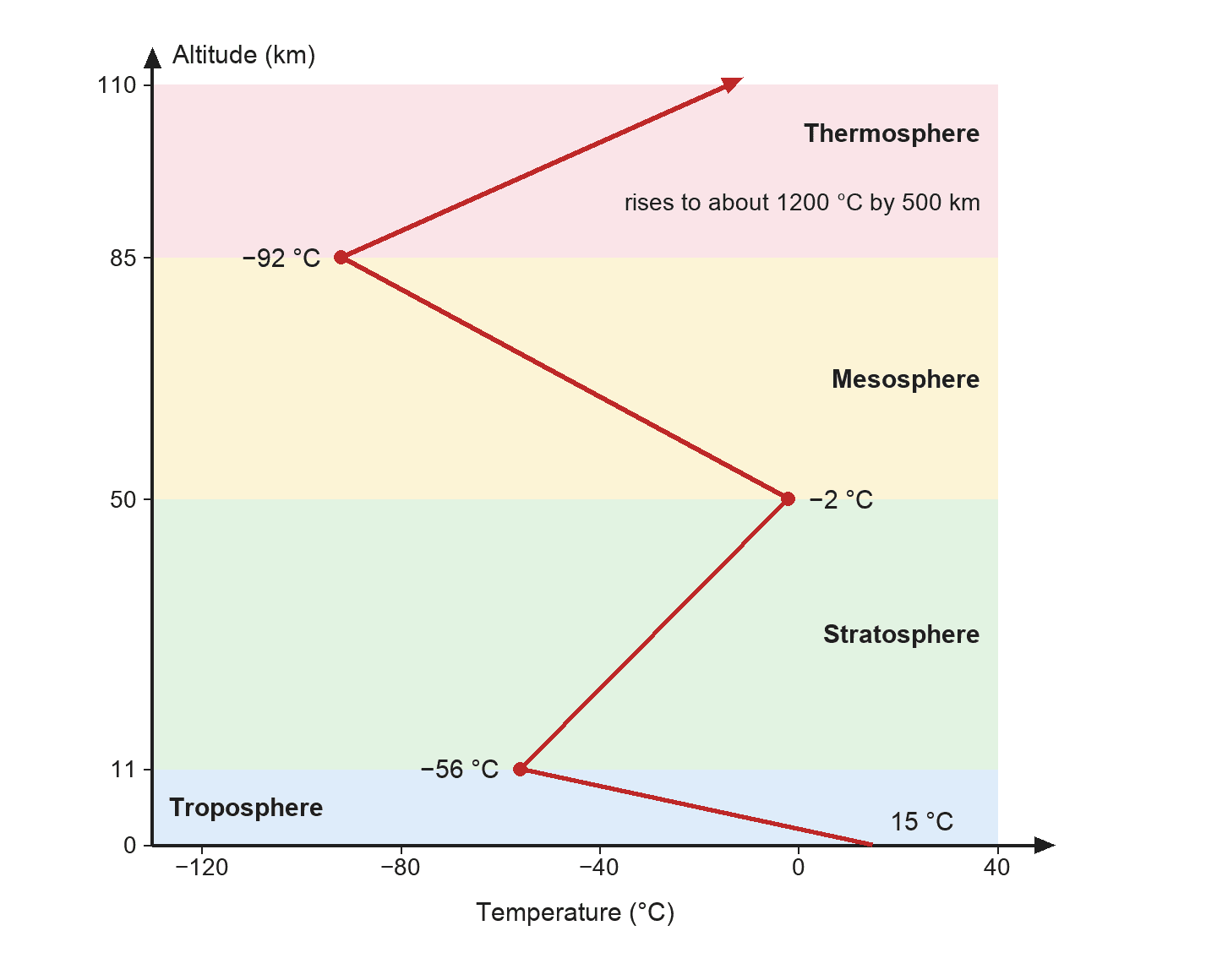
Step 2 — Find the boundaries where the trend reverses.
At the top of the troposphere (the tropopause, about 11 km) the fall turns into a rise; the temperature there is about −56 °C. At the top of the stratosphere (the stratopause, about 50 km) the rise turns into a fall, at about −2 °C. At the top of the mesosphere (the mesopause, about 85 km) the fall turns into a rise again, at about −92 °C.
Step 3 — Explain why these reversals happen.
The troposphere is heated from the ground, so it cools upward. In the stratosphere ozone absorbs ultraviolet light and heats the air, so it warms upward. The mesosphere has little ozone, so it cools again, and in the thermosphere oxygen and nitrogen absorb very short-wave solar radiation, so the temperature rises steeply.
Watch out: Near the ground a temperature inversion (warm air lying over cold air) can also form on calm winter nights; it traps smoke and makes smog worse.
Therefore, the inversion temperature is the temperature at the boundary where the trend of temperature with height reverses: about −56 °C at 11 km, −2 °C at 50 km and −92 °C at 85 km.
- 891 mark
Question 89
Acid rain is considered as a threat to Taj Mahal. Why?
Solve with AIWritten solution
Solution:
Key idea: The Taj Mahal is built of marble, which is calcium carbonate. Acids react with carbonates and dissolve them.
Step 1 — Find the source of the acid rain.
The air around Agra receives sulphur dioxide and nitrogen oxides from the Mathura oil refinery, foundries, brick kilns and vehicles. These gases form sulphuric acid and nitric acid in rain.
Step 2 — Show the attack on marble.
The acids react with the calcium carbonate of the marble.
Step 3 — State the damage.
The marble surface is slowly eaten away, becoming pitted, rough and dull, and it loses its white shine (often called 'marble cancer'). Soot and dust settling on the surface add yellow-brown stains.
Therefore, acid rain threatens the Taj Mahal because its acids dissolve the calcium carbonate of the marble, pitting it and dulling its shine, while deposited soot and dust stain it yellow-brown.
- 901 mark
Question 90
Fish do not grow as well in warm water as in cold water. Why?
Solve with AIWritten solution
Solution:
Key idea: Fish breathe the oxygen dissolved in water. Like other gases, oxygen is less soluble in water at higher temperature, because dissolving a gas gives out heat.
Step 1 — Compare the dissolved oxygen.
Fresh water in contact with air holds about 11.3 mg L⁻¹ of oxygen at 10 °C but only about 7.6 mg L⁻¹ at 30 °C, about one-third less.
Step 2 — Compare the fish's needs.
Fish are cold-blooded, so in warm water their body processes speed up and they need more oxygen. Bacteria in warm water also use up oxygen faster while decomposing organic matter.
Step 3 — Put the two together.
Warm water therefore has less oxygen while the fish need more. When dissolved oxygen falls below about 6 ppm, fish growth suffers.
Therefore, fish do not grow as well in warm water because warm water holds less dissolved oxygen while the fish need more oxygen.
- 911 mark
Question 91
Oxidation of sulphur dioxide into sulphur trioxide in the absence of a catalyst is a slow process but this oxidation occurs easily in the atmosphere. Explain how does this happen. Give chemical reactions for the conversion of into .
Solve with AIWritten solution
Solution:
Key idea: The direct reaction of sulphur dioxide with oxygen has a high activation energy, so it is very slow without a catalyst. In the atmosphere, particles, other pollutants and sunlight provide easier routes.
Step 1 — Catalysis by particulates.
Airborne particles containing metal ions such as iron, manganese and copper, and soot particles, adsorb and on their surface and catalyse the reaction.
Step 2 — Oxidation by nitrogen dioxide.
Nitrogen dioxide gives an oxygen atom to sulphur dioxide; the nitric oxide formed takes up oxygen from the air again, so it acts as a catalyst.
Step 3 — Oxidation by ozone and by hydroxyl radicals formed in sunlight.
Ozone, especially in water droplets, oxidises sulphur dioxide directly. Sunlight also forms hydroxyl radicals (OH), which start a fast chain of reactions.
Step 4 — Form sulphuric acid.
The sulphur trioxide dissolves in water vapour and falls as acid rain.
Therefore, in the atmosphere SO₂ is oxidised quickly to SO₃ because particulates (metal ions, soot), nitrogen dioxide, ozone and sunlight-made hydroxyl radicals catalyse or bring about the oxidation.
- 921 mark
Question 92
In what regions of the atmosphere, the temperature increases with altitude and in which regions it decreases.
Solve with AIWritten solution
Solution:
Key idea: The regions of the atmosphere are separated by the way temperature changes with height.
Step 1 — Look at the temperature profile.
The graph uses the book's table of the four main regions.
Step 2 — Find where the temperature rises with height.
In the stratosphere (about 11–50 km) the temperature rises from about −56 °C to about −2 °C, because ozone absorbs ultraviolet light and heats the air. In the thermosphere (above about 85 km) it rises from about −92 °C to over 1000 °C, because oxygen and nitrogen absorb very short-wave solar radiation.
Step 3 — Find where the temperature falls with height.
In the troposphere (0–11 km) the temperature falls from about 15 °C to −56 °C, by about 6.5 °C per km, because this layer is heated from the ground. In the mesosphere (about 50–85 km) it falls from about −2 °C to −92 °C, because there is little ozone to absorb sunlight.
Therefore, the temperature increases with altitude in the stratosphere and the thermosphere, and decreases in the troposphere and the mesosphere.
- 931 mark
Question 93
Ozone is a gas heavier than air. Why does ozone layer not settle down near the earth?
Solve with AIWritten solution
Solution:
Key idea: Ozone () is heavier than air (average ), but gases in the lower atmosphere do not sort themselves by weight. The ozone layer stays where it is made and destroyed.
Step 1 — Ozone is made only high up.
Ozone forms when ultraviolet light of wavelength shorter than about 242 nm splits oxygen molecules. This light is absorbed high in the atmosphere, so oxygen atoms, and hence ozone, are produced mainly in the stratosphere.
Step 2 — Ozone is also destroyed up there.
Ultraviolet light splits ozone again, so ozone is formed and destroyed continuously, and a steady amount stays in the stratosphere.
Step 3 — Gases do not settle out.
Winds and the random motion of molecules keep the gases of the lower atmosphere well mixed, which is also why heavier gases such as carbon dioxide and argon do not collect at the ground. Ozone carried downward reacts with other substances and is used up instead of piling up.
Therefore, the ozone layer does not settle near the earth because ozone is continuously formed and destroyed in the stratosphere by ultraviolet light, and mixing of the air stops gases from separating by weight.
- 941 mark
Question 94
Name the three methods (techniques) which are generally used in green chemistry.
Solve with AIWritten solution
Solution:
Key idea: Green chemistry makes chemical processes safer and cleaner by changing what the reaction is run in, what it uses and how it is driven.
Step 1 — Use safer solvents.
Harmful organic solvents are replaced by water, liquid carbon dioxide (kept liquid under pressure at room temperature) or no solvent at all; for example, clothes are dry-cleaned with liquid instead of tetrachloroethene.
Step 2 — Use safer reagents and catalysts.
Toxic reagents are replaced by safe ones, and catalysts are used so that most atoms of the starting materials end up in the product; for example, paper is bleached with hydrogen peroxide instead of chlorine, and ibuprofen is now made by a short catalytic route.
Step 3 — Use cleaner energy sources.
Reactions are driven by microwaves, ultrasound or sunlight instead of long heating, which saves energy and time.
Therefore, the three techniques of green chemistry are the use of safer (alternative) solvents, safer reagents and catalysts, and alternative energy sources such as microwaves and ultrasound.
- 951 mark
Question 95
Name the different regions of the atmosphere along with their altitudes and temperature ranges.
Solve with AIWritten solution
Solution:
Key idea: The atmosphere is divided into four main regions according to how the temperature changes with height.
Step 1 — List the regions.
The table gives the approximate altitude and temperature range of each region (values from the book's table).
Region Altitude Temperature range Troposphere 0–11 km falls from about 15 °C to −56 °C Stratosphere (ozonosphere) 11–50 km rises from about −56 °C to −2 °C Mesosphere 50–85 km falls from about −2 °C to −92 °C Thermosphere 85–500 km rises from about −92 °C to 1200 °C Step 2 — See the pattern on a graph.
Plotting these values shows the temperature falling and rising in turn.
Note: the top of the troposphere is lower over the poles (about 8 km) and higher over the equator (about 16–18 km); 11 km is an average.
Therefore, the regions are the troposphere (0–11 km, 15 °C to −56 °C), stratosphere (11–50 km, −56 °C to −2 °C), mesosphere (50–85 km, −2 °C to −92 °C) and thermosphere (85–500 km, −92 °C to 1200 °C).
- 961 mark
Question 96
What is represented by 5 in ?
Solve with AIWritten solution
Solution:
Key idea: BOD is the oxygen used by microorganisms to break down the organic matter in a water sample.
Step 1 — Recall the test.
The water sample is saturated with oxygen and then kept (incubated) in the dark at 20 °C. The dissolved oxygen is measured at the start and at the end.
Step 2 — Explain the subscript.
The standard incubation time is 5 days, so the oxygen used in those 5 days is written as .
Therefore, the 5 in BOD₅ represents the 5 days of incubation (at 20 °C) over which the oxygen used is measured.
- 971 mark
Question 97
Water is considered as pure if its BOD value is less than ppm. The value of is .....
Solve with AIWritten solution
Solution:
Key idea: A low BOD means little organic waste, because microorganisms need little oxygen to break it down.
Step 1 — Recall the limits.
Clean water has a BOD of less than 5 ppm (5 mg of oxygen per litre), while highly polluted water has a BOD of 17 ppm or more.
Therefore, the value of x is 5 ppm.
- 981 mark
Question 98
(a) What do you mean by inversion temperature in different regions of atmosphere?
(b) How does temperature vary in stratosphere?
Solve with AIWritten solution
Solution:
(a)
Key idea: In the atmosphere, temperature first falls with height, then rises, then falls and then rises again. The temperature at the boundary where the trend reverses is called the inversion temperature of that boundary.
Step 1 — Look at how the temperature changes with height.
The graph below uses the values in the book's table of atmospheric regions.
Step 2 — Find the boundaries where the trend reverses.
At the top of the troposphere (the tropopause, about 11 km) the fall turns into a rise; the temperature there is about −56 °C. At the top of the stratosphere (the stratopause, about 50 km) the rise turns into a fall, at about −2 °C. At the top of the mesosphere (the mesopause, about 85 km) the fall turns into a rise again, at about −92 °C.
Step 3 — Explain why these reversals happen.
The troposphere is heated from the ground, so it cools upward. In the stratosphere ozone absorbs ultraviolet light and heats the air, so it warms upward. The mesosphere has little ozone, so it cools again, and in the thermosphere oxygen and nitrogen absorb very short-wave solar radiation, so the temperature rises steeply.
Watch out: Near the ground a temperature inversion (warm air lying over cold air) can also form on calm winter nights; it traps smoke and makes smog worse.
(b)
Step 4 — Describe the stratosphere.
In the stratosphere (about 11–50 km) the temperature rises with height, from about −56 °C at 11 km to about −2 °C at 50 km. The ozone there absorbs ultraviolet light and the energy ends up as heat, which warms the upper part most.
Therefore, (a) the inversion temperature is the temperature at a boundary where the trend of temperature with height reverses (about −56 °C at 11 km, −2 °C at 50 km and −92 °C at 85 km), and (b) in the stratosphere the temperature rises from about −56 °C to about −2 °C with height.
- 992 marks
Question 99
What are the sources of dissolved oxygen in water?
Solve with AIWritten solution
Solution:
Key idea: Oxygen enters natural water in only two main ways: it dissolves from the air at the water surface, and it is released by photosynthesis of plants and algae living in the water. Cold, clean, moving water holds the most (about 9 mg L⁻¹, that is about 9 ppm, at 20 °C when saturated).
Step 1 — Dissolving of oxygen from the atmosphere. Air contains about 21 % oxygen, and some of it dissolves wherever air touches water. Mixing at the surface speeds this up, so waves, wind, rapids, waterfalls, flowing streams and rain falling through the air all add oxygen to the water (this is called aeration or re-aeration).
Step 2 — Photosynthesis by aquatic plants and algae. In daylight, green water plants, algae and phytoplankton make food from carbon dioxide and water and give out oxygen, which dissolves in the water around them.
Step 3 — Inflow of oxygen-rich water. Cold, fast-flowing streams and melt-water running into a lake or river bring in oxygen that they took up from the air on their way, so they add to the supply. (Water from underground springs, by contrast, is often low in oxygen until it has flowed for some distance in the open.)
Watch out: At night photosynthesis stops while respiration goes on, so dissolved oxygen in a pond is lowest just before dawn.
Therefore, dissolved oxygen in water comes mainly from oxygen of the air dissolving at the surface (helped by waves, flowing water and rain) and from oxygen released by photosynthesis of aquatic plants and algae.
- 1002 marks
Question 100
Ozone is a toxic gas and is a strong oxidising agent even then its presence in the stratosphere is very important. Explain what would happen if ozone from this region is completely removed?
Solve with AIWritten solution
Solution:
Key idea: Near the ground ozone is a harmful pollutant, but in the stratosphere (the ozone layer, about 15–35 km up) it absorbs most of the Sun's harmful ultraviolet (UV) radiation before it reaches the earth. That is why the ozone layer is called the earth's protective umbrella.
Step 1 — Why stratospheric ozone matters. Ozone molecules absorb UV light and split; the pieces join again and give out the energy as heat. In this way the layer stops most UV-B and practically all UV-C radiation from reaching the surface.
Step 2 — Effects on human health if the ozone were removed. Much more UV radiation would reach the ground. UV damages DNA, so cases of skin cancer (including melanoma) and sunburn would rise sharply, cataract of the eye and damage to the cornea would increase, and the body's immune system would be weakened.
Step 3 — Effects on plants, animals and climate. UV radiation damages plant proteins and reduces chlorophyll, so photosynthesis and crop yields would fall. Phytoplankton in the oceans, which are the base of aquatic food chains, would be killed, so fish and other sea life would suffer. Animals would also suffer eye and skin damage. The stratosphere would lose its source of heating, so the temperature pattern of the atmosphere and the climate would be upset.
Therefore, if the stratospheric ozone were completely removed, the Sun's harmful UV radiation would reach the earth's surface, causing skin cancer, cataract and weakened immunity in humans, damage to plants, crops and phytoplankton, and a disturbed heat balance and climate.
- 1012 marks
Question 101
Why is London smog formed in winter while photochemical smog is formed in summer?
Solve with AIWritten solution
Solution:
Key idea: The two kinds of smog need different conditions. London (classical) smog needs smoke, sulphur dioxide and fog (cold, very humid air). Photochemical smog needs nitrogen oxides, hydrocarbons and strong sunlight to drive its reactions.
Step 1 — Conditions in winter favour London smog. In winter more coal is burnt for heating, so the air holds more smoke (soot) and sulphur dioxide. The air is cold and humid, so fog forms easily, and on still winter mornings a temperature inversion traps the polluted air near the ground. Sulphur dioxide is oxidised on the particles and dissolves in the fog droplets, giving a fog of sulphuric acid mixed with smoke.
Step 2 — Conditions in summer favour photochemical smog. Photochemical smog starts when sunlight splits nitrogen dioxide (from vehicle exhaust) into nitric oxide and an oxygen atom, which then forms ozone. Strong, bright sunlight and warm, dry weather are needed, and these are found on sunny summer afternoons, when traffic has also put plenty of nitrogen oxides and hydrocarbons into the air.
Step 3 — Why each does not form in the other season. Summer air is warm and dry, so fog does not form and London smog cannot build up. Winter sunlight is weak, so the light-driven reactions are too slow for much photochemical smog.
Therefore, London smog forms in winter because cold, humid, foggy air together with smoke and sulphur dioxide from heating fuels is needed, while photochemical smog forms in summer because its reactions are driven by strong sunlight acting on nitrogen oxides and hydrocarbons in warm, dry air.
- 1022 marks
Question 102
What is the importance of measuring BOD of a water body?
Solve with AIWritten solution
Solution:
Key idea: Biochemical Oxygen Demand (BOD) is the amount of oxygen that micro-organisms use up while decomposing the organic matter present in a sample of water (usually measured over 5 days at 20 °C and given in ppm or mg L⁻¹). The more organic waste, the higher the BOD.
Step 1 — BOD tells us how polluted the water is. Because BOD measures the oxygen needed to break down organic wastes, it is a direct measure of the amount of biodegradable pollution (sewage, food and farm wastes) in the water. Clean water has a BOD below about 5 ppm, while highly polluted water has a BOD of 17 ppm or more.
Step 2 — BOD warns of harm to aquatic life. When the BOD is high, microbes use up the dissolved oxygen faster than it is replaced. The dissolved oxygen falls (below about 6 ppm the growth of fish is held back), so fish and other aquatic animals may die and the water starts to smell.
Step 3 — BOD is used to control pollution. Measuring BOD shows whether the water is fit for drinking, bathing or fisheries, how well a sewage-treatment plant is working (by comparing the BOD of the water entering and leaving it), and whether factories are keeping their effluents within the limits set by pollution-control authorities.
Therefore, measuring BOD is important because it shows how much biodegradable organic pollution a water body holds, warns when dissolved oxygen will fall too low for fish, and is used to judge water quality and the working of sewage-treatment and effluent controls.
- 1032 marks
Question 103
From where does ozone come in stratosphere?
Solve with AIWritten solution
Solution:
Key idea: Ozone in the stratosphere is not carried up from the ground; it is made right there from ordinary oxygen by the action of the Sun's ultraviolet (UV) radiation.
Step 1 — UV light splits oxygen molecules. In the stratosphere the high-energy UV radiation from the Sun (wavelength below about 240 nm) breaks some dioxygen molecules into free oxygen atoms.
Step 2 — Oxygen atoms join oxygen molecules to give ozone. Each oxygen atom combines with an oxygen molecule. A third molecule M (usually or ) takes away the extra energy so that the new ozone molecule does not fall apart.
Step 3 — Why it is not ozone from the ground. Ozone formed near the ground (for example in photochemical smog) is very reactive and is destroyed within days to a few weeks, much faster than air is carried up into the stratosphere, so it adds practically nothing to the ozone layer.
Therefore, the ozone in the stratosphere is produced there itself: UV radiation from the Sun splits into oxygen atoms, and each oxygen atom combines with an molecule to form .
- 1042 marks
Question 104
In which part of the atmosphere is formed and how?
Solve with AIWritten solution
Solution:
Key idea: Ozone of the ozone layer forms in the stratosphere (about 11–50 km above the earth, also called the ozonosphere); it is most concentrated at about 20–25 km (a little higher over the tropics), and even at its highest it makes up only about 10 ppm of the air by volume (near 30–35 km). It is formed by photochemical reactions, that is, reactions started by sunlight.
Step 1 — Name the region. The stratosphere lies just above the troposphere. Here the Sun's UV radiation is strong enough to split oxygen molecules, and there is still enough oxygen to form ozone, so most of the earth's ozone is made and found here.
Step 2 — First reaction: oxygen is split by UV light. UV radiation breaks a dioxygen molecule into two oxygen atoms.
Step 3 — Second reaction: an oxygen atom joins an oxygen molecule. Each oxygen atom combines with an molecule to give ozone.
Step 4 — The ozone cycle keeps the layer steady. Ozone itself absorbs UV radiation and splits back into and an oxygen atom, releasing heat that warms the stratosphere. The atom can form ozone again, so ozone is constantly made and broken, and in an undisturbed atmosphere its amount stays nearly constant.
Therefore, ozone is formed in the stratosphere (ozonosphere, about 11–50 km, most concentrated at about 20–25 km) when UV radiation splits into oxygen atoms which then combine with molecules to form .
- 1052 marks
Question 105
Why does rain water normally have a pH of about 5.6? When does it become acid rain?
Solve with AIWritten solution
Solution:
Key idea: Even unpolluted rain is slightly acidic, because rain drops dissolve carbon dioxide from the air and form the weak acid carbonic acid. Rain becomes acid rain when its pH falls below 5.6 because of the much stronger acids formed from oxides of sulphur and nitrogen.
Step 1 — Carbon dioxide dissolves and forms carbonic acid. Rain water dissolves some of the carbon dioxide of the air. Carbonic acid ionises only slightly, but it gives enough hydrogen ions to lower the pH from 7.
Step 2 — Estimate the pH. We take the carbon dioxide level of about 425 ppm (the 2025 average, a partial pressure of atm), the Henry's law constant of carbon dioxide, 0.034 mol L⁻¹ atm⁻¹, and the first ionisation constant of carbonic acid, . First we find , the concentration of dissolved carbon dioxide, by multiplying the Henry's law constant by the partial pressure.
For a weak acid, the hydrogen-ion concentration is the square root of times .
Finally we take the negative logarithm.
Step 3 — When rain becomes acid rain. When the air contains sulphur dioxide and nitrogen oxides (from burning coal and oil, smelting and vehicles), these are oxidised and dissolve in rain water to give sulphuric acid and nitric acid. These strong acids lower the pH below 5.6, usually to about 4–5. Rain with pH below 5.6 is called acid rain.
Therefore, normal rain has a pH of about 5.6 because it dissolves atmospheric carbon dioxide to form weak carbonic acid, and it becomes acid rain when its pH falls below 5.6 because sulphur and nitrogen oxides in polluted air form sulphuric and nitric acids in it.
- 1062 marks
Question 106
Dissolved oxygen in water is very important for aquatic life. What processes are responsible for the reduction of dissolved oxygen in water?
Solve with AIWritten solution
Solution:
Key idea: Dissolved oxygen falls whenever something uses oxygen faster than air and photosynthesis can replace it, or when the water becomes less able to hold oxygen.
Step 1 — Decomposition of organic wastes. Sewage, food-industry and farm wastes are broken down by aerobic micro-organisms, which use dissolved oxygen for this (this is the oxygen demand measured as BOD). A simple equation for organic matter is:
Step 2 — Eutrophication. Phosphates and nitrates from fertilisers and detergents make algae grow very fast (algal bloom). The algae cover the surface and cut off light, and when they die their decay by bacteria uses up large amounts of oxygen.
Step 3 — Thermal pollution. Hot water discharged from power plants and factories raises the water temperature. Oxygen is less soluble in warm water, and warm water also speeds up the respiration and decay that consume it.
Step 4 — Other causes. Respiration of aquatic organisms, especially at night when there is no photosynthesis, also uses oxygen. Oxidisable chemicals such as iron(II) salts, sulphides and ammonia react with dissolved oxygen. Oil films on the surface and muddy (turbid) water cut down the entry of oxygen from air and the light needed for photosynthesis.
Therefore, dissolved oxygen in water is reduced mainly by microbial decomposition of organic wastes, eutrophication with decay of algal blooms, thermal pollution, respiration of organisms, oxidation of chemicals in the water, and oil films or turbidity that block aeration and photosynthesis.
- 1072 marks
Question 107
(i) What is the composition of London smog?
(ii) In what season there is London smog?
(iii) What is the nature of London smog?
Solve with AIWritten solution
Solution:
Key idea: London smog, also called classical or sulphurous smog, is a mixture of smoke and fog formed in cold, humid air polluted by burning coal and other sulphur-containing fuels.
Step 1 — (i) Composition. London smog contains smoke (soot or carbon particles and fly ash), sulphur dioxide, and fog (tiny water droplets). Sulphur dioxide is oxidised on the particles and dissolves in the droplets, so the fog also contains droplets of sulphuric acid and sulphate particles.
Step 2 — (ii) Season. It forms in winter, especially in the early morning, when the air is cold and humid, fog forms easily and more coal is burnt for heating.
Step 3 — (iii) Nature. Sulphur dioxide and carbon (soot) are reducing substances, so London smog is reducing in nature. It irritates the lungs and causes bronchitis and other breathing problems.
Therefore, (i) London smog is a mixture of smoke (soot), sulphur dioxide and fog containing sulphuric acid droplets, (ii) it occurs in winter, mainly in the early morning, and (iii) it is reducing in nature.
- 1082 marks
Question 108
Give three examples in which green chemistry has been applied.
Solve with AIWritten solution
Solution:
Key idea: Green chemistry designs chemical products and processes so that they use and produce as few harmful substances as possible: fewer steps, less waste, safer solvents and reagents, and catalysts instead of large amounts of reagents.
Step 1 — Example 1: synthesis of ibuprofen. The pain-killer ibuprofen used to be made in a six-step process that produced much waste. A newer three-step catalytic process wastes far less: about 77 % of the mass of the starting materials ends up in the product, and nearly all the rest (acetic acid) is recovered and used, so very little waste and solvent are left.
Step 2 — Example 2: bleaching with hydrogen peroxide. Paper and clothes were once bleached with chlorine, which is toxic and forms harmful chlorinated compounds. Hydrogen peroxide with a suitable catalyst is now used; it leaves only water and oxygen.
Step 3 — Example 3: liquid carbon dioxide for dry cleaning. Tetrachloroethene (), the old dry-cleaning solvent, is a suspected carcinogen and pollutes ground water. Liquefied carbon dioxide with a suitable detergent now does the same job and is much less harmful to ground water.
Watch out: Other examples from the chapter are making ethanal from ethene in one catalytic step in water, catalytic dehydrogenation of diethanolamine (which avoids cyanide and formaldehyde), and using carbon dioxide instead of CFCs as the blowing agent for polystyrene foam.
Therefore, three applications of green chemistry are the low-waste catalytic synthesis of ibuprofen, bleaching of paper and clothes with hydrogen peroxide instead of chlorine, and dry cleaning with liquid carbon dioxide instead of tetrachloroethene.
- 1092 marks
Question 109
(a) Why photochemical smog is called so?
(b) In which season and at what time of day there is photochemical smog?
(c) What is the nature of photochemical smog?
Solve with AIWritten solution
Solution:
Key idea: Photochemical smog (Los Angeles smog) forms when sunlight acts on nitrogen oxides and hydrocarbons from vehicle exhaust, producing ozone, PAN and aldehydes.
Step 1 — (a) Reason for the name. Its formation starts with a photochemical reaction, the splitting of nitrogen dioxide by sunlight, and the products then react further in light. So it is called photochemical smog.
Step 2 — (b) Season and time. It forms in summer (warm, dry, sunny weather), and is worst in the afternoon, when sunlight has been acting for several hours on the nitrogen oxides and hydrocarbons released by morning traffic.
Step 3 — (c) Nature. It contains ozone, nitrogen dioxide and peroxyacetyl nitrate (PAN), which are strong oxidising agents, so photochemical smog is oxidising in nature. It irritates the eyes and the respiratory tract.
Therefore, (a) it is called photochemical smog because it is produced by reactions started by sunlight, (b) it occurs in summer, mainly in the afternoon, and (c) it is oxidising in nature.
- 1102 marks
Question 110
Give two examples of green chemistry in day-to-day life.
Solve with AIWritten solution
Solution:
Key idea: Green chemistry in daily life means replacing toxic chemicals in everyday processes with safer ones that work just as well and harm the environment less.
Step 1 — Example 1: bleaching of paper and clothes. Earlier, chlorine gas was used to bleach paper and cloth; chlorine is highly toxic and pollutes the environment. Now hydrogen peroxide with a suitable catalyst is used. It does the bleaching and breaks down to harmless water and oxygen, and it also gives good results in laundry with less water.
Step 2 — Example 2: dry cleaning of clothes. Earlier, tetrachloroethene () was used as the dry-cleaning solvent; it is a suspected carcinogen and contaminates ground water. Now liquefied carbon dioxide with a suitable detergent is used, which is much less harmful to ground water.
Therefore, two day-to-day examples of green chemistry are bleaching paper and clothes with hydrogen peroxide instead of chlorine, and dry cleaning clothes with liquid carbon dioxide and a detergent instead of tetrachloroethene.
- 1112 marks
Question 111
From where does ozone come in the photochemical smog?
Solve with AIWritten solution
Solution:
Key idea: Ozone in photochemical smog is a secondary pollutant: it is not emitted by any source but is formed in the air from nitrogen dioxide and oxygen by the action of sunlight. Hydrocarbons make it pile up.
Step 1 — Sunlight splits nitrogen dioxide. Nitrogen dioxide (formed from the nitric oxide in vehicle exhaust) absorbs sunlight and splits into nitric oxide and a free oxygen atom.
Step 2 — The oxygen atom forms ozone. The very reactive oxygen atom combines with an ordinary oxygen molecule of the air to give ozone.
Step 3 — Normally the ozone would be used up again. Ozone reacts quickly with nitric oxide and gives back nitrogen dioxide, so in clean air these reactions only cycle round and ozone does not build up.
Step 4 — Hydrocarbons let ozone accumulate. Hydrocarbons from exhaust are attacked to give reactive free radicals (written ). These radicals turn nitric oxide back into nitrogen dioxide without using ozone, so less ozone is destroyed and more nitrogen dioxide is available to make more ozone.
Therefore, ozone in photochemical smog comes from the photolysis of nitrogen dioxide by sunlight, whose oxygen atoms combine with ; it builds up because hydrocarbon radicals convert NO back to so that NO no longer removes the ozone.
- 1122 marks
Question 112
How can you prevent the formation of photochemical smog?
Solve with AIWritten solution
Solution:
Key idea: Photochemical smog needs nitrogen oxides + hydrocarbons + sunlight. We cannot stop sunlight, so we prevent the smog by cutting the emission of nitrogen oxides and hydrocarbons, mainly from vehicles.
Step 1 — Fit efficient catalytic converters. A catalytic converter (platinum, palladium and rhodium on a ceramic support) in the exhaust converts nitrogen oxides to nitrogen and oxidises carbon monoxide and unburnt hydrocarbons to carbon dioxide and water before the gases leave the vehicle.
Step 2 — Reduce emissions in other ways. Keep engines well tuned and check vehicle exhaust regularly; use cleaner fuels such as CNG, and electric vehicles and public transport; prevent the evaporation of petrol and solvents (hydrocarbons) at fuel stations and factories.
Step 3 — Other measures. Planting trees such as Pinus, Juniperus, Quercus, Pyrus and Vitis, which can take up nitrogen dioxide, helps. In principle, compounds that produce free radicals able to combine with the smog-forming radicals can be sprayed into the air, but this method is hardly used in practice.
Therefore, photochemical smog is prevented mainly by cutting the release of nitrogen oxides and hydrocarbons, using efficient catalytic converters in vehicles, well-maintained engines and cleaner fuels or transport, together with planting trees that absorb nitrogen dioxide.
- 1132 marks
Question 113
In place of tetrachloroethene (), the use of liq. along with some detergent for dry cleaning of clothes is not completely safe. Why?
Solve with AIWritten solution
Solution:
Key idea: Replacing the chlorinated solvent tetrachloroethene by liquid carbon dioxide is a green-chemistry step, because it removes a carcinogenic, ground-water-polluting solvent. Yet no process is perfectly safe: liquid carbon dioxide brings its own, smaller, risks.
Step 1 — Why tetrachloroethene is replaced. Tetrachloroethene is a suspected carcinogen; it is persistent, and because it is denser than water it sinks into and contaminates ground water. Liquid carbon dioxide with a suitable detergent cleans clothes without leaving any chlorinated solvent in the environment, so it is far safer for ground water.
Step 2 — Risk 1: carbon dioxide is a greenhouse gas. Any carbon dioxide that escapes from the machines adds to the greenhouse effect. (In practice the carbon dioxide is taken as a by-product of other industries and is recycled in a closed system, so the extra amount added is small, but it is not zero.)
Step 3 — Risk 2: high pressure and suffocation. Carbon dioxide is a liquid at room temperature only under high pressure (about 57 bar at 20 °C and 64 bar at 25 °C), so the cleaning machines are pressure vessels and must be handled carefully. Carbon dioxide is heavier than air, so a leak in a closed room can build up near the floor and push out oxygen, causing suffocation.
Step 4 — Risk 3: the detergents. The detergents added to liquid carbon dioxide must also be disposed of safely, or they can pollute water.
Therefore, dry cleaning with liquid is much safer than with tetrachloroethene but not completely safe, because escaping is a greenhouse gas, the high-pressure equipment and any leak of heavy gas (which can cause suffocation) are hazards, and the detergents used must also be disposed of safely.
- 1145 marks
Question 114
Acid rain is known to contain some acids. Name these acids and where from they come in rain?
Solve with AIWritten solution
Solution:
Key idea: Acid rain is rain (or snow, fog, dew) with a pH below 5.6. Its acidity comes mainly from sulphuric acid (about 60–70 %) and nitric acid (about 30–40 %), with a little hydrochloric acid. These acids are not emitted directly: they form in the air from oxides of sulphur and nitrogen released by natural processes and, much more, by human activities.
Step 1 — Name the acids. The acids found in acid rain are:
- sulphuric acid, (the main contributor);
- nitric acid, ;
- a small amount of hydrochloric acid, HCl.
(Carbonic acid from carbon dioxide is present in all rain, but it only brings the pH down to about 5.6, so it is not counted as the cause of acid rain.)
Step 2 — Sources of sulphur dioxide. Sulphur dioxide comes mainly from burning coal and oil (which contain sulphur) in thermal power plants, industries and homes, and from roasting and smelting of sulphide ores such as and ZnS. Volcanoes are its main natural source.
Step 3 — Sulphur dioxide becomes sulphuric acid. In the air, sulphur dioxide is oxidised to sulphur trioxide; the reaction is speeded up by soot particles, metal ions such as iron(III) and manganese(II) in cloud droplets and aerosols, and nitrogen oxides. Sulphur trioxide dissolves in rain water.
Step 4 — Sources of nitrogen oxides and formation of nitric acid. In the very hot engines of vehicles and furnaces of power plants, nitrogen and oxygen of the air combine to give nitric oxide; lightning does the same naturally. Nitric oxide is oxidised to nitrogen dioxide, which forms nitric acid with water and oxygen.
Step 5 — Source of hydrochloric acid. Small amounts of hydrogen chloride come from volcanoes, from some industries and from burning wastes that contain chlorine (for example PVC plastics). It dissolves in rain water as hydrochloric acid.
Watch out: These acids fall on buildings, lakes and forests; for example, sulphuric acid attacks marble monuments such as the Taj Mahal.
Therefore, acid rain contains mainly sulphuric acid and nitric acid with a little hydrochloric acid; they form in the air from sulphur dioxide (burning of coal and oil, smelting of sulphide ores, volcanoes), nitrogen oxides (vehicle engines, power plants, lightning) and hydrogen chloride (industries, burning of chlorine-containing wastes, volcanoes), which dissolve in rain water.
- 1155 marks
Question 115
What is the difference between BOD and COD? Which is better and Why?
Solve with AIWritten solution
Solution:
Key idea: Both BOD and COD measure how much oxygen would be needed to oxidise the pollutants in water, but BOD uses micro-organisms (so it counts only biodegradable matter, and takes days), while COD uses a strong chemical oxidising agent, acidified potassium dichromate (so it counts almost all oxidisable matter, and takes a few hours).
Step 1 — Define BOD. Biochemical Oxygen Demand is the amount of oxygen used by micro-organisms in decomposing the organic matter in a water sample. The sample is saturated with oxygen, kept in the dark at 20 °C for 5 days, and the fall in dissolved oxygen is measured; the result is given in ppm (mg L⁻¹).
Step 2 — Define COD. Chemical Oxygen Demand is the amount of oxygen (in ppm) equivalent to the acidified potassium dichromate used up in oxidising the pollutants in a water sample. A known excess of dichromate is boiled with the sample; the dichromate left over is found by titration with Mohr's salt, and the dichromate used is converted to oxygen.
Step 3 — Convert dichromate to oxygen. The symbol [O] in the equation above is only textbook shorthand for the oxidising power of dichromate. What really happens is that each dichromate ion takes up six electrons.
An oxygen molecule takes up four electrons when it oxidises a pollutant, so six electrons are worth one and a half moles of (three moles of oxygen atoms).
The mass of oxygen equal to one mole of dichromate is therefore found as follows.
So every mole of dichromate used corresponds to 48 g of oxygen demand.
Step 4 — Compare them. The table below sets the two measures side by side, point by point.
Point BOD COD Oxidising agent micro-organisms (bacteria) and dissolved oxygen acidified (chemical) What it measures only biodegradable organic matter almost all organic and oxidisable inorganic matter, biodegradable or not Time taken 5 days about 2–3 hours Effect of poisons toxic wastes kill the microbes and give a falsely low value not affected by toxic substances Usual size smaller larger (COD is usually greater than BOD) Step 5 — Decide which is better. COD is generally the better measure of pollution. It is quick (hours instead of days), its results are more reproducible, it is not upset by toxic industrial wastes, and it includes the non-biodegradable pollutants that BOD misses. BOD is still useful because it shows how fast the biodegradable waste will actually use up the dissolved oxygen of a river, so the two are often used together (the ratio BOD/COD shows how biodegradable a waste is).
Therefore, BOD is the oxygen used by micro-organisms in 5 days to decompose only the biodegradable organic matter, while COD is the oxygen equivalent of acidified dichromate used to oxidise almost all oxidisable matter in a few hours; COD is generally better because it is faster, more reproducible, unaffected by toxic wastes and covers non-biodegradable pollutants too.
- 1165 marks
Question 116
On the basis of chemical reactions involved, explain how do chlorofluorocarbons cause thinning of ozone layer in stratosphere.
- 1175 marks
Question 117
(a) Give the gaseous species present in mesosphere and thermosphere?
(b) What are viable and non-viable particulates?
(c) What are primary and secondary pollutants of air?
(d) Which zone is called ozonosphere?
- 1185 marks
Question 118
(a) How particulates help in the cloud formation?
(b) What are 'asbestosis' and 'silicosis'?
(c) What type of aromatic compounds are present as particulates in the air?
- 1195 marks
Question 119
Write down the reactions involved during the formation of photochemical smog.
- 1205 marks
Question 120
(a) What are the harmful effects of photochemical smog?
(b) How can harmful effects caused by photochemical smog be controlled?
- 1215 marks
Question 121
What are biodegradable and non-biodegradable pollutants?
- 1225 marks
Question 122
(a) What do you understand by greenhouse effect or global warming?
(b) What are the consequences of global warming?
What Class 11 Chemistry Ch 15 covers
The sections of the chapter, in the order the book takes them. Every question above comes from one of these.
- 01Renewable and Non-Renewable Energy Sources
- 02Environmental Pollution and Types of Pollutants
- 03Gaseous Air Pollutants: Oxides of Carbon, Nitrogen and Sulphur, and Hydrocarbons
- 04Acid Rain
- 05Particulate Pollutants and Smog
- 06Ozone Layer Depletion
More ways to study this chapter
The same chapter asked three other ways. Practise it, revise it, and see what the board has set on Ch 15 before.
Class 11 Chemistry Ch 15 questions students ask
How many questions are there in Class 11 Chemistry Ch 15?
122 questions. Every one is solved step by step on this page.
Are these Class 11 Chemistry solutions free?
Yes. Every question and its full working is free to read, with no account needed.
Can I download the Class 11 Chemistry Ch 15 solutions as a PDF?
There is no PDF to download. Every solution is on this page instead, which means it is searchable, always the current syllabus, and readable on a phone. Use your browser's print option if you want it on paper.