
Question 921 markEasy
In what regions of the atmosphere, the temperature increases with altitude and in which regions it decreases.
Confirming your payment
Sign up now and get 250 free tokens.
Environmental Chemistry · Question 92 of 122
In what regions of the atmosphere, the temperature increases with altitude and in which regions it decreases.
Solution:
Key idea: The regions of the atmosphere are separated by the way temperature changes with height.
Step 1 — Look at the temperature profile.
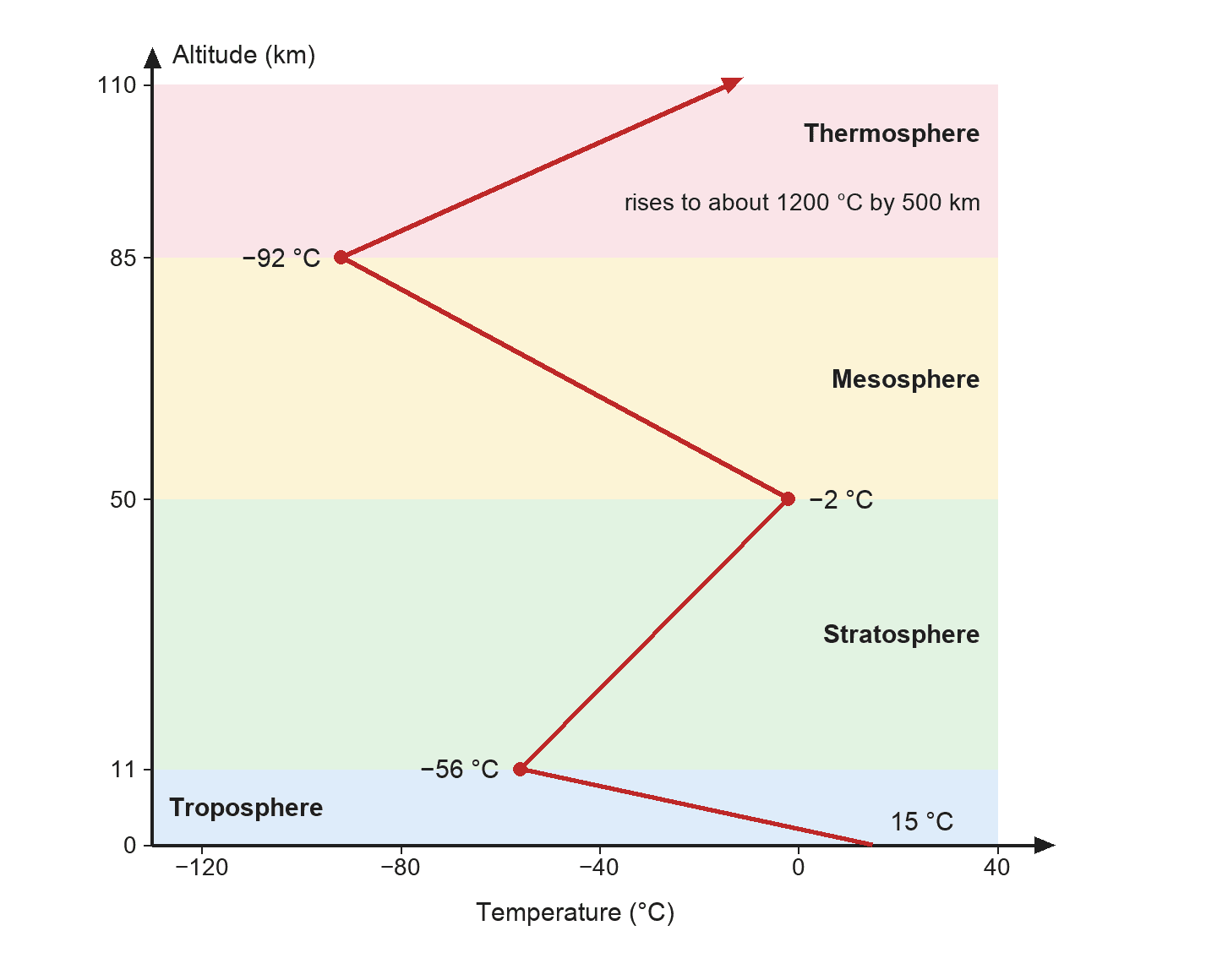
The graph uses the book's table of the four main regions.
Step 2 — Find where the temperature rises with height.
In the stratosphere (about 11–50 km) the temperature rises from about −56 °C to about −2 °C, because ozone absorbs ultraviolet light and heats the air. In the thermosphere (above about 85 km) it rises from about −92 °C to over 1000 °C, because oxygen and nitrogen absorb very short-wave solar radiation.
Step 3 — Find where the temperature falls with height.
In the troposphere (0–11 km) the temperature falls from about 15 °C to −56 °C, by about 6.5 °C per km, because this layer is heated from the ground. In the mesosphere (about 50–85 km) it falls from about −2 °C to −92 °C, because there is little ozone to absorb sunlight.
Therefore, the temperature increases with altitude in the stratosphere and the thermosphere, and decreases in the troposphere and the mesosphere.