
Question 981 markMedium
(a) What do you mean by inversion temperature in different regions of atmosphere?
(b) How does temperature vary in stratosphere?
Confirming your payment
Sign up now and get 250 free tokens.
Environmental Chemistry · Question 98 of 122
(a) What do you mean by inversion temperature in different regions of atmosphere?
(b) How does temperature vary in stratosphere?
Solution:
(a)
Key idea: In the atmosphere, temperature first falls with height, then rises, then falls and then rises again. The temperature at the boundary where the trend reverses is called the inversion temperature of that boundary.
Step 1 — Look at how the temperature changes with height.
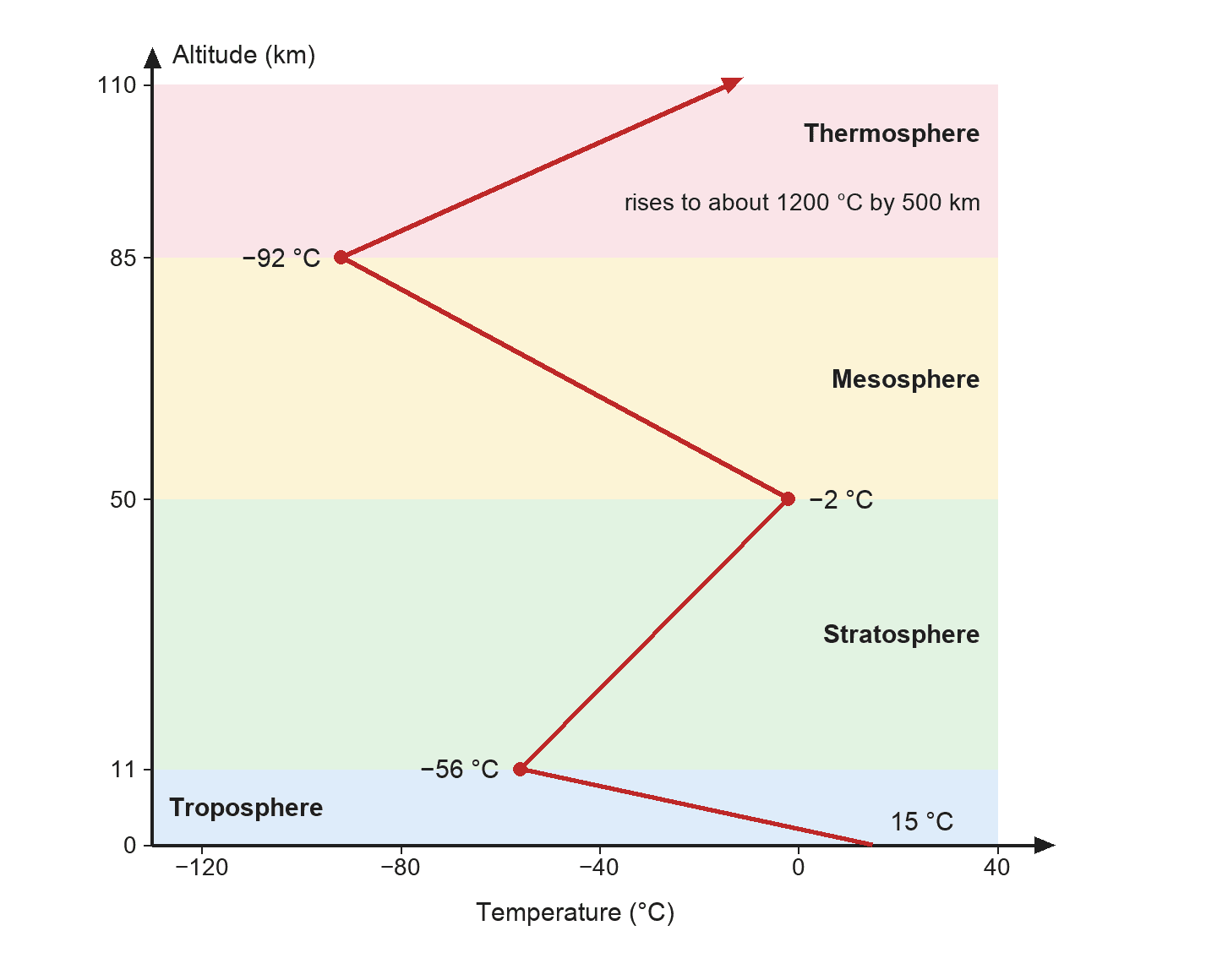
The graph below uses the values in the book's table of atmospheric regions.
Step 2 — Find the boundaries where the trend reverses.
At the top of the troposphere (the tropopause, about 11 km) the fall turns into a rise; the temperature there is about −56 °C. At the top of the stratosphere (the stratopause, about 50 km) the rise turns into a fall, at about −2 °C. At the top of the mesosphere (the mesopause, about 85 km) the fall turns into a rise again, at about −92 °C.
Step 3 — Explain why these reversals happen.
The troposphere is heated from the ground, so it cools upward. In the stratosphere ozone absorbs ultraviolet light and heats the air, so it warms upward. The mesosphere has little ozone, so it cools again, and in the thermosphere oxygen and nitrogen absorb very short-wave solar radiation, so the temperature rises steeply.
Watch out: Near the ground a temperature inversion (warm air lying over cold air) can also form on calm winter nights; it traps smoke and makes smog worse.
(b)
Step 4 — Describe the stratosphere.
In the stratosphere (about 11–50 km) the temperature rises with height, from about −56 °C at 11 km to about −2 °C at 50 km. The ozone there absorbs ultraviolet light and the energy ends up as heat, which warms the upper part most.
Therefore, (a) the inversion temperature is the temperature at a boundary where the trend of temperature with height reverses (about −56 °C at 11 km, −2 °C at 50 km and −92 °C at 85 km), and (b) in the stratosphere the temperature rises from about −56 °C to about −2 °C with height.