
Opening your dashboard
Class 11 Biology Chapter 6: Plant Kingdom Solutions
68 textbook questions with step-by-step answers, free to read, for ISC 2026-27.
Get talked through Ch 6, not just shown the answer
Reading a finished solution is not the same as being able to do it. The AI tutor takes one question at a time and works it with you, in your own words, until you can.
- Ask it out loud, in your own words
- It gives you the next step, not the answer
- Stuck on part (ii)? Start there
68 questions with solutions
1–5 marks · Mixed difficulty
- 11 mark
Question 1
What do pyrenoids contain?
Solve with AIWritten solution
Solution:
Concept: most green algae have one or more small storage bodies called pyrenoids inside their chloroplasts.
Step 1 — What is asked: the materials stored in a pyrenoid.
Step 2 — The fact used: pyrenoids are protein bodies that are linked with the storage of starch, so they hold proteins besides starch.
Therefore, pyrenoids contain proteins and starch.
- 21 mark
Question 2
Name the pigment that gives brown colour to brown algae.
Solve with AIWritten solution
Solution:
Concept: algae are grouped into classes by the pigments they carry; an extra pigment can hide the green of chlorophyll.
Step 1 — What is asked: the pigment responsible for the brown colour of Phaeophyceae.
Step 2 — The fact used: brown algae have chlorophyll a and c, but a golden-brown xanthophyll pigment found only in this group masks the green colour.
Therefore, the pigment is fucoxanthin.
- 31 mark
Question 3
Which algae stores carbohydrates as floridean starch?
Solve with AIWritten solution
Solution:
Concept: each class of algae stores its food in a typical form: green algae as starch, brown algae as laminarin and mannitol, red algae as floridean starch (similar in structure to amylopectin and glycogen).
Step 1 — What is asked: the class whose reserve food is floridean starch.
Step 2 — Match the reserve to the class: floridean starch is the stored food of Rhodophyceae.
Therefore, red algae (Rhodophyceae) store carbohydrates as floridean starch.
- 41 mark
Question 4
Bryophytes show alternation of generation. Which phase is dominant in them?
Solve with AIWritten solution
Solution:
Concept: alternation of generation means a haploid gamete-producing phase (gametophyte) alternates with a diploid spore-producing phase (sporophyte).
Step 1 — What is asked: which of the two phases is the main, long-lived one in bryophytes.
Step 2 — The fact used: the green moss or liverwort plant we see is haploid and produces gametes, so it is the gametophyte; the sporophyte is small and attached to it.
Therefore, the gametophytic phase is dominant in bryophytes.
- 51 mark
Question 5
Which phase in pteridophytes is diploid in nature?
Solve with AIWritten solution
Solution:
Concept: in every plant life cycle the sporophyte (formed from the zygote) is diploid (2n) and the gametophyte (formed from a spore) is haploid (n).
Step 1 — What is asked: the diploid phase of a pteridophyte such as a fern.
Step 2 — Apply the rule: the fern plant itself, with true roots, stem and leaves, grows from the zygote, so it is the diploid sporophyte (the prothallus is the haploid gametophyte).
Therefore, the sporophytic phase is diploid in pteridophytes.
- 61 mark
Question 6
Name the male and female organs in a fern.
Solve with AIWritten solution
Solution:
Concept: the sex organs of a fern are formed on the small heart-shaped prothallus (the gametophyte).
Step 1 — Male organ: the antheridium produces many motile sperms.
Step 2 — Female organ: the archegonium produces one egg.
Therefore, antheridia are the male organs and archegonia are the female organs of a fern.
- 71 mark
Question 7
What is the association between the roots of Pinus with fungi called as?
Solve with AIWritten solution
Solution:
Concept: some gymnosperm roots live in partnership with other organisms; Cycas roots hold nitrogen-fixing cyanobacteria (coralloid roots), while Pinus roots hold fungi.
Step 1 — What is asked: the name of the root–fungus partnership in Pinus.
Step 2 — The fact used: a symbiotic association of a fungus with the roots of a plant is called mycorrhiza; the fungus helps the root absorb water and minerals.
Therefore, the association is called mycorrhiza.
- 81 mark
Question 8
How many male gametes does each pollen grain contain?
Solve with AIWritten solution
Solution:
Concept: a pollen grain is the male gametophyte of a seed plant; its pollen tube carries the male gametes to the egg.
Step 1 — What is asked: the number of male gametes in one pollen grain (pollen tube).
Step 2 — The fact used: the pollen grain is shed 2-celled (tube + generative cell) in most plants, or 3-celled; the generative cell divides into two male gametes, so in angiosperms each pollen tube carries two male gametes — one fuses with the egg and the other with the secondary nucleus (double fertilisation).
Therefore, each pollen grain gives rise to two male gametes.
- 91 mark
Question 9
Name the group of plants in which seeds are not enclosed in an ovary.
Solve with AIWritten solution
Solution:
Concept: seed plants (phanerogams) are split by whether the ovule, and so the seed, is covered by an ovary.
Step 1 — What is asked: the seed plants whose seeds are naked.
Step 2 — The fact used: the name gymnosperm means 'naked seed' (Greek gymnos = naked, sperma = seed): the ovules lie exposed on scales, so the seeds are not inside a fruit.
Therefore, the group is the gymnosperms.
- 101 mark
Question 10
Name the group of plants that include mosses and liverworts.
Solve with AIWritten solution
Solution:
Concept: the simplest land plants, with no vascular tissue and no true roots, stem or leaves, form one division.
Step 1 — What is asked: the division containing mosses (class Musci) and liverworts (class Hepaticae).
Step 2 — The fact used: both classes belong to the division Bryophyta.
Therefore, mosses and liverworts belong to Bryophyta.
- 111 mark
Question 11
Chondrus, Porphyra and Gelidium are examples of which group of algae?
Solve with AIWritten solution
Solution:
Concept: algae are divided into green (Chlorophyceae), brown (Phaeophyceae) and red (Rhodophyceae) algae.
Step 1 — What is asked: the class of these three algae.
Step 2 — The fact used: Chondrus (Irish moss, source of carrageenan), Porphyra (eaten as food) and Gelidium (source of agar) all contain the red pigment phycoerythrin.
Therefore, they are red algae (Rhodophyceae).
- 121 mark
Question 12
Name the first stage in moss that develops directly from the spore.
Solve with AIWritten solution
Solution:
Concept: the moss gametophyte has two stages: a juvenile filamentous stage and the adult leafy stage.
Step 1 — What is asked: the stage that grows straight out of a germinating spore.
Step 2 — The fact used: the spore grows into a creeping, green, branched, filament-like stage called the protonema; leafy shoots later arise from it as buds.
Therefore, the first stage is the protonema.
- 131 mark
Question 13
The underside of the frond of a fern, small brown dots appear close to the margins what are they called and what do they consist of?
Solve with AIWritten solution
Solution:
Concept: a mature fern leaf (frond) that bears spores is called a sporophyll.
Step 1 — Name the dots: the small brown dots on the underside near the margin are sori (singular sorus).
Step 2 — What a sorus consists of: each sorus is a cluster of several sporangia, and each sporangium holds haploid spores made by meiosis.
Therefore, they are sori, and each sorus consists of several sporangia.
- 141 mark
Question 14
Give two characteristics of long shoots of the Pinus plant.
Solve with AIWritten solution
Solution:
Concept: Pinus has two kinds of shoots: long shoots (main shoots) and dwarf shoots (small, needle-bearing branches).
Step 1 — First feature: long shoots show unlimited growth — they keep growing year after year.
Step 2 — Second feature: they bear apical buds at their tips (dwarf shoots lack them).
Therefore, long shoots of Pinus have unlimited growth and bear apical buds.
- 151 mark
Question 15
What is another name of microsporangia?
Solve with AIWritten solution
Solution:
Concept: in seed plants the microsporophyll bears microsporangia, in which microspores (pollen grains) form.
Step 1 — What is asked: the common name of a microsporangium.
Step 2 — The fact used: since a microsporangium is filled with pollen grains, it is called a pollen sac.
Therefore, microsporangia are also called pollen sacs.
- 161 mark
Question 16
Pinus plant has 1st year, 2nd year and 3rd year cones. In which cone does fertilisation occur?
Solve with AIWritten solution
Solution:
Concept: the female cone of Pinus takes three years to mature: pollination in the 1st year, fertilisation in the 2nd year, seed ripening and dispersal in the 3rd year.
Step 1 — 1st year: pollen reaches the nucellus and germinates; its tube grows a little, then rests through the winter.
Step 2 — 2nd year: the pollen tube resumes growth and fertilisation takes place; the fertilised ovules become winged seeds.
Therefore, fertilisation occurs in the 2nd year cone.
- 171 mark
Question 17
Seeds develop from which part of the flower?
Solve with AIWritten solution
Solution:
Concept: after fertilisation in a flower, the ovary becomes the fruit and the ovules inside it change into seeds.
Step 1 — What is asked: the part of the flower that becomes a seed.
Step 2 — The fact used: a seed is a fertilised ovule: its integuments form the seed coat and the zygote inside becomes the embryo.
Therefore, seeds develop from the ovules.
- 181 mark
Question 18
A plant leaf shows reticulate venation. What kind of roots would it have?
Solve with AIWritten solution
Solution:
Concept: angiosperms are dicots or monocots: dicots have reticulate venation and a tap root; monocots have parallel venation and adventitious (fibrous) roots.
Step 1 — Identify the group: reticulate (net-like) venation is a dicot feature.
Step 2 — Apply the rule: dicots usually have a persistent tap root system.
Therefore, the plant would have a tap root.
- 191 mark
Question 19
The endosperm of a plant is haploid, diploid or triploid.
Solve with AIWritten solution
Solution:
Concept: in angiosperms the endosperm comes from the primary endosperm nucleus (PEN), formed in double fertilisation.
Step 1 — How the PEN forms: two haploid polar nuclei fuse into a diploid secondary nucleus (n + n = 2n).
Step 2 — Add the male gamete: the second male gamete (n) fuses with it: 2n + n = 3n.
Therefore, the endosperm (of an angiosperm) is triploid.
- 201 mark
Question 20
In which year cone in a Pinus plant does fertilisation occur?
Solve with AIWritten solution
Solution:
Concept: the female cone of Pinus passes through three yearly stages before its seeds are shed.
Step 1 — Recall the stages: 1st year — pollination only; 2nd year — pollen tube resumes growth and fertilisation occurs; 3rd year — seeds mature and are dispersed by wind.
Step 2 — Pick the stage asked: fertilisation belongs to the second year.
Therefore, fertilisation occurs in the 2nd year cone.
Note: the book prints this question twice (Q16 and Q20).
- 212 marks
Question 21
On which features are green algae believed to be the ancestors of first land plants?
Solve with AIWritten solution
Solution:
Concept: land plants are thought to have evolved from green algae of ancient seas because the two groups share their basic biochemistry.
Step 1 — Same pigments: both have the same kind of chlorophyll (chlorophyll a and b).
Step 2 — Same cell wall: in both, the cell walls contain cellulose.
Step 3 — Same products: both produce carbohydrates in photosynthesis.
Step 4 — Same food store: both store food as starch.
Therefore, same chlorophyll, cellulose walls, carbohydrate production and starch storage link green algae to the first land plants.
- 222 marks
Question 22
Name the main two sub-kingdoms and their basis of classification as given by Eichler.
Solve with AIWritten solution
Solution:
Concept: Eichler (1883) divided the plant kingdom into two sub-kingdoms by whether the reproductive organs are hidden or visible and whether seeds are produced.
Step 1 — Sub-kingdom 1 — Cryptogamae: plants with hidden (inconspicuous) reproductive organs that do not form seeds — the flowerless, seedless lower plants: Thallophyta (algae), Bryophyta (mosses, liverworts) and Pteridophyta (ferns).
Step 2 — Sub-kingdom 2 — Phanerogamae (Spermatophyta): plants with well-differentiated, visible reproductive organs that always bear seeds — gymnosperms and angiosperms.
Step 3 — The basis: the visibility of the reproductive organs and the presence or absence of seeds.
Therefore, Eichler's sub-kingdoms are Cryptogamae and Phanerogamae, based on hidden versus visible reproductive organs and seed formation.
- 232 marks
Question 23
Explain sexual reproduction in Chlamydomonas.
Solve with AIWritten solution
Solution:
Concept: the adult Chlamydomonas is haploid; its sexual cycle ends with zygotic meiosis, so the only diploid cell is the zygospore.
Step 1 — Gametes form: the parent cell divides by mitosis to give many gametes, which look like the parent but are smaller.
Step 2 — Gametes fuse: two gametes of opposite strains fuse in pairs — isogamy (similar gametes) or, in some species, anisogamy (dissimilar gametes) — forming a diploid zygospore.
Step 3 — Resting stage: the zygospore has a tough, resistant wall and survives harsh conditions.
Step 4 — Meiosis: in favourable conditions it undergoes meiosis, giving four haploid biflagellate zoospores that are released into water; each grows into a new individual.
Therefore, Chlamydomonas reproduces sexually by fusion of gametes into a zygospore, which divides by meiosis into four haploid zoospores.
- 242 marks
Question 24
How are red algae adapted to conditions at sea?
Solve with AIWritten solution
Solution:
Concept: an adaptation is a feature that helps an organism survive in its habitat; red algae live attached to rocks, often in deep water where little light reaches.
Step 1 — Firm attachment: finger-like holdfasts attach them to the rough sea floor or to rocks, so waves and currents do not wash them away.
Step 2 — Light at depth: their red pigment phycoerythrin (with blue phycocyanin) absorbs the blue-green light that penetrates farthest into water, so red algae can grow deeper than any other algae.
Step 3 — Protective wall: their cell walls contain phycocolloids (water-holding polysaccharides), which help the thallus hold water.
Therefore, holdfasts, deep-light-absorbing pigments and phycocolloid walls adapt red algae to life at sea.
Note: red algae's blue pigment is phycocyanin (not anthocyanin, a flower pigment).
- 252 marks
Question 25
What is the importance of phycocolloids for an algae?
Solve with AIWritten solution
Solution:
Concept: phycocolloids are water-holding polysaccharides (hydrocolloids) in the cell walls of brown and red algae; in brown algae they form an outer covering of algin.
Step 1 — Prevent drying: they retain water, so the alga does not dry out when exposed at low tide.
Step 2 — Prevent freezing: the water they hold protects the cells from freezing in winter.
Step 3 — Cushion against waves: the slimy covering protects the cells when large waves beat them against rocks.
Step 4 — Use to humans (extra): they are extracted commercially — algin from brown algae, carrageenan and agar from red algae — as thickeners and for bacterial culture media.
Therefore, phycocolloids protect algae from drying, freezing and wave damage.
- 262 marks
Question 26
How is a zygospore formed in Ulothrix?
Solve with AIWritten solution
Solution:
Concept: Ulothrix is a haploid filamentous green alga; it reproduces sexually by isogamy.
Step 1 — Isogametes form: its cells divide by mitosis to form 8–64 isogametes, smaller than zoospores and with only two flagella.
Step 2 — Fusion: the isogametes swim away, and two gametes of different strains fuse to form a diploid zygote.
Step 3 — Zygospore: the zygote develops a tough cell wall and becomes a zygospore, which later divides by meiosis to form haploid zoospores.
Therefore, a zygospore in Ulothrix forms when two isogametes of different strains fuse and the zygote grows a thick wall.
- 272 marks
Question 27
Name various pigments in different groups of algae.
Solve with AIWritten solution
Solution:
Concept: algae all have chlorophyll a; the other pigments differ in each class and give each its colour.
Step 1 — Green algae (Chlorophyceae): chlorophyll a and b (with small amounts of carotenoids).
Step 2 — Brown algae (Phaeophyceae): chlorophyll a and c, carotenoids and the brown xanthophyll fucoxanthin.
Step 3 — Red algae (Rhodophyceae): chlorophyll a and d, the red pigment phycoerythrin (and in some, blue phycocyanin).
Therefore, green algae have chlorophyll a and b, brown algae chlorophyll a, c and fucoxanthin, and red algae chlorophyll a, d and phycoerythrin.
- 282 marks
Question 28
Give the structure of a moss sporophyte.
Solve with AIWritten solution
Solution:
Concept: the moss sporophyte (2n) grows from the zygote on the gametophyte and is not free-living.
Step 1 — Foot: the foot is embedded in the gametophyte and absorbs food and water from it.
Step 2 — Seta: the seta is the stalk that raises the capsule.
Step 3 — Capsule: the capsule at the tip has a lid (operculum) covered by a hood; inside, diploid spore mother cells undergo meiosis to form haploid spores.
Step 4 — Dependence: the sporophyte stays attached to and dependent on the gametophyte for nourishment.
Therefore, a moss sporophyte consists of a foot, a seta and a capsule, and depends on the gametophyte.
- 292 marks
Question 29
Where and how are spores produced in a fern?
Solve with AIWritten solution
Solution:
Concept: the fern plant is the diploid sporophyte; spores (haploid) are made by meiosis.
Step 1 — Where: on the underside of mature fronds (sporophylls), near the margins, small brown sori form; each sorus is a cluster of sporangia.
Step 2 — How: inside each sporangium, diploid spore mother cells undergo meiosis to form haploid spores.
Step 3 — Release: on maturity the sporangium ruptures and releases the spores.
Therefore, fern spores are produced by meiosis in sporangia grouped in sori on the underside of the fronds.
- 302 marks
Question 30
Explain alternation of generation in a fern.
Solve with AIWritten solution
Solution:
Concept: in alternation of generation, a diploid spore-producing sporophyte alternates with a haploid gamete-producing gametophyte; in ferns the sporophyte is dominant.
Step 1 — Sporophyte to spores: the fern plant (2n) bears sporangia in sori; spore mother cells divide by meiosis into haploid spores.
Step 2 — Spore to gametophyte: a spore germinates into a small, heart-shaped, photosynthetic prothallus (n) — the short-lived gametophyte.
Step 3 — Gametes and fertilisation: the prothallus bears antheridia (sperms) and archegonia (egg); a sperm swims through water and fuses with the egg, forming a diploid zygote.
Step 4 — Back to sporophyte: the zygote forms an embryo and a young sporophyte that soon becomes independent; the prothallus dies.
Therefore, in a fern a dominant diploid sporophyte alternates with a small haploid prothallus.
- 312 marks
Question 31
List the advantages of a seed in a gymnosperm.
Solve with AIWritten solution
Solution:
Concept: a seed is a fertilised ovule: an embryo plant with stored food, wrapped in protective seed coats. Its evolution was the main reason for the success of gymnosperms.
Step 1 — Protection: the embryo is well protected by many layers of cells (seed coats).
Step 2 — Food supply: stored food in the seed feeds the young plant during germination.
Step 3 — Dormancy: a seed can remain dormant until conditions are suitable.
Step 4 — Dispersal: seeds are modified for dispersal, e.g. winged seeds of Pinus carried by wind.
Therefore, a seed protects and feeds the embryo, can wait in dormancy and is easily dispersed.
- 322 marks
Question 32
Explain the sporophyll of male cone in Pinus.
Solve with AIWritten solution
Solution:
Concept: a sporophyll is a leaf-like structure bearing sporangia; in the male cone of Pinus these are microsporophylls, spirally arranged and closely packed around a central axis.
Step 1 — Pollen sacs: each microsporophyll bears two microsporangia (pollen sacs) on its lower side.
Step 2 — Pollen formation: inside each pollen sac, cells divide by meiosis to form many pollen grains (microspores).
Step 3 — Wind dispersal: each pollen grain has two large air sacs (wings) that help it float in the wind to the female cone.
Therefore, each microsporophyll of a male Pinus cone carries two pollen sacs that produce winged pollen grains.
- 332 marks
Question 33
Give two important reasons for success of gymnosperms.
Solve with AIWritten solution
Solution:
Concept: gymnosperms were among the first plants fully independent of water for reproduction, which let them spread widely on land.
Step 1 — Seeds: the seed — an embryo with stored food in protective coats — survives drought and can wait in dormancy.
Step 2 — Dry, wind-blown pollen: pollen is carried by wind, needs no water for fertilisation and can travel for miles, surviving dry conditions.
Step 3 — Extra point: secondary growth thickens stem and root, giving large trees with big root and shoot systems.
Therefore, the seed and dry wind-carried pollen (with secondary growth) explain the success of gymnosperms.
- 342 marks
Question 34
Explain the role of carpels and stamens in angiosperms.
Solve with AIWritten solution
Solution:
Concept: the flower is the reproductive structure of angiosperms; the stamen is the male organ (microsporophyll) and the carpel (pistil) the female organ (megasporophyll).
Step 1 — Stamen: a stamen has a slender filament and an anther (with microsporangia); cells in the anther divide by meiosis to form pollen grains, which carry the male gametes.
Step 2 — Carpel: a carpel has a stigma (receives pollen), a style (pollen tube grows through it) and an ovary containing ovules; each ovule holds an embryo sac with the egg cell.
Step 3 — Result: after fertilisation the ovules become seeds and the ovary becomes the fruit.
Therefore, stamens produce pollen (male gametes) and carpels hold the ovules (egg) and later form the fruit.
- 352 marks
Question 35
What are the changes that occur after fertilisation in angiosperms?
Solve with AIWritten solution
Solution:
Concept: after double fertilisation in the embryo sac, the flower turns into a fruit with seeds.
Step 1 — Inside the ovule: the zygote develops into the embryo, the primary endosperm nucleus into the endosperm that feeds the embryo, and the synergids and antipodals degenerate.
Step 2 — Ovule to seed: the ovules develop into seeds; the seed contains the embryo (the future plant).
Step 3 — Ovary to fruit: the ovary develops into the fruit, and the ovary wall forms the fruit wall (pericarp).
Step 4 — Other parts: the rest of the flower withers away.
Therefore, after fertilisation ovules become seeds, the ovary becomes the fruit and the ovary wall becomes the pericarp.
- 363 marks
Question 36
What is the mode of reproduction in brown algae? Give a schematic diagram also.
Solve with AIWritten solution
Solution:
Concept: brown algae reproduce in three ways — vegetative, asexual and sexual; in forms like Fucus the adult plant is diploid, and many others show alternation of generation.
Step 1 — Vegetative: by fragmentation: each broken piece grows into a new plant.
Step 2 — Asexual: by biflagellate zoospores — pear-shaped, with two unequal, laterally attached flagella.
Step 3 — Sexual: isogamous, anisogamous or oogamous. The diploid plant forms gametangia (antheridium and oogonium); in Fucus the haploid gametes are produced by meiosis (in kelps and Ectocarpus meiosis happens in sporangia, and haploid gametophytes form the gametes by mitosis). Pear-shaped flagellated antherozoids are released as the tide advances and fuse with the non-flagellated egg, in water or inside the oogonium.
Step 4 — Result: the zygote (oospore, 2n) grows into a new diploid plant.
Schematic diagram:
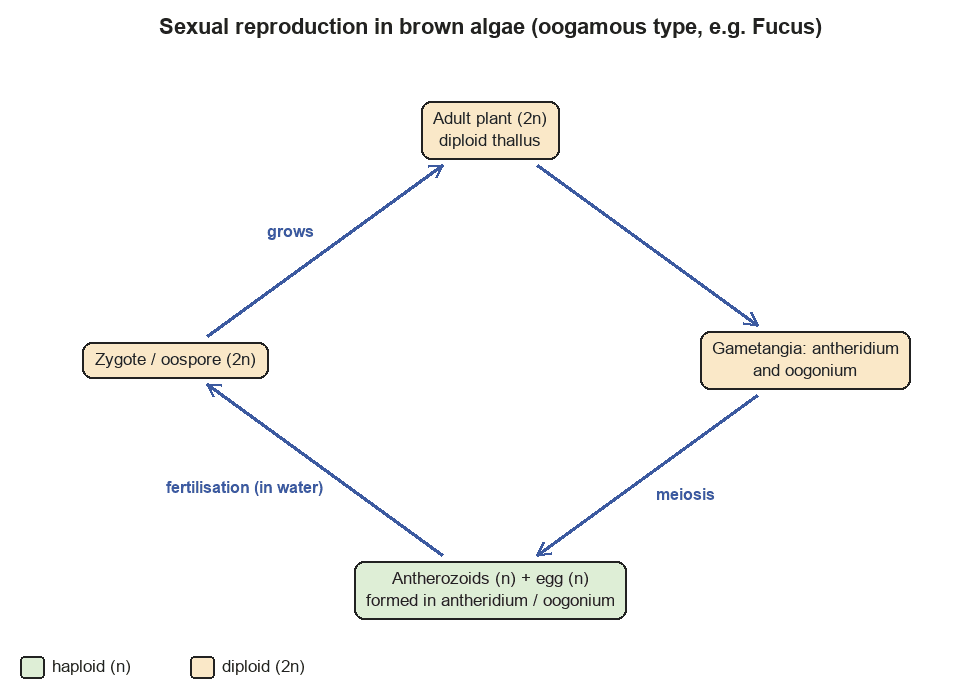
Therefore, brown algae reproduce by fragmentation, by biflagellate zoospores and sexually (often oogamously) through haploid gametes formed by meiosis.
- 373 marks
Question 37
What is the economic importance of red algae? Give two important differences between mosses and liverworts. Name the dominant phase in life cycle of ferns.
Solve with AIWritten solution
Solution:
Concept: this question has three parts: uses of red algae, contrasts between the two classes of bryophytes, and the main phase of the fern life cycle.
Step 1 — Economic importance of red algae: (i) Gelidium and Gracilaria give agar, used to grow bacterial cultures and to make jellies and ice-creams; (ii) Chondrus (Irish moss) gives carrageenan, used to give creaminess to chocolate drinks; (iii) Porphyra is eaten as food; (iv) calcareous red algae deposit calcium salts and form a good fossil record.
Step 2 — Mosses vs liverworts:
Feature Liverworts Mosses Plant body thalloid, dorsiventrally flattened stem-like axis with leaf-like structures Rhizoids unicellular multicellular Spore germination spore grows directly into a thallus spore forms a protonema first Step 3 — Dominant phase in ferns: the fern plant is the diploid sporophyte, which is dominant; the prothallus (gametophyte) is small and short-lived.
Therefore, red algae give agar, carrageenan and food; liverworts are thalloid with unicellular rhizoids while mosses are leafy with multicellular rhizoids; the sporophyte is dominant in ferns.
- 383 marks
Question 38
Mention the ploidy of the following
(i) Protonema of moss
(ii) Primary endosperm nucleus
(iii) Prothallus of fern.
Solve with AIWritten solution
Solution:
Concept: ploidy is the number of chromosome sets: structures of the gametophyte (formed from a spore) are haploid (n); the sporophyte is diploid (2n); the angiosperm endosperm nucleus is triploid (3n).
Step 1 — Protonema of moss: it grows directly from a haploid spore by mitosis and is part of the gametophyte, so it is haploid (n).
Step 2 — Primary endosperm nucleus: a male gamete (n) fuses with the diploid secondary nucleus (two polar nuclei, n + n), so it is triploid (3n).
Step 3 — Prothallus of fern: it grows from a haploid spore and is the fern gametophyte, so it is haploid (n).
Therefore, protonema = n, primary endosperm nucleus = 3n, prothallus = n.
- 393 marks
Question 39
Give a schematic diagram explaining alternation of generation in Dryopteris.
Solve with AIWritten solution
Solution:
Concept: Dryopteris (a fern) shows alternation of generation with a dominant diploid sporophyte and a short-lived haploid gametophyte (prothallus).
Step 1 — Diagram:
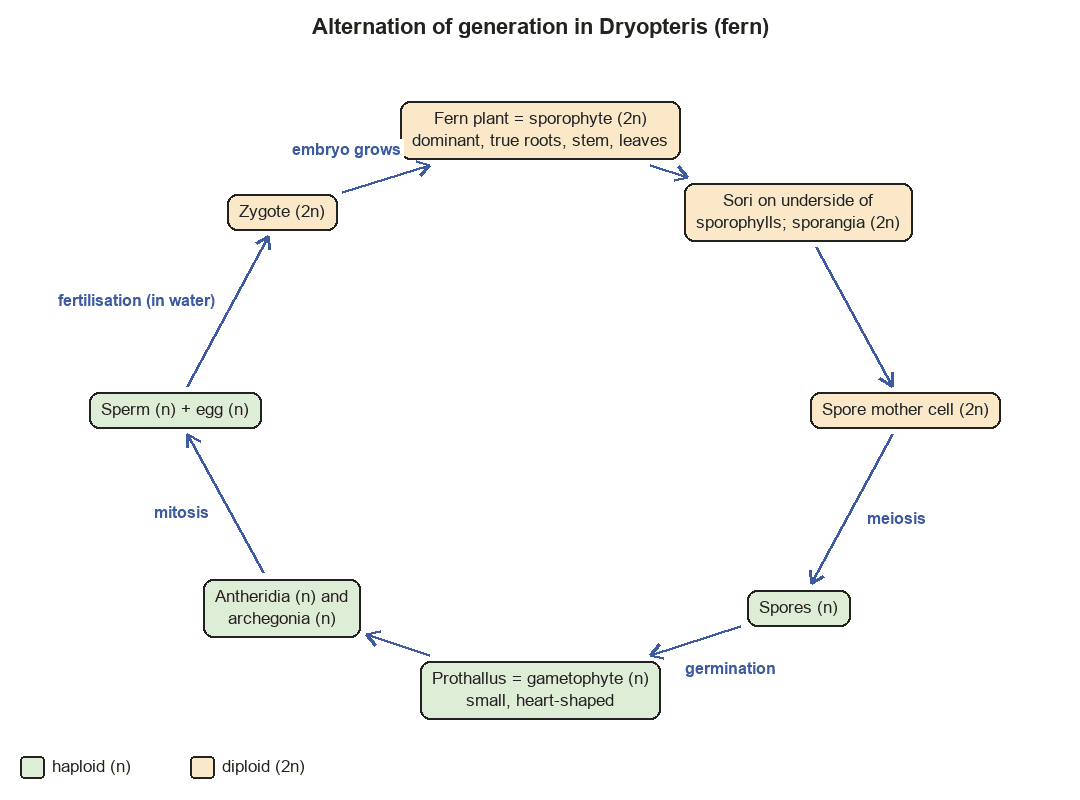
Step 2 — Diploid half: the fern plant (2n) bears sori of sporangia on the underside of its sporophylls; spore mother cells (2n) in the sporangia divide by meiosis.
Step 3 — Haploid half: the spores (n) germinate into the heart-shaped prothallus (n), which bears antheridia and archegonia; sperms swim in water to the egg.
Step 4 — Closing the cycle: fertilisation gives the zygote (2n), which grows into a young sporophyte and then a new fern plant.
Therefore, in Dryopteris: sporophyte (2n) → spores (n) by meiosis → prothallus (n) → gametes → zygote (2n) → sporophyte.
- 403 marks
Question 40
Give three characteristic features of gymnosperms. What are the reasons for their success on land?
Solve with AIWritten solution
Solution:
Concept: gymnosperms are seed plants whose seeds are naked (not enclosed in an ovary).
Step 1 — Features: (i) ovules are exposed on scales, so seeds are naked and no fruit is formed; (ii) they are woody perennials (trees or shrubs, no herbs) with well-developed xylem tracheids; (iii) they are heterosporous, bearing microspores and megaspores on sporophylls usually grouped in cones.
Step 2 — Reason 1 — secondary growth: secondary growth increases the girth of stem and root, giving an extensive root system below ground and a large shoot system above.
Step 3 — Reason 2 — dry pollen: dry, wind-blown pollen needs no water for fertilisation and can travel for miles, surviving dry conditions.
Step 4 — Reason 3 — seed: the seed protects the embryo, stores food, can remain dormant and is adapted for dispersal.
Therefore, gymnosperms have naked seeds, are woody perennials and heterosporous; secondary growth, dry pollen and seeds made them successful on land.
- 413 marks
Question 41
What is heterospory? Name the types of sporophylls in pine trees and their significance.
Solve with AIWritten solution
Solution:
Concept: heterospory is the production of two kinds of spores — small microspores and large megaspores.
Step 1 — Definition: a heterosporous plant (e.g. Selaginella, all gymnosperms and angiosperms) forms microspores that give male gametophytes and megaspores that give female gametophytes.
Step 2 — Microsporophylls: found in the male cone; each bears two pollen sacs in which pollen grains (microspores) form by meiosis — they supply the male gametes.
Step 3 — Megasporophylls: found in the female cone as ovuliferous scales, each bearing two ovules; in an ovule one of four megaspores develops into the female gametophyte with the egg — it gives the seed after fertilisation.
Step 4 — Significance: heterospory separates male and female gametophytes, increases the survival of the female gametophyte (retained on the parent) and is a precursor of seed formation.
Therefore, heterospory is the formation of micro- and megaspores; pine has microsporophylls (pollen) and megasporophylls (ovules), which lead to seed formation.
- 423 marks
Question 42
Explain briefly the following terms with suitable examples
(i) Protonema
(ii) Antheridium
(iii) Diplontic life cycle
Solve with AIWritten solution
Solution:
Concept: each term belongs to a plant life cycle: the protonema to the moss gametophyte, the antheridium to the sex organs, and 'diplontic' to the pattern of alternation of generation.
Step 1 — Protonema: the first, creeping, green, branched, filament-like stage of the moss gametophyte that grows directly from a spore; leafy shoots arise on it as buds. Example: Funaria.
Step 2 — Antheridium: the male sex organ of bryophytes and pteridophytes; it produces many flagellated male gametes (antherozoids). Example: antheridia of moss and of the fern prothallus.
Step 3 — Diplontic life cycle: a life cycle in which the diploid sporophyte is dominant, photosynthetic and independent, while the gametophyte is reduced to a single cell or a few cells. Examples: all gymnosperms and angiosperms (and the alga Fucus).
Therefore, protonema is the juvenile moss gametophyte, the antheridium is the male sex organ, and a diplontic life cycle has a dominant sporophyte, as in seed plants.
- 433 marks
Question 43
A seed contains three generations. Explain.
Solve with AIWritten solution
Solution:
Concept: a seed is a fertilised ovule; it contains cells belonging to three successive generations of the plant.
Step 1 — Parent sporophyte (2n): the ovule (megasporangium) and its integuments (which become the seed coat) belong to the parent plant, which is diploid.
Step 2 — Female gametophyte (n): the embryo sac (megaspore product) inside the ovule is the haploid female gametophyte, formed after meiosis.
Step 3 — Next sporophyte (2n): the zygote/embryo, formed by fertilisation inside the embryo sac, is the diploid beginning of the next sporophyte generation.
Therefore, a seed holds the parent sporophyte (ovule, 2n), the female gametophyte (embryo sac, n) and the next sporophyte (embryo, 2n).
- 443 marks
Question 44
What do you understand by terms pine cones? Are they different in male and female plants, explain. If you collect cones which are 1 year, 2 years and 3 years old, will they differ?
Solve with AIWritten solution
Solution:
Concept: a cone (strobilus) is a compact structure formed by sporophylls arranged spirally around an axis; Pinus is heterosporous and bears male and female cones on the same tree (there are no separate male and female pine plants).
Step 1 — Pine cones: male cones bear microsporophylls (pollen sacs); female cones bear megasporophylls (ovuliferous scales with ovules).
Step 2 — Male vs female cones: male cones are small (about 1–2 cm), rounded, in clusters behind the apical bud of new shoots, yellow when mature; female cones grow from about 1 cm to 10–20 cm (chir pine), are scattered at the tips of new long shoots, green when young and brown and woody when mature.
Step 3 — 1-year cone: small and green; pollination has occurred; the pollen tube starts, then rests until spring.
Step 4 — 2-year cone: larger; the pollen tube grows and fertilisation occurs, the ovules become winged seeds.
Step 5 — 3-year cone: large, woody and brown; seeds mature, the scales bend outwards and the seeds are shed by wind.
Therefore, cones are the reproductive structures of pine; male and female cones differ in size, position and colour, and 1-, 2- and 3-year female cones differ in size, colour and stage of reproduction.
Note: the question says 'male and female plants', but Pinus bears both kinds of cones on the same plant.
- 453 marks
Question 45
Give one important difference between the following:
(i) Annuals and perennials
(ii) Haplontic and diplontic cycle
(iii) Cryptogamae and phanerogamae
Solve with AIWritten solution
Solution:
Concept: each pair is separated by one key feature: life span, dominant phase, and seed formation.
Step 1 — Annuals and perennials: annuals complete their life cycle (germination to seed) in one year, e.g. wheat, rice; perennials live for many years, e.g. mango, Bodhi tree.
Step 2 — Haplontic and diplontic cycle: in a haplontic cycle the haploid gametophyte is dominant and the sporophyte is only the one-celled zygote (e.g. Spirogyra, Volvox); in a diplontic cycle the diploid sporophyte is dominant and the gametophyte is reduced to a few cells (e.g. gymnosperms, angiosperms).
Step 3 — Cryptogamae and phanerogamae: cryptogams have hidden reproductive organs and do not bear seeds (algae, bryophytes, pteridophytes); phanerogams have visible reproductive organs and always bear seeds (gymnosperms, angiosperms).
Therefore, the differences are life span, dominant phase and seed formation respectively.
- 462 marks
Question 46
Differentiate between: Cryptogamae and Phanerogamae.
Solve with AIWritten solution
Solution:
Concept: Eichler's two sub-kingdoms of plants.
Step 1 — What is compared: Cryptogamae and Phanerogamae, feature by feature.
Step 2 — The differences:
Feature Cryptogamae Phanerogamae Reproductive organs hidden, inconspicuous well differentiated, visible Seeds not formed (flowerless, seedless) always formed (seed-bearing) Divisions Thallophyta, Bryophyta, Pteridophyta gymnosperms and angiosperms Examples algae, mosses, ferns Pinus, pea, wheat Step 3 — The key difference: the most important point is the presence of seeds.
Therefore, Cryptogamae and Phanerogamae differ mainly in the presence of seeds.
- 472 marks
Question 47
Differentiate between: Thallophyta and Bryophyta.
Solve with AIWritten solution
Solution:
Concept: two divisions of cryptogams, both without vascular tissue.
Step 1 — What is compared: Thallophyta and Bryophyta, feature by feature.
Step 2 — The differences:
Feature Thallophyta Bryophyta Plant body thallus, not differentiated into root, stem, leaves thallus-like; root-like, stem-like, leaf-like structures Habitat mainly aquatic land, in damp shady places Sex organs simple, mostly unicellular multicellular (antheridia, archegonia) Examples algae (Spirogyra) mosses, liverworts (Funaria, Riccia) Step 3 — The key difference: the most important point is the degree of differentiation of the plant body.
Therefore, Thallophyta and Bryophyta differ mainly in the degree of differentiation of the plant body.
- 482 marks
Question 48
Differentiate between: Bryophyta and Pteridophyta.
Solve with AIWritten solution
Solution:
Concept: two divisions of cryptogams; only pteridophytes have vascular tissue.
Step 1 — What is compared: Bryophyta and Pteridophyta, feature by feature.
Step 2 — The differences:
Feature Bryophyta Pteridophyta Vascular tissue absent xylem and phloem present Plant body rhizoids, leaf-like and stem-like structures true roots, stem and leaves Dominant phase gametophyte (n); moss plant is a gametophyte sporophyte (2n); fern plant is a sporophyte Sporophyte only foot, seta and capsule; dependent on gametophyte prominent and independent Step 3 — The key difference: the most important point is which phase is dominant and the presence of vascular tissue.
Therefore, Bryophyta and Pteridophyta differ mainly in which phase is dominant and the presence of vascular tissue.
- 492 marks
Question 49
Differentiate between: Gymnospermae and Angiospermae.
Solve with AIWritten solution
Solution:
Concept: the two groups of seed plants (phanerogams).
Step 1 — What is compared: Gymnospermae and Angiospermae, feature by feature.
Step 2 — The differences:
Feature Gymnospermae Angiospermae Seeds naked, not enclosed in an ovary enclosed in the ovary Fruit not formed (no ovary) ovary develops into a fruit Reproductive structures cones (usually) flowers Xylem and phloem only tracheids; phloem lacks companion cells vessels and tracheids; phloem has companion cells Step 3 — The key difference: the most important point is whether the seed is enclosed in an ovary.
Therefore, Gymnospermae and Angiospermae differ mainly in whether the seed is enclosed in an ovary.
- 502 marks
Question 50
Differentiate between: Dicotyledons and Monocotyledons.
Solve with AIWritten solution
Solution:
Concept: the two classes of angiosperms.
Step 1 — What is compared: Dicotyledons and Monocotyledons, feature by feature.
Step 2 — The differences:
Feature Dicotyledons Monocotyledons Cotyledons in seed two one Root tap root persists adventitious (fibrous) roots only Leaf venation reticulate parallel Flower parts usually in sets of 4 or 5 usually in sets of 3 Stem vascular bundles in a ring with central pith scattered Step 3 — The key difference: the most important point is the number of cotyledons.
Therefore, Dicotyledons and Monocotyledons differ mainly in the number of cotyledons.
- 512 marks
Question 51
Differentiate between: Chlorophyceae and Phaeophyceae.
Solve with AIWritten solution
Solution:
Concept: green and brown algae, two classes of algae.
Step 1 — What is compared: Chlorophyceae and Phaeophyceae, feature by feature.
Step 2 — The differences:
Feature Chlorophyceae Phaeophyceae Pigments chlorophyll a and b chlorophyll a and c, fucoxanthin Stored food starch laminarin and mannitol Cell wall cellulose (inner) and pectose (outer) cellulose and algin Habitat and form mostly freshwater; unicellular and multicellular mostly marine; only multicellular Step 3 — The key difference: the most important point is the pigments and stored food.
Therefore, Chlorophyceae and Phaeophyceae differ mainly in the pigments and stored food.
- 522 marks
Question 52
Differentiate between: Phaeophyceae and Rhodophyceae.
Solve with AIWritten solution
Solution:
Concept: brown and red algae.
Step 1 — What is compared: Phaeophyceae and Rhodophyceae, feature by feature.
Step 2 — The differences:
Feature Phaeophyceae Rhodophyceae Pigments chlorophyll a and c, fucoxanthin chlorophyll a and d, phycoerythrin Stored food laminarin and mannitol floridean starch Flagella 2, unequal, lateral (on zoospores, male gametes) absent at every stage Habitat mostly cool seas mostly warm seas, also at great depths Step 3 — The key difference: the most important point is pigments, stored food and flagella.
Therefore, Phaeophyceae and Rhodophyceae differ mainly in pigments, stored food and flagella.
- 532 marks
Question 53
Differentiate between: Isogametes and Anisogametes.
Solve with AIWritten solution
Solution:
Concept: kinds of gametes in algae, judged by their size and form.
Step 1 — What is compared: Isogametes and Anisogametes, feature by feature.
Step 2 — The differences:
Feature Isogametes Anisogametes Size and form similar in size and form dissimilar (different in size) Fusion called isogamy anisogamy Examples Chlamydomonas (flagellated), Spirogyra (non-flagellated) some species of Chlamydomonas Step 3 — The key difference: the most important point is whether the two fusing gametes are similar or unequal in size.
Therefore, Isogametes and Anisogametes differ mainly in whether the two fusing gametes are similar or unequal in size.
- 542 marks
Question 54
Differentiate between: Zoospore and Zygospore.
Solve with AIWritten solution
Solution:
Concept: two kinds of spores in algae such as Chlamydomonas.
Step 1 — What is compared: Zoospore and Zygospore, feature by feature.
Step 2 — The differences:
Feature Zoospore Zygospore Formed in asexual reproduction (also after meiosis of zygote) sexual reproduction only Ploidy haploid diploid Origin division of the protoplasm of a cell fusion of two gametes Wall and conditions no protective covering; favourable conditions tough coat; survives unfavourable conditions Step 3 — The key difference: the most important point is zoospores are haploid motile spores; zygospores are diploid resting zygotes.
Therefore, Zoospore and Zygospore differ mainly in zoospores are haploid motile spores; zygospores are diploid resting zygotes.
- 552 marks
Question 55
Differentiate between: Liverworts and Mosses.
Solve with AIWritten solution
Solution:
Concept: the two classes of bryophytes (Hepaticae and Musci).
Step 1 — What is compared: Liverworts and Mosses, feature by feature.
Step 2 — The differences:
Feature Liverworts Mosses Plant body thalloid, dorsiventrally flattened stem-like axis with leaf-like structures Rhizoids unicellular multicellular, branched Elaters present for spore dispersal absent Spore germination directly into a thallus into a protonema first Step 3 — The key difference: the most important point is the form of the plant body.
Therefore, Liverworts and Mosses differ mainly in the form of the plant body.
- 562 marks
Question 56
Differentiate between: Gametophytic generation and Sporophytic generation.
Solve with AIWritten solution
Solution:
Concept: the two alternating phases of a plant life cycle.
Step 1 — What is compared: Gametophytic generation and Sporophytic generation, feature by feature.
Step 2 — The differences:
Feature Gametophytic generation Sporophytic generation Ploidy haploid (n) diploid (2n) Produces gametes, by mitosis spores, by meiosis Formed from a spore a zygote In bryophytes free-living, dominant dependent on gametophyte, short-lived Step 3 — The key difference: the most important point is ploidy and what each produces.
Therefore, Gametophytic generation and Sporophytic generation differ mainly in ploidy and what each produces.
- 572 marks
Question 57
Differentiate between: Antheridia and Archegonia.
Solve with AIWritten solution
Solution:
Concept: the male and female sex organs of bryophytes and pteridophytes.
Step 1 — What is compared: Antheridia and Archegonia, feature by feature.
Step 2 — The differences:
Feature Antheridia Archegonia Sex and shape male, club-shaped female, flask-shaped Neck no neck a long neck through which the sperm enters to reach the egg Gametes many flagellated male gametes one large egg Release male gametes are released egg stays inside the archegonium Step 3 — The key difference: the most important point is the sex of the gametes they produce.
Therefore, Antheridia and Archegonia differ mainly in the sex of the gametes they produce.
- 582 marks
Question 58
Differentiate between: Microsporophyll and Megasporophyll.
Solve with AIWritten solution
Solution:
Concept: the two kinds of spore-bearing leaves of seed plants.
Step 1 — What is compared: Microsporophyll and Megasporophyll, feature by feature.
Step 2 — The differences:
Feature Microsporophyll Megasporophyll Sporangium borne microsporangium (pollen sac) megasporangium (ovule) Spores many microspores = pollen grains megaspore mother cell → 4 megaspores, one functional Gametophyte male (pollen grain), which later forms 2 male gametes female (embryo sac) with egg In angiosperm stamen carpel Step 3 — The key difference: the most important point is male versus female spores.
Therefore, Microsporophyll and Megasporophyll differ mainly in male versus female spores.
- 592 marks
Question 59
Differentiate between: Male pine cone and Female pine cone.
Solve with AIWritten solution
Solution:
Concept: the two kinds of cones borne on the same Pinus tree.
Step 1 — What is compared: Male pine cone and Female pine cone, feature by feature.
Step 2 — The differences:
Feature Male pine cone Female pine cone Size about 1–2 cm about 1 cm young to 10–20 cm mature (3 years) Arrangement in clusters behind apical buds of new shoots scattered, at the tips of new long shoots Colour yellow when mature green when young, brown when mature Sporophylls microsporophylls with 2 pollen sacs ovuliferous scales with 2 ovules Step 3 — The key difference: the most important point is male cones make pollen, female cones make ovules and seeds.
Therefore, Male pine cone and Female pine cone differ mainly in male cones make pollen, female cones make ovules and seeds.
- 602 marks
Question 60
Differentiate between: Annuals and Perennials.
Solve with AIWritten solution
Solution:
Concept: kinds of angiosperms by the length of their life cycle.
Step 1 — What is compared: Annuals and Perennials, feature by feature.
Step 2 — The differences:
Feature Annuals Perennials Life span one year (germination to seed) many years Flowering once, then the plant dies repeatedly, year after year Examples wheat, rice mango, Bodhi tree Step 3 — The key difference: the most important point is the length of life.
Therefore, Annuals and Perennials differ mainly in the length of life.
- 615 marks
Question 61
In a tabulated form, explain the differences in Chlorophyceae, Phaeophyceae and Rhodophyceae about pigments present, stored food, cell wall, flagella and habitat.
Solve with AIWritten solution
Solution:
Concept: the three classes of algae — green, brown and red — are distinguished mainly by their pigments, together with their stored food, cell wall, flagella and habitat.
Step 1 — The table:
Feature Chlorophyceae (green) Phaeophyceae (brown) Rhodophyceae (red) Pigments chlorophyll a, b chlorophyll a, c, fucoxanthin chlorophyll a, d, phycoerythrin Stored food starch laminarin, mannitol floridean starch Cell wall cellulose (and pectose) cellulose and algin cellulose with phycocolloids Flagella 2–8, equal, apical 2, unequal, lateral absent Habitat freshwater, brackish, salt water mostly marine (cool seas); rare in freshwater mostly marine (warm seas, great depths); some freshwater Step 2 — Pigments explained: the extra pigment hides the chlorophyll: fucoxanthin makes brown algae brown, phycoerythrin makes red algae red; green algae, like land plants, show only the green of chlorophyll.
Step 3 — Stored food explained: green algae store true starch like higher plants; brown algae store laminarin and mannitol; red algae store floridean starch, close to amylopectin and glycogen.
Step 4 — Cell wall explained: all have cellulose; brown algae add an outer layer of algin and red algae add phycocolloids (some with sulphur), which hold water.
Step 5 — Flagella and habitat explained: red algae have no flagellated cells at any stage; green algae are mostly freshwater while brown and red algae are mostly marine.
Therefore, the three classes differ in pigments, stored food, cell wall, flagella and habitat as tabulated.
- 625 marks
Question 62
Explain gametophytic and sporophytic phase in a bryophyte. What is alternation of generation? Make a schematic diagram of the same.
Solve with AIWritten solution
Solution:
Concept: bryophytes have a haplo-diplontic life cycle with a dominant haploid gametophyte and a dependent diploid sporophyte.
Step 1 — Gametophytic phase: the green moss or liverwort plant is the haploid gametophyte. It is free-living, photosynthetic and dominant. It bears multicellular sex organs — antheridia (biflagellate antherozoids) and flask-shaped archegonia (one egg). It is the sexual phase.
Step 2 — Fertilisation: antherozoids swim through a film of water (rain or dew) to the archegonium and fuse with the egg, giving a diploid zygote — the start of the sporophyte.
Step 3 — Sporophytic phase: the zygote divides by mitosis into the sporophyte — foot, seta and capsule. It stays attached to the gametophyte and depends on it for food. In the capsule, spore mother cells undergo meiosis to form haploid spores. It is the asexual phase.
Step 4 — Alternation of generation: the regular alternation, in one life cycle, of a haploid gamete-producing gametophyte and a diploid spore-producing sporophyte is called alternation of generation.
Step 5 — Back to gametophyte: spores germinate (through the protonema in mosses) into new gametophytes.
Schematic diagram:
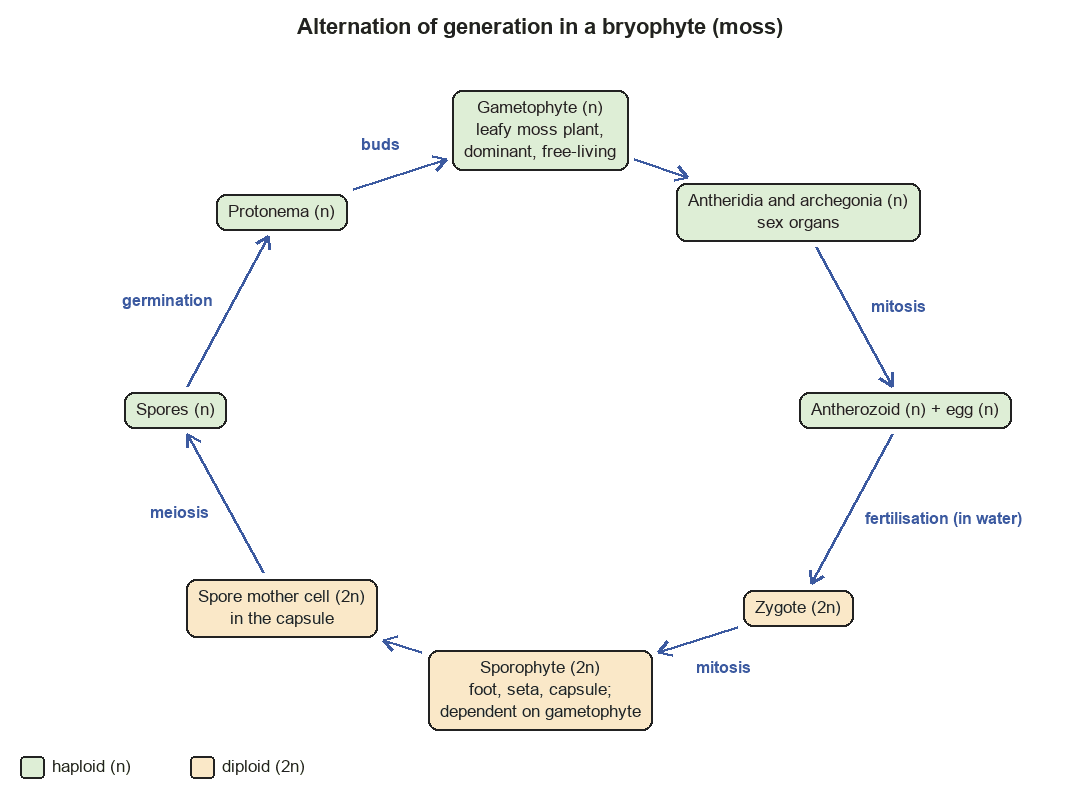
Therefore, in bryophytes a dominant haploid gametophyte alternates with a dependent diploid sporophyte.
- 635 marks
Question 63
List three important features of ferns. Explain life cycle of a fern with the help of a diagram.
Solve with AIWritten solution
Solution:
Concept: ferns are pteridophytes — vascular cryptogams whose main plant is the diploid sporophyte.
Step 1 — Three features: (i) the plant body is differentiated into true roots, stem (usually an underground rhizome) and leaves (fronds); (ii) vascular tissue is present — xylem carries water, phloem carries food; (iii) the sporophyte is dominant, and the gametophyte is a small prothallus; young leaves are circinate (coiled).
Step 2 — Spore formation: on the underside of mature fronds (sporophylls) brown sori appear; each sorus has several sporangia in which spore mother cells form haploid spores by meiosis. The sporangia burst and release the spores.
Step 3 — Prothallus: a spore falling on moist soil germinates into a short green filament and then a heart-shaped prothallus (n) — multicellular, photosynthetic, without vascular tissue, anchored by rhizoids.
Step 4 — Fertilisation: antheridia and archegonia form on the prothallus; motile sperms swim in a water film to the egg and form a diploid zygote. The zygote grows into an embryo inside the female gametophyte — a step towards the seed habit.
Step 5 — New fern: the young sporophyte first feeds on the prothallus, then forms its own roots and leaves and becomes independent; the prothallus dies.
Diagram:
Therefore, ferns have true roots, stem and leaves, vascular tissue and a dominant sporophyte, which alternates with a short-lived prothallus.
- 645 marks
Question 64
What is alternation of generation? How does it differ in bryophytes and pteridophytes?
Solve with AIWritten solution
Solution:
Concept: plants have a haploid phase and a diploid phase; both bryophytes and pteridophytes are haplo-diplontic (both phases multicellular), but they differ in which phase dominates.
Step 1 — Definition: alternation of generation is the alternation in the life cycle of a haploid gametophyte (makes gametes by mitosis) with a diploid sporophyte (makes spores by meiosis).
Step 2 — Bryophytes: the gametophyte (n) is dominant, independent and photosynthetic (thalloid or leafy); the sporophyte (foot, seta, capsule) is short-lived and totally or partly dependent on the gametophyte.
Step 3 — Pteridophytes: the sporophyte (2n) is dominant, independent, with true roots, stem, leaves and vascular tissue; the gametophyte (prothallus) is small, short-lived, but free-living and photosynthetic.
Step 4 — Table:
Feature Bryophytes Pteridophytes Dominant phase gametophyte (n) sporophyte (2n) Main plant gametophyte (moss plant) sporophyte (fern plant) Sporophyte dependent on gametophyte independent Gametophyte prominent, long-lived small prothallus, short-lived Step 5 — Common point: in both, water is needed for the male gametes to swim to the egg.
Therefore, both alternate gametophyte and sporophyte, but bryophytes have a dominant gametophyte while pteridophytes have a dominant sporophyte.
- 655 marks
Question 65
To which group does a pine tree belong? Explain the formation of seeds in this plant.
Solve with AIWritten solution
Solution:
Concept: the pine (Pinus) belongs to the gymnosperms (conifers): its ovules lie naked on cone scales, so its seeds are naked.
Step 1 — Group: Pinus is a gymnosperm (conifer): heterosporous, with male and female cones on the same tree.
Step 2 — Male side: microsporophylls of the male cone each carry two pollen sacs, where meiosis forms microspores that become winged pollen grains (each later forms two male gametes in its pollen tube).
Step 3 — Female side: each ovuliferous scale of the female cone bears two ovules; in each ovule the megaspore mother cell forms 4 megaspores by meiosis, but only one develops into the female gametophyte with the egg.
Step 4 — Pollination and fertilisation: wind carries pollen to the ovule (1st year cone); no water is needed. In the 2nd year a pollen tube grows through the nucellus and a male gamete fertilises the egg, forming a zygote.
Step 5 — Seed: the zygote becomes the embryo inside the ovule, the ovule wall becomes the seed coat, and the fertilised ovule becomes a winged seed, fed by the parent plant. In the 3rd year the scales bend outwards and the seeds are dispersed by wind; they stay dormant until they germinate.
Therefore, the pine is a gymnosperm, and its seed forms when a wind-borne pollen grain's male gamete fertilises the egg in a naked ovule, which matures into a winged seed by the third year.
Note: gymnosperms have no stigma: the pollen reaches the ovule directly at its micropyle.
- 665 marks
Question 66
Explain the following briefly:
(i) leaf cell of a moss,
(ii) prothallus of a fern,
(iii) gemma in Marchantia,
(iv) ovum of liverworts,
(v) zygote of fern.
Solve with AIWritten solution
Solution:
Concept: each structure belongs to a life cycle: work out whether it is part of the gametophyte (n) or the sporophyte (2n), then describe it.
Step 1 — Leaf cell of a moss: the leaf-like scales of the moss gametophyte are one cell thick (except along the centre) and contain chlorophyll; the cell is haploid (n), being part of the gametophyte.
Step 2 — Prothallus of a fern: the small, heart-shaped, multicellular, photosynthetic, free-living haploid gametophyte of a fern, formed from a spore; it has rhizoids and bears antheridia and archegonia but has no vascular tissue.
Step 3 — Gemma in Marchantia: a green, multicellular asexual bud formed in small gemma cups on the thallus; it detaches and grows into a new plant — vegetative reproduction. It is haploid (n).
Step 4 — Ovum of liverworts: the single large female gamete formed inside the flask-shaped archegonium; it is haploid (n) and fuses with an antherozoid to form the zygote.
Step 5 — Zygote of fern: the diploid (2n) cell formed when a sperm fuses with the egg in the archegonium of the prothallus; it develops into an embryo inside the female gametophyte and then into the new fern sporophyte.
Therefore, the moss leaf cell, prothallus, gemma and liverwort ovum are haploid structures, while the fern zygote is the diploid start of the sporophyte.
- 675 marks
Question 67
What is double fertilisation? Explain the gametophytic and sporophytic generations in an angiosperm.
Solve with AIWritten solution
Solution:
Concept: angiosperms have a diplontic life cycle: the flowering plant is the sporophyte, and the gametophytes are tiny — the pollen grain (male) and the embryo sac (female).
Step 1 — Double fertilisation: the pollen tube enters the ovule through the micropyle and releases two male gametes into the embryo sac. One fuses with the egg → diploid zygote (syngamy). The other fuses with the diploid secondary nucleus → triploid primary endosperm nucleus. Since fertilisation happens twice in one embryo sac, it is called double fertilisation — unique to angiosperms.
Step 2 — Sporophytic generation: the plant with roots, stem, leaves and flowers is the diploid sporophyte; it is dominant and independent. Its stamens (microsporophylls) and carpels (megasporophylls) bear microsporangia (pollen sacs) and megasporangia (ovules).
Step 3 — Male gametophyte: microspore mother cells in the anther divide by meiosis into microspores; each develops into a pollen grain (male gametophyte) whose generative cell forms two male gametes.
Step 4 — Female gametophyte: in the ovule a megaspore mother cell divides by meiosis; a megaspore forms the embryo sac (female gametophyte) with 8 haploid nuclei in 7 cells — egg apparatus (egg + 2 synergids), 3 antipodals and one large central cell holding 2 polar nuclei.
Step 5 — Next sporophyte: after double fertilisation the zygote forms the embryo, the PEN forms the endosperm, the ovule becomes the seed and the ovary the fruit; the seed germinates into a new sporophyte.
Therefore, double fertilisation is the fusion of one male gamete with the egg and the other with the secondary nucleus; in angiosperms the sporophyte dominates and the gametophytes are the pollen grain and embryo sac.
- 685 marks
Question 68
Describe the life cycle of moss and fern with suitable diagrams.
Solve with AIWritten solution
Solution:
Concept: both moss and fern show alternation of generation and need water for fertilisation, but the moss plant is the gametophyte (n) while the fern plant is the sporophyte (2n).
Step 1 — Moss — gametophyte: the leafy moss plant (n), with multicellular rhizoids, bears antheridia and archegonia at the tips of leafy stems; flagellated sperms swim in a film of rain or dew to the egg.
Step 2 — Moss — sporophyte: the zygote (2n) forms a sporophyte of foot, seta and capsule, attached to and fed by the gametophyte; in the capsule meiosis forms haploid spores, released when the hood falls and the capsule opens. Each spore forms a protonema, whose buds grow into new moss plants.
Step 3 — Fern — sporophyte: the fern plant (2n), with rhizome, roots and fronds, bears sori of sporangia on the underside of sporophylls; meiosis in the sporangia forms haploid spores.
Step 4 — Fern — gametophyte: a spore grows into a heart-shaped prothallus (n), which bears antheridia and archegonia; a sperm swims to the egg and forms a zygote (2n).
Step 5 — Fern — new sporophyte: the zygote develops into an embryo inside the female gametophyte and then into a young sporophyte, which becomes independent as the prothallus dies.
Therefore, in moss the gametophyte is dominant and the sporophyte dependent, while in fern the sporophyte is dominant and the prothallus short-lived.
What Class 11 Biology Ch 6 covers
The sections of the chapter, in the order the book takes them. Every question above comes from one of these.
- 01Evolution and Classification
- 02Algae - Chlorophyceae
- 03Phaeophyceae and Rhodophyceae
- 04Bryophytes
- 05Pteridophytes
- 06Gymnosperms
More ways to study this chapter
The same chapter asked three other ways. Practise it, revise it, and see what the board has set on Ch 6 before.
Class 11 Biology Ch 6 questions students ask
How many questions are there in Class 11 Biology Ch 6?
68 questions. Every one is solved step by step on this page.
Are these Class 11 Biology solutions free?
Yes. Every question and its full working is free to read, with no account needed.
Can I download the Class 11 Biology Ch 6 solutions as a PDF?
There is no PDF to download. Every solution is on this page instead, which means it is searchable, always the current syllabus, and readable on a phone. Use your browser's print option if you want it on paper.