
Question 625 marksMedium
Explain gametophytic and sporophytic phase in a bryophyte. What is alternation of generation? Make a schematic diagram of the same.
Confirming your payment
Sign up now and get 250 free tokens.
Plant Kingdom · Question 62 of 68
Explain gametophytic and sporophytic phase in a bryophyte. What is alternation of generation? Make a schematic diagram of the same.
Solution:
Concept: bryophytes have a haplo-diplontic life cycle with a dominant haploid gametophyte and a dependent diploid sporophyte.
Step 1 — Gametophytic phase: the green moss or liverwort plant is the haploid gametophyte. It is free-living, photosynthetic and dominant. It bears multicellular sex organs — antheridia (biflagellate antherozoids) and flask-shaped archegonia (one egg). It is the sexual phase.
Step 2 — Fertilisation: antherozoids swim through a film of water (rain or dew) to the archegonium and fuse with the egg, giving a diploid zygote — the start of the sporophyte.
Step 3 — Sporophytic phase: the zygote divides by mitosis into the sporophyte — foot, seta and capsule. It stays attached to the gametophyte and depends on it for food. In the capsule, spore mother cells undergo meiosis to form haploid spores. It is the asexual phase.
Step 4 — Alternation of generation: the regular alternation, in one life cycle, of a haploid gamete-producing gametophyte and a diploid spore-producing sporophyte is called alternation of generation.
Step 5 — Back to gametophyte: spores germinate (through the protonema in mosses) into new gametophytes.
Schematic diagram:
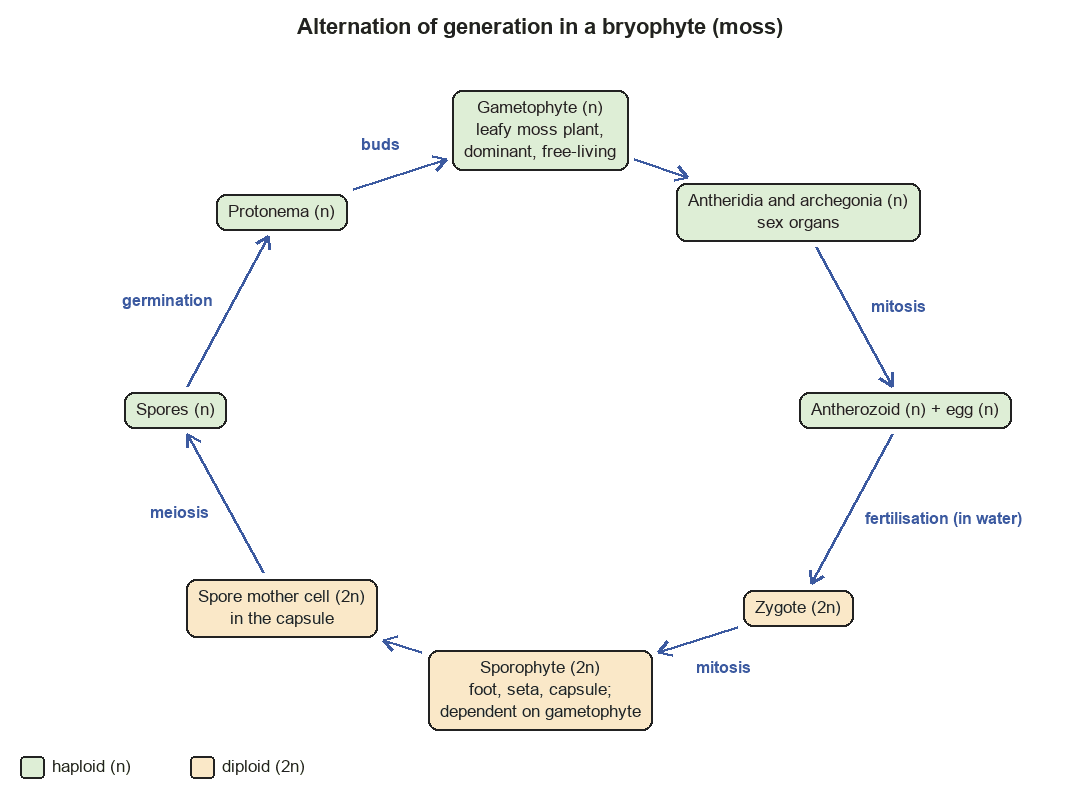
Therefore, in bryophytes a dominant haploid gametophyte alternates with a dependent diploid sporophyte.