
Question 635 marksMedium
List three important features of ferns. Explain life cycle of a fern with the help of a diagram.
Confirming your payment
Sign up now and get 250 free tokens.
Plant Kingdom · Question 63 of 68
List three important features of ferns. Explain life cycle of a fern with the help of a diagram.
Solution:
Concept: ferns are pteridophytes — vascular cryptogams whose main plant is the diploid sporophyte.
Step 1 — Three features: (i) the plant body is differentiated into true roots, stem (usually an underground rhizome) and leaves (fronds); (ii) vascular tissue is present — xylem carries water, phloem carries food; (iii) the sporophyte is dominant, and the gametophyte is a small prothallus; young leaves are circinate (coiled).
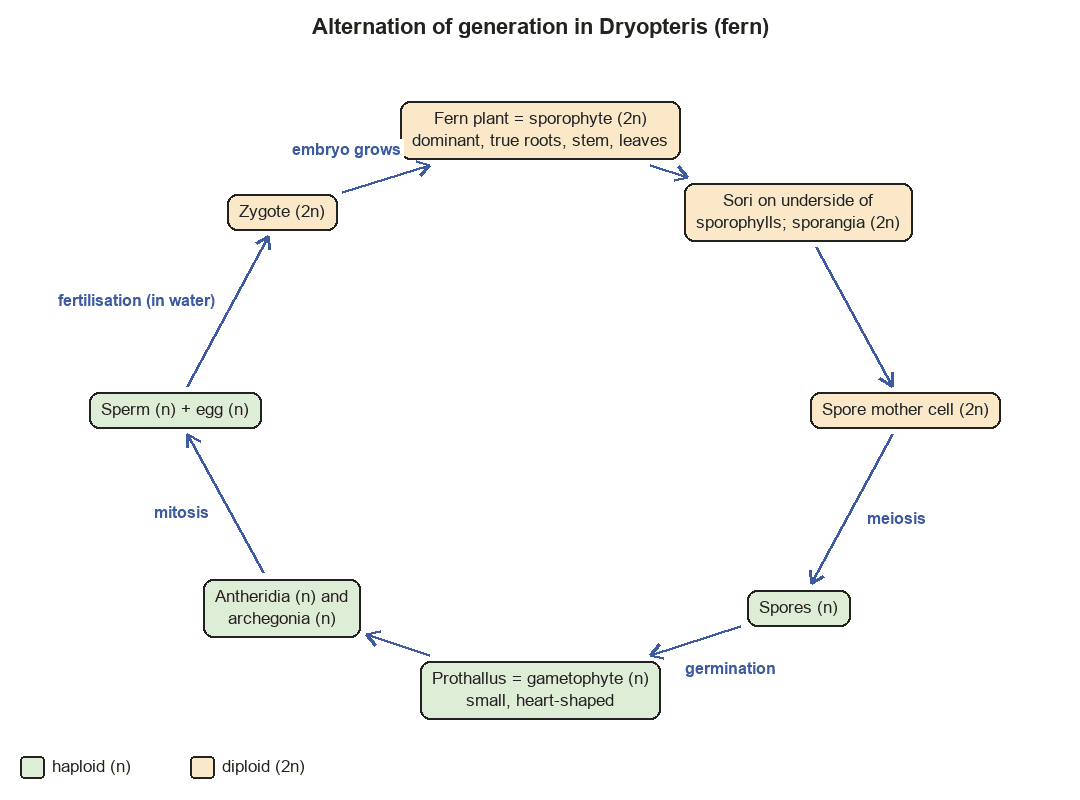
Step 2 — Spore formation: on the underside of mature fronds (sporophylls) brown sori appear; each sorus has several sporangia in which spore mother cells form haploid spores by meiosis. The sporangia burst and release the spores.
Step 3 — Prothallus: a spore falling on moist soil germinates into a short green filament and then a heart-shaped prothallus (n) — multicellular, photosynthetic, without vascular tissue, anchored by rhizoids.
Step 4 — Fertilisation: antheridia and archegonia form on the prothallus; motile sperms swim in a water film to the egg and form a diploid zygote. The zygote grows into an embryo inside the female gametophyte — a step towards the seed habit.
Step 5 — New fern: the young sporophyte first feeds on the prothallus, then forms its own roots and leaves and becomes independent; the prothallus dies.
Diagram:
Therefore, ferns have true roots, stem and leaves, vascular tissue and a dominant sporophyte, which alternates with a short-lived prothallus.