
Opening your dashboard
Class 11 Biology Chapter 6 Plant Kingdom: Competency-Based Questions (CBQ)
40 questions on Chapter 6, each worked through on its own page with the AI tutor. Class 11 Biology, ICSE 2026-27.
40 questions
1–10 marks · Mixed difficulty
- 13 marks
Question 1
In a college laboratory in Bhopal, students test four organisms, W, X, Y and Z. Three are algae collected from a pond and the sea; Z is a moss from the college wall. Their results are given below.
Organism Chlorophylls present Main stored food Cell wall made of W a and b starch cellulose X a and c laminarin and mannitol cellulose and algin Y a and d floridean starch cellulose, pectin and polysulphate esters Z (moss) a and b starch cellulose (a) Which alga, W, X or Y, matches the moss in all three features? To which class of algae does it belong?
(b) What idea about the origin of land plants does this match support? Apart from the three features in the table, name one more feature that this alga shares with land plants.
(c) A student argues that Y could equally be the ancestor of land plants, "because Y also stores starch". Explain why this argument is weak.
- 21 mark
Question 2
A plant nursery in Pune puts up two signboards based on Eichler's grouping: Cryptogamae — flowerless plants that do not form seeds and Phanerogamae — seed-bearing plants. Under the Cryptogamae board it places four pots. Which pot has been placed wrongly?
- 31 mark
Question 3
Assertion (A): Eichler placed Pinus in Cryptogamae, along with the ferns.
Reason (R): Pinus and ferns both have xylem and phloem for conduction.
- 43 marks
Question 4
A teacher in Kolkata grows three cultures, P, Q and R, of the same species of Chlamydomonas. When each culture is moved to a medium lacking nitrogen, its cells form gametes. Gametes from different cultures are then mixed in pairs and observed under the microscope. (Hypothetical data.)
Mixture Gametes pair and fuse? P alone, Q alone or R alone No P + Q Yes P + R No Q + R Yes All the gametes look alike: same size, each with two flagella.
(a) What do these results show about the cultures? Which two cultures belong to the same mating strain?
(b) After fusion, the product swims for a while and then forms a thick wall. Name this walled structure and explain its value to the alga when the pond starts to dry up.
(c) Name the type of sexual reproduction seen here, and state how it would be named if one gamete were large and non-motile and the other small and motile.
- 51 mark
Question 5
Assertion (A): When a Spirogyra filament that has been kept in light for some hours is stained with iodine, blue-black patches appear around the pyrenoids.
Reason (R): Pyrenoids are bodies in the chloroplast made mainly of protein, around which starch is deposited.
- 63 marks
Question 6
A village pond in Bihar is covered with a thick green scum of filamentous green algae. Students of the school's eco-club measure the dissolved oxygen in the pond water at different times on one sunny day and the night that follows. (Hypothetical data.)
Time 6 am 10 am 2 pm 6 pm 10 pm 2 am Dissolved oxygen (mg per litre) 4.5 8.0 11.5 9.0 6.5 5.0 (a) At what time is the oxygen highest? Explain the rise from 6 am to that time.
(b) Explain why the oxygen keeps falling through the night.
(c) The panchayat wants to poison all the algae in the pond. Give one reason, from the role of algae in water, why removing them completely would harm the pond's other life.
- 71 mark
Question 7
A space-food research team wants to grow a protein-rich, single-celled, eukaryotic green alga in a sealed tank aboard a spacecraft, as a food supplement for the crew. Which organism fits all of these conditions?
- 84 marks
Question 8
On a field trip to the rocky shore at Okha, Gujarat, students collect three seaweeds, P, Q and R. In the laboratory they record the following. (Hypothetical data.)
Observation P Q R Colour of fresh plant olive-brown dark red grass green Pigment found besides chlorophyll a fucoxanthin phycoerythrin chlorophyll b Main stored food laminarin and mannitol floridean starch starch Flagellated reproductive cells pear-shaped, two unequal flagella attached at the side none found at any stage two or more equal flagella at the front end (a) Name the class of algae to which P, Q and R each belong, giving one deciding observation for each. (2 marks)
(b) At low tide, P lies exposed on the rocks for hours, yet its surface stays slimy and it does not dry out. Explain why.
(c) A food company wants a seaweed extract to make jellies and creamy desserts set. Name one such extract that P can supply and one that Q can supply.
- 91 mark
Question 9
Assertion (A): Brown algae are found mostly in the sea.
Reason (R): Brown algae contain the pigment fucoxanthin, which masks their chlorophyll.
- 101 mark
Question 10
Assertion (A): Polysiphonia shows a haplontic life cycle.
Reason (R): In red algae, sexual reproduction is oogamous.
- 113 marks
Question 11
In a moist forest near Darjeeling, a researcher studies a moss species in which male and female shoots are separate plants. After the rainy season she counts the fraction of archegonia that have been fertilised on female shoots growing at different distances from the nearest male shoot. (Hypothetical data.)
Distance from nearest male shoot (cm) 1 3 6 10 20 Archegonia fertilised (%) 78 52 21 4 0 (a) Describe the trend and explain it from the way the male gametes reach the archegonia.
(b) What does a fertilised archegonium give rise to, and how does this structure obtain water and minerals?
(c) Fertilisation works only over a few centimetres, yet this moss spreads to new rocks many metres away. Explain how.
- 121 mark
Question 12
In a laboratory, a single moss spore is sown on moist soil. It grows into a green, branched thread, and after some weeks about 30 leafy shoots rise from this one thread. Which statement about these leafy shoots is correct?
- 131 mark
Question 13
Assertion (A): A moss sporophyte cannot survive on its own once it is cut away from the leafy gametophyte.
Reason (R): The moss sporophyte has no chlorophyll at any stage and so depends entirely on the gametophyte for its food.
- 143 marks
Question 14
A botany teacher in Shillong shows her class the table below for four plants found in the same moist hill forest.
Plant Usual height Xylem and phloem Where it grows best Liverwort about 2 cm absent wet soil and rocks Moss about 5 cm absent damp walls and logs Tree fern up to about 10 m present moist, shady valleys Chir pine up to about 40 m present dry, sunny slopes too (a) Why can the tree fern and the pine grow many metres tall, while the liverwort and moss stay only a few centimetres high?
(b) The tree fern is tall and vascular, yet it grows well only in moist, shady places. Explain why, from its life cycle.
(c) The tall green plant you see is a different generation in the moss and in the tree fern. Name the generation in each case.
- 151 mark
Question 15
Assertion (A): After a forest fire, ferns are often among the first plants to reappear on the burnt ground.
Reason (R): Ferns have xylem and phloem for conducting water and food.
- 161 mark
Question 16
On the wet wall of a greenhouse, a student finds tiny, flat, heart-shaped green plates growing near some ferns. Under a hand lens, their underside shows rhizoids and small flask-shaped organs. After an egg in one flask-shaped organ is fertilised, what happens next?
- 173 marks
Question 17
At a plant research nursery in Bengaluru, young Cycas plants are grown for six months in clean sand that contains no nitrogen compounds. (Hypothetical data.)
Group Treatment Gain in dry mass (g) Nitrogen in leaves (%) A coralloid roots with their usual cyanobacteria 24 2.1 B coralloid roots without cyanobacteria 6 0.9 C no cyanobacteria, nitrate fertiliser added 22 2.0 (a) What are coralloid roots, and what lives in them in group A?
(b) Use groups A and B to explain how the partners help Cycas in the sand.
(c) What does group C show about the cause of poor growth in group B?
- 181 mark
Question 18
Young Pinus seedlings raised in sterilised nursery soil grow poorly after planting on a bare hill slope in Himachal Pradesh. When a little soil from an old pine forest is mixed around their roots, they grow well. What did the forest soil most likely supply?
- 191 mark
Question 19
Assertion (A): Pinus can complete sexual reproduction on dry, windy hill slopes where ferns cannot.
Reason (R): In Pinus, wind carries the pollen to the ovule, and a pollen tube carries the male gametes to the egg, so no external water is needed for fertilisation.
- 203 marks
Question 20
A timber-testing laboratory in Dehradun receives two logs whose labels have been lost. One is from a teak tree and one from a chir pine. Thin sections are examined under the microscope.
Feature Log P Log Q Water-conducting cells in xylem vessels and tracheids tracheids only Phloem sieve tubes with companion cells no companion cells (a) Which log is from the chir pine? Give two reasons from the table.
(b) The tree of the other log bears seeds in a different way from the pine. State how, and which part of the flower forms the structure around its seeds.
(c) A student says log Q might come from a Cycas stem instead of a pine. Can these sections decide this? Explain.
- 214 marks
Question 21
A cook in Lucknow shells a pea pod. Inside are 7 well-formed peas and 2 small, shrivelled ovules that never developed. (Hypothetical data.)
(a) Which part of the flower became the pod, and which parts became the peas?
(b) What is the smallest number of pollen grains that must have grown pollen tubes into this ovary to give the 7 peas? How many male gametes did those pollen grains release in total?
(c) How many fusions of nuclei (counting both kinds) took place in the 7 developed ovules? Name both kinds and give the ploidy of the product of each. (2 marks)
- 221 mark
Question 22
A plant scientist studies sections of mustard ovules just after double fertilisation. Before fertilisation each embryo sac had 7 cells (8 nuclei). Which cells of the embryo sac will degenerate soon after fertilisation?
- 231 mark
Question 23
A farmer in Punjab sows the seeds of an unfamiliar crop. Every seedling comes up with a single cotyledon (seed leaf). Which pair of features should he expect in the grown plants?
- 241 mark
Question 24
Assertion (A): In a flowering plant, the primary endosperm nucleus is triploid.
Reason (R): The primary endosperm nucleus is formed when a male gamete fuses with the egg.
- 254 marks
Question 25
A botanical garden display shows three life-history cards, P, Q and R, without the names of the plants.
Card P: The plant you see is haploid, multicellular and free-living. The only diploid cell is the zygote, which divides by meiosis.
Card Q: The plant you see is diploid. The only haploid cells are the gametes, which are formed by meiosis.
Card R: The plant you see is haploid, leafy and long-lived. A multicellular diploid stage grows attached to it and forms spores by meiosis.
(a) Name the life-cycle pattern shown on each card. (2 marks)
(b) Give one example from the plant kingdom for card P and one for card R.
(c) On which card does meiosis give rise to gametes directly, and on which does it give rise to spores?
- 2610 marks
Question 26
Match the following:
Column A Column B 1. Plant body is undifferentiated into root, stem and leaves. (a) Bryophyta 2. Filamentous green alga with band-shaped chloroplasts. (b) Gymnosperms 3. Marine brown algae present as giant kelps, attached to substratum by holdfast. (c) Chlamydomonas 4. Plants with naked seeds that develop at the surface of scales. (d) Laminaria 5. Plant body is a gametophyte. Spores form filamentous protonema. (e) Cryptogamae 6. Flowering plants in which seeds are enclosed in the ovary. (f) Rhodophyceae 7. Ferns with plant body well differentiated and with conducting tissue. (g) Thallophyta 8. A unicellular, flagellated, green alga with cup-shaped chloroplast. (h) Angiosperms 9. A sub-kingdom that includes lower plants without seeds and hidden or inconspicuous reproductive organs. (i) Ulothrix 10. Class of algae that have red pigment called phycoerythrin. (j) Pteridophyta - 275 marks
Question 27
Algae belong to the group thallophyta. They are autotrophic, photosynthetic organisms with body not differentiated into root, stem or leaves. Reproduction can be vegetative, asexual or sexual. Vegetative reproduction occurs by fragmentation. Each fragment after fragmentation gives rise to a new thallus. Asexual reproduction occurs by motile spores known as zoospores. These spores on germination give rise to a new plant or thallus. Zoospores can be flagellated or non-flagellated. Sexual reproduction is by formation of gametes. If the gamete are similar in size, they are known as isogamous. But if they are of different size, they are known as anisogamous. Fusion between small, motile male gamete and large, non-motile female gamete is known as oogamy.
(1) Vegetative reproduction in thallophyta occurs by
(a) fragmentation
(b) zoospores
(c) isogamous gametes
(d) spores
(2) Asexual reproduction in algae occurs by
(a) flagellated spores
(b) non-flagellated spores
(c) zoospores
(d) isogametes
(3) Isogametes are the ones which are
(a) motile gametes
(b) non-motile gametes
(c) different in size
(d) same in size
(4) Fusion between a motile male gamete and a non-motile female gamete is called
(a) isogamous
(b) anisogamous
(c) zoogamy
(d) oogamy
(5) Algae belong to group thallophyta because
(a) body is not differentiated
(b) autotrophic
(c) photosynthetic
(d) eukaryotic
- 285 marks
Question 28
Bryophytes include liverworts and mosses. They need water for sexual reproduction and so are known as "amphibians of the plant kingdom". Liverworts are found in moist and shady places. Asexual reproduction occurs by fragmentation and by specialised structures known as gemmae. Gemma are multicellular structures which develop in gemmae cups. Mosses are flowerless plants. Their life cycle includes two stages: protonema and leafy stage. The first stage is protonema stage which develops directly from spore. It is green, branched and filamentous. The second stage is leafy stage which develops from the secondary protonema. It is upright, multicellular and has branched rhizoids. It bears sex organs, antheridia and archegonia.
(1) Which of the following statements is true of mosses?
(a) produce small flowers
(b) flowerless plants
(c) have unicellular rhizoids
(d) water is not essential
(2) The following stage of mosses develops from the spores
(a) gemmae
(b) liverworts
(c) protonema
(d) buds
(3) In liverworts asexual reproduction occurs by specialised structures called
(a) thallus
(b) spores
(c) antheridia
(d) gemmae
(4) Bryophytes are called amphibians of the plant kingdom because
(a) exist in moist and shady places
(b) need water for sexual reproduction
(c) reproduce by protonema
(d) can exist on land and in water
(5) The secondary protonema gives rise to the _____ structure in mosses.
(a) leafy stage
(b) antheridia
(c) archegonia
(d) gemmae
- 295 marks
Question 29
In ferns, the plant body is a sporophyte with gametophyte reduced to a simple thallus. The sporophyte is diploid and dominant and grows for many years while gametophyte is haploid, short lived and inconspicuous. Spores germinate and give rise to a heart-shaped prothallus which is a gametophyte. Gymnosperms have exposed seeds as the ovules are naked and do not have flower or fruit. Angiosperms are flowering plants. Ovules develop in the flowers and seeds are enclosed in the fruit. Enclosed seeds, presence of flowers and fruits, adaptations to different habitats, and the development of conducting tissues have led them to dominate the earth for years.
(1) The sporophyte in ferns is
(a) diploid and dominant
(b) diploid and inconspicuous
(c) haploid and dominant
(d) haploid and inconspicuous
(2) Which of the following statement is true for angiosperms?
(a) have exposed seeds
(b) have flowers but no fruits
(c) have seeds enclosed in fruits
(d) have flowers but naked seeds
(3) Heart-shaped structure called prothallus is
(a) a sporophyte
(b) present in gymnosperms
(c) a gametophyte
(d) present in angiosperms
(4) Which of the following statement is true for gymnosperms?
(a) ovules are in flowers
(b) ovules are naked
(c) seeds are in ovary
(d) seeds are in fruit
(5) Angiosperms have dominated the earth because of
(a) seeds enclosed in fruits
(b) adaptations to habitats
(c) none of these
(d) all of these
- 305 marks
Question 30
Label the parts marked (i) to (x) in the following diagrams.
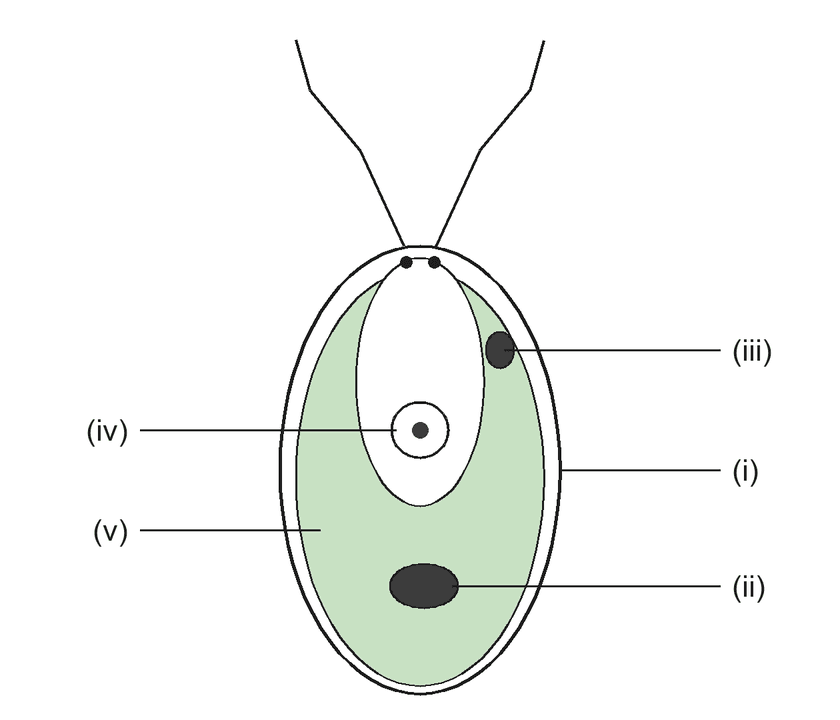
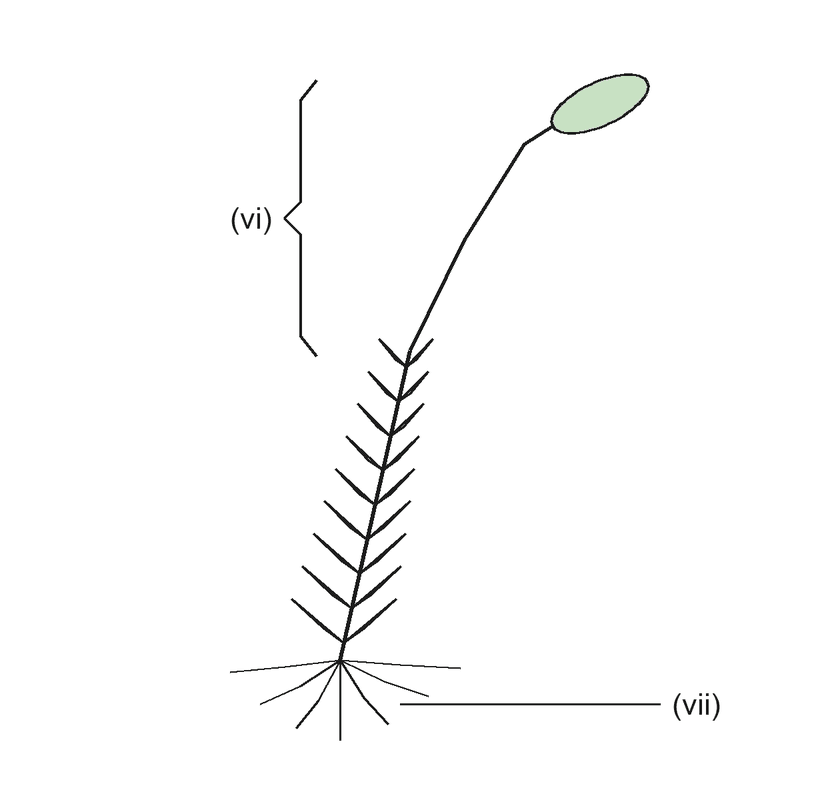
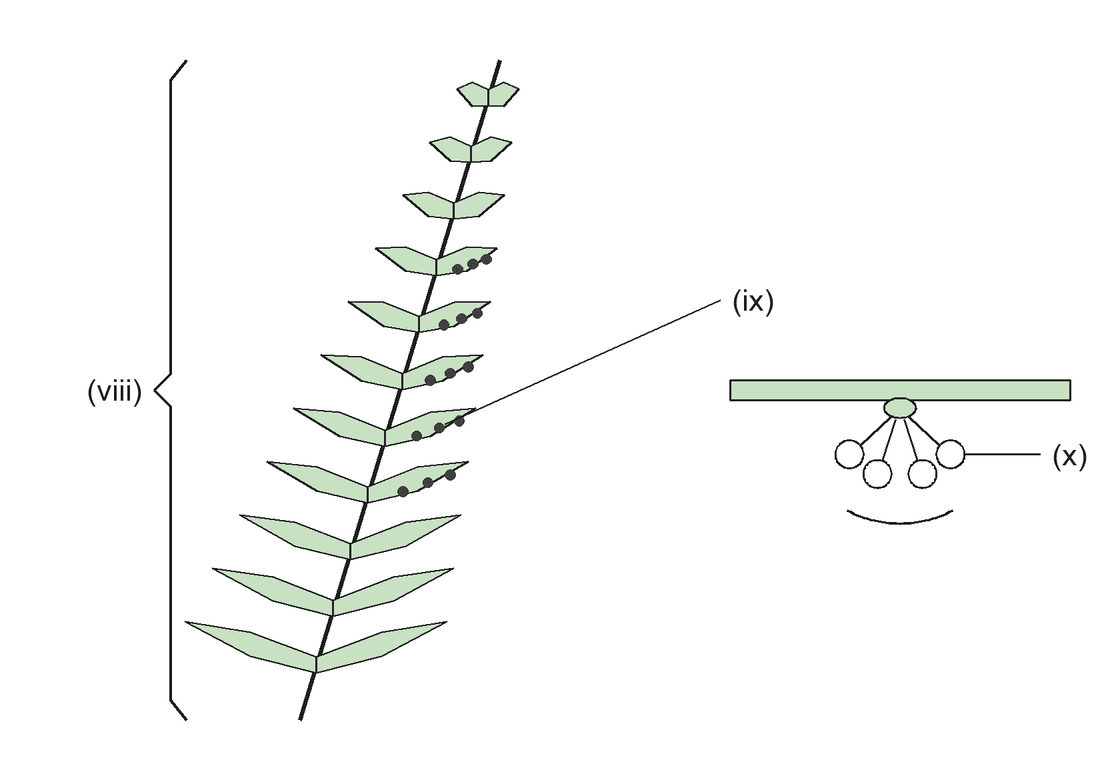
- 315 marks
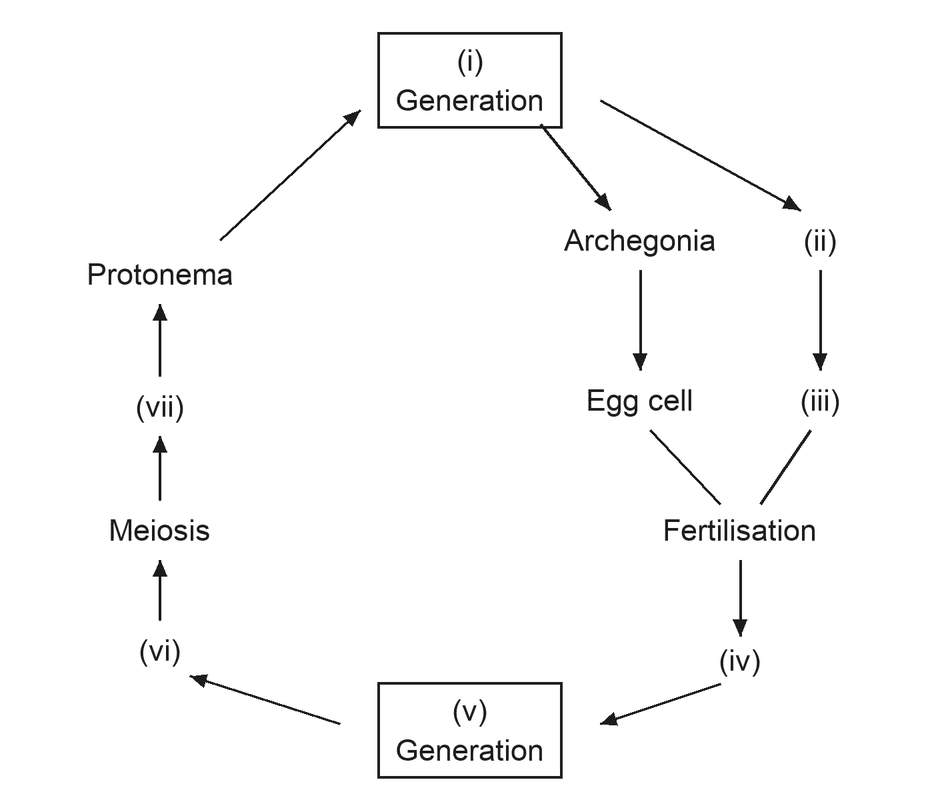
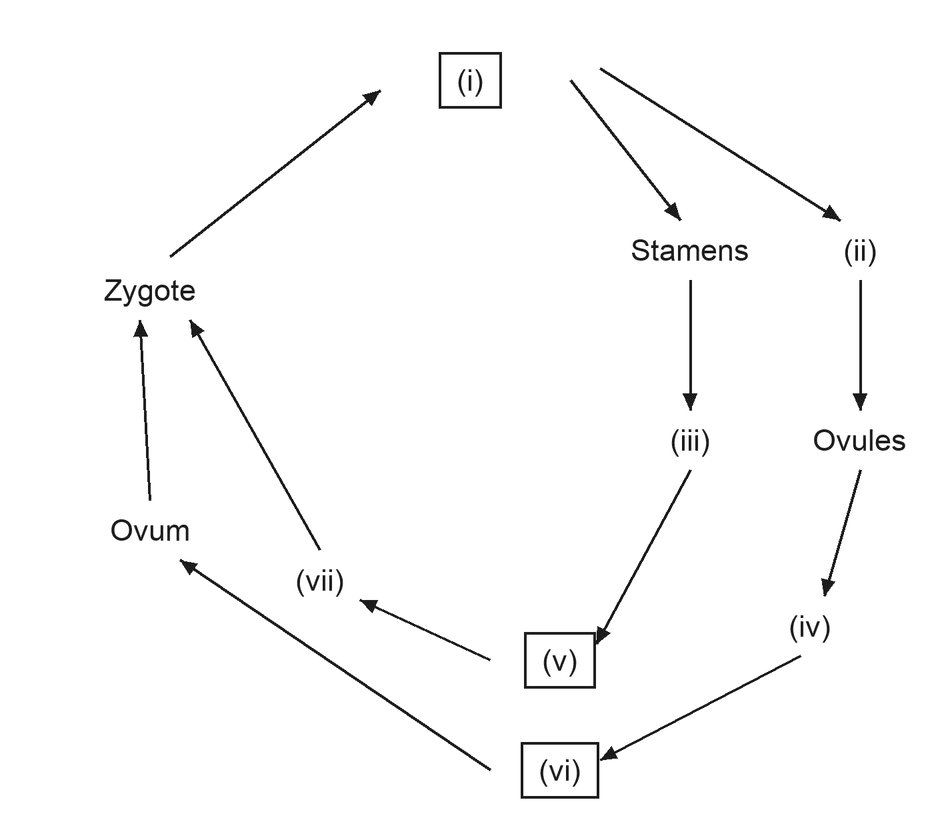
Question 31
Identify the stages marked (i) to (vii) in the following life cycles.
(a) Life cycle of bryophyte
(b) Life cycle of angiosperms
- 323 marks
Question 32
When and where does reduction division take place in the life cycle of a liverwort, a moss, a fern, a gymnosperm and an angiosperm?
- 333 marks
Question 33
Mention the ploidy of the following: protonemal cell of a moss, primary endosperm nucleus in dicot, leaf cell of a moss, prothallus cell of a fern, gemma cell in Marchantia, meristem cell of monocot, ovum of a liverwort and zygote of a fern.
- 343 marks
Question 34
What is heterospory? Briefly comment on its significance. Give two examples.
- 355 marks
Question 35
Explain briefly the following terms with suitable examples:
(i) Protonema
(ii) Antheridium
(iii) Archegonium
(iv) Diplontic
(v) Sporophyll
(vi) Isogamy
- 361 mark
Question 36
A student at a seed-testing laboratory in Shimla counts the chromosomes in nuclei from four tissues taken from two ripe seeds: one seed of chir pine (Pinus, a gymnosperm) and one seed of castor (an angiosperm). The labels of the four slides came off. The leaf cells of chir pine have chromosomes and the leaf cells of castor have .
Slide W X Y Z Chromosomes in each nucleus 12 30 24 20 Which statement about the slides is correct?
- 371 mark
Question 37
Assertion (A): When a dish of Chlamydomonas culture is lit from one side by moderate light, most of the cells soon gather near the lit side of the dish.
Reason (R): Each Chlamydomonas cell has a red eyespot that helps it detect the direction of light, and two flagella with which it swims.
- 382 marks
Question 38
A nursery in Ooty raises the maidenhair fern Adiantum for sale as a pot plant. The gardener does not sow spores. Instead, he cuts the underground rhizome of an old fern into pieces, each with a few roots and a bud, and plants each piece in a pot. Within a few weeks every piece grows new fronds.
(a) Which generation of the fern is each rhizome piece? Name the stages of the life cycle that this method skips.
(b) The potting shed is dry, and the plants are watered only at the roots. Give one reason, based on the fern's life cycle, why this method works here while raising ferns from spores often fails.
- 393 marks
Question 39
A college museum has six preserved specimens, each kept with its reproductive parts (spores, cones, seeds or fruits) where it has them: Ulothrix, the moss Funaria, the fern Dryopteris, Cycas, maize and pea.
(a) Design a key of yes/no questions, set out as a table, that a visitor could use to name each specimen. Every question must be answerable by looking at the specimen with the eye or a hand lens, and the key must end with each specimen on its own. (2 marks)
(b) A classmate's key begins with the question "Does the plant make its own food by photosynthesis?" Explain why this is a poor first question for these six specimens. (1 mark)
- 405 marks
Question 40
Along the coast of the Gulf of Mannar in Tamil Nadu, many fisherwomen farm the seaweed Kappaphycus, a red alga brought to India from South-East Asia because it yields carrageenan. Small pieces cut from harvested plants are tied to ropes on floating bamboo rafts in shallow, clear sea water. After about days the grown plants are harvested; some are cut up to plant the next raft and the rest are dried and sold. Scientists have found that pieces broken off by storms can drift onto nearby coral reefs and grow over the corals. The table shows the fresh mass of seaweed on one raft. (Hypothetical data.)
Day 0 15 30 45 Fresh mass on the raft (kg) 60 110 190 300 (a) Many farmed Kappaphycus plants look brownish-green, yet it is classed as a red alga. Name the red pigment found in red algae and the form in which red algae store their food. (1 mark)
(b) In which -day period did the raft gain the most mass? How many times its starting mass did the raft hold at harvest? The farmer keeps kg of fresh seaweed to plant the next raft and dries the rest. If dry mass is one-tenth of fresh mass, find the mass of dry seaweed she can sell. (2 marks)
(c) Using the way red algae reproduce, explain why storm-broken pieces can become a threat to the coral reefs, and suggest one precaution the farmers can take. (2 marks)