
Opening your dashboard
Class 11 Biology Chapter 6 Plant Kingdom: Practice Questions
156 questions on Chapter 6, each worked through on its own page with the AI tutor. Class 11 Biology, ICSE 2026-27.
156 questions
1–4 marks · Mixed difficulty
- 13 marks
Question 1
A student collects three plant specimens.
- Specimen X is a flat green thallus. Its body is not divided into root, stem and leaves.
- Specimen Y has a stem-like axis with leaf-like parts and rhizoids, but no xylem or phloem.
- Specimen Z has true roots, stem and leaves with xylem and phloem, but it never forms seeds.
Place each specimen in its division of Kingdom Plantae and name the feature that decides each placement.
- 21 mark
Question 2
In older classifications some organisms were placed among the algae, but they are no longer placed in Kingdom Plantae. Which pair is this?
- 32 marks
Question 3
Hydrilla and the water lily spend their whole lives in water, yet they are not algae.
(i) What term describes their way of life?
(ii) Explain why this term is used for them, with the animal comparison that fits.
- 43 marks
Question 4
It is believed that multicellular plant life evolved from green algae attached to underwater surfaces, and that the move to land took place along two lines.
(i) Name the two lines and the plants each led to.
(ii) Which line is described as a blind end, and which showed continuous adaptation? Explain the difference.
- 51 mark
Question 5
Kingdom Plantae is classified in levels. Which feature is correctly matched with the groups it separates?
- 61 mark
Question 6
A green alga is made of just one cell, yet it is shaped like an umbrella and can be a few centimetres tall. It is
- 74 marks
Question 7
The diagram shows one cell of a Spirogyra filament, with parts of the cells on either side.
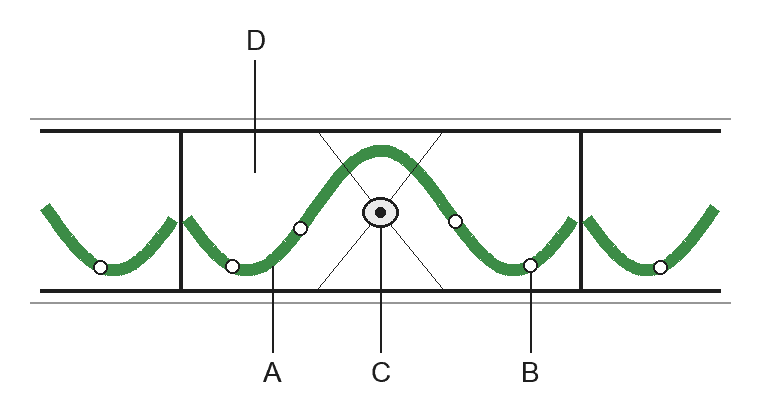
(i) Identify the parts labelled A, B, C and D.
(ii) When iodine solution is added, which labelled part shows dark blue-black spots? Give the reason.
(iii) The filament feels slimy to touch. Which layer, not labelled here, causes this?
- 81 mark
Question 8
A cell of Ulothrix releases many small cells, each with two flagella. They swim away from the filament and fuse in pairs, one from each strain. These small cells are
- 93 marks
Question 9
In a pond culture of Chlamydomonas, 12 pairs of gametes fuse. Later, conditions become favourable and every zygospore germinates. (Hypothetical data.)
(i) How many zygospores are formed?
(ii) How many zoospores are released in all when the zygospores germinate?
(iii) State the ploidy (n or 2n) of a gamete, a zygospore and a zoospore.
- 101 mark
Question 10
After conjugation in Spirogyra, the zygospore germinates when conditions are favourable. Which statement describes the new filament correctly?
- 112 marks
Question 11
In the rainforests of South America, the fur of the sloth often looks green.
(i) Explain the reason.
(ii) Name this kind of habit of green algae and give one other example of a green alga living in association with an animal.
- 123 marks
Question 12
Three green algae are seen under the microscope.
P — a single oval cell with two anterior flagella, a red eyespot and one cup-shaped chloroplast.
Q — an unbranched filament anchored by a holdfast cell; each cell has one band-shaped chloroplast.
R — an unbranched, slimy filament, one cell thick; each cell has ribbon-like spiral chloroplasts.
Name P, Q and R, giving the clue that decides each.
- 131 mark
Question 13
Caulerpa is described as a coenocytic green alga. This means that its body is
- 141 mark
Question 14
Red light is absorbed in the top layers of sea water, while blue-green light goes much deeper. Which algae can grow at the greatest depth, and why?
- 154 marks
Question 15
A kelp about 20 m long is anchored to a rock on the sea floor, while its broad leaf-like parts float near the sunlit surface.
(i) Name the three parts of the kelp from its base to its top and give the job of each.
(ii) The kelp is a non-vascular plant. How does food made at the top reach the base?
- 161 mark
Question 16
In Fucus, the adult plant is diploid. By which division are its gametes formed, and what is their ploidy?
- 172 marks
Question 17
On some coasts, farmers spread large seaweeds on their fields, and an ice-cream factory buys an extract of kelps.
(i) Why are large seaweeds useful to the farmers?
(ii) Name the substance extracted from kelps for the factory and state why it is used.
- 182 marks
Question 18
Red algae have no flagellated cells at any stage of their life.
Explain how, in spite of this, a male gamete reaches the female gamete, and name the type of sexual reproduction.
- 191 mark
Question 19
Red algae store their food as floridean starch. In structure, floridean starch is very similar to
- 202 marks
Question 20
Mosses usually stay very small and grow mostly in damp, shady places. Give two reasons for this, based on their structure and reproduction.
- 211 mark
Question 21
Gardeners pack cut plant parts in the moss Sphagnum when sending them over long distances. This is because Sphagnum
- 223 marks
Question 22
A gardener notices small cup-like structures on the flat green thallus of Marchantia.
(i) Name these cups and what they contain.
(ii) How do their contents form new plants?
(iii) Will the new plants be haploid or diploid, and will they be genetically like the parent? Explain.
- 231 mark
Question 23
A bryophyte has a dorsiventrally flattened thallus, unicellular rhizoids and gemma cups on its upper surface. It is
- 243 marks
Question 24
A moss capsule contains 2,000 spore mother cells, and every one of them completes its division. (Hypothetical data.)
(i) How many spores are formed?
(ii) State the ploidy of a spore mother cell and of a spore, and name the division that links them.
(iii) What is the first structure a spore forms when it lands on moist soil?
- 252 marks
Question 25
After a landslide, a hill slope is left with bare rock and loose soil. Explain two ways in which mosses help this slope.
- 261 mark
Question 26
A student compares Selaginella with the fern Dryopteris. Which feature is found in Selaginella but NOT in Dryopteris?
- 271 mark
Question 27
On a field trip, a student finds a pteridophyte (a horsetail) with a jointed, ribbed green stem bearing a ring of tiny scale-like leaves at each joint. To which class of pteridophytes does it belong?
- 282 marks
Question 28
In ferns and in Selaginella, the zygote develops into a young embryo while it is still inside the female gametophyte. Explain why this is described as a step towards (a precursor of) the seed habit.
- 293 marks
Question 29
(Hypothetical data.) The leaf cells of a Selaginella plant have 18 chromosomes. How many chromosomes will be present in:
(i) a microspore,
(ii) a cell of the female gametophyte,
(iii) a cell of the young embryo?
Give a reason for each.
- 303 marks
Question 30
(Hypothetical data.) Fern spores were sown in three trays and kept for several months:
Tray P: moist soil in shade, sprayed lightly every day so that a thin film of water stayed on the plants.
Tray Q: moist soil in shade until small heart-shaped green structures appeared; after that, watered only from below, so no film of water ever formed on top of them.
Tray R: dry sand, never watered.
Young fern plants with coiled leaves appeared only in tray P. Explain:
(a) why nothing grew in tray R;
(b) why tray Q had the heart-shaped structures but no young fern plants;
(c) which generation the young fern plant is, and from which cell it began.
- 311 mark
Question 31
Which pteridophyte is correctly paired with its use?
- 321 mark
Question 32
A gardener thinks that the Cycas plant in his garden is a kind of palm (an angiosperm). Which observation would prove that Cycas is a gymnosperm?
- 331 mark
Question 33
Which list contains ONLY conifers?
- 342 marks
Question 34
A hiker in a Himalayan pine forest sees a sticky, strong-smelling liquid oozing from a fresh cut on a pine trunk.
(a) What is this liquid and how does it help the tree?
(b) Name one useful product made from it and give its use.
- 353 marks
Question 35
Each pollen grain of Pinus has two large air sacs.
(a) Name the agent of pollination in Pinus and state how the air sacs help.
(b) How do the male gametes of Pinus reach the egg without needing water?
(c) Why does this method suit gymnosperms in the colder regions of the world?
- 361 mark
Question 36
During pollination in Pinus, where does a wind-borne pollen grain finally settle?
- 372 marks
Question 37
At a hill station, a student finds male and female cones on the same Pinus tree. In a botanical garden, one Cycas plant bears only a male cone, while another Cycas plant bears only megasporophylls.
(a) Explain this difference between Pinus and Cycas.
(b) Which structures form the seeds in these plants?
- 383 marks
Question 38
(Hypothetical data.) A young female cone of Pinus has 60 fertile ovuliferous scales, each bearing the usual number of ovules. Each ovule has one megaspore mother cell. Find:
(a) the number of ovules in the cone;
(b) the number of megaspores formed by meiosis, and how many of them develop further;
(c) the greatest number of seeds the cone can produce.
- 394 marks
Question 39
The figure shows a mature embryo sac inside the ovule of a flowering plant.
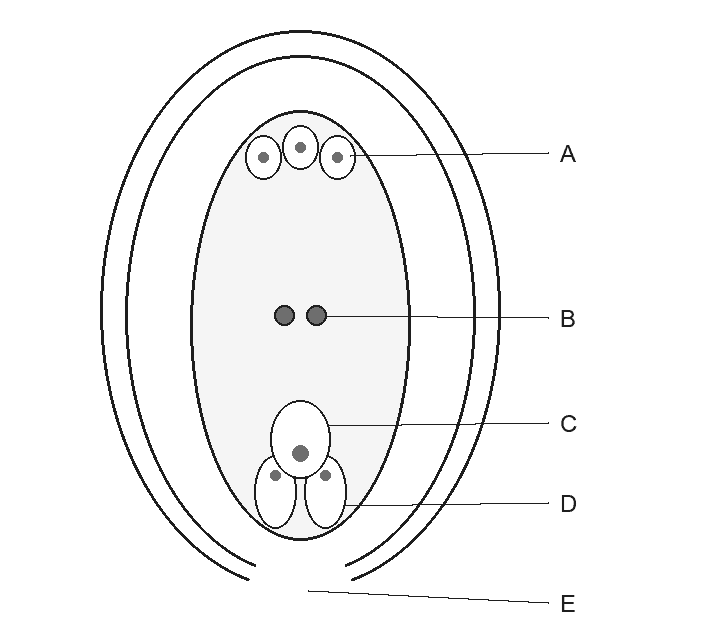
(a) Name the parts labelled A to E.
(b) Which of these parts take part in double fertilisation? State what each one forms and its ploidy.
- 401 mark
Question 40
The trunk of a mango tree grows thicker every year, but a coconut palm of the same age keeps almost the same trunk thickness while growing taller. What explains this?
- 411 mark
Question 41
A farmer finds slender, flowering plants growing among his jowar (sorghum) crop. When he pulls one out, it is attached to the roots of a jowar plant, and the crop nearby is stunted. The plant is most likely:
- 422 marks
Question 42
A farmer grows carrots. Most plants are dug up and sold at the end of the first season, but he leaves a few plants in the field through the winter so that he can collect seeds from them the next year.
(a) On the basis of its life cycle, what kind of plant is the carrot?
(b) Why must he wait until the second year for the seeds, and what is the role of the swollen root?
- 433 marks
Question 43
Give reasons:
(i) Many insect-pollinated flowers are brightly coloured and scented.
(ii) Birds that eat ripe guavas help the guava plant.
(iii) Some small dry fruits are covered with tiny hooks.
- 441 mark
Question 44
The leaf cells of rice have 24 chromosomes. How many chromosomes are present in a cell of its endosperm?
- 453 marks
Question 45
A cactus grows in a desert, while a lotus grows rooted in a pond.
(i) Why is the stem of a cactus green and fleshy?
(ii) Why are the leaves of a cactus reduced to spines?
(iii) What names are given to the cactus and the lotus on the basis of their habitats?
- 461 mark
Question 46
In which of these algae is the zygote the ONLY diploid cell in the whole life cycle?
- 471 mark
Question 47
In which pair do BOTH members show a haplo-diplontic life cycle?
- 483 marks
Question 48
In the general life cycle of a plant, name the type of cell division (mitosis or meiosis) in each step below and give a reason:
(i) the haploid plant body forms gametes;
(ii) the diploid sporophyte forms spores;
(iii) the zygote grows into the sporophyte plant body.
- 493 marks
Question 49
A plant has a large, dominant, green diploid body with xylem and phloem. Its haploid stage is a small but multicellular, free-living, green thallus, and its male gametes swim in water.
(a) Name its life cycle pattern and the plant group it most likely belongs to.
(b) Why is this life cycle not called diplontic, although the diploid phase is dominant?
(c) Name the first cell of each generation in this life cycle.
- 504 marks
Question 50
(Hypothetical data.) A green alga with a haplontic life cycle has 16 chromosomes in each cell of its free-living body. Its zygote divides by meiosis to form four spores, and each spore grows into a new individual. Find the number of chromosomes in:
(a) a gamete;
(b) the zygote;
(c) each spore;
(d) Also find the greatest number of new individuals that 25 zygotes can give.
- 511 mark
Question 51
Floridean starch is found in
- 521 mark
Question 52
Fucoxanthin is found in
- 531 mark
Question 53
The zoospore of Ulothrix has
- 541 mark
Question 54
A diploid structure with a tough coat produced during unfavourable conditions is
- 551 mark
Question 55
A multicellular green alga is
- 561 mark
Question 56
Which one of the following groups led to evolution of land plants?
- 571 mark
Question 57
A distinct feature of bryophytes when compared to other green plants is that they
- 581 mark
Question 58
The first land inhabiting plants are
- 591 mark
Question 59
Which of the following is not a characteristic feature of bryophytes?
- 601 mark
Question 60
Water is essential for the life cycle of Funaria because
- 611 mark
Question 61
A moss differs from a fern in having
- 621 mark
Question 62
Which of the following groups produces spores, but lacks vascular tissue?
- 631 mark
Question 63
The protonema of a moss is
- 641 mark
Question 64
The male gametophyte in higher plants is represented by
- 651 mark
Question 65
Which of the following conditions is found in Pinus but not Pteris?
- 661 mark
Question 66
Which of the following is an amphibian of plant kingdom?
- 671 mark
Question 67
A Pinus does not have
- 681 mark
Question 68
Which of the following has a dominant sporophytic generation?
- 691 mark
Question 69
Which of the following groups produce seeds but lack flowers?
- 701 mark
Question 70
Irish moss is the common name of a particular
- 711 mark
Question 71
Agar-Agar is produced from
- 721 mark
Question 72
Kelp is a kind of
- 731 mark
Question 73
The sporangia of a fern develop on
- 741 mark
Question 74
An ovule is an equivalent of
- 751 mark
Question 75
In Pinus, the fertilisation takes place in the
- 761 mark
Question 76
Wolffia a small plant about 1 mm in diameter is a
- 771 mark
Question 77
Carpels of angiosperms are equivalent to
- 781 mark
Question 78
A monocot angiosperm has
- 791 mark
Question 79
A plant showing reticulate venation and a woody stem is a
- 801 mark
Question 80
Chilgozas are the seeds of
- 811 mark
Question 81
Frond is a term given to the leaves of
- 821 mark
Question 82
The group of plants having vascular tissue is called
- 831 mark
Question 83
Which group has seeds enclosed in fruits?
- 841 mark
Question 84
Ferns belong to the following group
- 851 mark
Question 85
Lichens have symbiotic relationship between
- 861 mark
Question 86
Dicotyledon plants generally have
- 871 mark
Question 87
Mushroom belong to the group
- 881 mark
Question 88
Seed bearing plants include
- 891 mark
Question 89
In Ulothrix, meiosis takes place in
- 901 mark
Question 90
Angiosperms have dominated the land flora primarily because of their
- 911 mark
Question 91
Which of the following propagates through leaf tip?
- 921 mark
Question 92
Which of the following is a living fossil?
- 931 mark
Question 93
Sea weeds are important source of
- 941 mark
Question 94
Which of the following form contains algae?
- 951 mark
Question 95
Coralloid roots are the feature of
- 961 mark
Question 96
Which of the following is characteristic feature of ferns?
- 971 mark
Question 97
The pigments phycocyanin and phycoerythrin are present in
- 981 mark
Question 98
Zygospore is formed from
- 991 mark
Question 99
Which one of the following contain xylem vessels?
- 1001 mark
Question 100
First vascular plant is
- 1011 mark
Question 101
Which one of the following is not a characteristic feature of bryophytes?
- 1021 mark
Question 102
Which differentiates leaf of dicots from monocots?
- 1031 mark
Question 103
Which one of the following is not the feature of gymnosperm?
- 1041 mark
Question 104
In moss, the sporophyte
- 1051 mark
Question 105
The fusion between similar gametes is called _____.
- 1061 mark
Question 106
During favourable conditions, Spirogyra reproduces sexually by _____.
- 1071 mark
Question 107
In red algae, food is stored as a carbohydrate called _____.
- 1081 mark
Question 108
Phycoerythrin gives _____ colour of the algae.
- 1091 mark
Question 109
In bryophytes the alternation of generation _____ is the dominant phase.
- 1101 mark
Question 110
In Funaria, the haploid spores germinate to produce the _____.
- 1111 mark
Question 111
In the bryophytes, the gametophyte stage consists of first stage which is a _____ stage that develops from the spore.
- 1121 mark
Question 112
Antheridia are _____ shaped male organs while archegonia are _____ shaped female organs in bryophytes.
- 1131 mark
Question 113
In pteridophytes, the spores germinate and grow into a heart-shaped thalloid structure called _____ which is a _____.
- 1141 mark
Question 114
In pine tree, the main axis is of growth called _____ growth.
- 1151 mark
Question 115
In the female of the pine trees, _____ occurs in the 1st year cone while _____ occurs in the 2nd year cone.
- 1161 mark
Question 116
The ovules develop into the _____ and the ovary develops into the _____.
- 1171 mark
Question 117
In _____ the seeds are naked while in _____ the seeds are enclosed in an ovary.
- 1181 mark
Question 118
In monocots the vascular bundles are _____ while in dicots the vascular bundles are _____.
- 1191 mark
Question 119
Chlorophycae includes _____ algae while phaeophyceae includes _____ algae.
- 1201 mark
Question 120
_____ present in the cell wall of brown algae prevents drying or freezing.
- 1211 mark
Question 121
Fern is an example of _____ and Pinus is an example of _____.
- 1221 mark
Question 122
On reaching the ovary, the pollen tube releases two male gametes. One fuses with the egg cell of ovule to form _____ while the other fuses with the secondary nucleus to form _____.
- 1231 mark
Question 123
The dominant phase in ferns is the _____ generation while _____ generation is short lived.
- 1241 mark
Question 124
Mosses and ferns are said to be amphibians among plants because both are _____ for fertilisation.
- 1251 mark
Question 125
Pteridophyta have no true root, stem and leaves.
- 1261 mark
Question 126
Mosses and liverworts are not examples of thallophyta.
- 1271 mark
Question 127
Ulothrix and Spirogyra are types of fungi.
- 1281 mark
Question 128
Gymnosperms do not have seeds enclosed in fruits.
- 1291 mark
Question 129
Monocotyledons have taproot system.
- 1301 mark
Question 130
Mosses are said to be amphibians of plants because they need water for fertilisation.
- 1311 mark
Question 131
In monocots, the vascular bundles are arranged in a ring while in dicots they are scattered.
- 1321 mark
Question 132
The dominant phase in ferns is the sporophytic generation.
- 1331 mark
Question 133
Pinus is an example of pteridophytes.
- 1341 mark
Question 134
Phycocolloids present in the cell wall of brown algae prevent drying or freezing in winter.
- 1351 mark
Question 135
Class of algae, mainly marine has pigment fucoxanthin which gives it a brown colour.
- 1361 mark
Question 136
Smallest angiosperm found floating in ponds.
- 1371 mark
Question 137
A structure in lower plants like mosses, that produces female gametes.
- 1381 mark
Question 138
A chemical extracted from red algae Chondrus, which is used in drinks to give creaminess.
- 1391 mark
Question 139
A diploid structure with protective cover formed by fusion of two gametes in algae.
- 1401 mark
Question 140
Photosynthetic pigment present in brown algae besides chlorophyll.
- 1411 mark
Question 141
A thread-like structure produced from a haploid spore in mosses.
- 1421 mark
Question 142
A type of carbohydrate produced in brown algae.
- 1431 mark
Question 143
Reproductive structures of gymnosperms that produce pollens and eggs.
- 1441 mark
Question 144
A life cycle in which dominant phase is a photosynthetic, haploid, gametophytic phase.
- 1451 mark
Question 145
Assertion (A): Division thallophyta and bryophyta are included in sub-kingdom Cryptogamae.
Reason (R): Plant body of both thallophyta and bryophyta is not differentiated into true roots, stem and leaves.
- 1461 mark
Question 146
Assertion (A): Red algae contribute in producing coral reefs.
Reason (R): Some red algae secrete and deposit calcium carbonate on their cell walls.
- 1471 mark
Question 147
Assertion (A): Members of Class Rhodophyceae vary in colour from red, brown, bluish to green colours.
Reason (R): Rhodophyceae has pigments chlorophyll, phycoerythrin and anthocyanins.
- 1481 mark
Question 148
Assertion (A): Bryophytes are called amphibians of the plant kingdom.
Reason (R): Bryophytes are dependent on water for fertilisation during sexual reproduction.
- 1491 mark
Question 149
Assertion (A): First stage of mosses is the protonema stage which develops directly from the spore.
Reason (R): Second stage is the leafy stage which develops from the secondary protonema as a lateral bud.
- 1501 mark
Question 150
Assertion (A): Ferns exhibit alternation of generation with gametophytic stage being dominant.
Reason (R): Gametophytic stage gives rise to the sporophytic stage by spores.
- 1511 mark
Question 151
Assertion (A): The pine tree has needle-like leaves covered with thick cuticle and have sunken stomata.
Reason (R): Pine tree is heterosporous and bears male and female cones.
- 1521 mark
Question 152
Assertion (A): The male and female gametophytes do not have independent existence in gymnosperms.
Reason (R): They remain within the sporangia retained on the sporophyte.
- 1531 mark
Question 153
Assertion (A): In angiosperms, each pollen grain releases two male gametes into the embryo sac of ovule.
Reason (R): It leads to double fertilisation giving rise to diploid endosperm and a zygote.
- 1541 mark
Question 154
Assertion (A): The biennial plants live for two years.
Reason (R): Biennial plants produce flowers and seeds only for two years.
- 1552 marks
Question 155
What is the basis of classification of algae?
- 1562 marks
Question 156
Both gymnosperms and angiosperms bear seeds, then why are they classified separately?