
Opening your dashboard
Class 11 Biology Chapter 29: Chemical Coordination and Integration Solutions
87 textbook questions with step-by-step answers, free to read, for ISC 2026-27.
Get talked through Ch 29, not just shown the answer
Reading a finished solution is not the same as being able to do it. The AI tutor takes one question at a time and works it with you, in your own words, until you can.
- Ask it out loud, in your own words
- It gives you the next step, not the answer
- Stuck on part (ii)? Start there
87 questions with solutions
1–5 marks · Mixed difficulty
- 11 mark
Question 1
Name two systems that regulate various functions in the body.
Solve with AIWritten solution
Solution:
Concept: The body's organs are kept working together by two control systems: one sends electrical impulses along nerves, the other sends chemical messengers (hormones) through the blood.
Step 1 — What is asked: We need the two systems that control and coordinate body functions.
Step 2 — The answer: The nervous system gives quick, short-lived control through nerve impulses, and the endocrine system gives slower, longer-lasting control through hormones carried in the blood.
Therefore, the nervous system and the endocrine system regulate the functions of the body.
- 21 mark
Question 2
Where is hypothalamus present?
Solve with AIWritten solution
Solution:
Concept: The hypothalamus is the floor part of the diencephalon of the forebrain.
Step 1 — What is asked: We need the position of the hypothalamus.
Step 2 — The position: It lies at the base of the forebrain, just below the thalamus, and the pituitary gland hangs below it on a stalk, the infundibulum.
Therefore, the hypothalamus lies in the forebrain below the thalamus, just above the pituitary gland.
- 31 mark
Question 3
How is anterior pituitary different from posterior pituitary in terms of secretions of their hormones?
Solve with AIWritten solution
Solution:
Concept: The pituitary has two main lobes that are joined to the hypothalamus in different ways — by blood vessels (anterior lobe) and by nerve fibres (posterior lobe).
Step 1 — What is asked: We need to find how the two lobes differ in making their hormones.
Step 2 — Anterior lobe: Its own gland cells make and secrete six hormones (GH, prolactin, TSH, ACTH, FSH, LH).
Step 3 — Posterior lobe: It makes no hormone; it only stores and releases ADH and oxytocin, which are made by nerve cells of the hypothalamus.
Therefore, the anterior pituitary synthesises its own hormones, while the posterior pituitary only stores and releases hormones made by the hypothalamus.
- 41 mark
Question 4
Name the hormones released from hypothalamus.
Solve with AIWritten solution
Solution:
Concept: Neurosecretory cells of the hypothalamus release releasing and inhibiting hormones that control the anterior pituitary.
Step 1 — What is asked: We need the hormones the hypothalamus sends to the pituitary.
Step 2 — Releasing hormones: TRH (thyrotropin-releasing hormone), CRH (corticotropin- or ACTH-releasing hormone), GnRH (gonadotropin-releasing hormone) and GHRH (growth hormone-releasing hormone).
Step 3 — Inhibiting hormones: Somatostatin (growth hormone-inhibiting hormone) stops the release of growth hormone, and prolactin-inhibiting hormone (dopamine) holds back the release of prolactin. The hypothalamus also makes ADH and oxytocin, which it sends down to the posterior pituitary.
Therefore, the hypothalamus releases TRH, CRH, GnRH, GHRH, somatostatin and prolactin-inhibiting hormone (dopamine), and it also makes ADH and oxytocin.
- 51 mark
Question 5
What is another name of luteinising hormone (LH) in males?
Solve with AIWritten solution
Solution:
Concept: In males LH acts on the interstitial (Leydig) cells of the testes, which gives it its second name.
Step 1 — What is asked: We need the name used for LH in males.
Step 2 — The name: It is called interstitial cell-stimulating hormone (ICSH) because it stimulates the interstitial cells of the testes to secrete testosterone.
Therefore, LH in males is called interstitial cell-stimulating hormone (ICSH).
- 61 mark
Question 6
Where does LH act on in males and females?
Solve with AIWritten solution
Solution:
Concept: LH is a gonadotropin: its targets are the gonads.
Step 1 — What is asked: We need the target of LH in each sex.
Step 2 — In males: LH acts on the interstitial (Leydig) cells of the testes, which then secrete testosterone.
Step 3 — In females: LH acts on the ovary: it triggers ovulation of the Graafian follicle and changes the ruptured follicle into the corpus luteum, which secretes progesterone.
Therefore, LH acts on the Leydig cells of the testes in males and on the ovary (Graafian follicle and corpus luteum) in females.
- 71 mark
Question 7
Name a hormone released from posterior pituitary.
Solve with AIWritten solution
Solution:
Concept: The posterior pituitary stores and releases two hormones made in the hypothalamus.
Step 1 — What is asked: We need one hormone released from the posterior pituitary.
Step 2 — The answer: Oxytocin is released from it (the other one is ADH, vasopressin).
Therefore, oxytocin (or ADH) is released from the posterior pituitary.
- 81 mark
Question 8
Where does oxytocin act?
Solve with AIWritten solution
Solution:
Concept: Oxytocin makes smooth muscle and the contractile cells round the milk glands contract.
Step 1 — What is asked: We need the target organs of oxytocin.
Step 2 — The targets: It acts on the smooth muscle of the uterus (contraction during childbirth) and on the mammary glands (ejection of milk during suckling).
Therefore, oxytocin acts on the uterus and the mammary glands.
- 91 mark
Question 9
Which hormones does posterior pituitary synthesise? Are hormones released from posterior pituitary synthesized by it? Clarify.
Solve with AIWritten solution
Solution:
Concept: The posterior pituitary is made of nerve fibres coming from the hypothalamus, not of gland cells.
Step 1 — What is asked: We need to find whether the posterior pituitary makes the hormones it releases.
Step 2 — The answer: It synthesises no hormone. ADH and oxytocin are made in the cell bodies of neurosecretory cells in the hypothalamus, travel down their axons through the pituitary stalk, are stored in the axon endings in the posterior lobe and are released into the blood when needed.
Therefore, the posterior pituitary synthesises no hormone; it only stores and releases ADH and oxytocin made by the hypothalamus.
- 101 mark
Question 10
What is acromegaly due to?
Solve with AIWritten solution
Solution:
Concept: Growth hormone makes bones grow; once the growth plates of long bones have closed after adolescence, they can no longer grow in length.
Step 1 — What is asked: We need the cause of acromegaly.
Step 2 — The cause: Acromegaly is due to too much growth hormone (GH) in adults, after adolescence, usually from a tumour of the anterior pituitary. The bones of the hands, feet and jaw thicken instead of growing longer.
Therefore, acromegaly is due to hypersecretion of growth hormone after adolescence.
- 111 mark
Question 11
Where is adenohypophysis?
Solve with AIWritten solution
Solution:
Concept: The pituitary gland (hypophysis) has two parts that develop from different tissues.
Step 1 — What is asked: We need to find where the adenohypophysis lies.
Step 2 — The answer: The adenohypophysis is the anterior (front) lobe of the pituitary gland, which hangs from the base of the brain below the hypothalamus; it is joined to the hypothalamus by portal blood vessels.
Therefore, the adenohypophysis is the anterior lobe of the pituitary, below the hypothalamus.
- 121 mark
Question 12
What is another name of ADH?
Solve with AIWritten solution
Solution:
Concept: ADH means antidiuretic hormone, named from its action on urine output.
Step 1 — What is asked: We need the other name of ADH.
Step 2 — The answer: ADH is also called vasopressin, because in larger amounts it constricts arterioles and raises blood pressure.
Therefore, ADH is also called vasopressin.
- 131 mark
Question 13
What inhibits the releases of ADH and what does it lead to?
Solve with AIWritten solution
Solution:
Concept: Osmoreceptors in the hypothalamus sense the concentration (osmotic pressure) of the blood and control ADH release.
Step 1 — What is asked: We need to find what stops ADH release and the result.
Step 2 — The trigger: A fall in the osmotic pressure of the blood (for example after drinking a lot of water) inhibits the release of ADH.
Step 3 — The result: Without ADH, the distal convoluted tubules and collecting ducts become less permeable to water, so less water is reabsorbed and a large volume of dilute (hypotonic) urine is passed.
Therefore, a fall in blood osmotic pressure inhibits ADH release, which leads to a large volume of dilute urine.
- 141 mark
Question 14
What is the function of oxytocin?
Solve with AIWritten solution
Solution:
Concept: Oxytocin is a posterior pituitary hormone that acts on smooth muscle and milk-gland cells.
Step 1 — What is asked: We need to find what oxytocin does.
Step 2 — The functions: It causes contraction of the smooth muscles of the uterus during childbirth and the ejection of milk from the mammary glands during suckling.
Therefore, oxytocin causes uterine contractions during childbirth and milk ejection.
- 151 mark
Question 15
Name the hormone involved in the daily cycle or circadian rhythm of the body. From which gland is this hormone released?
Solve with AIWritten solution
Solution:
Concept: A circadian rhythm is a roughly 24-hour cycle, such as the sleep–wake cycle, set by light and darkness.
Step 1 — What is asked: We need the hormone of the daily rhythm and its gland.
Step 2 — The answer: Melatonin, released by the pineal gland; more is made in darkness, so its level is high at night and low by day. The master clock in the hypothalamus drives this pattern, and melatonin carries the night signal to the rest of the body.
Therefore, the hormone is melatonin, released by the pineal gland; it helps regulate the circadian rhythm.
- 161 mark
Question 16
What is cretinism due to?
Solve with AIWritten solution
Solution:
Concept: Thyroid hormones are needed for the normal growth and development of the body and brain from birth.
Step 1 — What is asked: We need the cause of cretinism.
Step 2 — The cause: It is due to too little thyroid hormone before birth or from early infancy, because the thyroid is missing, does not work, or the mother and child lack iodine. Today the condition is called congenital hypothyroidism; found early by newborn screening and treated with thyroxine, the child develops normally.
Therefore, cretinism is due to deficiency of thyroid hormones (hypothyroidism) before birth or from early infancy.
- 171 mark
Question 17
Production of which hormone is affected due to deficiency of iodine in diet?
Solve with AIWritten solution
Solution:
Concept: Iodine is built into the thyroid hormones, which are iodinated forms of the amino acid tyrosine.
Step 1 — What is asked: We need the hormone whose production needs iodine.
Step 2 — The answer: Thyroxine (T₄, with four iodine atoms) and triiodothyronine (T₃, with three) cannot be made in enough amount when iodine is short.
Therefore, thyroxine (thyroid hormone) production is affected by iodine deficiency.
- 181 mark
Question 18
Hyperactivity of which hormone may lead to osteoporosis?
Solve with AIWritten solution
Solution:
Concept: Parathyroid hormone (PTH) raises blood calcium partly by releasing calcium from the bones.
Step 1 — What is asked: We need the hormone whose excess weakens bones.
Step 2 — The answer: Too much parathyroid hormone (PTH) keeps removing calcium from the bones, so they become thin, porous and easily broken (osteoporosis).
Therefore, hyperactivity of parathyroid hormone (PTH) may lead to osteoporosis.
- 191 mark
Question 19
Which gland is active in young children and then reduces in size, but functions in the maturation of T-cells?
Solve with AIWritten solution
Solution:
Concept: T-lymphocytes mature in a lymphoid gland in the upper chest that is most active in childhood.
Step 1 — What is asked: We need the gland that shrinks with age but helps T-cells mature.
Step 2 — The answer: The gland is the thymus, which lies behind the sternum in front of the heart; its hormones (thymosins) help T-lymphocytes mature. It is very active in childhood, reaches its largest size around puberty and then slowly shrinks, much of it being replaced by fat in adults.
Therefore, the gland is the thymus.
- 201 mark
Question 20
Which hormone increases the blood Ca⁺⁺ levels and which decrease it and both together regulate the level in blood plasma?
Solve with AIWritten solution
Solution:
Concept: Two hormones with opposite effects keep blood calcium within a narrow normal range.
Step 1 — What is asked: We need the hormone that raises and the one that lowers blood calcium.
Step 2 — The answer: Parathyroid hormone (PTH) from the parathyroid glands raises blood Ca²⁺; calcitonin (thyrocalcitonin) from the parafollicular cells of the thyroid lowers it.
Therefore, parathormone increases and calcitonin decreases the blood Ca²⁺ level.
- 211 mark
Question 21
Name the groups of hormones released from adrenal cortex.
Solve with AIWritten solution
Solution:
Concept: The adrenal cortex makes steroid hormones (corticoids) from cholesterol.
Step 1 — What is asked: We need the groups of corticoids.
Step 2 — The groups: The adrenal cortex releases three groups of hormones: mineralocorticoids (e.g. aldosterone), glucocorticoids (e.g. cortisol) and sex corticoids (gonadocorticoids, mainly weak androgens such as DHEA).
Therefore, the adrenal cortex releases mineralocorticoids, glucocorticoids and sex corticoids.
- 221 mark
Question 22
Name an important mineralocorticoid.
Solve with AIWritten solution
Solution:
Concept: Mineralocorticoids control the minerals (salts) of the body fluids.
Step 1 — What is asked: We need one important mineralocorticoid.
Step 2 — The answer: The most important mineralocorticoid is aldosterone, which gives about 90% of the body's mineralocorticoid activity.
Therefore, aldosterone is the most important mineralocorticoid.
- 231 mark
Question 23
What is the main function of aldosterone?
Solve with AIWritten solution
Solution:
Concept: Aldosterone acts on the kidney tubules to control salt and water balance.
Step 1 — What is asked: We need the main action of aldosterone.
Step 2 — The action: It makes the distal tubules and collecting ducts reabsorb Na⁺ from the filtrate and excrete K⁺ into the urine; water follows the Na⁺, so blood volume and blood pressure are kept normal.
Therefore, aldosterone makes the kidneys reabsorb Na⁺ (and water) and excrete K⁺, keeping salt–water balance.
- 241 mark
Question 24
What is the target tissue of glucocorticoids?
Solve with AIWritten solution
Solution:
Concept: Glucocorticoids such as cortisol raise blood glucose.
Step 1 — What is asked: We need the main target tissue of glucocorticoids.
Step 2 — The answer: The main target tissue is the liver, where they promote the making of glucose from amino acids (gluconeogenesis); they also act on muscle, fat tissue and immune cells.
Therefore, the main target tissue of glucocorticoids is the liver.
- 251 mark
Question 25
Name an important glucocorticoid and what is its main function?
Solve with AIWritten solution
Solution:
Concept: Glucocorticoids are named for their effect on blood glucose.
Step 1 — What is asked: We need one glucocorticoid and its function.
Step 2 — The answer: Cortisol raises the blood glucose level: it causes breakdown of muscle proteins to amino acids, which the liver converts to glucose (gluconeogenesis). It also helps the body cope with stress and reduces inflammation.
Therefore, cortisol is an important glucocorticoid; it raises blood sugar by gluconeogenesis.
- 261 mark
Question 26
What is the causes of Addison's disease?
Solve with AIWritten solution
Solution:
Concept: Addison's disease is a disorder of the adrenal cortex.
Step 1 — What is asked: We need the cause of Addison's disease.
Step 2 — The cause: It is due to underactivity of the adrenal cortex, so too little cortisol and aldosterone are made. The cortex is most often destroyed by the body's own immune system (autoimmune); infections such as tuberculosis are another cause.
Therefore, Addison's disease is caused by underactivity (hyposecretion) of the adrenal cortex.
- 271 mark
Question 27
Where are adrenal glands located? Are they known by any other name?
Solve with AIWritten solution
Solution:
Concept: The adrenal glands are a pair of small endocrine glands in the abdomen.
Step 1 — What is asked: We need their position and other name.
Step 2 — The answer: One adrenal gland sits on top of each kidney, so they are also called suprarenal glands (supra = above, renal = kidney).
Therefore, the adrenal glands lie on top of the kidneys and are also called suprarenal glands.
- 281 mark
Question 28
Name the parts of adrenal gland that are endocrine in nature.
Solve with AIWritten solution
Solution:
Concept: Each adrenal gland has an outer region and an inner region of different origin.
Step 1 — What is asked: We need the endocrine parts of the adrenal gland.
Step 2 — The answer: Both parts are endocrine: the outer adrenal cortex (corticoids) and the inner adrenal medulla (adrenaline and noradrenaline).
Therefore, both the adrenal cortex and the adrenal medulla are endocrine.
- 291 mark
Question 29
How are adrenal cortex and adrenal medulla different from hormone point of view?
Solve with AIWritten solution
Solution:
Concept: The cortex makes steroid hormones; the medulla makes catecholamines.
Step 1 — What is asked: We need to find how their hormones differ.
Step 2 — The difference: The cortex secretes steroid corticoids (aldosterone, cortisol) that are essential for life (salt–water balance, blood glucose); the medulla secretes adrenaline and noradrenaline, which prepare the body for emergencies and are not essential for life.
Therefore, cortical hormones are steroids essential for life, while medullary hormones are emergency (fight-or-flight) hormones.
- 301 mark
Question 30
Which disease does deficiency of insulin lead to?
Solve with AIWritten solution
Solution:
Concept: Insulin lowers blood glucose by making cells take it up and store it.
Step 1 — What is asked: We need the disease caused by lack of insulin.
Step 2 — The answer: Lack of insulin leads to diabetes mellitus, with high blood glucose and sugar in the urine.
Therefore, insulin deficiency leads to diabetes mellitus.
- 311 mark
Question 31
From where is insulin produced?
Solve with AIWritten solution
Solution:
Concept: The pancreas has small clusters of endocrine cells, the islets of Langerhans, scattered in its exocrine tissue.
Step 1 — What is asked: We need the cells that make insulin.
Step 2 — The answer: Insulin is made by the β (beta) cells of the islets of Langerhans of the pancreas.
Therefore, insulin is produced by the β-cells of the islets of Langerhans.
- 321 mark
Question 32
Where are interstitial cells of Leydig present?
Solve with AIWritten solution
Solution:
Concept: A testis is made of coiled seminiferous tubules with connective tissue between them.
Step 1 — What is asked: We need to find where Leydig cells lie.
Step 2 — The answer: They lie in the connective tissue between the seminiferous tubules of the testes.
Therefore, Leydig cells are present in the testes, in the spaces between the seminiferous tubules.
- 331 mark
Question 33
What is the function of interstitial cells?
Solve with AIWritten solution
Solution:
Concept: The interstitial (Leydig) cells are the endocrine part of the testis.
Step 1 — What is asked: We need to find what Leydig cells do.
Step 2 — The answer: They secrete the male sex hormone testosterone (androgens) when stimulated by LH (ICSH).
Therefore, interstitial cells produce testosterone.
- 341 mark
Question 34
Name the hormone produced by Graafian follicle.
Solve with AIWritten solution
Solution:
Concept: The Graafian follicle is the mature follicle of the ovary.
Step 1 — What is asked: We need the hormone of the Graafian follicle.
Step 2 — The answer: Its cells secrete oestrogen (mainly oestradiol).
Therefore, the Graafian follicle produces oestrogen.
- 351 mark
Question 35
From where is progesterone produced?
Solve with AIWritten solution
Solution:
Concept: After ovulation, the empty follicle changes into a yellow body.
Step 1 — What is asked: We need the source of progesterone.
Step 2 — The answer: Progesterone is produced by the corpus luteum of the ovary. During pregnancy the placenta also produces it and becomes the main source after about the first two months.
Therefore, progesterone is produced by the corpus luteum (and by the placenta during pregnancy).
- 361 mark
Question 36
Name some lipid-soluble hormones.
Solve with AIWritten solution
Solution:
Concept: Lipid-soluble (lipophilic) hormones can cross the plasma membrane: steroids diffuse through the lipid bilayer, and thyroid hormones enter mainly through membrane transporter proteins.
Step 1 — What is asked: We need examples of lipid-soluble hormones.
Step 2 — The examples: All steroid hormones are lipid-soluble — oestrogen, progesterone, testosterone, cortisol, aldosterone — and so are the thyroid hormones (thyroxine, T₃).
Therefore, steroid hormones (oestrogen, progesterone, testosterone, cortisol) and thyroxine are lipid-soluble.
- 371 mark
Question 37
Which hormones stimulate ovulation and development of corpus luteum?
Solve with AIWritten solution
Solution:
Concept: Ovulation is set off by a sudden surge of a pituitary gonadotropin in mid-cycle.
Step 1 — What is asked: We need the hormone for ovulation and corpus luteum.
Step 2 — The answer: Luteinising hormone (LH): the LH surge makes the Graafian follicle burst (ovulation) and turns the empty follicle into the corpus luteum.
Therefore, luteinising hormone (LH) stimulates ovulation and development of the corpus luteum.
- 381 mark
Question 38
If you see a speeding car coming, which hormone suddenly increases in the body?
Solve with AIWritten solution
Solution:
Concept: Sudden danger causes a fight-or-flight response controlled by the sympathetic nerves and the adrenal medulla.
Step 1 — What is asked: We need the emergency hormone.
Step 2 — The answer: The adrenal medulla suddenly releases adrenaline (epinephrine), with some noradrenaline; adrenaline raises heart rate, blood pressure and blood glucose so that you can react quickly.
Therefore, adrenaline suddenly increases in the body.
- 391 mark
Question 39
Oversecretion of thyroid results in which disease?
Solve with AIWritten solution
Solution:
Concept: Oversecretion of thyroid hormones is hyperthyroidism.
Step 1 — What is asked: We need the disease caused by an overactive thyroid.
Step 2 — The answer: Oversecretion (hyperthyroidism) most often shows as exophthalmic goitre (Graves' disease), an autoimmune disorder with an enlarged thyroid, bulging eyes and a high metabolic rate.
Therefore, oversecretion of the thyroid results in exophthalmic goitre (Graves' disease).
- 401 mark
Question 40
Name the hormone released from intermediate pituitary.
Solve with AIWritten solution
Solution:
Concept: The intermediate lobe (pars intermedia) lies between the anterior and posterior lobes.
Step 1 — What is asked: We need the hormone of the intermediate lobe.
Step 2 — The answer: The intermediate lobe releases melanocyte-stimulating hormone (MSH), which acts on the melanocytes of the skin and makes them produce more melanin, so the skin darkens.
Step 3 — In humans: In adult humans the intermediate lobe is rudimentary, so little MSH comes from it; MSH made locally in the skin (and ACTH, which acts on the same melanocyte receptor) still helps control skin pigmentation.
Therefore, the intermediate pituitary releases melanocyte-stimulating hormone (MSH).
- 412 marks
Question 41
Name the endocrine gland that produces insulin. Which disease occurs due to deficiency of insulin?
Solve with AIWritten solution
Solution:
Concept: The pancreas is both exocrine (digestive juice) and endocrine (hormones from the islets of Langerhans).
Step 1 — The gland: Insulin is produced by the pancreas, in the β-cells of its islets of Langerhans.
Step 2 — The disease: Deficiency of insulin causes diabetes mellitus: glucose cannot enter muscle and fat cells well, so blood glucose rises (hyperglycaemia) and sugar appears in the urine (glycosuria).
Therefore, insulin is produced by the pancreas (β-cells of the islets), and its deficiency causes diabetes mellitus.
- 422 marks
Question 42
Where are interstitial cells of Leydig present? What is their function?
Solve with AIWritten solution
Solution:
Concept: The testis has two jobs: making sperms (seminiferous tubules) and making hormones (Leydig cells).
Step 1 — Position: Leydig cells lie in the connective tissue between the seminiferous tubules of the testes.
Step 2 — Function: Stimulated by LH (ICSH), they secrete testosterone, which controls the development of male sex organs and secondary sex characters (beard, deep voice, muscle growth) and helps sperm formation.
Therefore, Leydig cells lie between the seminiferous tubules and secrete testosterone.
- 432 marks
Question 43
Name the hormone produced by Graafian follicle. From where is progesterone produced?
Solve with AIWritten solution
Solution:
Concept: The ovary makes different hormones before and after ovulation.
Step 1 — Graafian follicle: The mature follicle secretes oestrogen, which builds up the uterine lining and brings about female secondary sex characters.
Step 2 — Progesterone: After ovulation the ruptured follicle becomes the corpus luteum, which secretes progesterone; it prepares and maintains the uterine lining for the embryo. During pregnancy the placenta also secretes progesterone and becomes its main source after about the first two months.
Therefore, the Graafian follicle produces oestrogen, and progesterone is produced by the corpus luteum (and by the placenta during pregnancy).
- 442 marks
Question 44
Name some lipid-soluble hormones.
Solve with AIWritten solution
Solution:
Concept: Lipid-soluble (lipophilic) hormones dissolve in the lipid bilayer, so they can enter their target cells.
Step 1 — Steroid hormones: All steroid hormones, which are made from cholesterol, are lipid-soluble: oestrogen, progesterone, testosterone, cortisol and aldosterone.
Step 2 — Thyroid hormones: Thyroxine (T₄) and triiodothyronine (T₃) are also lipid-soluble; they enter the cell mainly through membrane transporter proteins and bind receptors inside it.
Therefore, steroid hormones (oestrogen, progesterone, testosterone, cortisol, aldosterone) and thyroid hormones (thyroxine) are lipid-soluble.
- 452 marks
Question 45
Name the hormones released from anterior pituitary.
Solve with AIWritten solution
Solution:
Concept: The anterior pituitary (adenohypophysis) makes six main hormones under the control of hypothalamic releasing and inhibiting hormones.
Step 1 — Non-tropic hormones: Growth hormone (GH, somatotropin) for body growth and prolactin (PRL) for milk production act directly on body tissues.
Step 2 — Tropic hormones: TSH (thyroid-stimulating), ACTH (adrenocorticotropic), FSH (follicle-stimulating) and LH (luteinising, called ICSH in males) act on other endocrine glands.
Therefore, the anterior pituitary releases GH, prolactin, TSH, ACTH, FSH and LH.
- 462 marks
Question 46
What is another name of luteinising hormone (LH) in male? What is its function?
Solve with AIWritten solution
Solution:
Concept: LH is a gonadotropin from the anterior pituitary.
Step 1 — Other name: In males LH is called interstitial cell-stimulating hormone (ICSH).
Step 2 — Function: It stimulates the interstitial (Leydig) cells of the testes to secrete testosterone.
Therefore, LH in males is ICSH, and it makes the Leydig cells secrete testosterone.
- 472 marks
Question 47
Where is adenohypophysis present? Name two hormones released by it.
Solve with AIWritten solution
Solution:
Concept: The adenohypophysis is the glandular part of the pituitary.
Step 1 — Position: It is the anterior lobe of the pituitary gland, which hangs from the base of the brain below the hypothalamus and is joined to it by the hypophyseal portal blood vessels.
Step 2 — Two hormones: Two of its hormones are growth hormone (GH), which promotes body growth, and thyroid-stimulating hormone (TSH), which stimulates the thyroid (others are prolactin, ACTH, FSH and LH).
Therefore, the adenohypophysis is the anterior pituitary; it releases, for example, GH and TSH.
- 482 marks
Question 48
Name the category of hormones that bind to the extracellular receptor or bind with membrane-bound receptor. Give two examples of these hormones.
Solve with AIWritten solution
Solution:
Concept: A hormone that cannot pass through the lipid bilayer must bind a receptor on the outer surface of the cell.
Step 1 — The category: Hydrophilic (water-soluble) hormones — peptide and protein hormones and the catecholamines — bind membrane-bound receptors, and most of them act through second messengers such as cAMP.
Step 2 — Examples: Two examples are insulin (a peptide hormone) and adrenaline (a catecholamine); glucagon and FSH are others.
Therefore, hydrophilic (water-soluble) hormones such as insulin and adrenaline bind membrane-bound receptors.
- 492 marks
Question 49
Why is insulin considered to be an anabolic hormone?
Solve with AIWritten solution
Solution:
Concept: Anabolism is the building up of large molecules from small ones; catabolism is their breakdown.
Step 1 — What insulin builds: Insulin promotes glycogen synthesis from glucose in the liver and muscles, fat synthesis from glucose in adipose tissue, and protein synthesis from amino acids.
Step 2 — What it stops: It also reduces the breakdown of glycogen, fats and proteins.
Therefore, insulin is called an anabolic hormone because it promotes the building up of glycogen, fats and proteins.
- 502 marks
Question 50
Name various gonadotropin hormones.
Solve with AIWritten solution
Solution:
Concept: Gonadotropins are hormones whose targets are the gonads (testes and ovaries); the main ones come from the anterior pituitary.
Step 1 — The pituitary gonadotropins: The anterior pituitary makes two gonadotropins: follicle-stimulating hormone (FSH), which controls the growth of ovarian follicles and spermatogenesis, and luteinising hormone (LH), called ICSH in males, which brings about ovulation and the corpus luteum and makes the testes secrete testosterone.
Step 2 — Their control: Both are released when the hypothalamus secretes gonadotropin-releasing hormone (GnRH).
Note: Prolactin is sometimes listed with them, but it acts on the mammary glands, not on the gonads, so it is not counted as a gonadotropin.
Note: During pregnancy the placenta also secretes a gonadotropin, human chorionic gonadotropin (hCG), which keeps the corpus luteum active.
Therefore, the gonadotropins are FSH and LH (ICSH) from the anterior pituitary, together with hCG from the placenta in pregnancy.
- 512 marks
Question 51
Why is vasopressin also called antidiuretic hormone?
Solve with AIWritten solution
Solution:
Concept: Diuresis means the passing of a large volume of urine; 'anti' means against.
Step 1 — Its action: Vasopressin makes the distal convoluted tubules and collecting ducts permeable to water, so more water is reabsorbed into the blood.
Step 2 — The result: The urine becomes small in volume and concentrated — it works against diuresis, so it is called antidiuretic hormone (ADH).
Therefore, vasopressin is called antidiuretic hormone because it reduces urine output by increasing water reabsorption.
- 522 marks
Question 52
Why is posterior pituitary called a storage-releaser centre?
Solve with AIWritten solution
Solution:
Concept: The posterior pituitary is made of the axon endings of neurosecretory cells of the hypothalamus.
Step 1 — It makes nothing: ADH and oxytocin are made in the hypothalamus and carried down the axons of the hypothalamo-hypophyseal tract to the posterior lobe.
Step 2 — It stores and releases: They are stored in the axon endings and released into the blood on nerve signals from the hypothalamus.
Therefore, the posterior pituitary is called a storage-releaser centre because it only stores and releases hormones made by the hypothalamus.
- 532 marks
Question 53
Why is oxytocin given to induce labour?
Solve with AIWritten solution
Solution:
Concept: Labour is the series of strong uterine contractions that push the baby out.
Step 1 — Its action: Oxytocin makes the smooth muscle of the uterus contract strongly and rhythmically.
Step 2 — Clinical use: So, when labour does not start or is too slow, doctors give oxytocin (by a controlled drip) to start or strengthen the contractions and help delivery.
Therefore, oxytocin is given to induce labour because it causes contraction of the uterine muscles.
- 542 marks
Question 54
What is the correlation of goitre and thyroid?
Solve with AIWritten solution
Solution:
Concept: Goitre means an enlargement of the thyroid gland, often seen as a swelling in the front of the neck (a small goitre may only be felt or seen on ultrasound).
Step 1 — Simple goitre: Lack of iodine means too little thyroxine; with less negative feedback, the pituitary secretes more TSH, which makes the thyroid cells grow, so the gland enlarges.
Step 2 — Exophthalmic goitre: In Graves' disease antibodies stimulate the thyroid like TSH, so it enlarges and oversecretes hormones.
Therefore, goitre is an enlarged thyroid gland, which can occur with under-activity (iodine deficiency) or over-activity (Graves' disease) of the thyroid.
- 552 marks
Question 55
Why are adrenal glands also called supra-renal? Name the hormones released by this gland.
Solve with AIWritten solution
Solution:
Concept: Each adrenal gland has an outer cortex and an inner medulla that act as two glands.
Step 1 — The name: They sit on top of the kidneys (supra = above, renal = kidney), so they are called suprarenal glands.
Step 2 — The hormones: The cortex releases mineralocorticoids (aldosterone), glucocorticoids (cortisol) and sex corticoids (androgens); the medulla releases adrenaline and noradrenaline.
Therefore, the adrenals are called suprarenal because they lie above the kidneys; they release corticoids from the cortex and adrenaline and noradrenaline from the medulla.
- 562 marks
Question 56
Why is adrenal medulla said to be not essential for life?
Solve with AIWritten solution
Solution:
Concept: The adrenal medulla is controlled by sympathetic nerves; it secretes a little all the time but mainly in stress.
Step 1 — Its hormones act in emergencies: Adrenaline and noradrenaline prepare the body for fight or flight; they are not needed for the day-to-day control of salts and glucose.
Step 2 — Nerves can take over: The sympathetic nervous system produces the same effects (its nerve endings release noradrenaline), so a person can live after the medulla is removed — unlike the cortex, whose loss is fatal unless its hormones are replaced by medicine.
Therefore, the adrenal medulla is not essential for life because its emergency actions can be carried out by the sympathetic nervous system.
- 572 marks
Question 57
Where is thyroid gland present? Name the hormones released by it.
Solve with AIWritten solution
Solution:
Concept: The thyroid is the largest endocrine gland of the neck.
Step 1 — Position: It lies in the front of the neck, just below the larynx, with its two lobes on either side of the trachea, joined by the isthmus.
Step 2 — Hormones: Thyroxine (T₄, tetraiodothyronine) and triiodothyronine (T₃) from the follicle cells, and calcitonin (thyrocalcitonin) from the parafollicular cells.
Therefore, the thyroid lies below the larynx on either side of the trachea and releases thyroxine, T₃ and calcitonin.
- 582 marks
Question 58
How is diabetes mellitus different from diabetes insipidus?
Solve with AIWritten solution
Solution:
Concept: Both diseases cause a large volume of urine, but for different reasons.
Step 1 — What is asked: We need the main ways in which diabetes mellitus differs from diabetes insipidus.
Step 2 — Compare them: The main points of difference are given below.
Feature Diabetes mellitus Diabetes insipidus Cause Lack of insulin or poor response to it Lack of ADH (vasopressin) in the common (central) form; poor kidney response to ADH in the rarer (nephrogenic) form Blood glucose High (hyperglycaemia) Normal Urine Large volume with sugar (glycosuria) Large volume of dilute urine, no sugar Note: In a rarer (nephrogenic) form of diabetes insipidus, enough ADH is released but the kidney tubules do not respond to it. Since 2022 the two forms are also called arginine vasopressin (AVP) deficiency and AVP resistance.
Therefore, diabetes mellitus is an insulin disorder with sugar in the urine, while diabetes insipidus is an ADH disorder (mainly too little ADH, less often too little kidney response to it) with dilute urine and no sugar.
- 592 marks
Question 59
Give two important differences between lipophilic and hydrophilic hormones.
Solve with AIWritten solution
Solution:
Concept: Hormones are grouped by whether they dissolve in lipids (and cross the plasma membrane) or in water.
Step 1 — What is asked: We need two differences between hormones that dissolve in lipids and hormones that dissolve in water.
Step 2 — Compare them: Two important differences are given below.
Feature Lipophilic hormones Hydrophilic hormones Entry into cell Cross the plasma membrane (thyroid hormones with the help of membrane carriers) Cannot cross; stay outside Receptor and action Intracellular receptor; complex acts on genes Membrane receptor; acts mostly through a second messenger (cAMP, Ca²⁺) Examples Steroids, thyroxine Adrenaline, glucagon, insulin Therefore, lipophilic hormones enter the cell and act on genes through intracellular receptors, while hydrophilic hormones bind membrane receptors and act mostly through second messengers.
- 602 marks
Question 60
Give the functions of hormone
(i) melatonin
(ii) oxytocin.
Solve with AIWritten solution
Solution:
Concept: Melatonin is a pineal hormone; oxytocin is a posterior pituitary hormone made in the hypothalamus.
Step 1 — (i) Melatonin: It helps regulate the circadian (day–night) rhythm: its level rises in darkness and makes us sleepy, and it also influences body temperature, metabolism, the menstrual cycle and defence capability.
Step 2 — (ii) Oxytocin: It causes contraction of the uterine muscles during childbirth and ejection of milk from the mammary glands during suckling.
Therefore, melatonin helps regulate the sleep–wake (circadian) rhythm, and oxytocin causes uterine contraction and milk ejection.
- 613 marks
Question 61
Where is hypothalamus-pituitary axis present? What is infundibulum? Give full forms of ACTH and TSH.
Solve with AIWritten solution
Solution:
Concept: The hypothalamus and the pituitary work as one control unit, the hypothalamus–pituitary axis.
Step 1 — Position: The axis lies at the base of the brain: the hypothalamus forms the floor of the forebrain (diencephalon) below the thalamus, and the pituitary hangs just below it. The figure shows how the two are linked.

Step 2 — Infundibulum: The infundibulum (pituitary stalk) is the stalk that attaches the pituitary to the hypothalamus; it carries the nerve fibres of the hypothalamo-hypophyseal tract to the posterior lobe, and the hypophyseal portal vessels run beside it to the anterior lobe.
Step 3 — Full forms: ACTH = adrenocorticotropic hormone; TSH = thyroid-stimulating hormone (thyrotropin).
Therefore, the axis lies at the base of the forebrain, the infundibulum is the pituitary stalk, ACTH is adrenocorticotropic hormone and TSH is thyroid-stimulating hormone.
- 623 marks
Question 62
What are tropic hormones? Name them and give one important function of each.
Solve with AIWritten solution
Solution:
Concept: The word tropic comes from the Greek tropos (turning towards); tropic (also spelt trophic) hormones are pituitary hormones whose targets are other endocrine glands.
Step 1 — Meaning: Tropic hormones are anterior pituitary hormones that stimulate other endocrine glands to grow and secrete their own hormones.
Step 2 — TSH and ACTH: TSH stimulates the thyroid to secrete thyroxine (T₄) and T₃; ACTH stimulates the adrenal cortex to secrete glucocorticoids such as cortisol.
Step 3 — FSH and LH: FSH stimulates growth of ovarian follicles (and oestrogen secretion) in females and spermatogenesis in males; LH triggers ovulation and formation of the corpus luteum in females and testosterone secretion by Leydig cells in males.
Therefore, tropic hormones are pituitary hormones that control other endocrine glands: TSH (thyroid), ACTH (adrenal cortex), FSH and LH (gonads).
- 633 marks
Question 63
Name the disorders caused due to hypersecretion of growth hormone and thyroid gland. Give two important symptoms of each.
Solve with AIWritten solution
Solution:
Concept: Too much hormone gives a disorder whose symptoms exaggerate the hormone's normal effects.
Step 1 — Excess GH in children: gigantism: The long bones keep growing in length, so the person becomes very tall, with long limbs and enlarged organs.
Step 2 — Excess GH in adults: acromegaly: The bones cannot lengthen, so they thicken: enlarged hands, feet and jaw, and coarse, heavy facial features.
Step 3 — Thyroid oversecretion: Graves' disease (exophthalmic goitre): The person has a goitre with bulging eyes (exophthalmos), and a high metabolic rate with fast heartbeat, sweating, restlessness and loss of weight.
Therefore, excess GH causes gigantism (very tall) or acromegaly (enlarged hands, feet, jaw), and excess thyroid hormone causes Graves' disease (goitre, bulging eyes, high BMR, weight loss).
- 643 marks
Question 64
What is a feedback mechanism of hormones? Give one example.
Solve with AIWritten solution
Solution:
Concept: Most hormone levels are kept steady by negative feedback, in which the result of a process slows the process down.
Step 1 — Meaning: A feedback mechanism is the control of a hormone's secretion by the level of the hormone (or of the substance it controls) in the blood: a high level inhibits further secretion (negative feedback) and a low level allows more secretion.
Step 2 — Example: thyroxine: The hypothalamus releases TRH, which makes the anterior pituitary release TSH, which makes the thyroid release thyroxine. When blood thyroxine rises, it inhibits TRH and TSH release, so thyroxine output falls; when it falls, TRH and TSH rise again. The flow chart shows the loop.
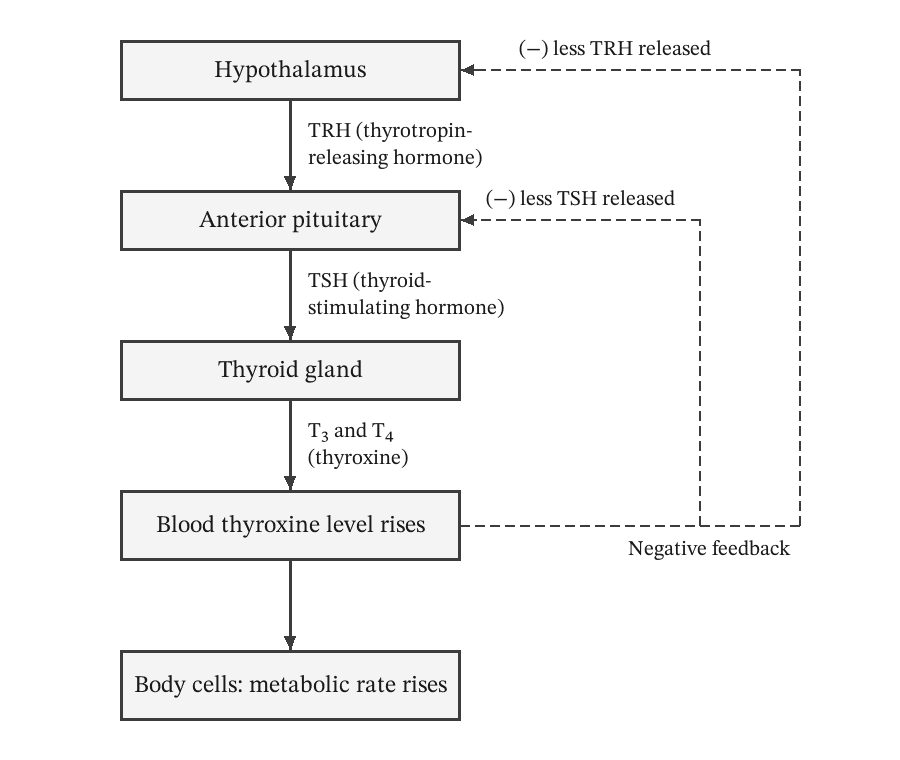
Step 3 — Why it matters: In this way the hormone level is held within a narrow normal range (homeostasis).
Therefore, feedback is the control of hormone secretion by its own blood level; for example, high thyroxine inhibits TRH and TSH release.
- 653 marks
Question 65
What is the role of melatonin in everyday life? Which gland secretes this hormone? What happens if ADH is not secreted?
Solve with AIWritten solution
Solution:
Concept: Melatonin links the body's daily rhythm to light and darkness; ADH controls water loss in urine.
Step 1 — Role of melatonin: More melatonin is made in darkness and less in light, so its level rises at night and makes us sleepy; it helps regulate the 24-hour (circadian) sleep–wake cycle and body-temperature rhythm, and influences metabolism, the menstrual cycle and defence capability.
Step 2 — The gland: It is secreted by the pineal gland, a small cone-shaped gland on the roof of the third ventricle of the brain.
Step 3 — Without ADH: The collecting ducts of the kidney reabsorb little water, so a large volume of dilute urine is passed and the person is always thirsty — diabetes insipidus.
Therefore, melatonin from the pineal gland helps regulate the daily sleep–wake rhythm, and lack of ADH causes diabetes insipidus.
- 663 marks
Question 66
Give location and structure of
(i) thyroid
(ii) pancreas and
(iii) adrenal glands.
Solve with AIWritten solution
Solution:
Concept: Each of these glands has a typical position and a structure that fits the hormones it makes.
Step 1 — (i) Thyroid: It lies in the front of the neck below the larynx; it is butterfly-shaped, with two lobes on either side of the trachea joined by a thin isthmus. Each lobe has many follicles lined by cuboidal cells and filled with colloid (thyroglobulin); parafollicular cells lie between them.
Step 2 — (ii) Pancreas: It is a leaf-shaped gland lying behind the stomach, with its head in the loop of the duodenum. Most of it is exocrine (makes pancreatic juice); scattered in it are about 1–2 million islets of Langerhans with α-cells (glucagon), β-cells (insulin) and δ-cells (somatostatin).
Step 3 — (iii) Adrenal glands: One conical gland sits on top of each kidney; each has an outer cortex (three layers: zona glomerulosa, fasciculata and reticularis) and an inner medulla.
Therefore, the thyroid lies below the larynx (two lobes, isthmus, follicles), the pancreas behind the stomach in the duodenal loop (exocrine tissue with islets) and the adrenals on the kidneys (cortex and medulla).
- 673 marks
Question 67
Where is parathyroid gland present? Name the hormones released by it and their role in the body.
Solve with AIWritten solution
Solution:
Concept: The parathyroid glands control the level of calcium in the blood.
Step 1 — Position: There are four small pea-sized parathyroid glands, two on each side, embedded in the back (dorsal) surface of the thyroid gland.
Step 2 — Hormone: They release only one hormone, parathyroid hormone (PTH, parathormone).
Step 3 — Role: PTH raises blood Ca²⁺: it releases calcium from bones, increases reabsorption of Ca²⁺ by the kidney tubules and increases absorption of Ca²⁺ from the intestine; it also lowers blood phosphate. High blood Ca²⁺ in turn reduces PTH secretion (negative feedback).
Therefore, the parathyroids lie on the back of the thyroid and secrete PTH, which raises blood calcium.
- 683 marks
Question 68
Adrenal gland behaves as two different glands. Justify the statement.
Solve with AIWritten solution
Solution:
Concept: A gland is judged by its tissue, its control and its hormones.
Step 1 — Two tissues: The adrenal gland has an outer cortex and an inner medulla, which develop from different tissues (the medulla is related to nerve tissue).
Step 2 — Different hormones: The cortex secretes steroid hormones — mineralocorticoids, glucocorticoids and sex corticoids; the medulla secretes the catecholamines adrenaline and noradrenaline.
Step 3 — Different control and roles: The cortex is controlled by hormones — ACTH for cortisol and the adrenal androgens, the renin–angiotensin system and blood K⁺ for aldosterone — and its hormones are essential for life; the medulla is controlled by sympathetic nerves and its hormones act in emergencies.
Therefore, the cortex and medulla differ in origin, hormones, control and function, so the adrenal gland behaves as two glands.
- 693 marks
Question 69
What is the role
(i) insulin
(ii) testosterone
(iii) adrenaline in the body?
Solve with AIWritten solution
Solution:
Concept: Each hormone acts on particular target tissues to bring about its effects.
Step 1 — (i) Insulin: It lowers blood glucose by helping liver, muscle and fat cells take up glucose, by making glycogen from glucose and fat from glucose, and by promoting protein synthesis.
Step 2 — (ii) Testosterone: It brings about the growth of male sex organs (prostate, seminal vesicles), male secondary sex characters (beard, deep voice, broad shoulders), sperm formation, and the growth spurt of bones and muscles at puberty.
Step 3 — (iii) Adrenaline: It prepares the body for fight or flight: it raises the heart rate, blood pressure and blood glucose (glycogen breakdown), widens the pupils and sends more blood to the muscles.
Therefore, insulin lowers blood sugar, testosterone controls male sex characters and sperm formation, and adrenaline prepares the body for emergencies.
- 703 marks
Question 70
What are lipophilic hormones? How do they enter the cells and act on the body?
Solve with AIWritten solution
Solution:
Concept: Lipophilic hormones are fat-soluble; the plasma membrane is a lipid bilayer, so they can get through it.
Step 1 — Meaning: Lipophilic hormones are lipid-soluble hormones: all steroids (cortisol, aldosterone, oestrogen, progesterone, testosterone) and the thyroid hormones. They travel in the blood bound to carrier proteins.
Step 2 — Entry: At the target cell they leave the carrier and pass through the plasma membrane into the cell (steroids diffuse through the lipid bilayer, while thyroid hormones are carried in by membrane transporter proteins); the right-hand chain of the figure shows the steps.
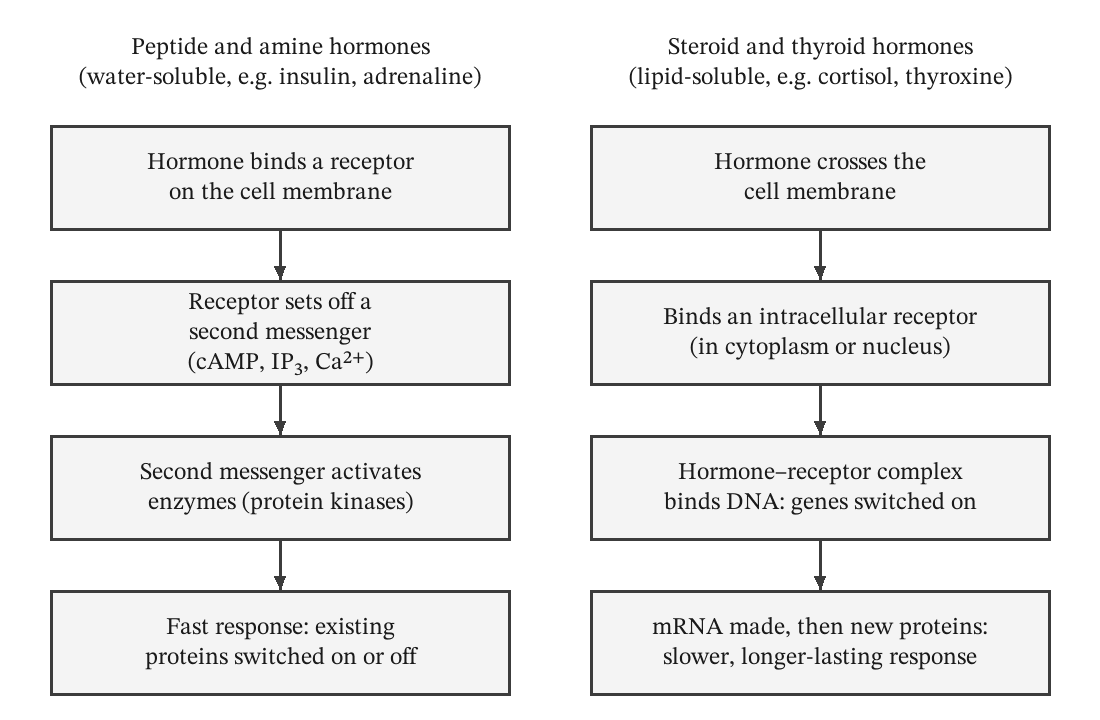
Step 3 — Action: Inside, they bind an intracellular receptor (in the cytoplasm or nucleus); the hormone–receptor complex binds DNA and switches particular genes on, so mRNA and then new proteins (often enzymes) are made, which change the cell's activity.
Therefore, lipophilic hormones cross the plasma membrane, bind intracellular receptors and act by changing gene expression.
- 712 marks
Question 71
Differentiate between the following: Exocrine and Endocrine glands.
Solve with AIWritten solution
Solution:
Concept: Glands are grouped by whether their secretion leaves through a duct.
Step 1 — What is asked: We need the differences between exocrine and endocrine glands.
Step 2 — Compare them: The main points of difference are set out below.
Feature Exocrine glands Endocrine glands Ducts Have ducts Ductless Where the secretion goes Through a duct to a body surface or cavity Directly into the blood Secretion Enzymes, sweat, mucus, saliva Hormones Examples Salivary glands, sweat glands Thyroid, pituitary, adrenal Therefore, exocrine glands pour their secretions through ducts, while endocrine glands are ductless and release hormones into the blood.
- 722 marks
Question 72
Differentiate between the following: Hormones and Enzymes.
Solve with AIWritten solution
Solution:
Concept: Hormones are chemical messengers; enzymes are biological catalysts.
Step 1 — What is asked: We need the differences between hormones and enzymes.
Step 2 — Compare them: The main points of difference are set out below.
Feature Hormones Enzymes Role Carry messages that regulate target organs Speed up chemical reactions Source and route Endocrine glands, into the blood Mostly exocrine glands and cells, through ducts or inside cells Site of action Far from where they are made At or near where they are made Chemical nature Proteins, peptides, steroids or amines Proteins (almost all) Therefore, hormones are messengers carried in the blood to distant targets, while enzymes are protein catalysts that act near their site of production.
- 732 marks
Question 73
Differentiate between the following: Diabetes mellitus and Diabetes insipidus.
Solve with AIWritten solution
Solution:
Concept: Both cause much urine and thirst, but the hormone at fault differs.
Step 1 — What is asked: We need the differences between diabetes mellitus and diabetes insipidus.
Step 2 — Compare them: The main points of difference are set out below.
Feature Diabetes mellitus Diabetes insipidus Cause Lack of insulin (type 1) or poor response to it (type 2) Lack of ADH (vasopressin) in the common (central) form; poor kidney response to ADH in the rarer (nephrogenic) form Blood glucose High (hyperglycaemia) Normal Sugar in urine Present (glycosuria) Absent Why urine is more Glucose in the filtrate holds water (osmotic effect) Collecting ducts reabsorb little water Note: In a rarer (nephrogenic) form of diabetes insipidus, enough ADH is released but the kidney tubules do not respond to it. Since 2022 the two forms are also called arginine vasopressin (AVP) deficiency and AVP resistance.
Therefore, diabetes mellitus is due to insulin failure with high blood sugar and sugar in urine, while diabetes insipidus is due mainly to lack of ADH (less often to lack of the kidney's response to it) with dilute urine and no sugar.
- 742 marks
Question 74
Differentiate between the following: Exophthalmic goitre and Iodine deficiency goitre.
Solve with AIWritten solution
Solution:
Concept: Both are goitres (an enlarged thyroid) but the thyroid works in opposite ways.
Step 1 — What is asked: We need the differences between exophthalmic goitre and iodine deficiency goitre.
Step 2 — Compare them: The main points of difference are set out below.
Feature Exophthalmic goitre (Graves' disease) Iodine deficiency (simple) goitre Cause Antibodies over-stimulate the thyroid (hyperthyroidism) Too little iodine in the diet, so too little thyroxine Eyes Bulging eyes (exophthalmos) Eyes normal BMR and heart rate High Normal or low Other signs Restlessness, nervousness, loss of weight Often none; tiredness and sluggishness if thyroxine is low Note: The BMR, heart-rate and nervousness rows are easy to swap: they go with the overactive thyroid (Graves' disease); simple goitre comes with a normal or low BMR.
Therefore, exophthalmic goitre is an overactive thyroid with bulging eyes and high BMR, while simple goitre is due to iodine deficiency with a normal or low BMR and no eye changes.
- 752 marks
Question 75
Differentiate between the following: Follicle-stimulating hormone and Luteinising hormone.
Solve with AIWritten solution
Solution:
Concept: FSH and LH are the two gonadotropins of the anterior pituitary.
Step 1 — What is asked: We need the differences between follicle-stimulating hormone and luteinising hormone.
Step 2 — Compare them: The main points of difference are set out below.
Feature FSH LH In females Growth of ovarian follicles and oestrogen secretion Ovulation; forms the corpus luteum, which secretes progesterone In males Stimulates spermatogenesis in seminiferous tubules Stimulates Leydig cells to secrete testosterone (called ICSH) Main target cells Follicle cells; seminiferous tubules Graafian follicle and corpus luteum; Leydig cells Therefore, FSH promotes follicle growth and spermatogenesis, while LH causes ovulation, the corpus luteum and testosterone secretion.
- 762 marks
Question 76
Differentiate between the following: Glucocorticoids and Mineralocorticoids.
Solve with AIWritten solution
Solution:
Concept: Both are steroid hormones of the adrenal cortex.
Step 1 — What is asked: We need the differences between glucocorticoids and mineralocorticoids.
Step 2 — Compare them: The main points of difference are set out below.
Feature Glucocorticoids Mineralocorticoids Layer of cortex Zona fasciculata (middle) Zona glomerulosa (outer) Main example Cortisol Aldosterone Main action Raise blood glucose (gluconeogenesis); reduce inflammation Na⁺ and water reabsorption, K⁺ excretion by the kidneys Main target Liver Kidney tubules Therefore, glucocorticoids such as cortisol control glucose metabolism, while mineralocorticoids such as aldosterone control Na⁺, K⁺ and water balance.
- 772 marks
Question 77
Differentiate between the following: Oestrogen and Progesterone.
Solve with AIWritten solution
Solution:
Concept: Both are female sex hormones made mainly in the ovary at different stages of the cycle; in pregnancy the placenta makes both of them.
Step 1 — What is asked: We need the differences between oestrogen and progesterone.
Step 2 — Compare them: The main points of difference are set out below.
Feature Oestrogen Progesterone Source Graafian follicle (also the corpus luteum, and the placenta in pregnancy) Corpus luteum (and the placenta in pregnancy) Uterus Builds up (thickens) the uterine lining in each cycle Keeps the lining ready for implantation and maintains pregnancy Other roles Female sex organs and secondary sex characters Growth of milk-secreting alveoli of the mammary glands Therefore, oestrogen, made mainly by the Graafian follicle (and by the placenta in pregnancy), develops female sex characters and builds up the uterine lining, while progesterone from the corpus luteum (and the placenta in pregnancy) prepares the uterus for and maintains pregnancy.
- 782 marks
Question 78
Differentiate between the following: Vasopressin and Oxytocin.
Solve with AIWritten solution
Solution:
Concept: Both are made in the hypothalamus and released from the posterior pituitary.
Step 1 — What is asked: We need the differences between vasopressin and oxytocin.
Step 2 — Compare them: The main points of difference are set out below.
Feature Vasopressin (ADH) Oxytocin Target Distal tubules and collecting ducts of the kidney (and arterioles) Uterus and mammary glands Action More water reabsorbed; less, concentrated urine; raises blood pressure Uterine contractions in childbirth; milk ejection Lack causes Diabetes insipidus Poor milk ejection (let-down); labour usually still proceeds Therefore, vasopressin conserves water through the kidneys, while oxytocin causes uterine contraction and milk ejection.
- 792 marks
Question 79
Differentiate between the following: Somatotropin and Somatostatin.
Solve with AIWritten solution
Solution:
Concept: The two names are alike, but somatotropin is growth hormone itself, while somatostatin stops its release.
Step 1 — What is asked: We need the differences between somatotropin and somatostatin.
Step 2 — Compare them: The main points of difference are set out below.
Feature Somatotropin Somatostatin What it is Growth hormone (GH) Growth hormone-inhibiting hormone (GHIH) Made by Anterior pituitary Hypothalamus (also δ-cells of the pancreatic islets) Action Promotes growth of bones and tissues and protein synthesis Stops the release of growth hormone Its own release Stimulated by GHRH and inhibited by somatostatin Rises when GH and growth factors are high Note: Somatostatin does not stimulate somatotropin release; it inhibits it — GH release is stimulated by GHRH (growth hormone-releasing hormone).
Therefore, somatotropin is growth hormone from the anterior pituitary, while somatostatin from the hypothalamus inhibits its release.
- 805 marks
Question 80
What is the role of hypothalamus in the endocrine system? Name various hormones released by anterior and posterior pituitary and their target organs or tissues. What are tropic hormones and what is their function?
Solve with AIWritten solution
Solution:
Concept: The hypothalamus links the nervous system to the endocrine system through the pituitary gland.
Step 1 — Role of the hypothalamus: It collects information from the brain and the blood (for example blood osmotic pressure and hormone levels) and controls the pituitary. Its neurosecretory cells release releasing hormones (TRH, CRH, GnRH, GHRH) and inhibiting hormones (somatostatin, which stops GH release, and prolactin-inhibiting hormone, which is dopamine) into the hypophyseal portal vessels, which carry them to the anterior pituitary.
Step 2 — It also makes posterior-lobe hormones: Other neurosecretory cells make ADH and oxytocin, which pass down their axons in the pituitary stalk to the posterior pituitary. The figure shows both links.
Step 3 — Anterior pituitary hormones: The six hormones and their targets are listed below.
Anterior pituitary hormone Target organ or tissue GH (growth hormone, somatotropin) body tissues, bones and muscles PRL (prolactin) mammary glands TSH (thyroid-stimulating hormone) thyroid gland ACTH (adrenocorticotropic hormone) adrenal cortex FSH (follicle-stimulating hormone) ovarian follicles and seminiferous tubules LH (luteinising hormone) ovary (ovulation, corpus luteum) and Leydig cells of the testis Step 4 — Posterior pituitary hormones: It releases ADH (vasopressin), which acts on the distal tubules and collecting ducts of the kidney (and on arterioles), and oxytocin, which acts on the uterus and the mammary glands.
Step 5 — Tropic hormones: These are the anterior pituitary hormones whose targets are other endocrine glands — TSH, ACTH, FSH and LH. They make their target glands grow and secrete their own hormones: TSH → thyroid hormones, ACTH → cortisol and adrenal androgens, FSH and LH → sex hormones and gametes.
Therefore, the hypothalamus controls the pituitary through releasing and inhibiting hormones and makes ADH and oxytocin; the anterior pituitary releases GH, PRL, TSH, ACTH, FSH and LH, the posterior pituitary ADH and oxytocin, and the tropic hormones (TSH, ACTH, FSH, LH) control other endocrine glands.
- 815 marks
Question 81
Even though pituitary is a small pea-sized gland, it is considered to be a master gland. Why? Why is posterior pituitary called a storage-releaser? Give two disorders caused by growth hormone.
Solve with AIWritten solution
Solution:
Concept: The pituitary is about 1.3 cm across and weighs about 0.5 g, yet its hormones control many other glands.
Step 1 — Why 'master gland': Its tropic hormones control other endocrine glands: TSH controls the thyroid, ACTH the adrenal cortex, and FSH and LH the gonads. It also secretes GH for the growth of the whole body and prolactin for milk production.
Step 2 — Its own master: The pituitary itself works under the hypothalamus, so today it is better described as the master gland working under hypothalamic control.
Step 3 — Storage-releaser: The posterior pituitary makes no hormone: ADH and oxytocin are made by neurosecretory cells of the hypothalamus, carried down their axons, stored in the axon endings in the posterior lobe and released into the blood when nerve signals arrive.
Step 4 — Disorder 1: gigantism: Too much GH in childhood makes the long bones grow too long, so the person becomes abnormally tall.
Step 5 — Disorder 2: acromegaly: Too much GH in adults thickens the bones of the hands, feet and jaw, giving coarse facial features. (Too little GH in childhood causes pituitary dwarfism, with short but well-proportioned body.)
Therefore, the pituitary is a master gland because its tropic hormones control the thyroid, adrenal cortex and gonads; the posterior lobe only stores and releases hypothalamic hormones; and excess GH causes gigantism or acromegaly.
- 825 marks
Question 82
What do you understand by feedback mechanism? Explain feedback mechanism by hormones and by metabolites. Give one example of each.
Solve with AIWritten solution
Solution:
Concept: Homeostasis needs hormone levels that rise and fall as required; feedback lets a result control its own cause.
Step 1 — Feedback mechanism: It is the control of the secretion of a hormone by the level of that hormone, or of the substance it controls, in the blood. In negative feedback, a rise in the level slows further secretion; a fall allows more secretion. (In positive feedback the result increases the stimulus, as with oxytocin in labour.)
Step 2 — Feedback by hormones: The hormone of a target gland acts back on the hypothalamus and pituitary.
Step 3 — Example: thyroxine: TRH from the hypothalamus → TSH from the anterior pituitary → thyroxine from the thyroid. A high blood thyroxine level inhibits TRH and TSH release, so thyroxine output falls; a low level removes the inhibition. The flow chart shows the loop.
Step 4 — Feedback by metabolites: The level of a metabolite (a substance such as glucose or calcium) directly controls the gland that regulates it.
Step 5 — Example: glucose: After a sugary meal blood glucose rises → β-cells release insulin → glucose is taken up and stored → blood glucose falls → insulin release falls. (Similarly, high blood Ca²⁺ inhibits PTH secretion.)
Therefore, feedback is the control of hormone secretion by its own effects: by hormones (high thyroxine inhibits TRH and TSH) and by metabolites (high blood glucose stimulates insulin, which brings glucose down).
- 835 marks
Question 83
Why is adrenal gland said to be composed of two glands? Name the parts of adrenal gland and all the hormones produced by them. Give two important functions of each hormone.
Solve with AIWritten solution
Solution:
Concept: Each adrenal gland, on top of a kidney, has an outer cortex and an inner medulla that differ in origin, control and hormones.
Step 1 — Two glands in one: The cortex secretes steroid hormones, is controlled by ACTH (cortisol, androgens) and by the renin–angiotensin system and blood K⁺ (aldosterone), and is essential for life; the medulla secretes catecholamines, is controlled by sympathetic nerves and is not essential for life. So they behave as two separate glands.
Step 2 — Cortex: mineralocorticoids (aldosterone): They make the kidney tubules reabsorb Na⁺ (with Cl⁻ and water) and excrete K⁺, so they keep blood volume and blood pressure normal.
Step 3 — Cortex: glucocorticoids (cortisol): They raise blood glucose by gluconeogenesis from amino acids in the liver, and they reduce inflammation and help the body recover from stress.
Step 4 — Cortex: sex corticoids (androgens): They are made in small amounts and help in the growth of pubic and underarm hair and other secondary sex characters, especially in females.
Step 5 — Medulla: adrenaline and noradrenaline: These fight-or-flight hormones raise heart rate and blood pressure and raise blood glucose by glycogen breakdown; they also widen the pupils and send more blood to the muscles and brain (noradrenaline mainly keeps up blood pressure).
Therefore, the adrenal gland is two glands — a cortex secreting mineralocorticoids, glucocorticoids and sex corticoids, and a medulla secreting adrenaline and noradrenaline — each with its own functions.
- 845 marks
Question 84
What role does hypothalamus and pituitary gland play in the development of secondary sex characteristics? Why are gonads considered endocrine glands also? Explain.
Solve with AIWritten solution
Solution:
Concept: Secondary sex characters appear at puberty, when a hormone chain from the brain to the gonads switches on.
Step 1 — Hypothalamus: At puberty the hypothalamus starts releasing gonadotropin-releasing hormone (GnRH) into the portal vessels.
Step 2 — Pituitary: GnRH makes the anterior pituitary release the gonadotropins FSH and LH, which act on the testes and ovaries.
Step 3 — Male hormones: LH (ICSH) makes the Leydig cells secrete testosterone, which produces beard and moustache, a deep voice, broad shoulders and muscle growth.
Step 4 — Female hormones: FSH makes the follicles grow and secrete oestrogen, which develops the breasts, the female voice and hair pattern and the cyclic changes of the uterus; after ovulation (LH) the corpus luteum secretes progesterone.
Step 5 — Why gonads are endocrine: Besides making gametes (exocrine-like work), the gonads have cells — Leydig cells in the testes, follicle cells and the corpus luteum in the ovaries — that secrete hormones directly into the blood, so they are also endocrine glands.
Therefore, the hypothalamus (GnRH) makes the pituitary release FSH and LH, which make the gonads secrete testosterone or oestrogen and progesterone that develop secondary sex characters; gonads are endocrine because they secrete these hormones into the blood.
- 855 marks
Question 85
What are lipophilic and hydrophilic hormones? Explain the mechanism of action of both these hormones. List three important differences in their actions.
Solve with AIWritten solution
Solution:
Concept: A hormone acts only on cells that carry its specific receptor; where the receptor is depends on whether the hormone can cross the lipid plasma membrane.
Step 1 — Meaning: Lipophilic hormones are lipid-soluble — the steroids (cortisol, aldosterone, oestrogen, progesterone, testosterone) and the thyroid hormones. Hydrophilic hormones are water-soluble — peptide and protein hormones (insulin, glucagon, FSH, ADH) and the catecholamines (adrenaline).
Step 2 — Hydrophilic hormones: They cannot cross the plasma membrane, so they bind a receptor on the membrane surface; the hormone itself is the first messenger. For most of them (adrenaline, glucagon, FSH, ADH) this forms a second messenger inside the cell — cAMP, IP₃ or Ca²⁺ — which activates enzymes (protein kinases) that change existing proteins and produce the response. The insulin receptor is itself an enzyme (a tyrosine kinase) that starts a chain of protein changes directly.
Step 3 — Lipophilic hormones: They pass through the plasma membrane (steroids by diffusion, thyroid hormones with membrane transporter proteins) and bind an intracellular receptor in the cytoplasm or nucleus. The hormone–receptor complex binds DNA, switches particular genes on, and the mRNA formed is translated into new proteins (often enzymes). The two chains are shown side by side.
Step 4 — Differences: Three important differences in their actions are set out below.
Feature Lipophilic hormones Hydrophilic hormones Receptor Inside the cell (cytoplasm or nucleus) On the plasma membrane How the effect is made Hormone–receptor complex changes gene expression Mostly a second messenger (cAMP, IP₃, Ca²⁺) activates enzymes Speed and duration Slower, longer-lasting Faster, shorter-lasting Therefore, lipophilic hormones (steroids, thyroxine) enter the cell and act on genes through intracellular receptors, while hydrophilic hormones (peptides, catecholamines) act from the cell surface, mostly through second messengers.
- 865 marks
Question 86
Give important functions of these hormones
(i) luteinising hormone
(ii) ADH
(iii) cortisol
(iv) progesterone
(v) aldosterone.
Solve with AIWritten solution
Solution:
Concept: Each hormone acts on particular target cells that carry its receptor.
Step 1 — (i) Luteinising hormone: In females it triggers ovulation and forms the corpus luteum, which secretes progesterone; in males (as ICSH) it makes the Leydig cells secrete testosterone.
Step 2 — (ii) ADH (vasopressin): It makes the distal tubules and collecting ducts reabsorb more water, so less, concentrated urine is passed; in large amounts it constricts arterioles and raises blood pressure.
Step 3 — (iii) Cortisol: It raises blood glucose by gluconeogenesis in the liver from amino acids released by protein breakdown, helps the body cope with stress, and reduces inflammation and allergic responses.
Step 4 — (iv) Progesterone: It prepares and maintains the uterine lining for implantation and pregnancy, and stimulates the growth of the milk-secreting alveoli of the mammary glands.
Step 5 — (v) Aldosterone: It makes the kidney tubules reabsorb Na⁺ (with Cl⁻ and water) and excrete K⁺, so it keeps the salt–water balance, blood volume and blood pressure normal.
Therefore, LH causes ovulation and testosterone secretion, ADH conserves water, cortisol raises blood glucose and fights inflammation, progesterone maintains pregnancy, and aldosterone keeps Na⁺, K⁺ and water balance.
- 875 marks
Question 87
Give the cause and symptoms of
(i) Gigantism
(ii) Cretinism
(iii) Diabetes mellitus
(iv) Diabetes insipidus
(v) Graves' disease.
Solve with AIWritten solution
Solution:
Concept: Hormone disorders come from too much or too little of a hormone, and the symptoms follow from the hormone's normal role.
Step 1 — (i) Gigantism: Cause: too much growth hormone in childhood, usually from a pituitary tumour. Symptoms: abnormal lengthening of the long bones, so the person becomes very tall, with large hands, feet and organs.
Step 2 — (ii) Cretinism (congenital hypothyroidism): Cause: too little thyroid hormone before birth or from early infancy (thyroid absent or not working, or iodine deficiency). Symptoms: stunted growth, delayed mental development (intellectual disability), puffy face, thick protruding tongue, pot belly, dry skin, low BMR, body temperature and heart rate. Early diagnosis by newborn screening and thyroxine treatment prevent these effects.
Step 3 — (iii) Diabetes mellitus: Cause: lack of insulin because the β-cells are destroyed (type 1), or poor response of the body cells to insulin (type 2). Symptoms: high blood glucose, sugar in urine, a large volume of urine, great thirst, loss of weight and tiredness, and slow healing of wounds.
Step 4 — (iv) Diabetes insipidus: Cause: in the common (central) form, failure of secretion of ADH (vasopressin); in the rarer (nephrogenic) form, failure of the kidney to respond to it. Symptoms: a very large volume of dilute urine without sugar and great thirst.
Step 5 — (v) Graves' disease: Cause: an autoimmune disorder in which antibodies stimulate the thyroid like TSH, so it oversecretes hormones (hyperthyroidism). Symptoms: goitre with bulging eyes, high BMR, fast heartbeat, sweating, restlessness and nervousness, poor sleep and loss of weight.
Note: In a rarer (nephrogenic) form of diabetes insipidus, enough ADH is released but the kidney tubules do not respond to it. Since 2022 the two forms are also called arginine vasopressin (AVP) deficiency and AVP resistance.
Therefore, gigantism is due to excess GH in childhood, cretinism to thyroid hormone deficiency from before birth or early infancy, diabetes mellitus to lack of insulin action, diabetes insipidus mainly to lack of ADH (less often to lack of the kidney's response to it), and Graves' disease to autoimmune overactivity of the thyroid.
What Class 11 Biology Ch 29 covers
The sections of the chapter, in the order the book takes them. Every question above comes from one of these.
- 01Endocrine Glands and Hormones
- 02Hypothalamus and Pituitary
- 03Pineal and Thyroid Glands
- 04Parathyroid and Thymus
- 05Adrenal Gland
- 06Pancreas
More ways to study this chapter
The same chapter asked three other ways. Practise it, revise it, and see what the board has set on Ch 29 before.
Class 11 Biology Ch 29 questions students ask
How many questions are there in Class 11 Biology Ch 29?
87 questions. Every one is solved step by step on this page.
Are these Class 11 Biology solutions free?
Yes. Every question and its full working is free to read, with no account needed.
Can I download the Class 11 Biology Ch 29 solutions as a PDF?
There is no PDF to download. Every solution is on this page instead, which means it is searchable, always the current syllabus, and readable on a phone. Use your browser's print option if you want it on paper.