
Opening your dashboard
Class 11 Biology Chapter 29 Chemical Coordination and Integration: Practice Questions
174 questions on Chapter 29, each worked through on its own page with the AI tutor. Class 11 Biology, ICSE 2026-27.
174 questions
1–4 marks · Mixed difficulty
- 11 mark
Question 1
(Hypothetical data.) A gland G, which has no duct, is removed from young rats, and their growth stops. When a very small amount of an extract of G is injected into their blood, the rats start growing again. What does this experiment show?
- 22 marks
Question 2
A bus horn blares suddenly behind Meera. She jumps aside within a fraction of a second, but her heart keeps pounding for several minutes after the bus has gone. Using the differences between nervous and hormonal coordination, explain these two observations.
- 31 mark
Question 3
Which pair of glands both secrete steroid hormones?
- 42 marks
Question 4
Most hormones are broken down or removed from the blood soon after they have acted on their target cells. Give two reasons why this quick removal is useful to the body.
- 51 mark
Question 5
Four substances made in the body are described below. Which one is a hormone?
- 63 marks
Question 6
(Hypothetical data.) The graph shows the heights of two boys, X and Y, measured every two years from age 2 to age 10.
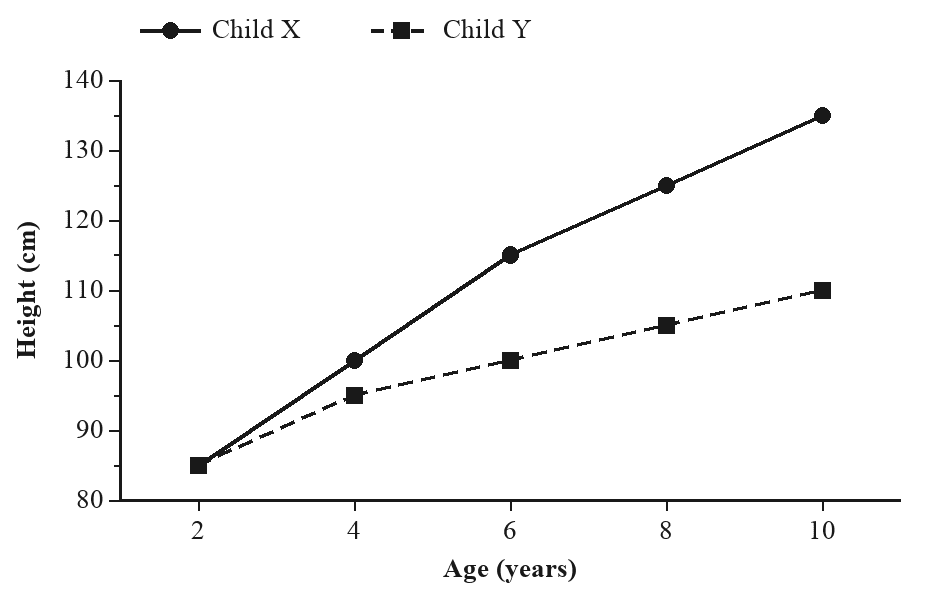
Tests at age 10 show that Y has a low level of growth hormone (GH) in his blood, while his thyroid hormones are normal.
(a) Between which two ages did Y begin to fall behind X, and by how many centimetres was Y shorter than X at age 10?
(b) Name the disorder Y will develop if he is not treated, and state how GH normally promotes growth.
(c) Doctors start GH injections at once. Explain why the same treatment started at age 25 would not make him taller.
- 71 mark
Question 7
(Hypothetical data.) A rare tumour in the hypothalamus of a child releases large amounts of somatostatin into the portal vessels that lead to the pituitary. Which change is most likely?
- 83 marks
Question 8
In an experiment on a laboratory animal, the pituitary stalk is cut, so that both the portal blood vessels and the nerve fibres running from the hypothalamus to the pituitary are interrupted. Predict, with a reason for each, what would happen soon afterwards to:
(a) the release of ADH into the blood;
(b) the secretion of TSH and, through it, of thyroxine;
(c) the volume of urine passed.
- 91 mark
Question 9
The releasing and inhibiting hormones of the hypothalamus are secreted in very small amounts, yet they reach the anterior pituitary in a concentration high enough to act. Which feature makes this possible?
- 102 marks
Question 10
(Hypothetical data.) Two adults, P and Q, each pass about 6 litres of urine a day and feel very thirsty. Their test results are shown below (normal fasting blood glucose: 70–100 mg/dL).
Test Patient P Patient Q Fasting blood glucose (mg/dL) 92 240 Benedict's test on urine Stays blue Brick-red precipitate Appearance of urine Very pale and dilute Pale yellow Which patient has diabetes insipidus? Name the hormone whose lack causes it, and explain why this patient's urine is so dilute.
- 113 marks
Question 11
(Hypothetical data.) A healthy student empties their bladder and then drinks 1 litre of water within a few minutes. The student's urine is collected every hour:
Hour after drinking 1st 2nd 3rd 4th Urine volume (mL) 120 480 300 80 (a) Explain the large volume of urine in the 2nd hour in terms of ADH.
(b) Explain why the volume falls again by the 4th hour.
(c) Why is this control of ADH secretion called negative feedback?
- 123 marks
Question 12
A patient with severe arthritis takes cortisol-like (corticosteroid) tablets every day for many months.
(a) Predict what happens to the amount of ACTH secreted by the patient's anterior pituitary, and give the reason.
(b) What would you expect to happen to the size and activity of the patient's own adrenal cortex?
(c) Use your answers to explain why doctors reduce such tablets slowly instead of stopping them suddenly.
- 131 mark
Question 13
A patient's anterior pituitary is destroyed by disease. The secretion of which hormone would be least affected?
- 141 mark
Question 14
Aman flies from Delhi to a city several time zones to the west. For a few days he feels sleepy in the afternoon and wide awake at night. He is advised to spend time outdoors in daylight during the local daytime. How does daylight help?
- 152 marks
Question 15
Many teenagers who use bright phone or laptop screens late into the night find it hard to fall asleep. Explain this using the role of melatonin, and suggest one change in habit based on your explanation.
- 163 marks
Question 16
(Hypothetical data.) Blood reports of three adults are given below. Normal ranges: TSH 0.4–4.0 mIU/L; free T₄ (thyroxine) 0.8–1.8 ng/dL.
Person TSH (mIU/L) Free T₄ (ng/dL) A 18.0 0.4 B 0.1 0.5 C 0.02 3.2 (a) Which person has a fault in the thyroid gland itself? Explain that person's TSH value.
(b) Which person has low thyroxine because the thyroid is getting too little stimulation? Give the reason.
(c) Person C has bulging eyes and a swelling in the neck. Name the disorder and explain why C's TSH is so low.
- 171 mark
Question 17
(Hypothetical data.) In a hilly district, goitre was found in 28% of schoolchildren in 1990. After iodised salt became the only salt sold there, surveys found goitre in 12% (2000) and 4% (2015) of schoolchildren. Which explanation of this fall is correct?
- 182 marks
Question 18
Many hospitals test a drop of blood from the heel of every newborn baby for congenital hypothyroidism, and babies who test positive are given thyroxine within the first few weeks of life. Explain why such early detection and treatment matter so much.
- 191 mark
Question 19
A healthy adult goes on a diet that contains very little iodine. Signs of thyroid hormone deficiency appear only after several weeks, not within a day or two. Which feature of the thyroid best explains this delay?
- 203 marks
Question 20
Some patients with Graves' disease are treated with a measured dose of radioactive iodine.
(a) Why does the radioactive iodine collect in the thyroid gland instead of spreading evenly to all organs?
(b) How does this treatment bring the patient's high BMR down?
(c) Several months later, some of these patients need to take thyroxine tablets for life. Explain why.
- 214 marks
Question 21
(Hypothetical data.) A woman had her whole thyroid gland removed because of a disease. Her plasma calcium was measured every day (normal range 8.5–10.5 mg/dL). On day 2 she complained of tingling in her fingers and painful spasms of the muscles of her hands and face, and calcium treatment was started that day.

(a) Read her plasma calcium on day 0 and on day 2 from the graph.
(b) Which glands were most probably damaged during the operation? Explain why their position makes this likely.
(c) Explain why the low plasma calcium caused the muscle spasms.
(d) The loss of calcitonin cannot explain the fall in her calcium. Give the reason.
- 221 mark
Question 22
Parathormone (PTH) is injected into a healthy laboratory animal. Which set of changes is expected over the next few hours?
- 232 marks
Question 23
Normally a rise in plasma calcium reduces the secretion of parathormone (PTH). In a patient with a tumour of a parathyroid gland, PTH stays high although the patient's plasma calcium is already above normal, and an X-ray shows that the patient's bones have become thin and weak. Explain both observations.
- 241 mark
Question 24
In an experiment, the thymus was removed from mice soon after birth. As these mice grew up, which effect would be expected?
- 252 marks
Question 25
(Hypothetical data.) The average mass of the human thymus at different ages is:
Age (years) 0 (birth) 6 12 30 60 Mass of thymus (g) 15 25 34 22 14 (a) At which of these ages is the thymus largest, and what happens to it after that?
(b) Why is a large, active thymus especially important during childhood?
- 263 marks
Question 26
(Hypothetical data.) Rohan is cycling home when a stray dog suddenly chases him, barking. His fitness watch and a blood glucose meter gave these readings while he was resting earlier that day and again just after he reached home:
Measurement At rest Just after the chase Heart rate (beats per minute) 72 130 Blood glucose (mg/dL) 95 125 (a) Name the hormone mainly responsible for these changes and the part of the gland that secretes it.
(b) Explain how the rise in heart rate and the rise in blood glucose help him to escape.
(c) His friends notice that his face looks pale. Explain this observation.
- 271 mark
Question 27
(Hypothetical data.) A 35-year-old woman has weakness, low blood pressure and darkening of the skin. Her blood shows a low level of Na⁺ and a high level of K⁺, and tests show that her own immune system has destroyed the cells of one endocrine tissue. Which disorder does she most likely have?
- 282 marks
Question 28
During a long fast or prolonged stress, the body's glycogen stores run low, yet the blood glucose level is kept close to normal. Explain how cortisol helps to do this, and state one harmful effect of a very high cortisol level that lasts for many months.
- 291 mark
Question 29
A small tumour arises in the zona glomerulosa (the outermost layer) of one adrenal cortex and secretes its hormone in excess. Which group of findings is most likely?
- 302 marks
Question 30
A woman develops a beard, a moustache and a deeper voice, although her ovaries are normal. Tests reveal a tumour in her adrenal cortex. Explain how an adrenal tumour can cause these male-type features.
- 311 mark
Question 31
The secretion of adrenaline by the adrenal medulla is controlled mainly by
- 324 marks
Question 32
(Hypothetical data.) A healthy student fasts overnight and then eats a breakfast rich in starch. The student's blood glucose and plasma insulin are measured every 30 minutes for 3 hours, as shown in the graphs.
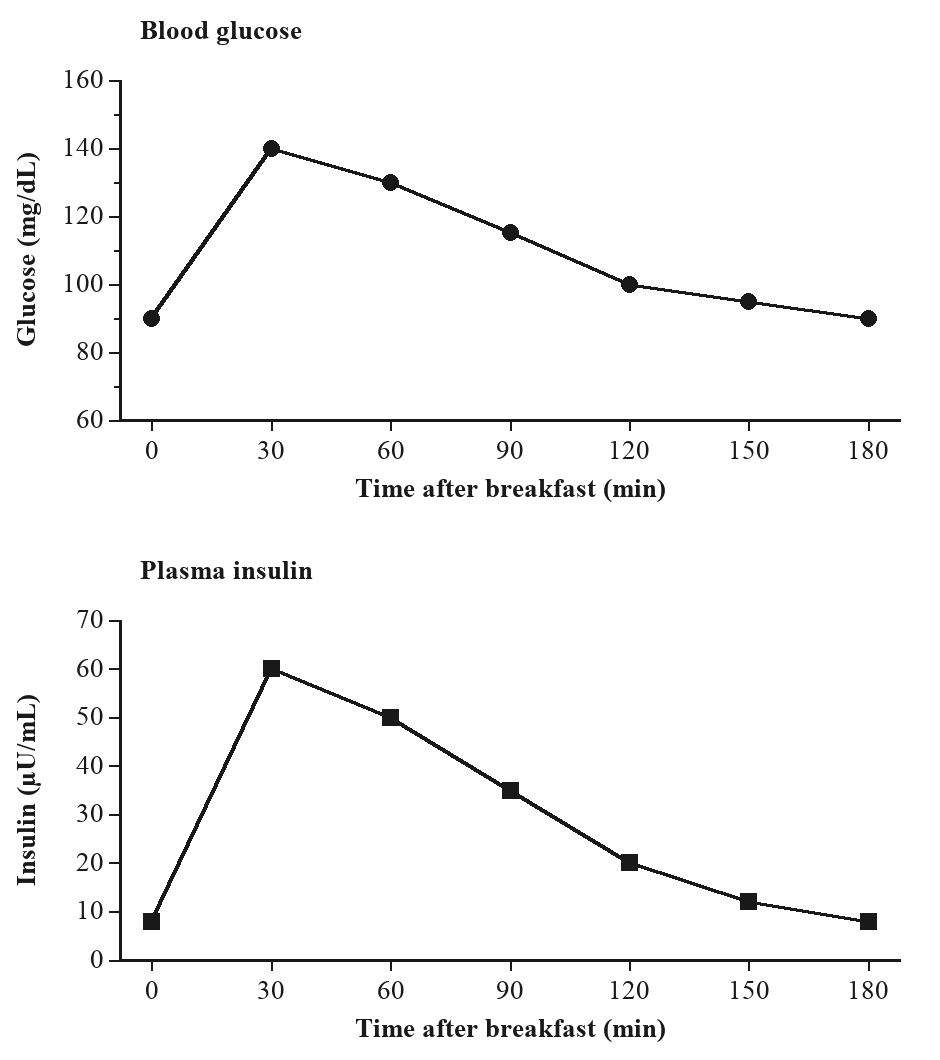
The student's plasma glucagon falls during the first hour and is back at its fasting level by 3 hours.
(a) At what time does the student's blood glucose reach its peak, and what is the peak value?
(b) Explain why the student's insulin changes as it does, and how insulin brings the glucose back to the fasting level.
(c) Explain why the student's glucagon falls after the meal.
(d) Predict how the glucose curve would differ in a person with untreated type 1 diabetes, giving a reason.
- 331 mark
Question 33
Which combination best describes a healthy person's pancreas and liver late at night, about ten hours after the last meal?
- 343 marks
Question 34
Mr Rao, aged 55, has had type 2 diabetes for twelve years. It was controlled at first by diet, exercise and tablets, but his doctor has now added insulin injections.
(a) How does the cause of type 2 diabetes differ from that of type 1 diabetes?
(b) Suggest why a person with type 2 diabetes may come to need insulin.
(c) Why must insulin be injected instead of being swallowed as a tablet?
- 351 mark
Question 35
Neha, who has type 1 diabetes, took her usual insulin dose but missed lunch. In the afternoon she is sweating, shaky and confused, but awake and able to swallow. What should her friends do first?
- 363 marks
Question 36
(Hypothetical data.) A man with diabetes mellitus measured his blood glucose and tested his urine for glucose three times in one day. His kidneys reabsorb all the glucose filtered from the blood only while the blood glucose is below about 180 mg/dL.
Time 8 a.m. 2 p.m. 8 p.m. Blood glucose (mg/dL) 150 230 175 Glucose in urine Absent Present Absent (a) Explain why glucose appeared in his urine only at 2 p.m.
(b) Explain why he passes more urine and feels more thirsty when his blood glucose is high.
- 371 mark
Question 37
A stone blocks the main duct of a patient's pancreas, so pancreatic juice cannot reach the duodenum. Which effect is expected soon after the blockage?
- 382 marks
Question 38
Some people with type 1 diabetes keep a glucagon injection kit at home, for use if they become unconscious from very low blood glucose.
(a) How does glucagon raise the blood glucose level?
(b) Why might the injection work poorly in a person who has eaten almost nothing for two days?
- 393 marks
Question 39
(Hypothetical data.) The graph shows the level of progesterone in a woman's blood during one 28-day ovarian cycle (day 1 is the first day of menstruation).
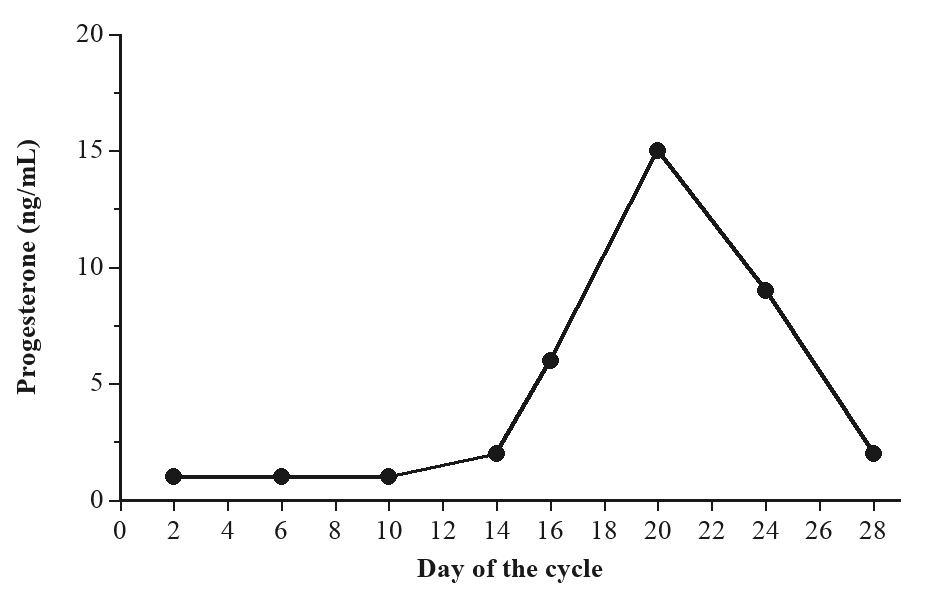
(a) On which day is progesterone highest, what is its level, and which structure in the ovary secretes it?
(b) What does the sharp rise after day 14 tell you about an event in the ovary? Name the pituitary hormone that triggers this event.
(c) In a cycle in which no ovum is released, this rise does not occur. Explain why.
- 402 marks
Question 40
Because of a disease, a boy's testes stop secreting testosterone when he is 10 years old, and he receives no treatment. Name the disorder, and predict two ways in which his body at 18 would differ from that of other young men.
- 411 mark
Question 41
After a fatty meal reaches the duodenum, the gall bladder contracts and the pancreas releases a juice rich in enzymes. Which hormone, released by the wall of the small intestine, brings about both these effects?
- 422 marks
Question 42
Patients with long-standing kidney failure often become anaemic (they have too few red blood cells), and many are given regular injections of erythropoietin. Explain the cause of the anaemia and how the injections help.
- 431 mark
Question 43
A patient is given a large volume of saline through a drip, and the walls of the atria of the patient's heart are stretched. Which hormonal response helps to bring the patient's blood pressure back down?
- 443 marks
Question 44
Several hormones coordinate digestion as a meal passes from the stomach into the duodenum.
(a) Which hormone makes the gastric glands secrete HCl and pepsinogen when food is in the stomach?
(b) When acidic food enters the duodenum, which hormone makes the pancreas release a juice rich in bicarbonate ions, and why is this useful?
(c) Which intestinal hormone inhibits gastric secretion, and why is this useful once food has passed on to the intestine?
- 451 mark
Question 45
Adrenaline raises the blood glucose level within seconds of its release, whereas the effects of cortisol take hours to develop. Which statement best explains this difference?
- 463 marks
Question 46
Adrenaline released into the blood reaches almost every cell of the body, yet it changes the activity of only some of them.
(a) Explain why only certain cells respond to a hormone.
(b) In type 2 diabetes, the blood often contains a normal or even a high level of insulin, yet the blood glucose stays high. Use the idea in (a) to explain this.
- 471 mark
Question 47
When a certain hormone binds to its receptor on the outer surface of liver cells, the level of cyclic AMP inside the cells rises within seconds and the breakdown of glycogen speeds up. Which hormone is it most likely to be?
- 482 marks
Question 48
(Hypothetical data.) In an experiment, insulin molecules were firmly attached to tiny plastic beads far too large to enter a cell. When these beads were added to fat cells in a dish, the cells still took up more glucose, just as they did with free insulin. What does this experiment show about how insulin acts, and why is this expected from its chemical nature?
- 491 mark
Question 49
A hormone travels in the blood bound to a carrier protein, passes through the plasma membrane of its target cells, binds to a receptor inside the cell, and the hormone–receptor complex then binds to DNA. Which hormone fits this description?
- 504 marks
Question 50
(Hypothetical data.) A researcher treats kidney cells and liver cells grown in dishes with two drugs.
Drug X blocks the making of mRNA from DNA (transcription).
Drug Y blocks the glucagon receptor on the plasma membrane.
(a) Drug X stops the effect of aldosterone on the kidney cells but not the effect of adrenaline on the liver cells. Explain why.
(b) Predict, with a reason, the effect of drug Y on the release of glucose by liver cells exposed to glucagon.
(c) Would drug Y block the action of cortisol on the same liver cells? Give a reason.
(d) Why do steroid hormones such as aldosterone need carrier proteins in the blood, while glucagon does not?
- 511 mark
Question 51
Antidiuretic hormone is produced from
- 521 mark
Question 52
Which of the following is secreted by the pituitary?
- 531 mark
Question 53
The hormone that increases the blood calcium level and decreases its excretion by kidneys is
- 541 mark
Question 54
Which of the following is produced from adrenal cortex?
- 551 mark
Question 55
Corpus luteum produces
- 561 mark
Question 56
Addison's disease is due to
- 571 mark
Question 57
Cretinism is due to
- 581 mark
Question 58
Which one of the following is an endocrine as well as an exocrine gland?
- 591 mark
Question 59
Acromegaly is due to oversecretion of
- 601 mark
Question 60
FSH from anterior pituitary causes
- 611 mark
Question 61
Oxytocin is secreted by
- 621 mark
Question 62
Cushing's disease is due to oversecretion of
(i) pituitary
(ii) adrenal cortex
(iii) thyroid
(iv) adrenal medulla
- 631 mark
Question 63
Diabetes insipidus is due to failure of secretion of
- 641 mark
Question 64
Which cells of pancreas produce insulin?
- 651 mark
Question 65
Which of the following endocrine glands produces the hormones, similar to chemicals produced by sympathetic nervous system?
- 661 mark
Question 66
Corticotropin–releasing hormone stimulates the release of
- 671 mark
Question 67
The hormone which is not synthesised by the anterior lobe of pituitary is
- 681 mark
Question 68
Increased glucose synthesis by break down of fats and amino acids is due to
- 691 mark
Question 69
Bulging of eyes, increased BMR, BP and heart rate are symptoms of
- 701 mark
Question 70
The following hormone is not a gonadotropin hormone
(i) ACTH
(ii) FSH
(iii) LH
(iv) prolactin
- 711 mark
Question 71
Synthesis of testosterone by Leydig cells is stimulated by
- 721 mark
Question 72
Which one of following hormones is a modified amino acid?
- 731 mark
Question 73
Which one of the following pairs matches with the deficiency disease called by it?
- 741 mark
Question 74
Chemically, the hormones are
- 751 mark
Question 75
Hormone that helps in the conversion of glucose to glycogen is
- 761 mark
Question 76
Secretin is produced by
- 771 mark
Question 77
During emergency situations the increase in heart rate, and blood pressure is due to the following hormone
- 781 mark
Question 78
ICSH acts on
- 791 mark
Question 79
The hormone that regulates the calcium level in blood is
- 801 mark
Question 80
Mammalian prolactin is secreted by
- 811 mark
Question 81
Gland which is both exocrine and endocrine in function is
- 821 mark
Question 82
Hormone which is responsible for maintenance of corpus luteum is
- 831 mark
Question 83
Which of the following is not a hereditary disease?
- 841 mark
Question 84
Which of the following disease is not related to thyroid gland?
- 851 mark
Question 85
The hormone that controls the level of calcium and phosphorus in the blood is secreted by
- 861 mark
Question 86
FSH is produced by
- 871 mark
Question 87
Hormone secreted by Leydig cells of testes is
- 881 mark
Question 88
FSH and LH are collectively known as
- 891 mark
Question 89
Hormone released from anterior pituitary responsible for ovulation is
- 901 mark
Question 90
Reabsorption of water in the kidney is under the control of
- 911 mark
Question 91
Endocrine part of pancreas is
- 921 mark
Question 92
Insulin promotes
- 931 mark
Question 93
Following is an example of stress hormone
- 941 mark
Question 94
Hypothyroidism in adult causes
- 951 mark
Question 95
Which one of the following is not a second messenger in hormone action?
- 961 mark
Question 96
Which of the following is an accumulation and releasing centre of neurohormone?
- 971 mark
Question 97
Withdrawal of which of the following hormones is the immediate cause of menstruation?
- 981 mark
Question 98
Which hormone causes dilation of blood vessels, increased oxygen consumption and glycogenesis?
- 991 mark
Question 99
Diabetes insipidus is caused by the deficiency of hormone
- 1001 mark
Question 100
Myxoedema is a disorder of
- 1011 mark
Question 101
During emergency, which of the following hormones is secreted?
- 1021 mark
Question 102
The Islets of Langerhans are found in
- 1031 mark
Question 103
Which of the following is responsible for sleep cycle movement?
- 1041 mark
Question 104
Feeling the tremors of earthquakes, a scared resident of seventh floor of a multistoried building starts climbing down the stairs rapidly. Which hormone initiated this reaction?
- 1051 mark
Question 105
Melanocyte stimulating hormone (MSH) is produced by
- 1061 mark
Question 106
Corpus luteum secretes
- 1071 mark
Question 107
Testosterone is secreted by
- 1081 mark
Question 108
Hypothyroidism causes
- 1091 mark
Question 109
Which of the following controls the function of Sertoli cells?
(i) FSH
(ii) oestrogen
(iii) ACTH
(iv) testosterone
- 1101 mark
Question 110
Flight and fight hormone is
- 1111 mark
Question 111
Deficiency of which mineral, causes goitre disease?
- 1121 mark
Question 112
Deficiency of vasopressin hormone causes
- 1131 mark
Question 113
Sertoli cells are regulated by pituitary hormone known as
- 1141 mark
Question 114
Which hormone is responsible for milk ejection after the birth of the baby?
- 1151 mark
Question 115
Diabetes insipidus is caused due to lack of
- 1161 mark
Question 116
Corticotropin stimulates the growth of ______ and the secretion of ______ from it.
- 1171 mark
Question 117
Secretion of milk is stimulated by ______ while ejection of milk is stimulated by ______.
- 1181 mark
Question 118
Diabetes insipidus results from deficiency of ______ while diabetes mellitus is caused by a deficiency of ______.
- 1191 mark
Question 119
Growth of female secondary sex organs is stimulated at puberty by ______ while growth of male secondary sex organs is stimulated by ______.
- 1201 mark
Question 120
Deficiency of growth hormone from childhood produces the disease called ______ while oversecretion of that hormone from childhood causes ______.
- 1211 mark
Question 121
Urinary loss of Na⁺ is reduced by the hormone ______ while the Ca²⁺ concentration is raised in the plasma by ______.
- 1221 mark
Question 122
Reabsorption of water from the urine is increased by the hormone ______ while reabsorption of Na⁺ from the urine is enhanced by ______.
- 1231 mark
Question 123
Alpha cells of pancreas produce ______ hormone while beta cells produce ______ hormone.
- 1241 mark
Question 124
Target tissue of mineralocorticoids is ______ while target tissue of glucocorticoids is ______.
- 1251 mark
Question 125
On the basis of solubility, FSH and insulin are categorised as ______ hormones and steroid hormones as ______.
- 1261 mark
Question 126
Interstitial cells of Leydig produces hormone testosterone.
- 1271 mark
Question 127
Insulin is produced by alpha cells of pancreas.
- 1281 mark
Question 128
Thyroid gland secretes adrenalin.
- 1291 mark
Question 129
Adrenal medulla produces mineralocorticoids and glucocorticoids.
- 1301 mark
Question 130
Deficiency of iodine causes simple goitre.
- 1311 mark
Question 131
Oxytocin is water-retaining hormone.
- 1321 mark
Question 132
Production of parathormone is controlled by concentration of calcium ions in blood.
- 1331 mark
Question 133
Lipophilic hormones bind to a receptor protein at the surface of plasma membrane.
- 1341 mark
Question 134
The nerve centre N₁ of hypothalamus is connected to the anterior lobe of pituitary by portal blood vessels.
- 1351 mark
Question 135
Diabetes insipidus is caused by deficiency of hormone released from posterior pituitary.
- 1361 mark
Question 136
Chemical released by hypothalamus that stimulates the synthesis of FSH and LH from pituitary.
- 1371 mark
Question 137
A hormone released from posterior pituitary that acts on uterine smooth muscles.
- 1381 mark
Question 138
Endocrine gland from which hormone melatonin is produced.
- 1391 mark
Question 139
A disorder that leads to a condition called exophthalmic goitre.
- 1401 mark
Question 140
A hormone that has stimulating effect on immune system and causes maturation of T cells.
- 1411 mark
Question 141
Specific cells from which mineralocorticoids are released.
- 1421 mark
Question 142
An emergency hormone that causes increase in blood pressure.
- 1431 mark
Question 143
Endocrine part of pancreas that produces hormones.
- 1441 mark
Question 144
Hormones that cannot enter the cells and so bind to a surface receptor of plasma membrane.
- 1451 mark
Question 145
Organ that produces hormone progesterone.
- 1461 mark
Question 146
Mark the odd one out: Growth hormone; TSH; vasopressin; LH.
- 1471 mark
Question 147
Mark the odd one out: Goitre; cretinism; dwarfism; myxoedema.
- 1481 mark
Question 148
Mark the odd one out: Oxytocin; somatostatin; gonadotropin releasing hormone; corticotropin releasing hormone.
- 1491 mark
Question 149
Mark the odd one out: Glucocorticoids; mineralocorticoids; sex corticoids; corticotropin.
- 1501 mark
Question 150
Mark the odd one out: FSH; TSH; prolactin; LH.
- 1511 mark
Question 151
Write the name and source of the hormone regulating the following: Uterine changes in pregnancy.
- 1521 mark
Question 152
Write the name and source of the hormone regulating the following: Urinary elimination of water.
- 1531 mark
Question 153
Write the name and source of the hormone regulating the following: Metamorphosis of tadpoles.
- 1541 mark
Question 154
Write the name and source of the hormone regulating the following: Plasma Ca²⁺ level.
- 1551 mark
Question 155
Write the name and source of the hormone regulating the following: Na⁺ and K⁺ metabolism.
- 1561 mark
Question 156
Write the name and source of the hormone regulating the following: Blood sugar level.
- 1571 mark
Question 157
Write the name and source of the hormone regulating the following: Milk secretion.
- 1581 mark
Question 158
Write the name and source of the hormone regulating the following: Uterine contractions at childbirth.
- 1591 mark
Question 159
Assertion (A): The person with diabetes insipidus feels thirsty.
Reason (R): A person with diabetes insipidus suffers from excess secretion of vasopressin.
- 1601 mark
Question 160
Assertion (A): Oxytocin is also known as antidiuretic hormone (ADH).
Reason (R): It can cause an increase in the renal reabsorption of water.
- 1611 mark
Question 161
Assertion (A): Hormone calcitonin has an antagonistic effect to that of parathormone.
Reason (R): Calcitonin decreases the blood calcium level while parathormone increases the blood calcium level.
- 1621 mark
Question 162
Assertion (A): Thyroid hormones promote physical growth and development of mental alertness.
Reason (R): Hypothyroidism in adults causes retarded sexual development.
- 1631 mark
Question 163
Assertion (A): Adrenal cortex is not vital for survival and may be removed without subsequently leading to death.
Reason (R): It secretes a number of steroid hormones which have only cumulative effects on the hormones of other glands.
- 1641 mark
Question 164
Assertion (A): FSH is also known as interstitial cell stimulating hormone.
Reason (R): It is because of the fact that FSH stimulates the interstitial cells of testis.
- 1651 mark
Question 165
Assertion (A): Acromegaly is due to hypersecretion of growth hormone after adolescence.
Reason (R): It causes enlargement of parts like hands, feet and jaws giving a man gorilla-like appearance.
- 1661 mark
Question 166
Assertion (A): Neurohypophysis is under the direct regulation of the hypothalamus.
Reason (R): Neurohypophysis stores and releases two hormones called oxytocin and vasopressin which are actually synthesised by the hypothalamus.
- 1673 marks
Question 167
Define the following:
(i) Exocrine gland
(ii) Endocrine gland
(iii) Hormone
- 1683 marks
Question 168
Fill in the blanks:
Hormones — Target gland
(i) Hypothalamic hormones — __________
(ii) Thyrotrophin (TSH) — __________
(iii) Corticotrophins (ACTH) — __________
(iv) Gonadotrophins (LH, FSH) — __________
(v) Melanotrophin (MSH) — __________
- 1693 marks
Question 169
Give example(s) of:
(i) Hyperglycaemic hormone and hypoglycaemic hormone
(ii) Hypercalcaemic hormone
(iii) Gonadotrophic hormones
(iv) Progestational hormone
(v) Blood pressure lowering hormone
(vi) Androgens and oestrogens
- 1702 marks
Question 170
Which hormonal deficiency is responsible for the following:
(i) Diabetes mellitus
(ii) Goitre
(iii) Cretinism
- 1712 marks
Question 171
Match the following:
Column I Column II 1. T₄ (a) Hypothalamus 2. PTH (b) Thyroid 3. GnRH (c) Pituitary 4. LH (d) Parathyroid - 1723 marks
Question 172
List various hormones released from pituitary.
- 1732 marks
Question 173
Name the hormones released from thyroid and parathyroid.
- 1743 marks
Question 174
Name the hormones released from adrenal gland.