
Opening your dashboard
Class 11 Biology Chapter 29 Chemical Coordination and Integration: Competency-Based Questions (CBQ)
40 questions on Chapter 29, each worked through on its own page with the AI tutor. Class 11 Biology, ICSE 2026-27.
40 questions
1–10 marks · Mixed difficulty
- 14 marks
Question 1
(Hypothetical data.) At a poultry research station in Namakkal, young male chicks (cockerels) of the same breed are divided into three groups. Their combs are measured at 20 weeks of age.
Group Treatment at 4 weeks of age Comb length at 20 weeks Behaviour 1 None 9.0 cm Crows and fights 2 Both testes removed 3.0 cm Does not crow 3 Both testes removed; one testis then placed in the belly cavity of the same bird, where it gains a new blood supply but no nerve connections and no link to the sperm ducts 8.5 cm Crows and fights (a) Which two groups, compared together, show that the comb and male behaviour depend on the testes? Give a reason. (1 mark)
(b) What does group 3 show about the way the testes control the comb, which lies far away on the head? (2 marks)
(c) Name the substance responsible and the cells of the testis that secrete it. (1 mark)
- 21 mark
Question 2
Assertion (A): Hormones such as insulin and thyroxine are present in the blood in very small amounts, yet they produce large effects in the body.
Reason (R): Hormones act as biocatalysts that speed up reactions and are used up in the reactions that they speed up.
- 31 mark
Question 3
(Hypothetical data.) A hospital laboratory report gives a woman's total thyroxine (T₄) as 8 µg per 100 mL of plasma. Her total plasma volume is about 3 litres. About how much thyroxine is present in all of her plasma at that moment?
- 44 marks
Question 4
(Hypothetical data.) At a hospital in Chennai, a woman at 41 weeks of pregnancy whose labour has not started is given oxytocin through a drip to start labour. The doctor raises the drip rate step by step, holds it steady from hour 3, and halves it at hour 5. Stretching of the cervix by the baby's head is known to send nerve impulses to the hypothalamus.
Time (hours) Oxytocin drip (milli-units per minute) Contractions of the uterus in 10 minutes Opening of the cervix (cm) 0 0 0 2 1 2 1 2 2 4 2 3 3 6 3 4 4 6 4 6 5 3 4 8 (a) Where is oxytocin made in the body, and from where is it released into the blood? (1 mark)
(b) From hour 3 to hour 5 the drip was held steady and then halved, yet the contractions did not fall. Use the data and the information above to explain this. (2 marks)
(c) Most hormone levels are kept steady by negative feedback. Explain why the control seen here is called positive feedback, and what normally brings it to an end. (1 mark)
- 51 mark
Question 5
In a maternity ward, a mother hears her baby crying in the next room. Within about a minute, milk begins to drip from her breasts, even before the baby has been put to the breast. Which statement best explains this?
- 64 marks
Question 6
(Hypothetical data.) A 42-year-old man visits a hospital in Pune. Over six years his rings and shoes have stopped fitting and his jaw has become larger. He has also started bumping into people on both his left and his right side. A scan shows a tumour of the anterior pituitary that has grown upwards and presses on the optic chiasma, the place just above the pituitary where some fibres of the two optic nerves cross. These crossing fibres carry signals from the outer (side) parts of the field of vision of each eye.
Year Ring size Shoe size (UK) Height (cm) 2018 14 8 172 2021 18 9 172 2024 21 10 172 His fasting growth hormone (GH) level is 22 ng/mL; the laboratory's healthy adult value is below 5 ng/mL.
(a) Name his condition, and explain why his height has not changed although GH is high. (1 mark)
(b) Explain why the tumour has made him bump into people on both sides. (1 mark)
(c) After the tumour is removed, his GH level returns to normal. Predict which of his changes are likely to improve and which are likely to stay, and give a reason. (2 marks)
- 71 mark
Question 7
Assertion (A): In a person who has lost a large amount of blood after a road accident, the secretion of ADH (vasopressin) increases.
Reason (R): ADH is synthesised by nerve cells in the hypothalamus and stored in the posterior pituitary before it is released.
- 84 marks
Question 8
(Hypothetical data.) In a university zoology laboratory in Shillong, three tanks each hold 20 frog tadpoles of the same age and size, fed in the same way.
- Tank P: pond water only.
- Tank Q: pond water with a very small amount of thyroxine added.
- Tank R: pond water with thiourea, a chemical that stops the thyroid gland from making thyroxine.
Tank Mean day front legs appear Mean day tail fully absorbed Observation on day 120 P 45 58 All are young frogs Q 22 30 All are small young frogs R Not seen Not seen All are still tadpoles, larger than normal (a) Which tank is the control, and why is it needed? (1 mark)
(b) Calculate how many days earlier the tail was fully absorbed in tank Q than in tank P, and express this as a percentage of the time taken in tank P. (1 mark)
(c) Explain the results in tanks Q and R, and predict what would happen if the tadpoles of tank R were moved on day 120 to pond water containing thyroxine. (2 marks)
- 91 mark
Question 9
Assertion (A): A person with an overactive thyroid gland often feels hot and sweats even in a cool room.
Reason (R): Thyroid hormones raise the rate of cellular oxidation (the basal metabolic rate), so more heat is produced in the body.
- 104 marks
Question 10
(Hypothetical data.) A sheep research station in Himachal Pradesh keeps a breed of sheep whose ewes come into breeding condition (start oestrous cycles) in autumn, when the nights are getting longer. The staff record the length of the night, the hours for which melatonin is secreted each night, and the percentage of ewes in breeding condition.
Month Hours of darkness Hours of melatonin secretion per night Ewes in breeding condition (%) June 9.8 9.3 0 August 10.7 10.2 10 October 12.7 12.2 85 December 14.0 13.5 90 (a) Name the gland that secretes melatonin and state where it lies. (1 mark)
(b) Describe how the hours of melatonin secretion change with the hours of darkness, and explain why. (1 mark)
(c) In some countries, farmers place a small slow-release melatonin implant under the skin of ewes in early summer, and the ewes come into breeding condition some weeks earlier than usual. Suggest how the implant works. (2 marks)
- 114 marks
Question 11
(Hypothetical data.) An 8-year-old girl is brought to a children's clinic in Delhi with bowed legs and aching bones. She rarely goes outdoors and, when she does, her skin is fully covered. Vitamin D is made in the skin in sunlight, and it is needed for the intestine to absorb Ca²⁺ from food. Her blood test results are:
Test Her result Normal range for her age Calcium (mg/dL) 8.1 8.8–10.8 Phosphate (mg/dL) 2.8 3.7–5.6 Parathormone, PTH (pg/mL) 145 15–65 Vitamin D (ng/mL) 8 20 or more (a) Explain why her PTH level is high. (1 mark)
(b) Explain how the high PTH is keeping her blood calcium close to normal, and why this is harming her bones. Use the result for phosphate in your answer. (2 marks)
(c) Suggest why her high PTH cannot correct the problem by itself, and what treatment the doctor is likely to advise. (1 mark)
- 121 mark
Question 12
Assertion (A): When the level of Ca²⁺ in the blood falls far below normal, the skeletal muscles become relaxed and difficult to stimulate.
Reason (R): A low level of Ca²⁺ in the body fluids makes neurons fire action potentials even without their usual stimulus.
- 131 mark
Question 13
During an open-heart operation on a three-month-old baby at a hospital in Kochi, the surgeon opens the chest through the breastbone. Before reaching the heart, the surgeon must move aside a large, soft, lobed organ lying in front of the heart and the great blood vessels. Which statement about this organ is correct?
- 144 marks
Question 14
(Hypothetical data.) A health study at a school in Kota measures the cortisol level in the saliva of 30 Class 12 students at four times of day, once in a normal week and again in the week of their board examinations. The graph shows the mean values.

Time of day 07:00 12:00 16:00 21:00 Normal week (nmol/L) 15 8 5 3 Exam week (nmol/L) 22 13 9 6 (a) Name the layer of the adrenal gland that secretes cortisol, and the pituitary hormone that controls its secretion. (1 mark)
(b) Describe two patterns shown by the data, and calculate the percentage rise in cortisol at 07:00 in the exam week. (1 mark)
(c) Explain how the higher cortisol may help the students cope during the exam week, and why cortisol that stays high for many weeks can be harmful. (2 marks)
- 151 mark
Question 15
A 40-year-old man at a hospital in Lucknow has repeated sudden attacks of a pounding heartbeat, heavy sweating, headache and very high blood pressure; during each attack his blood glucose also rises. A scan shows a tumour in one of his adrenal glands. Which hormones is the tumour most likely to be secreting in excess?
- 161 mark
Question 16
Assertion (A): When a person is suddenly frightened, the skin often turns pale.
Reason (R): Adrenaline raises the blood glucose level by stimulating the breakdown of glycogen in the liver.
- 174 marks
Question 17
(Hypothetical data.) At an antenatal clinic in Jaipur, every pregnant woman is tested at about 26 weeks. She drinks a solution containing 75 g of glucose, and her blood glucose is measured 2 hours later. The clinic records gestational diabetes if this 2-hour value is 140 mg/dL or more.
Woman Blood glucose 2 hours after the drink (mg/dL) Asha 118 Farida 152 Gurpreet 139 Lata 176 During pregnancy, hormones from the placenta make the mother's body cells respond less strongly to insulin. Glucose passes easily from the mother's blood to the baby through the placenta, but the mother's insulin does not.
(a) Which women have gestational diabetes by the clinic's rule? (1 mark)
(b) All four women have the same placental hormones, yet only some develop gestational diabetes. Suggest why. (1 mark)
(c) If gestational diabetes is not controlled, the baby may grow unusually large before birth and may have low blood glucose soon after birth. Explain both effects. (2 marks)
- 181 mark
Question 18
A 14-year-old girl is brought to a clinic in Bhubaneswar. For three weeks she has been very thirsty, has passed large amounts of urine and has lost weight although she eats well. Her blood glucose is very high, and her breath has a fruity smell. Which statement best explains the fruity smell of her breath?
- 191 mark
Question 19
Assertion (A): People who need insulin usually take it by injection under the skin rather than by swallowing it as a tablet.
Reason (R): Insulin is a polypeptide hormone, so protein-digesting enzymes in the gut would break it down before it could act.
- 204 marks
Question 20
(Hypothetical data.) A 24-year-old weightlifter at a sports clinic in Patiala reports that he injected anabolic steroids for six months to build muscle. These drugs act on body cells in the same way as testosterone. His results before he began, at the end of the six months, and six months after he stopped are shown.
Measurement Before After 6 months of steroids 6 months after stopping Normal range LH (IU/L) 5.0 0.4 4.2 1.5–9.0 FSH (IU/L) 4.0 0.3 3.5 1.5–12.0 Sperm count (million per mL) 60 4 45 16 or more Volume of each testis (mL) 20 14 18 — (a) Explain why his LH and FSH levels fell while he was taking the steroids. (1 mark)
(b) Calculate the percentage fall in his sperm count, and use the data to explain why his sperm count and testis size fell. (2 marks)
(c) What do the results in the column '6 months after stopping' suggest about these effects? (1 mark)
- 211 mark
Question 21
A family-planning clinic in Nagpur explains that the combined oral contraceptive pill contains small doses of a synthetic oestrogen and a synthetic progesterone-like hormone, taken every day. What is the main way in which this pill prevents pregnancy?
- 221 mark
Question 22
Assertion (A): In the ovary, progesterone is secreted mainly by the developing Graafian follicle before ovulation.
Reason (R): Luteinising hormone (LH) from the anterior pituitary triggers ovulation and the formation of the corpus luteum.
- 234 marks
Question 23
(Hypothetical data.) A research group studies how adrenaline makes fat cells break down stored fat. Adrenaline binds to a receptor on the outer surface of the plasma membrane and starts the following chain of events inside the cell, each counted over the same 10 seconds:
- Each adrenaline–receptor complex switches on 10 molecules of enzyme X.
- Each molecule of enzyme X makes 1000 molecules of cyclic AMP (cAMP).
- Every 10 molecules of cAMP switch on 1 molecule of a fat-splitting enzyme (lipase).
- Each lipase molecule splits 100 fat molecules.
(a) In this chain, which substance is the first messenger and which is the second messenger? (1 mark)
(b) Calculate how many fat molecules are split in 10 seconds as a result of one adrenaline molecule binding to its receptor. (1 mark)
(c) Use your answer to (b) to explain why hormones can act in very small amounts. A second fat cell has normal adrenaline receptors but its enzyme X does not work; predict and explain its response to adrenaline. (2 marks)
- 241 mark
Question 24
Assertion (A): Ions such as Ca²⁺ can act as second messengers inside the target cells of some hormones.
Reason (R): Ca²⁺ is a hormone that is secreted into the blood by the parathyroid glands.
- 251 mark
Question 25
A 6-year-old boy at a hospital in Bhopal passes very large volumes of dilute urine and is always thirsty. His blood glucose is normal, and the level of ADH in his blood is higher than normal. An injection of extra ADH does not reduce his urine output. Which is the most likely cause?
- 2610 marks
Question 26
Match the following:
Column A Column B 1. Acromegaly (a) Luteinising hormone 2. Vasopressin (b) Diabetes mellitus 3. Ovulation (c) Thyroxine 4. Spermatogenesis (d) Prolactin 5. Insulin (e) Oxytocin 6. Cretinism (f) Growth hormone 7. Aldosterone (g) ACTH 8. Childbirth (h) Follicle-stimulating hormone 9. Glucocorticoids (i) Adrenaline 10. Milk secretion (j) Diabetes insipidus - 275 marks
Question 27
Read the sources given and answer any four from the questions given below.
The pituitary gland is often referred as the 'master gland' of the body because the anterior and posterior pituitary secrete a number of hormones that influence a number of other endocrine glands to secrete hormones regulating various physiological processes of the body. The pituitary gland works under the influence of hypothalamus which is a part of the forebrain. The hypothalamic hormones are referred as releasing hormones reflecting their influence on anterior pituitary. Hypothalamic hormones are carried directly to the anterior pituitary gland via portal blood vessels. The specific hypothalamic hormones bind to the receptors on specific anterior pituitary cells, modulating the release of hormone they produce. As an example, TSH releasing hormone or TSH RH from the hypothalamus binds to receptors on anterior pituitary cells called thyrotrophs, stimulating them to secrete thyroid-stimulating hormone or TSH. The anterior pituitary hormones enter the systemic circulation and bind to their receptors on other target organs. In the case of TSH, the target organ is the thyroid gland.
(1) The hypothalamic hormones are carried to the anterior pituitary gland by
(a) nerve fibres
(b) releasing factors
(c) portal nerves
(d) portal blood vessels
(2) The function of thyrotrophs is to
(a) to stimulate pituitary
(b) to stimulate thyroid
(c) to secrete TSH
(d) to secrete TSH RH
(3) Pituitary gland is called a master gland because it
(a) secretes releasing hormones
(b) influences other endocrine glands to release hormones
(c) influences hypothalamus to secrete hormones
(d) stimulates target cells like thyrotrophs
(4) Which of the following statements is true for hypothalamus?
(a) It is a part of brain
(b) It has cells called thyrotrophs
(c) It is under the influence of pituitary
(d) It releases TSH
(5) The target organ for TSH is
(a) thyrotrophs
(b) thyroid
(c) TSH RH
(d) pituitary
- 285 marks
Question 28
Read the sources given and answer any four from the questions given below.
Hormones are released into the bloodstream through which they travel to target sites. The target cells have receptors specific to a given hormone. Water-soluble hormones bind to a surface receptor protein on the plasma membrane of the cell while lipid-soluble hormones diffuse through the plasma membrane to enter the target cell and bind to a receptor protein in the cytoplasm. Receptor stimulation results in a change in cell activity, which may send feedback to the original hormone-producing cell. A hormone receptor is a molecule that binds to a specific hormone. Receptors for water-soluble hormones like peptide hormones tend to be found on the plasma membrane of the cells, whereas receptors for lipid-soluble hormones are usually found within the cytoplasm. Lipophilic hormones such as steroid or thyroid hormones are able to pass through the cell and nuclear membrane. The majority of lipophilic hormone receptors are transcription factors that are either located in the cytoplasm and move to the cell nucleus upon activation or remain in the nucleus for the steroid hormone to enter and activate them.
(1) The receptors for water-soluble hormones are present
(a) in cytoplasm
(b) on plasma membrane
(c) on nuclear membrane
(d) in nucleoplasm
(2) The thyroid hormones are examples of following type of hormones
(a) steroid
(b) water-soluble
(c) lipid-soluble
(d) protein
(3) The receptor molecules for peptide hormones are present
(a) in nucleus
(b) on chromosomes
(c) in blood
(d) on plasma membrane
(4) The following hormones have receptors as transcription factors in cytoplasm
(a) thyroid hormones
(b) peptide hormones
(c) water-soluble hormones
(d) receptor hormones
(5) Which statement is true for the target cells? They have receptor proteins
(a) on their surface
(b) in cytoplasm
(c) specific to a given hormone
(d) in blood stream
- 293 marks
Question 29
Given diagram is a part of human body showing some structures.
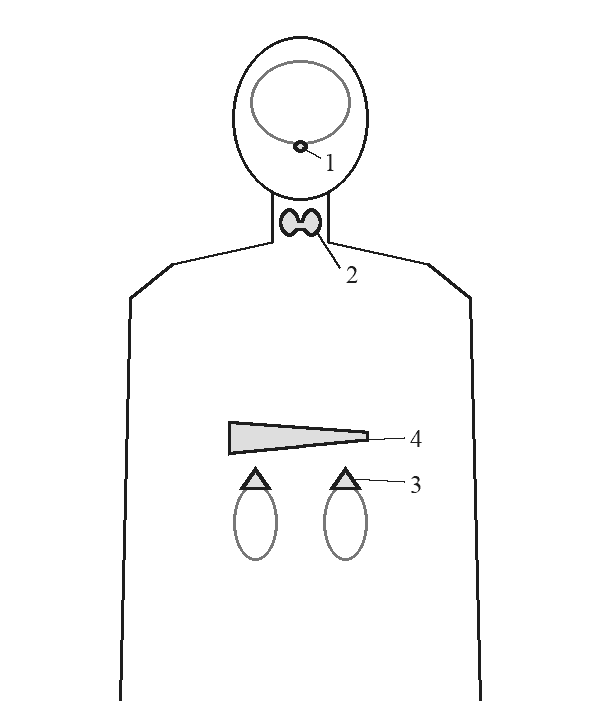
(i) Label the parts 1–4.
(ii) What is common to all these parts in regard to the nature of their function?
(iii) In what way is part 3 different from other parts shown in the diagram?
- 303 marks
Question 30
(i) Draw and indicate approximate location of the thyroid, adrenal and pancreas in simple outline sketch of the human body.
(ii) Which of these glands is both exocrine and endocrine gland?
(iii) Name the hormones secreted by adrenal gland.
- 313 marks
Question 31
Given here is the diagrammatic sketch of an endocrine gland. Observe the figure and answer the following questions:
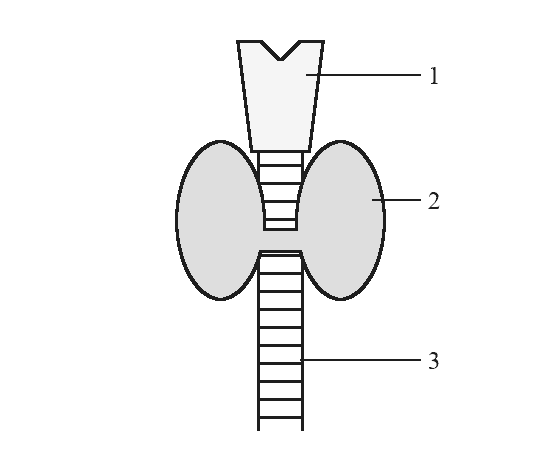
(i) Label the parts 1–3.
(ii) Name the hormone secreted by 2.
(iii) Name the element related with the functioning of hormones secreted by the structure.
- 326 marks
Question 32
The sketch here shows a certain condition in an individual:
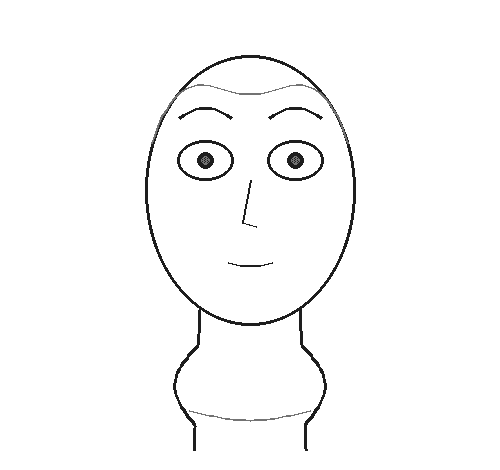
(i) Name the condition.
(ii) What is the underlying cause of this condition?
(iii) Name one other condition that could have resulted due to undersecretion of the same hormone.
(iv) Which hormone is required for iodine synthesis?
(v) Where is thyroid gland located?
(vi) The hormone secreted by thyroid gland is controlled by which hormone?
- 335 marks
Question 33
Which hormones do the following glands release?
Pancreas, Testis, Ovary, Thymus, Kidney, GI tract
- 341 mark
Question 34
(Hypothetical data.) In a zoology laboratory in Kolkata, young frog tadpoles of the same age are kept in four tanks. The colour of their skin is given a score from 1 (pale: the black pigment in the skin cells is gathered into small clumps) to 5 (dark: the pigment is spread out through the cells).
Tank Lighting Tadpoles Added to the water Skin-darkness score after 2 hours P Light Normal None 5 Q Darkness Normal None 1 R Darkness Pineal gland removed a week earlier None 4 S Light Normal Melatonin 1 Which conclusion do these results support best?
- 351 mark
Question 35
At a pharmacy in Mysuru, a pharmacist explains that some women going through menopause are prescribed a skin patch that releases oestradiol, a form of the steroid hormone oestrogen, which passes through the skin into the blood.
Assertion (A): An oestradiol skin patch can deliver its hormone into the blood, whereas an insulin patch of the same simple kind would deliver very little insulin.
Reason (R): Steroid hormones such as oestradiol are lipid-soluble, so they can pass through lipid layers such as cell membranes, whereas insulin is a large, water-soluble polypeptide that cannot.
- 361 mark
Question 36
(Hypothetical data.) In a research study on rabbits, which carry their young for about 31 days, pregnant rabbits are divided into four groups on day 10 of pregnancy, after the embryos have implanted in the uterus.
Group Operation on day 10 of pregnancy Daily injection from day 10 Rabbits Rabbits that gave birth to live young A Sham operation: abdomen opened and closed, ovaries left in place None 10 10 B Both ovaries removed None 10 0 C Both ovaries removed Progesterone 10 9 D Both ovaries removed Oestrogen 10 0 Which conclusion do these results support best?
- 372 marks
Question 37
A 45-year-old woman in Kochi has a small, non-cancerous tumour of the thymus, and her surgeon plans to remove the whole thymus. Her brother has read that the thymus is needed for T-lymphocytes to develop. He says: "Once her thymus is removed she will have no T-lymphocytes, so she will be unable to fight any infection, just like a baby born without a thymus."
Evaluate her brother's claim.
- 382 marks
Question 38
A team of engineers in Bengaluru is building an "artificial pancreas" for teenagers with type 1 diabetes, whose β cells make almost no insulin. The device has a glucose sensor under the skin, which reads the blood glucose every 5 minutes, and a small pump that delivers insulin under the skin. A healthy person's fasting blood glucose is about 70–100 mg/dL.
(a) Using the way the β cells of a healthy pancreas respond to blood glucose, write two rules that the insulin pump should follow. (1 mark)
(b) The team plans to add a second pump that delivers glucagon. Suggest when this pump should be used, and explain why it would make the device safer. (1 mark)
- 393 marks
Question 39
(Hypothetical data.) In a nutrition study at a medical college in Jaipur, a healthy volunteer eats a normal diet on day 0 and then a diet very low in salt (Na⁺) from day 1 to day 5. The amount of Na⁺ he passes in his urine and the level of the hormone aldosterone in his blood are measured each day. The secretion of aldosterone rises when the amount of Na⁺ in the body and the volume of the blood begin to fall.
Day 0 1 2 3 4 5 Na⁺ eaten (mmol per day) 150 20 20 20 20 20 Na⁺ passed in urine (mmol per day) 148 95 55 32 22 20 Plasma aldosterone (ng/dL) 8 12 19 26 29 30 (a) Describe how the Na⁺ in his urine changes from day 1 to day 5, and calculate the percentage fall in his urine Na⁺ from day 0 to day 5. (1 mark)
(b) Explain how the change in aldosterone brings about the change in his urine Na⁺, and why his blood volume stays almost steady. (1 mark)
(c) A second person cannot make aldosterone because, owing to an inherited defect, the cells of the outermost layer of her adrenal cortex lack an enzyme needed to make it. Predict how her urine Na⁺ on the same diet would differ from the volunteer's, and explain why her doctor advises her not to cut down on salt. (1 mark)
- 405 marks
Question 40
(Hypothetical data.) A research unit at a hospital in Hyderabad studies how long two hormones stay in the blood. The half-life of a hormone in the blood is the time taken for an extra amount of the hormone to fall to half.
A woman receives a single injection of insulin into a vein. The extra insulin in her plasma is measured every 5 minutes:
Time after the injection (minutes) 0 5 10 15 20 Extra insulin above her normal level (µU/mL) 80 40 20 10 5 A man with an underactive thyroid swallows a single large dose of thyroxine (T₄). Once the dose has been absorbed, the extra thyroxine in his plasma is measured every week:
Time after the dose was absorbed (days) 0 7 14 21 Extra thyroxine above his normal level (µg/dL) 4.0 2.0 1.0 0.5 More than 99 % of the thyroxine in plasma is carried bound to plasma proteins, whereas insulin travels free in the plasma.
(a) Use the tables to find the half-life of insulin and the half-life of thyroxine. (1 mark)
(b) How many times longer is the half-life of thyroxine than that of insulin? Using the information above and the chemical nature of the two hormones, explain this difference. (2 marks)
(c) A patient who takes one thyroxine tablet every morning says: "If I forget my tablet one morning, my thyroxine level will crash by evening, just as a person with type 1 diabetes who misses an insulin dose may have high blood glucose within hours." Use the half-life of thyroxine to evaluate this claim. (2 marks)