
Question 855 marksMedium
What are lipophilic and hydrophilic hormones? Explain the mechanism of action of both these hormones. List three important differences in their actions.
Confirming your payment
Sign up now and get 250 free tokens.
Chemical Coordination and Integration · Question 85 of 87
What are lipophilic and hydrophilic hormones? Explain the mechanism of action of both these hormones. List three important differences in their actions.
Solution:
Concept: A hormone acts only on cells that carry its specific receptor; where the receptor is depends on whether the hormone can cross the lipid plasma membrane.
Step 1 — Meaning: Lipophilic hormones are lipid-soluble — the steroids (cortisol, aldosterone, oestrogen, progesterone, testosterone) and the thyroid hormones. Hydrophilic hormones are water-soluble — peptide and protein hormones (insulin, glucagon, FSH, ADH) and the catecholamines (adrenaline).
Step 2 — Hydrophilic hormones: They cannot cross the plasma membrane, so they bind a receptor on the membrane surface; the hormone itself is the first messenger. For most of them (adrenaline, glucagon, FSH, ADH) this forms a second messenger inside the cell — cAMP, IP₃ or Ca²⁺ — which activates enzymes (protein kinases) that change existing proteins and produce the response. The insulin receptor is itself an enzyme (a tyrosine kinase) that starts a chain of protein changes directly.
Step 3 — Lipophilic hormones: They pass through the plasma membrane (steroids by diffusion, thyroid hormones with membrane transporter proteins) and bind an intracellular receptor in the cytoplasm or nucleus. The hormone–receptor complex binds DNA, switches particular genes on, and the mRNA formed is translated into new proteins (often enzymes). The two chains are shown side by side.
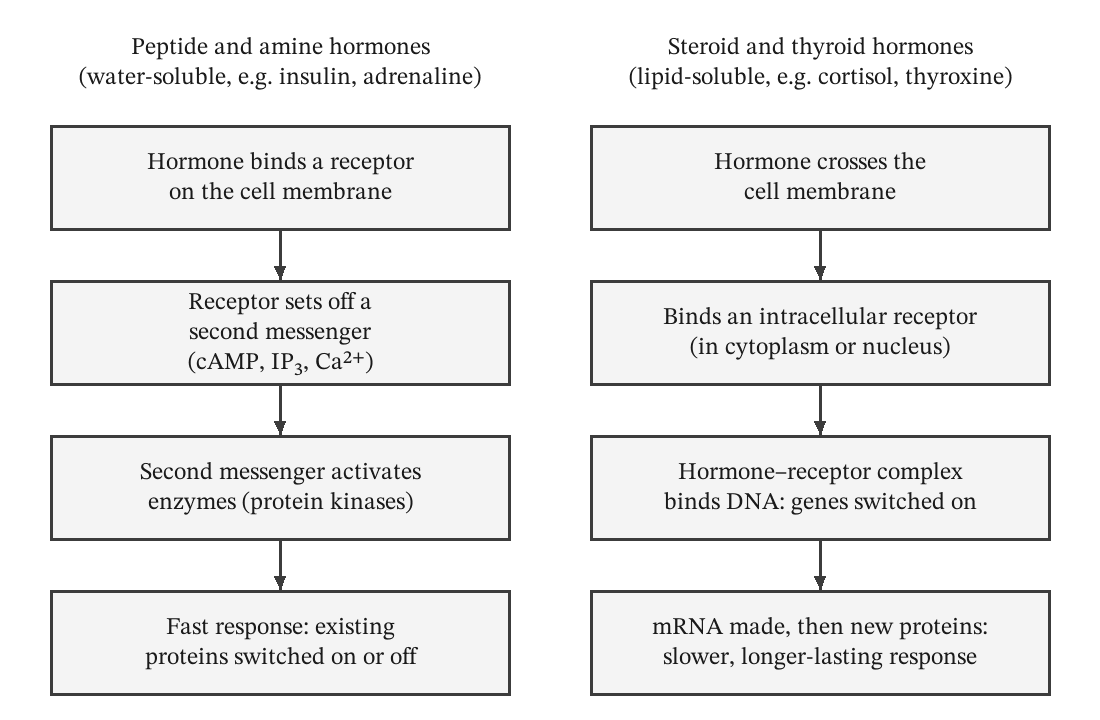
Step 4 — Differences: Three important differences in their actions are set out below.
| Feature | Lipophilic hormones | Hydrophilic hormones |
|---|---|---|
| Receptor | Inside the cell (cytoplasm or nucleus) | On the plasma membrane |
| How the effect is made | Hormone–receptor complex changes gene expression | Mostly a second messenger (cAMP, IP₃, Ca²⁺) activates enzymes |
| Speed and duration | Slower, longer-lasting | Faster, shorter-lasting |
Therefore, lipophilic hormones (steroids, thyroxine) enter the cell and act on genes through intracellular receptors, while hydrophilic hormones (peptides, catecholamines) act from the cell surface, mostly through second messengers.