
Question 825 marksMedium
What do you understand by feedback mechanism? Explain feedback mechanism by hormones and by metabolites. Give one example of each.
Confirming your payment
Sign up now and get 250 free tokens.
Chemical Coordination and Integration · Question 82 of 87
What do you understand by feedback mechanism? Explain feedback mechanism by hormones and by metabolites. Give one example of each.
Solution:
Concept: Homeostasis needs hormone levels that rise and fall as required; feedback lets a result control its own cause.
Step 1 — Feedback mechanism: It is the control of the secretion of a hormone by the level of that hormone, or of the substance it controls, in the blood. In negative feedback, a rise in the level slows further secretion; a fall allows more secretion. (In positive feedback the result increases the stimulus, as with oxytocin in labour.)
Step 2 — Feedback by hormones: The hormone of a target gland acts back on the hypothalamus and pituitary.
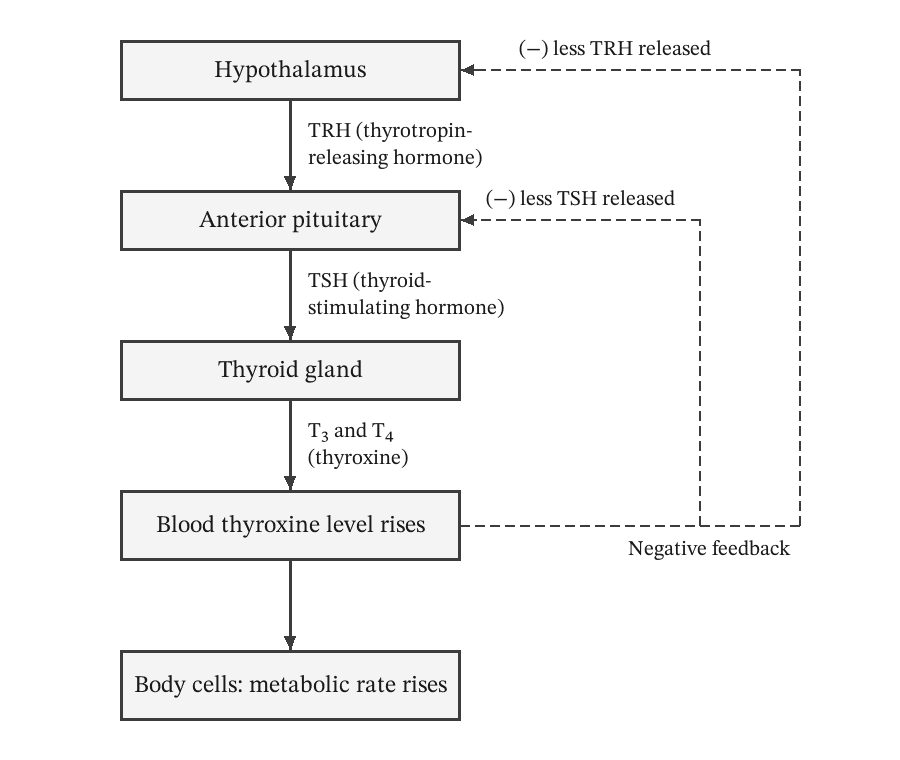
Step 3 — Example: thyroxine: TRH from the hypothalamus → TSH from the anterior pituitary → thyroxine from the thyroid. A high blood thyroxine level inhibits TRH and TSH release, so thyroxine output falls; a low level removes the inhibition. The flow chart shows the loop.
Step 4 — Feedback by metabolites: The level of a metabolite (a substance such as glucose or calcium) directly controls the gland that regulates it.
Step 5 — Example: glucose: After a sugary meal blood glucose rises → β-cells release insulin → glucose is taken up and stored → blood glucose falls → insulin release falls. (Similarly, high blood Ca²⁺ inhibits PTH secretion.)
Therefore, feedback is the control of hormone secretion by its own effects: by hormones (high thyroxine inhibits TRH and TSH) and by metabolites (high blood glucose stimulates insulin, which brings glucose down).