
Opening your dashboard
Class 10 Maths Chapter 10: Arithmetic Progression Solutions
107 textbook questions with step-by-step answers, free to read, for ICSE 2026-27.
Get talked through Ch 10, not just shown the answer
Reading a finished solution is not the same as being able to do it. The AI tutor takes one question at a time and works it with you, in your own words, until you can.
- Ask it out loud, in your own words
- It gives you the next step, not the answer
- Stuck on part (ii)? Start there
107 questions with solutions
1–3 marks · Mixed difficulty
The first 12 solutions are on this page. This chapter is a long one, so the rest open on their own page to keep this one quick to load.
- 11 mark
Question 1
The first term and the common difference of an A.P. are 8 and −5 respectively. The A.P. is :
Solve with AIAnswer
(A) 8, 13, 18, 23, 28, ……
- Correct
(B) 8, 3, −2, −7, ……
(C) −5, 3, 11, 19, 27, ……
(D) −5, −13, −21, −29, ……
Answer: (B) 8, 3, −2, −7, ……
Concept: An arithmetic progression (A.P.) is a sequence in which every term after the first is found by adding the same fixed number to the term before it. This fixed number is the common difference , and it may be positive, negative or zero. So the terms are , , , , … where is the first term.
Step 1 — Write down what is given.
The first term is and the common difference is . Adding is the same as subtracting 5, so each term will be 5 less than the term before it.
Step 2 — Build the terms one at a time.
We start at the first term 8 and keep adding .
So the A.P. is On a number line, each jump is 5 units to the left:
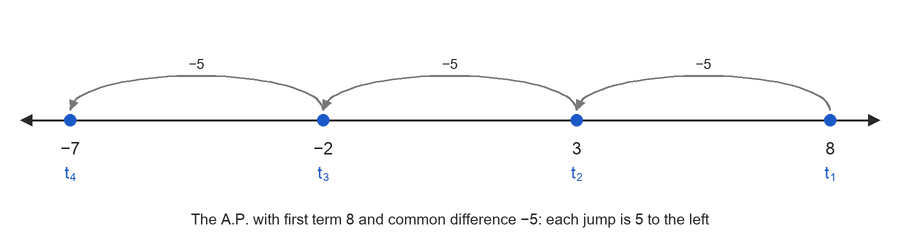
Watch out: A common difference of makes the terms go down by 5 each time. Do not add 5.
Why the other options are wrong:
- (A) 8, 13, 18, 23, 28, ……: these terms go up by 5 each time, so their common difference is , not .
- (C) −5, 3, 11, 19, 27, ……: this starts at and goes up by 8, so its first term is and its common difference is 8. The two given numbers have been swapped.
- (D) −5, −13, −21, −29, ……: this starts at and goes down by 8, so its first term is and its common difference is . Neither matches , .
Therefore, the A.P. is 8, 3, −2, −7, ……, option (B).
- 21 mark
Question 2
Is −8, −8, −8, −8, …… an A.P. ?
Solve with AIAnswer
(A) no
- Correct
(B) yes
(C) may be
(D) none of the above
Answer: (B) yes
Concept: The common difference of an A.P. is any term minus the term just before it: , and also , and so on. A sequence is an A.P. only when this difference is the same every time.
Step 1 — Find the difference between neighbouring terms.
We subtract each term from the term after it.
Every term is , so in the same way and .
Step 2 — Decide.
The difference is 0 every time, so it is the same for every pair of neighbouring terms. That is exactly the condition for an A.P. The sequence is an A.P. with first term and common difference .
Watch out: A constant sequence is an A.P. Its common difference is 0, and 0 is allowed.
Why the other options are wrong:
- (A) no: a common difference of 0 is allowed; the only condition is that the difference is the same every time, and here it is always 0.
- (C) may be: nothing is uncertain: every difference can be worked out, and each one is 0, so the answer is a definite yes.
- (D) none of the above: the correct answer, yes, is one of the options, so this cannot be chosen.
Therefore, −8, −8, −8, −8, …… is an A.P. (with ), option (B).
- 31 mark
Question 3
The term of the A.P. 3, 0, −3, −6, …… is :
Solve with AIAnswer
(A) −42
(B) 39
(C) 42
- Correct
(D) −39
Answer: (D) −39
Concept: In an A.P. with first term and common difference , the term is . To reach the term we start at and add exactly times.
Step 1 — Read off and .
The first term is . The common difference is any term minus the term before it.
The next pair gives the same value, , so the sequence is an A.P. with .
Step 2 — Find the term.
In , we put , and .
Watch out: The first term is , so is added only times to reach the term, not times.
Why the other options are wrong:
- (A) −42: is only . The first term 3 has not been added to it.
- (B) 39: 39 has the right size but the wrong sign. The terms fall by 3 each time and are negative from the term on, so the term is negative.
- (C) 42: 42 is : the minus sign of and the first term have both been dropped.
Therefore, the term is −39, option (D).
- 41 mark
Question 4
The term of an A.P. exceeds its term by 10, its common difference is :
Solve with AIAnswer
(A) 5
- Correct
(B) 2
(C) 10
(D) 1
Answer: (B) 2
Concept: In an A.P. with first term and common difference , the term is . To reach the term we start at and add exactly times.
Step 1 — Write both terms using and .
By the formula :
Step 2 — Subtract the two terms.
The term exceeds the term by 10, so their difference is 10. When we subtract, cancels.
Step 3 — Find .
We put the difference equal to 10 and solve.
Dividing both sides by 5:
Watch out: The gap between the and the terms is ; the first term cancels when we subtract.
Why the other options are wrong:
- (A) 5: 5 is the number of common differences between the two terms (), not . With , the gap would be , that is, 25.
- (C) 10: 10 is the whole gap, which is made of 5 equal steps. With , the gap would be , that is, 50.
- (D) 1: with , the term would exceed the term by only , that is, 5, not 10.
Therefore, the common difference is 2, option (B).
- 51 mark
Question 5
In the A.P. 8, 13, 18, ……, the term is 83, then is equal to :
Solve with AIAnswer
(A) 14
- Correct
(B) 16
(C) 13
(D) 15
Answer: (B) 16
Concept: In an A.P. with first term and common difference , the term is . To reach the term we start at and add exactly times. To test whether a number is a term, or to find which term it is, we put it equal to and solve for . The position must come out as a natural number (1, 2, 3, …).
Step 1 — Read off and .
The first term is . The common difference is , since and both give .
Step 2 — Put and solve for .
We want the position of the term 83, so we put it equal to the term.
In , we put , and :
Taking the first term to the right-hand side, where its sign changes:
Simplifying the right-hand side:
Dividing both sides by :
Adding 1 to both sides:
Watch out: After finding , remember to add 1 to get .
Why the other options are wrong:
- (A) 14: the term is , not 83.
- (C) 13: the term is , not 83.
- (D) 15: 15 is ; the 1 has not been added back. The term is , not 83.
Therefore, , option (B).
- 63 marks
Question 6
The term of a sequence is , find its fifteenth term.
Solve with AIWritten solution
Solution:
Concept: When the term of a sequence is given as a formula in , any term is found by putting its position number in place of .
Step 1 — Understand the rule.
The rule gives the term in position . The fifteenth term is the term in position 15, so we need .
Step 2 — Put .
We replace by 15, multiply first, and then subtract.
Watch out: Multiply before you subtract: is , not .
Therefore, the fifteenth term is 27.
- 73 marks
Question 7
If the term of an A.P. is ; find the A.P.
Solve with AIWritten solution
Solution:
Concept: When the term of a sequence is given by a formula, putting gives the first, second, third, … terms. The common difference of an A.P. is any term minus the term just before it: , and also , and so on. A sequence is an A.P. only when this difference is the same every time.
Step 1 — Find the first term.
In , we put .
Step 2 — Find the next three terms.
In the same way we put , and .
Step 3 — Check that the difference is always the same.
Any term minus the term before it must be the same number. For the general terms and :
The difference is 2 for every , so the sequence is an A.P. with first term 5 and common difference 2.
Watch out: The letter here plays the part of : it is the position of the term, so start with , not .
Therefore, the A.P. is 5, 7, 9, 11, ……
- 83 marks
Question 8
Find the term of the sequence : 12, 10, 8, 6, ……
Solve with AIWritten solution
Solution:
Concept: In an A.P. with first term and common difference , the term is . To reach the term we start at and add exactly times.
Step 1 — Read off and .
The first term is . The common difference is any term minus the term before it.
The next pairs give the same value (, ), so the sequence is an A.P. with .
Step 2 — Find the term.
In , we put , and .
Watch out: The common difference is a term minus the term before it. When the terms go down, is negative; keep its minus sign all through the working.
Therefore, the term is −34.
- 93 marks
Question 9
Find the term of the sequence :
Solve with AIWritten solution
Solution:
Concept: In an A.P. with first term and common difference , the term is . To reach the term we start at and add exactly times.
Step 1 — Read off and .
The first term is . The common difference is the second term minus the first.
The next pair gives the same value, , so the sequence is an A.P. with .
Step 2 — Find the term.
In , we put , and . The two fractions have the same denominator, so we add their numerators.
Watch out: The first term is , so is added only times to reach the term, not times.
Therefore, the term is 15.
- 103 marks
Question 10
Find the term of the sequence :
Solve with AIWritten solution
Solution:
Concept: In an A.P. with first term and common difference , the term is . To reach the term we start at and add exactly times. Surds such as are added like algebra terms: .
Step 1 — Read off and .
The first term is . The common difference is the second term minus the first.
The next pair gives the same value, , so the sequence is an A.P. with .
Step 2 — Find the term.
In , we put , and , and then add the like surds.
Watch out: is ; it is not or . Only the numbers in front of the same surd are added.
Therefore, the term is .
- 113 marks
Question 11
Find the term of the sequence :
Solve with AIWritten solution
Solution:
Concept: In an A.P. with first term and common difference , the term is . To reach the term we start at and add exactly times. Here the letter appears inside the terms, so it is just a fixed number; the position we want is 50.
Step 1 — Find the common difference.
We subtract the first term from the second. Both fractions have the denominator , so we subtract the numerators.
The next pair gives the same value: is , which is 1. So the sequence is an A.P. with first term and common difference 1.
Step 2 — Find the term.
In , we put and , then write the answer as one fraction.
Watch out: The in the terms is not the position of the term. Use 50 for the position and keep as it is.
Therefore, the term is .
- 123 marks
Question 12
Is 402 a term of the sequence : 8, 13, 18, 23, …… ?
Solve with AIWritten solution
Solution:
Concept: In an A.P. with first term and common difference , the term is . To reach the term we start at and add exactly times. To test whether a number is a term, or to find which term it is, we put it equal to and solve for . The position must come out as a natural number (1, 2, 3, …).
Step 1 — Read off and .
The first term is . The common difference is , since , and all give .
Step 2 — Suppose 402 is the term.
If 402 were a term, its position would satisfy .
In , we put , and :
Taking the first term to the right-hand side, where its sign changes:
Simplifying the right-hand side:
Dividing both sides by :
Adding 1 to both sides:
Step 3 — Decide.
, which is 79.8. This is not a natural number, and a sequence has no “79.8th” term, so 402 is not a term.
Check: The and terms are the two terms on either side of 402.
The sequence jumps from 398 straight to 403, so it passes over 402:

Watch out: A term's position must be a natural number. If comes out as a fraction or as 0 or negative, the number is not a term.
Therefore, 402 is not a term of the sequence 8, 13, 18, 23, ……
- 133 marks
Question 13
Find the common difference and term of the arithmetic progression :
- 143 marks
Question 14
How many terms are there in the series :
(i) 4, 7, 10, 13, ……, 148 ?
(ii) 0·5, 0·53, 0·56, ……, 1·1 ?
(iii) ?
- 153 marks
Question 15
Which term of the A.P. 1, 4, 7, 10, …… is 52 ?
- 163 marks
Question 16
If and terms of an A.P. are respectively 6 and 5, find the term of the A.P.
- 173 marks
Question 17
If represents term of an A.P., and , find its first term and its common difference.
- 183 marks
Question 18
Find the term from the end of the A.P. 4, 9, 14, ……, 254.
- 193 marks
Question 19
Determine the arithmetic progression whose term is 5 and term is 9.
- 203 marks
Question 20
Find the term of an A.P. whose term is 38 and term is 74.
- 213 marks
Question 21
Which term of the series : 21, 18, 15, …… is −81 ? Can any term of this series be zero ? If yes, find the number of terms.
- 223 marks
Question 22
An A.P. consists of 60 terms. If the first and the last terms be 7 and 125 respectively, find the term.
- 233 marks
Question 23
The sum of the and the terms of an A.P. is 24 and the sum of the and the terms of the same A.P. is 34. Find the first three terms of the A.P.
- 243 marks
Question 24
If the third term of an A.P. is 5 and the seventh terms is 9, find the term.
- 251 mark
Question 25
Two A.P.s have the same common difference. If the difference between their terms is 8, the difference between their terms is:
- 261 mark
Question 26
Ten times the term of an A.P. is equal to twenty times the term of the same A.P. The term of this A.P. is :
- 271 mark
Question 27
The term of an A.P. is . Its common difference is :
- 281 mark
Question 28
The term of an A.P. exceeds its term by 72. Then its common difference is:
- 291 mark
Question 29
The term of the A.P. 6, 11, 16, 21, …… is 106, then the value of is :
- 303 marks
Question 30
In an A.P., ten times of its tenth term is equal to thirty times of its term. Find its term.
- 313 marks
Question 31
How many two-digit numbers are divisible by 3 ?
- 323 marks
Question 32
Which term of A.P. 5, 15, 25, …… will be 130 more than its term ?
- 333 marks
Question 33
Find the value of , if , and are in A.P.
- 343 marks
Question 34
If the and the terms of an arithmetic progression are 4 and −8 respectively, which term of it is zero ?
- 353 marks
Question 35
How many three-digit numbers are divisible by 87 ?
- 363 marks
Question 36
For what value of , the term of A.P. 63, 65, 67, …… and term of A.P. 3, 10, 17, …… are equal to each other ?
- 373 marks
Question 37
Determine the A.P. whose term is 16 and the term exceeds the term by 12.
- 383 marks
Question 38
If numbers , and are in A.P., find the value of and its next two terms.
- 393 marks
Question 39
Determine the value of for which , and are in A.P.
- 403 marks
Question 40
State, true or false : if , and are in A.P. then :
(i) , and are in A.P.
(ii) , and are in A.P.
- 413 marks
Question 41
An A.P. consists of 57 terms of which term is 13 and the last term is 108. Find the term of this A.P.
- 423 marks
Question 42
term of an A.P. is equal to 3 times its first term and term exceeds twice the term by 1. Find the first term and the common difference.
- 433 marks
Question 43
The sum of the term and the term of an A.P. is 30. If its term is 1 less than twice of its term, find the A.P.
- 443 marks
Question 44
In an A.P., if term is and term is , show that its term is .
- 453 marks
Question 45
Which term of the A.P. 3, 10, 17, …… will be 84 more than its term ?
- 461 mark
Question 46
The sum of 41 terms of an A.P. with middle term 40 is :
- 471 mark
Question 47
The sum of all two digit numbers is :
- 481 mark
Question 48
The sum of A.P. 4, 7, 10, 13, …… upto 20 terms is :
- 491 mark
Question 49
The sum of 40 terms of the A.P. 7 + 10 + 13 + 16 + …… is :
- 501 mark
Question 50
The term of an A.P. is . The sum of its first 2 terms is :
- 513 marks
Question 51
How many terms of the A.P. : 24, 21, 18, …… must be taken so that their sum is 78 ?
- 523 marks
Question 52
Find the sum of 28 terms of an A.P. whose term is .
- 533 marks
Question 53
Find the sum of :
(i) all odd natural numbers less than 50.
(ii) first 12 natural numbers each of which is a multiple of 7.
- 543 marks
Question 54
Find the sum of first 51 terms of an A.P. whose and terms are 14 and 18 respectively.
- 553 marks
Question 55
The sum of first 7 terms of an A.P. is 49 and that of first 17 terms of it is 289. Find the sum of first terms.
- 563 marks
Question 56
The first term of an A.P. is 5, the last term is 45 and the sum of its terms is 1000. Find the number of terms and the common difference of the A.P.
- 573 marks
Question 57
Find the sum of all natural numbers between 250 and 1000 which are divisible by 9.
- 583 marks
Question 58
The first and the last terms of an A.P. are 34 and 700 respectively. If the common difference is 18, how many terms are there and what is their sum ?
- 593 marks
Question 59
In an A.P., the first term is 25, term is −17 and the sum of terms is 132. Find and the common difference.
- 603 marks
Question 60
If the term of an A.P. is 37 and the term is 15 more than the term, find the A.P. Also, find the sum of first 20 terms of this A.P.
- 613 marks
Question 61
The sum of natural numbers is . Find its term.
- 623 marks
Question 62
The fourth term of an A.P. is 11 and the eighth term exceeds twice the fourth term by 5. Find the A.P. and the sum of first 50 terms.
- 631 mark
Question 63
, and are the first three terms of an A.P. The first term of this A.P. is :
- 641 mark
Question 64
The sum of terms of an A.P. is . The second term of this A.P. is :
- 651 mark
Question 65
If 5, 7 and 9 are in A.P., then which of the following is in A.P. ?
- 663 marks
Question 66
Find three numbers in A.P. whose sum is 24 and product is 440.
- 673 marks
Question 67
The sum of three consecutive terms of an A.P. is 21 and the sum of their squares is 165. Find these terms.
- 683 marks
Question 68
The angles of a quadrilateral are in A.P. with common difference of 20°. Find its angles.
- 693 marks
Question 69
Divide 96 into four parts which are in A.P. and the ratio between product of their means to product of their extremes is 15 : 7.
- 703 marks
Question 70
Find five numbers in A.P. whose sum is and the ratio of the first to the last terms is 2 : 3.
- 713 marks
Question 71
Split 207 into three parts such that these parts are in A.P. and the product of the two smaller parts is 4623.
- 723 marks
Question 72
The sum of three numbers in A.P. is 15 and the sum of the squares of the extreme terms is 58. Find the numbers.
- 733 marks
Question 73
Find four numbers in A.P. whose sum is 20 and the sum of whose squares is 120.
- 743 marks
Question 74
Insert one arithmetic mean between 3 and 13.
- 753 marks
Question 75
The angles of a polygon are in A.P. with common difference 5°. If the smallest angle is 120°, find the number of sides of the polygon.
- 763 marks
Question 76
, and are in A.P. Show that : , and are also in A.P.
- 771 mark
Question 77
If A, B and C are three arithmetic progressions (APs) as given below :
A = 2, 4, 6, 8, …… upto terms
B = 3, 6, 9, 12, …… upto terms
C = 0, 4, 8, 12, …… upto terms, then
out of A + B, A − C, C − B and B − A which is/are A.P. ?
- 781 mark
Question 78
, and are in A.P.; the value of is :
- 791 mark
Question 79
In an A.P., , and , then is :
- 801 mark
Question 80
Do the numbers , , , 73 …… form an A.P. ? If yes, its next term will be :
- 811 mark
Question 81
The sum of first 10 even natural numbers is :
- 821 mark
Question 82
For the given numbers
Assertion (A) : To find whether these terms form an A.P. or not. Express each term as the product of a natural number and i.e. , , , , etc.
Reason (R) : Since, for the given numbers difference between the consecutive terms is same. It is an A.P.
- 831 mark
Question 83
5, 8, 11, 14, …… are in A.P.
Assertion (A) : are also in A.P.
Reason (R) : If each term of a given A.P. is divided by the same non-zero number, the resulting sequence is an A.P.
- 841 mark
Question 84
An A.P. with term and term .
Assertion (A) : Common difference, .
Reason (R) : If first term of the A.P. is , then .
- 851 mark
Question 85
The term of a sequence .
Statement (1) : The sequence is an A.P.
Statement (2) : If the term of a sequence is not linear; the sequence does not form an A.P.
- 861 mark
Question 86
The sum of first ten terms of an A.P. and sum of its first fifteen terms .
Statement (1) : The sum of first 5 terms of the given A.P. .
Statement (2) : The sum of last 5 terms of the given A.P. Sum of first 15 terms minus sum of first 10 terms.
- 873 marks
Question 87
The term of an A.P. is 16 and the term is 32. Determine the term.
- 883 marks
Question 88
If the third and the terms of an A.P. be 4 and −8 respectively, find which term is zero ?
- 893 marks
Question 89
An A.P. consists of 50 terms of which term is 12 and the last term is 106. Find the term of the A.P.
- 903 marks
Question 90
Find the arithmetic mean of :
(i) −5 and 41 (ii) and (iii) and
- 913 marks
Question 91
Find the sum of first 20 terms of an A.P. whose first term is 3 and the last term is 57.
- 923 marks
Question 92
How many terms of the series 18 + 15 + 12 + …… when added together will give 45 ?
- 933 marks
Question 93
The term of a sequence is . Show that the sequence is an A.P.
- 943 marks
Question 94
Find the general term ( term) and term of the sequence 3, 1, −1, −3, ……
- 953 marks
Question 95
Is −150 a term of 11, 8, 5, 2, …… ?
- 963 marks
Question 96
How many multiples of 4 lie between 10 and 250 ?
- 973 marks
Question 97
The sum of the term and the term of an A.P. is 24 and the sum of the term and the term is 44. Find the first three terms of the A.P.
- 983 marks
Question 98
The sum of first 14 terms of an A.P. is 1050 and its term is 140. Find the term.
- 993 marks
Question 99
The term of an A.P. exceeds its term by 16. Find its common difference.
- 1003 marks
Question 100
For an A.P., show that : term term term
- 1013 marks
Question 101
If the term of the A.P. 58, 60, 62, …… is equal to the term of the A.P. −2, 5, 12, ……, find the value of .
- 1023 marks
Question 102
Which term of the A.P. 105, 101, 97, …… is the first negative term ?
- 1033 marks
Question 103
Divide 216 into three parts which are in A.P. and the product of two smaller parts is 5040.
- 1043 marks
Question 104
Can be the term of an A.P. ? Explain.
- 1053 marks
Question 105
Find the sum of the A.P.; 14, 21, 28, ……, 168.
- 1063 marks
Question 106
The first term of an A.P. is 20 and the sum of its first seven terms is 2100; find the term of this A.P.
- 1073 marks
Question 107
Find the sum of last 8 terms of the A.P. −12, −10, −8, ……, 58.
What Class 10 Maths Ch 10 covers
The sections of the chapter, in the order the book takes them. Every question above comes from one of these.
- 01Arithmetic Progression (A.P.)
- 02General Term of an Arithmetic Progression
- 03Sum of n Terms of an A.P.
- 04Three or More Terms in A.P.
- 05Arithmetic Mean
- 06Properties of an A.P.
More ways to study this chapter
The same chapter asked three other ways. Practise it, revise it, and see what the board has set on Ch 10 before.
- Competency-Based Questions (CBQ)Case study questions: a situation, and the part of the chapter that answers it.40questionsOpen
- Previous Year QuestionsQuestions that have actually appeared in board papers, each tagged with its year.18questionsOpen
- Practice QuestionsExtra questions per chapter, for when one attempt at a method is not enough.44questionsOpen
Ch 10 in past ICSE papers
The same chapter as the board has actually asked it. These are worded differently from the textbook exercise, which is the point of reading them.
- 13 marks
Board paper question 1
If , and are three consecutive terms of an A.P., find the value of .
Solve with AIWritten solution
Solution:
Concept: Three numbers are in A.P. exactly when the middle one minus the first equals the third minus the middle one. For , , this means , that is, : twice the middle term equals the sum of the other two.
Step 1 — Use the rule for three terms.
Here , and . We put them into the rule from the concept line (twice the middle term equals the sum of the other two):
Step 2 — Simplify both sides.
We open the bracket on the left. On the right, and cancel, and is .
Step 3 — Solve for k.
We subtract from both sides.
Check: With the terms are , 5 and 11. Both differences are 6:
Watch out: The middle term is doubled: the left side is , not and not .
Therefore, .
- 24 marks
Board paper question 2
The term of an A.P. is 22 and term is 66. Find the first term and the common difference. Hence find the sum of the series to 8 terms.
Solve with AIWritten solution
Solution:
Concept: In an A.P. with first term and common difference , the term is . To reach the term we start at and add exactly times. Each given term gives one equation in and , and two such equations are solved together like simultaneous linear equations. The sum of the first terms of an A.P. with first term and common difference is . When the last term is known, the same sum is .
Step 1 — Form two equations and find d.
Each given term gives one equation in and .
We write each given term as and set it equal to its value:
Subtracting (1) from (2) removes :
Simplifying both sides:
Dividing both sides by 11:
Step 2 — Find a.
Now we put the value of back into equation (1).
Putting in (1):
Simplifying the product:
Moving 12 to the right-hand side, where its sign changes:
Step 3 — Find the sum of 8 terms.
We use the sum formula with , and .
Check: The 4th term is and the 15th is , as given. Also the 8th term is 38, and the other sum formula agrees:
Watch out: Subtracting the two equations removes ; subtract the whole of (1) from the whole of (2), term by term. multiplies the whole bracket; forgetting to halve doubles the sum.
Therefore, the first term is 10, the common difference is 4, and the sum of 8 terms is 192.
- 34 marks
Board paper question 3
In an Arithmetic Progression (A.P.) the fourth and sixth terms are 8 and 14 respectively. Find the:
(i) first term
(ii) common difference
(iii) sum of the first 20 terms.
Solve with AIWritten solution
Solution:
Concept: In an A.P. with first term and common difference , the term is . To reach the term we start at and add exactly times. Each given term gives one equation in and , and two such equations are solved together like simultaneous linear equations. The sum of the first terms of an A.P. with first term and common difference is . When the last term is known, the same sum is .
Step 1 — Form two equations and find d (part ii).
The 4th term is 8 and the 6th term is 14.
We write each given term as and set it equal to its value:
Subtracting (1) from (2) removes :
Simplifying both sides:
Dividing both sides by 2:
Step 2 — Find a (part i).
Now we put the value of back into equation (1).
Putting in (1):
Simplifying the product:
Moving 9 to the right-hand side, where its sign changes:
Step 3 — Find the sum of 20 terms (part iii).
We use the sum formula with , and .
Check: The 4th term is and the 6th is , as given. The 20th term is 56, and the other sum formula agrees:
Watch out: Keep the minus sign of : inside the bracket, gives , not 2. Subtracting the two equations removes ; subtract the whole of (1) from the whole of (2), term by term.
Therefore, (i) the first term is ; (ii) the common difference is 3; (iii) the sum of the first 20 terms is 550.
- 43 marks
Board paper question 4
The sum of the first three terms of an Arithmetic Progression (A.P.) is 42 and the product of the first and third term is 52. Find the first term and the common difference.
Solve with AIWritten solution
Solution:
Concept: When the sum of the terms is given, we name the terms so that the common difference cancels in the sum: three terms as , , (common difference ); four terms as , , , (common difference ); five terms as , , , , .
Step 1 — Name the three terms.
Because the sum of the three terms is given, we call them , and ; then cancels when we add them. Here is the middle term, and the first term is .
Step 2 — Use the sum.
The three terms add up to 42.
The and cancel:
Dividing both sides by 3:
Step 3 — Use the product.
The first term times the third term is 52. With these terms are and .
Using :
Moving 196 to the right-hand side:
Multiplying both sides by :
Taking the square root of both sides gives two values:
Step 4 — Write the first term in each case.
The first term is .
So the terms are 2, 14, 26 or 26, 14, 2. The figure shows both.

Check: In both cases the sum is and the product of the first and third terms is .
Watch out: has two square roots, 12 and ; both give a valid A.P., so give both answers.
Therefore, the first term is 2 and the common difference is 12, or the first term is 26 and the common difference is .
- 53 marks
Board paper question 5
If the term of an A.P. is equal to four times its first term and the sum of first six terms is 75, find the first term and the common difference.
Solve with AIWritten solution
Solution:
Concept: In an A.P. with first term and common difference , the term is . To reach the term we start at and add exactly times. The sum of the first terms of an A.P. with first term and common difference is . When the last term is known, the same sum is .
Step 1 — Use the sixth term.
The 6th term is , and it equals four times the first term.
Subtracting from both sides:
Step 2 — Use the sum of six terms.
We put in the sum formula .
Since :
Dividing both sides by 3:
Step 3 — Find a.
From (1), can be replaced by in (2).
Adding like terms:
Dividing both sides by 5:
Step 4 — Find d.
Putting in (1):
Multiplying:
Dividing both sides by 5:
Check: The six terms are 5, 8, 11, 14, 17, 20. The 6th term 20 is four times 5, and their sum is 75.
Watch out: The statement "the 6th term is four times the first term" gives ; the first term appears on both sides.
Therefore, the first term is 5 and the common difference is 3.
- 61 mark
Board paper question 6
If 70, 75, 80, 85 are the first four terms of an Arithmetic Progression, then the term is
Solve with AIAnswer
(A) 35
(B) 25
- Correct
(C) 115
(D) 105
Answer: (C) 115
Concept: In an A.P. with first term and common difference , the term is . To reach the term we start at and add exactly times.
Step 1 — Find a and d.
The first term is . The common difference is a term minus the term before it.
Step 2 — Find the 10th term.
We put in the formula for .
Check: Writing out the terms: 70, 75, 80, 85, 90, 95, 100, 105, 110, 115. The 10th is 115.
Watch out: The first term is , so is added only times to reach the term, not times.
Why the other options are wrong:
- (A) 35: 35 is less than the first term 70, but this A.P. goes up by 5 each time, so every later term is greater than 70.
- (B) 25: 25 is ; the 9 steps of 5 must be added, not subtracted.
- (D) 105: 105 is , which is the 8th term, not the 10th.
Therefore, the 10th term is 115, option (C).
All 18 board paper questions for this chapter, solved the same way.
Class 10 Maths Ch 10 questions students ask
How many questions are there in Class 10 Maths Ch 10?
107 questions. Every one is solved step by step on this page.
Are these Class 10 Maths solutions free?
Yes. Every question and its full working is free to read, with no account needed.
Can I download the Class 10 Maths Ch 10 solutions as a PDF?
There is no PDF to download. Every solution is on this page instead, which means it is searchable, always the current syllabus, and readable on a phone. Use your browser's print option if you want it on paper.