
Opening your dashboard
Class 10 Maths Chapter 10 Arithmetic Progression: Practice Questions
44 questions on Chapter 10, each worked through on its own page with the AI tutor. Class 10 Maths, ICSE 2026-27.
44 questions
1–5 marks · Mixed difficulty
- 11 mark
Question 1
Bloom's level: Remember
When the terms of a sequence are connected to each other by plus (+) or minus (−) signs, we get a :
- 21 mark
Question 2
Bloom's level: Remember
For an A.P. with first term and common difference , the term is :
- 31 mark
Question 3
Bloom's level: Remember
The first term , the last term and the number of terms of an A.P. are known. The sum of all its terms is :
- 41 mark
Question 4
Bloom's level: Remember
The arithmetic mean (A.M.) between two numbers and is :
- 51 mark
Question 5
Bloom's level: Understand
Which of the following sequences is an arithmetic progression?
- 61 mark
Question 6
Bloom's level: Apply
The term of the A.P. is :
- 71 mark
Question 7
Bloom's level: Apply
The sum of the first 15 terms of the A.P. is :
- 81 mark
Question 8
Bloom's level: Apply
Three numbers in A.P. have a sum of 36 and a product of 1428. The numbers are :
- 91 mark
Question 9
Bloom's level: Understand
The sequence is an A.P. Which of the following sequences is not an A.P.?
- 101 mark
Question 10
Bloom's level: Understand
Assertion (A) : The common difference of the A.P. is 3.
Reason (R) : Every arithmetic progression is an increasing sequence.
- 111 mark
Question 11
Bloom's level: Analyse
Assertion (A) : Since is an A.P., the sequence is also an A.P.
Reason (R) : If the same fixed number is subtracted from each term of an A.P., the resulting sequence is also an A.P.
- 121 mark
Question 12
Bloom's level: Evaluate
Assertion (A) : The term of the A.P. is 41.
Reason (R) : An A.P. whose common difference is positive is an increasing sequence.
- 132 marks
Question 13
Bloom's level: Understand
The term of a sequence is . Write its first four terms. Is this sequence an arithmetic progression? Give a reason.
- 142 marks
Question 14
Bloom's level: Understand
In which of the following situations do the numbers form an A.P.? Give a reason for each.
(i) Taxi fare: ₹ 50 for the first km and ₹ 15 for every additional km. The fares for 1 km, 2 km, 3 km, … .
(ii) The amount in an account when ₹ 1000 is deposited at 10% simple interest per year — the amounts at the end of the , , , … year.
(iii) The number of bacteria in a dish that starts with 100 bacteria and doubles every hour.
- 152 marks
Question 15
Bloom's level: Apply
The first term of an A.P. is and its term is 23. Find the common difference and the term.
- 162 marks
Question 16
Bloom's level: Analyse
The term of an A.P. is zero. Show that its term is twice its term.
- 172 marks
Question 17
Bloom's level: Apply
Find the sum of all multiples of 6 that lie between 50 and 200.
- 182 marks
Question 18
Bloom's level: Understand
stands for the sum of the first terms of an A.P. Explain in words why . Use this to find the term of an A.P. for which and .
- 192 marks
Question 19
Bloom's level: Apply
The angles of a triangle are in A.P. The largest angle is twice the smallest. Find all three angles.
- 202 marks
Question 20
Bloom's level: Apply
Insert three numbers between 7 and 31 so that the five numbers are in A.P.
- 211 mark
Question 21
Bloom's level: Understand
If is the arithmetic mean of and , explain why . Hence write the arithmetic mean of and .
- 222 marks
Question 22
Bloom's level: Evaluate
Anita says : "If , , are in A.P., then , , are also in A.P." Is she right? Justify your answer.
- 233 marks
Question 23
Bloom's level: Analyse
How many terms of the A.P. must be taken so that their sum is 513? You will get two answers. Explain why both are correct.
- 245 marks
Question 24
Bloom's level: Apply
Case study: Meera starts saving for a bicycle. She saves ₹ 200 in the first week and every week after that she saves ₹ 25 more than in the previous week.
(a) How much does she save in the week?
(b) What are her total savings at the end of 20 weeks?
(c) The bicycle costs ₹ 10,000. In which week will her total savings first reach the price of the bicycle?
- 255 marks
Question 25
Bloom's level: Analyse
Case study: A school auditorium has 25 rows of seats. The first row has 20 seats and each row has 2 seats more than the row in front of it.
(a) How many seats are there in the row?
(b) Find the total number of seats in the auditorium.
(c) For a function, 800 people arrive and fill the rows completely from the front. How many rows are completely filled? How many people sit in the next row, and how many seats in that row stay empty?
- 263 marks
Question 26
Bloom's level: Apply
The lengths of the sides of a right-angled triangle are in A.P. and its perimeter is 60 cm.
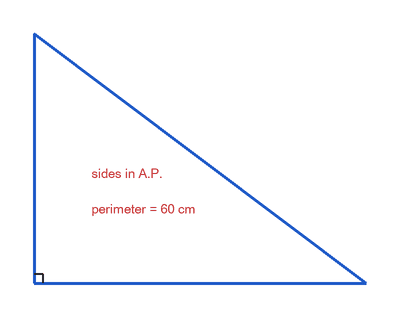
Find the lengths of the sides and the area of the triangle.
- 274 marks
Question 27
Bloom's level: Analyse
Some numbers are inserted between 5 and 41 so that all the numbers together form an A.P. The sum of the inserted numbers is 115.
(a) Show that if numbers are inserted, their sum is .
(b) Find and the inserted numbers.
- 283 marks
Question 28
Bloom's level: Evaluate
Two students find the sum of the first 40 terms of the A.P.
Student X:
Student Y: Last term , so
(a) Which student is correct? Identify the mistake made by the other student.
(b) Check the correct answer by using the other formula correctly.
- 294 marks
Question 29
Bloom's level: Create
(a) Construct two different A.P.s, each having 6 terms, such that the sum of the terms is 48 and every term is an odd integer. Show that each A.P. satisfies the conditions.
(b) Explain why it is impossible to construct an A.P. of 5 terms whose terms are all odd integers and whose sum is 40.
- 305 marks
Question 30
Bloom's level: Create
Case study: Riya wants to read a 275-page novel in exactly 10 days. Each day she plans to read the same number of pages more than on the day before.
(a) If she reads pages on day 1 and pages on day 10, show that .
(b) Design a reading plan for her in which she reads at least 10 pages on day 1, at most 45 pages on day 10, and the daily increase is a whole number of pages. Write the number of pages for every day and check the total.
(c) Her friend suggests increasing by 4 pages every day. Can this plan work with a whole number of pages each day? Explain.
- 314 marks
Question 31
In an Arithmetic Progression (A.P.) the third and fifth terms are 6 and 10 respectively. Find the :
(i) first term
(ii) common difference
(iii) sum of the first 12 terms.
- 323 marks
Question 32
The sum of the first three terms of an Arithmetic Progression (A.P.) is 45 and the product of the first and third terms is 221. Find the first term and the common difference.
- 334 marks
Question 33
In an Arithmetic Progression (A.P.) the second and seventh terms are 3 and 13 respectively. Find the :
(i) first term
(ii) common difference
(iii) sum of the first 10 terms.
- 343 marks
Question 34
The sum of the first three terms of an Arithmetic Progression (A.P.) is 90 and the product of the first and third terms is 875. Find the first term and the common difference.
- 351 mark
Question 35
The 15th term of the arithmetic progression is :
- 361 mark
Question 36
The sum of the first 12 terms of an A.P. whose first term is 5 and whose common difference is 3 is :
- 371 mark
Question 37
For which value of will the numbers , and form the first three terms of an arithmetic progression ?
- 382 marks
Question 38
Consider the arithmetic progression Examine whether 301 is a term of this progression. Give a reason for your answer.
- 393 marks
Question 39
In an arithmetic progression, the 6th term is 11 and the 11th term is . Find the first term, the common difference and the 20th term.
- 403 marks
Question 40
How many terms of the progression must be added to get the sum 135 ? Explain why there are two answers.
- 413 marks
Question 41
Three numbers are in A.P. Their sum is 33 and their product is 1287. Find the three numbers.
- 424 marks
Question 42
Logs are stacked in rows. The bottom row has 25 logs, and every row has 2 logs fewer than the row just below it. The top row has 5 logs.
(i) How many rows are there in the stack ?
(ii) How many logs are there in the whole stack ?
(iii) How many logs are there in the 7th row from the bottom ?
- 434 marks
Question 43
Four arithmetic means are inserted between 7 and 32.
(i) Find the four means.
(ii) Find the sum of the four means.
(iii) Find the sum of all six numbers, and use it to check your answer to (ii).
- 443 marks
Question 44
(i) If , and are in A.P., show that , and are also in A.P.
(ii) Verify the result for , and .