
Question 363 marksEasy
For what value of , the term of A.P. 63, 65, 67, …… and term of A.P. 3, 10, 17, …… are equal to each other ?
Confirming your payment
Sign up now and get 250 free tokens.
Arithmetic Progression · Question 36 of 107
For what value of , the term of A.P. 63, 65, 67, …… and term of A.P. 3, 10, 17, …… are equal to each other ?
Solution:
Concept: In an A.P. with first term and common difference , the term is . To reach the term we start at and add exactly times. We write the term of each A.P. and put the two expressions equal.
Step 1 — Write the term of the first A.P.
For 63, 65, 67, …, the first term is 63 and the common difference is .
Step 2 — Write the term of the second A.P.
For 3, 10, 17, …, the first term is 3 and the common difference is .
Step 3 — Put the two terms equal.
We want the same position to give the same value in both A.P.s.
Taking to the right and to the left:
Simplifying both sides:
Dividing both sides by 5:
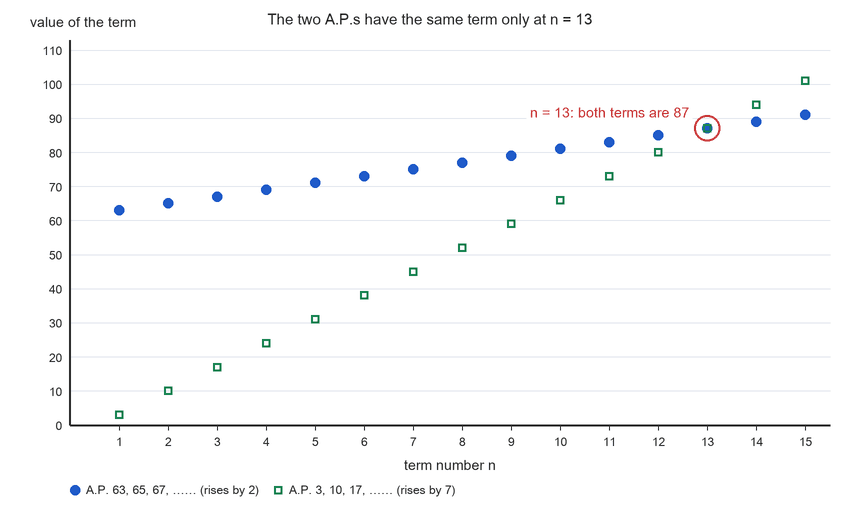
Check: We find the term of each A.P.
Both are 87. The graph shows the two A.P.s meeting only at :
Watch out: Each A.P. has its own first term and common difference; do not mix them up when writing the two terms.
Therefore, the terms are equal when .