
Question 11 markMCQEasy
The first term and the common difference of an A.P. are 8 and −5 respectively. The A.P. is :
Confirming your payment
Sign up now and get 250 free tokens.
Arithmetic Progression · Question 1 of 107
The first term and the common difference of an A.P. are 8 and −5 respectively. The A.P. is :
(A) 8, 13, 18, 23, 28, ……
(B) 8, 3, −2, −7, ……
(C) −5, 3, 11, 19, 27, ……
(D) −5, −13, −21, −29, ……
Answer: (B) 8, 3, −2, −7, ……
Concept: An arithmetic progression (A.P.) is a sequence in which every term after the first is found by adding the same fixed number to the term before it. This fixed number is the common difference , and it may be positive, negative or zero. So the terms are , , , , … where is the first term.
Step 1 — Write down what is given.
The first term is and the common difference is . Adding is the same as subtracting 5, so each term will be 5 less than the term before it.
Step 2 — Build the terms one at a time.
We start at the first term 8 and keep adding .
So the A.P. is On a number line, each jump is 5 units to the left:
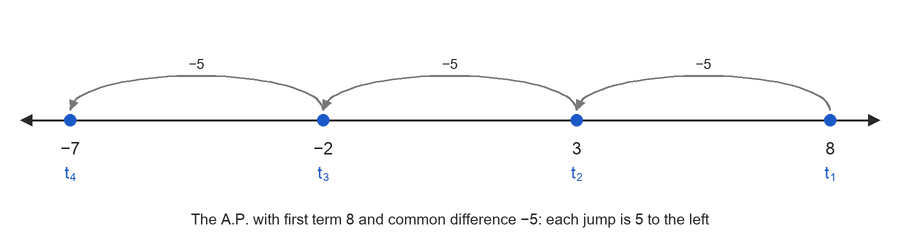
Watch out: A common difference of makes the terms go down by 5 each time. Do not add 5.
Why the other options are wrong:
Therefore, the A.P. is 8, 3, −2, −7, ……, option (B).