
Question 513 marksMedium
How many terms of the A.P. : 24, 21, 18, …… must be taken so that their sum is 78 ?
Confirming your payment
Sign up now and get 250 free tokens.
Arithmetic Progression · Question 51 of 107
How many terms of the A.P. : 24, 21, 18, …… must be taken so that their sum is 78 ?
Solution:
Concept: The sum of the first terms of an A.P. with first term and common difference is . When the last term is known, the same sum is . Putting the known values in gives a quadratic equation in ; each natural-number root is a possible number of terms.
Step 1 — Read off and .
The first term is , and the common difference is ; the sum is to be .
Step 2 — Form the equation in .
In , we put , and .
Simplifying the bracket ( is ):
Multiplying both sides by 2:
Opening the bracket:
Taking all the terms to the right-hand side:
Dividing every term by 3:
Step 3 — Solve the quadratic.
We split the middle term: we need two numbers whose product is 52 and whose sum is 17, namely 4 and 13.
Taking out common factors in pairs:
Taking out :
So either or ; hence or .
Step 4 — Check that both answers work.
Both roots are natural numbers. The first 4 terms add up to 78.
The term is 0 and the terms after it are negative, so the to the terms (12, 9, 6, 3, 0, −3, −6, −9, −12) cancel out and add up to 0. So the first 13 terms also add up to 78:
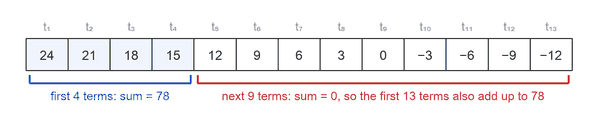
Watch out: Do not throw away one root. Both 4 and 13 are natural numbers, and both give the sum 78, because the later terms are negative.
Therefore, 4 terms or 13 terms must be taken (both give the sum 78).