
Opening your dashboard
Class 12 Chemistry Chapter 7 p-Block Elements: Previous Year Questions
17 questions on Chapter 7, each solved step by step. Class 12 Chemistry, ICSE 2026-27.
17 questions with solutions
1–5 marks · Mixed difficulty
- 11 mark
Question 1
Complete the following statements by selecting the correct alternative from the choices given:
The geometry of molecule and the hybridization of Xe atom in the molecule is:
Solve with AIAnswer
- Correct
(A) Distorted octahedral and
(B) Square planar and
(C) Pyramidal and
(D) Octahedral and
Answer: (A) Distorted octahedral and
Key idea: By VSEPR theory, the number of electron pairs (bond pairs + lone pairs) round the central atom fixes its hybridisation, and lone pairs distort the shape.
Step 1 — Count the electron pairs on Xe.
Xenon has 8 valence electrons. Six of them form six Xe–F bonds, and the remaining 2 electrons form 1 lone pair. So there are 7 electron pairs round Xe.
Step 2 — Find the hybridisation.
Seven electron pairs need seven hybrid orbitals: one s, three p and three d orbitals mix, so xenon is hybridised.
Step 3 — Find the shape.
The six F atoms would form an octahedron, but the lone pair pushes through one face and bends the F atoms round it, so the molecule is a distorted octahedron.
Why the others are wrong:
- (B) Square planar shape with xenon belongs to (4 bond pairs + 2 lone pairs), not to .
- (C) A pyramidal shape with xenon is found in (3 bond pairs + 1 lone pair); has 7 electron pairs, so it cannot be .
- (D) The hybridisation is right, but the shape is not a regular octahedron, because the lone pair distorts it.
Therefore, XeF₆ is distorted octahedral with sp³d³ xenon, so the answer is (A).
- 23 marks
Question 2
Give balanced chemical equations for the following reactions:
(i) Fluorine is passed through cold, dilute solution.
(ii) Hydrogen peroxide is treated with acidified solution.
(iii) Sulphuric acid is treated with hydrogen sulphide.
Solve with AIWritten solution
Solution:
Key idea: In a redox equation the electrons lost by the reducing agent equal the electrons gained by the oxidising agent; after that, the atoms of every element are counted on both sides.
Step 1 — (i) Fluorine with cold, dilute NaOH.
Fluorine is the strongest oxidising agent and cannot form an oxoanion (it has no positive oxidation state). With cold, dilute alkali it gives sodium fluoride and oxygen difluoride.
Step 2 — (ii) Hydrogen peroxide with acidified potassium permanganate.
Here acts as a reducing agent. Each gains 5 electrons (Mn goes from +7 to +2) and each loses 2 electrons (O goes from −1 to 0), so 2 permanganate ions react with 5 peroxide molecules. The ionic equation is shown first.
Adding the and ions gives the full equation. The purple colour fades and oxygen gas is given off.
Step 3 — (iii) Sulphuric acid with hydrogen sulphide.
Concentrated sulphuric acid is an oxidising agent and is a reducing agent. The sulphide (S at −2) is oxidised to sulphur (0), and the acid (S at +6) is reduced to sulphur dioxide (+4); each change involves 2 electrons, so they react 1 : 1.
Note: Fluorine and oxygen difluoride are very toxic, corrosive gases, hydrogen sulphide is a poisonous gas, and concentrated sulphuric acid causes severe burns, so these reactions are done only in a fume cupboard with protective equipment.
Therefore, the equations are (i) 2F₂ + 2NaOH → 2NaF + OF₂ + H₂O; (ii) 2KMnO₄ + 3H₂SO₄ + 5H₂O₂ → K₂SO₄ + 2MnSO₄ + 8H₂O + 5O₂; (iii) H₂SO₄ + H₂S → S + SO₂ + 2H₂O.
- 32 marks
Question 3
Draw the structure of xenon tetrafluoride molecule and state the hybridization of the central atom and the geometry of the molecule.
Solve with AIWritten solution
Solution:
Key idea: VSEPR theory: the number of electron pairs round the central atom gives its hybridisation, and the lone pairs take the positions that keep them farthest apart.
Step 1 — Count the electron pairs round xenon.
Xenon has 8 valence electrons (). Each of the four F atoms uses one of them in a single bond, which leaves 4 electrons. These 4 electrons form 2 lone pairs.
Step 2 — Find the hybridisation.
To form four bonds, xenon needs four half-filled orbitals. In the excited state two 5p electrons move into 5d orbitals, so one 5s, three 5p and two 5d orbitals mix. Six pairs need six hybrid orbitals, so xenon is hybridised.
Step 3 — Find the geometry.
The six orbitals point to the corners of an octahedron. The two lone pairs repel most strongly, so they take two opposite (trans) corners, one above and one below. The four F atoms then lie in one plane round Xe, with F–Xe–F angles of . The arrangement of the atoms is square planar.
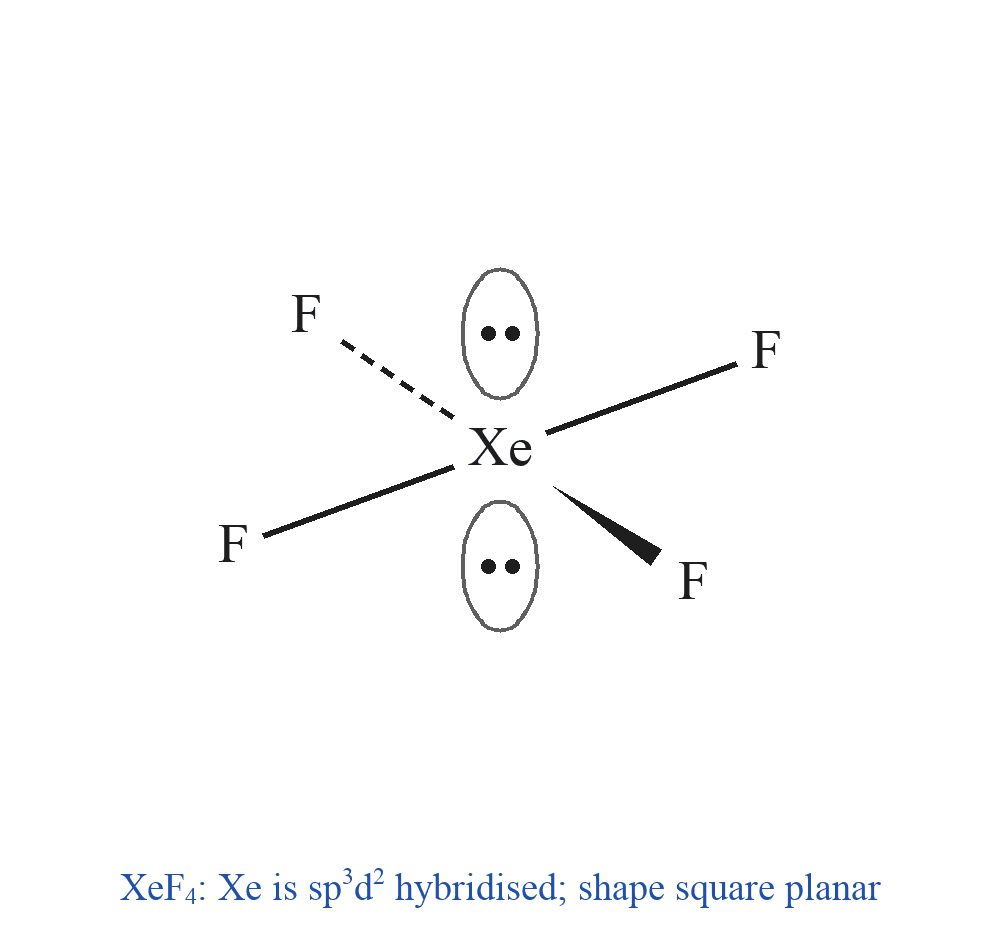
Therefore, in XeF₄ xenon is sp³d² hybridised and the molecule is square planar (two lone pairs above and below the plane).
- 41 mark
Question 4
Complete the following statements by selecting the correct alternative from the choices given:
When gas is passed through acidified solution, the colour of the solution changes to:
Solve with AIAnswer
(A) Red
(B) Black
(C) Orange
- Correct
(D) Green
Answer: (D) Green
Key idea: Sulphur dioxide is a reducing agent. It reduces orange dichromate ions (, Cr in the +6 state) to green chromium(III) ions ().
Step 1 — Write the reaction.
Each Cr atom gains 3 electrons (+6 to +3) and each loses 2 electrons (S goes from +4 to +6), so one dichromate ion reacts with three molecules.
Step 2 — Read off the colour.
Chromium(III) sulphate gives a green solution, so the orange colour changes to green. This colour change is used as a test for .
Why the others are wrong:
- (A) No red chromium compound forms; the product, chromium(III) sulphate, is green.
- (B) A black colour would need a black solid such as a metal sulphide; no such solid forms here.
- (C) Orange is the colour of the dichromate solution before the reaction; removes it.
Note: Potassium dichromate is a chromium(VI) compound, which is toxic and can cause cancer, and sulphur dioxide is a choking, toxic gas, so this test is done only with small amounts, with gloves, in a fume cupboard.
Therefore, the solution turns green, so the answer is (D).
- 53 marks
Question 5
(i) Sulphur dioxide acts as an oxidizing agent as well as a reducing agent. Give one reaction each to show its oxidizing nature and its reducing nature.
(ii) Explain why an aqueous solution of potassium hexacyanoferrate (II) does not give the test for ferrous ion.
Solve with AIWritten solution
Solution:
Key idea: In sulphur is in the +4 state, between its lowest (−2) and highest (+6) states, so it can either gain electrons (oxidising agent) or lose electrons (reducing agent).
Step 1 — (i) Show the oxidising nature of .
With a stronger reducing agent such as hydrogen sulphide, is reduced to sulphur (+4 to 0) and oxidises to sulphur (−2 to 0). Yellow sulphur is deposited.
Step 2 — (i) Show the reducing nature of .
With moist chlorine, is oxidised to sulphuric acid (+4 to +6) and reduces chlorine to hydrochloric acid.
Step 3 — (ii) Explain why potassium hexacyanoferrate(II) gives no test for .
Potassium hexacyanoferrate(II) is a complex salt. In water it ionises into potassium ions and the complex ion only.
The is held very firmly by the six cyanide ligands, and the complex ion is so stable that it hardly breaks up. So the solution contains almost no free ions, and the usual tests for ferrous ions (for example, a green precipitate with NaOH) do not work.
Note: Hydrogen sulphide (a poisonous gas that smells of rotten eggs), sulphur dioxide and chlorine are all toxic gases, so these reactions are done only in a fume cupboard.
Therefore, (i) SO₂ oxidises H₂S to sulphur and reduces Cl₂ to HCl; (ii) K₄[Fe(CN)₆] gives no ferrous test because Fe²⁺ stays locked in the stable complex ion [Fe(CN)₆]⁴⁻.
- 62 marks
Question 6
Explain why high pressure is required in the manufacture of sulphur trioxide by the contact process. State the law or principle used.
Solve with AIWritten solution
Solution:
Key idea: Le Chatelier's principle: when a system at equilibrium is disturbed (by a change of concentration, pressure or temperature), the equilibrium shifts in the direction that reduces the effect of the disturbance.
Step 1 — Write the equilibrium.
In the contact process sulphur dioxide is oxidised to sulphur trioxide over a catalyst.
Step 2 — Count the moles of gas.
The left side has 3 mol of gas (2 mol + 1 mol ) and the right side has 2 mol of gas. The forward reaction therefore decreases the number of gas molecules.
Step 3 — Apply Le Chatelier's principle.
Raising the pressure is opposed by a shift towards fewer gas molecules, that is, towards . So a higher pressure increases the yield of sulphur trioxide.
Note: In practice the plant runs at only about 2 bar, because the conversion over the catalyst is already very high and a much higher pressure would cost more and strain the equipment.
Therefore, a high pressure favours the forward reaction (3 mol of gas → 2 mol of gas) and raises the yield of SO₃; the principle used is Le Chatelier's principle.
- 73 marks
Question 7
Give balanced equations for the following reactions:
(i) Potassium permanganate is heated with concentrated hydrochloric acid.
(ii) Lead sulphide is heated with hydrogen peroxide.
(iii) Ozone is treated with potassium iodide solution.
Solve with AIWritten solution
Solution:
Key idea: Balance each redox equation by matching the electrons lost by the reducing agent with those gained by the oxidising agent, then count every atom.
Step 1 — (i) Potassium permanganate heated with concentrated HCl.
Permanganate oxidises chloride ions to chlorine gas (Mn: +7 to +2, gaining 5 electrons; 2 lose 2 electrons per ). So 2 give 5 .
Step 2 — (ii) Lead sulphide heated with hydrogen peroxide.
Hydrogen peroxide oxidises black lead sulphide (S at −2) to white lead sulphate (S at +6). This reaction is used to restore old oil paintings that have blackened.
Step 3 — (iii) Ozone with potassium iodide solution.
Ozone oxidises iodide ions to iodine, and is itself reduced to oxygen. The iodine set free can be seen (brown solution) or tested with starch (blue-black).
Note: Chlorine is a toxic, choking gas, so potassium permanganate is treated with concentrated hydrochloric acid only in a fume cupboard; ozone is also a toxic irritant.
Therefore, (i) 2KMnO₄ + 16HCl → 2KCl + 2MnCl₂ + 8H₂O + 5Cl₂; (ii) PbS + 4H₂O₂ → PbSO₄ + 4H₂O; (iii) 2KI + H₂O + O₃ → 2KOH + I₂ + O₂.
- 82 marks
Question 8
Discuss the theory involved in the manufacture of sulphuric acid by the contact process.
Solve with AIWritten solution
Solution:
Key idea: The key step of the contact process is a reversible, exothermic reaction with fewer gas molecules on the product side, so the conditions are chosen using Le Chatelier's principle and a catalyst.
Step 1 — Make sulphur dioxide.
Sulphur (or iron pyrites) is burnt in air to give , which is then freed from dust and arsenic compounds that would poison the catalyst.
Step 2 — Oxidise to (the main step).
The purified is mixed with air and passed over vanadium pentoxide () catalyst. The reaction is reversible and gives out heat ( for 2 mol of ).
Step 3 — Choose the conditions by Le Chatelier's principle.
The forward reaction is exothermic, so a low temperature would favour , but the rate would then be too slow; an optimum temperature of about 720 K is used with the catalyst to give a fast reaction and a good yield. The forward reaction also reduces the gas from 3 mol to 2 mol, so pressure favours it; a pressure of about 2 bar is enough because the conversion is already high. Excess air (oxygen) also pushes the equilibrium to the right.
Step 4 — Absorb the .
Sulphur trioxide is not dissolved in water directly, because that forms a fine mist of acid that is hard to condense. It is absorbed in concentrated (98%) sulphuric acid to give oleum, which is then diluted with the right amount of water.
Therefore, SO₂ is catalytically oxidised to SO₃ over V₂O₅ at about 720 K and 2 bar with excess air (conditions chosen by Le Chatelier's principle), and the SO₃ is absorbed in conc. H₂SO₄ to form oleum, which is diluted to give sulphuric acid.
- 93 marks
Question 9
(i) What are the types of hybridisation of iodine in interhalogen compounds , and , respectively?
(ii) Draw the structure of xenon hexafluoride () molecule and state the hybridisation of the central atom.
Solve with AIWritten solution
Solution:
Key idea: VSEPR theory: (number of bond pairs + lone pairs) round the central atom gives the hybridisation — 5 pairs , 6 pairs , 7 pairs .
Step 1 — (i) Count the electron pairs on iodine in each interhalogen.
Iodine has 7 valence electrons. Each F atom uses one of them in a single bond; the electrons left over form lone pairs.
Compound Bond pairs Lone pairs Total pairs Hybridisation of I Shape 3 2 5 T-shaped 5 1 6 square pyramidal 7 0 7 pentagonal bipyramidal Step 2 — (ii) Count the electron pairs round xenon in .
We now apply the same counting to xenon in . Xenon has 8 valence electrons. The six F atoms use six of them in single bonds, which leaves 2 electrons. These 2 electrons form 1 lone pair.
Step 3 — (ii) Find the hybridisation of xenon.
To form six bonds, xenon needs six half-filled orbitals, so three 5p electrons move into 5d orbitals in the excited state. One 5s, three 5p and three 5d orbitals mix to give seven hybrid orbitals, so xenon is hybridised.
Step 4 — (ii) Find the geometry of .
Six F atoms would make a regular octahedron, but the lone pair also needs space. It pushes out through the middle of one face of the octahedron and squeezes the F atoms round it apart, so the shape is a distorted octahedron.
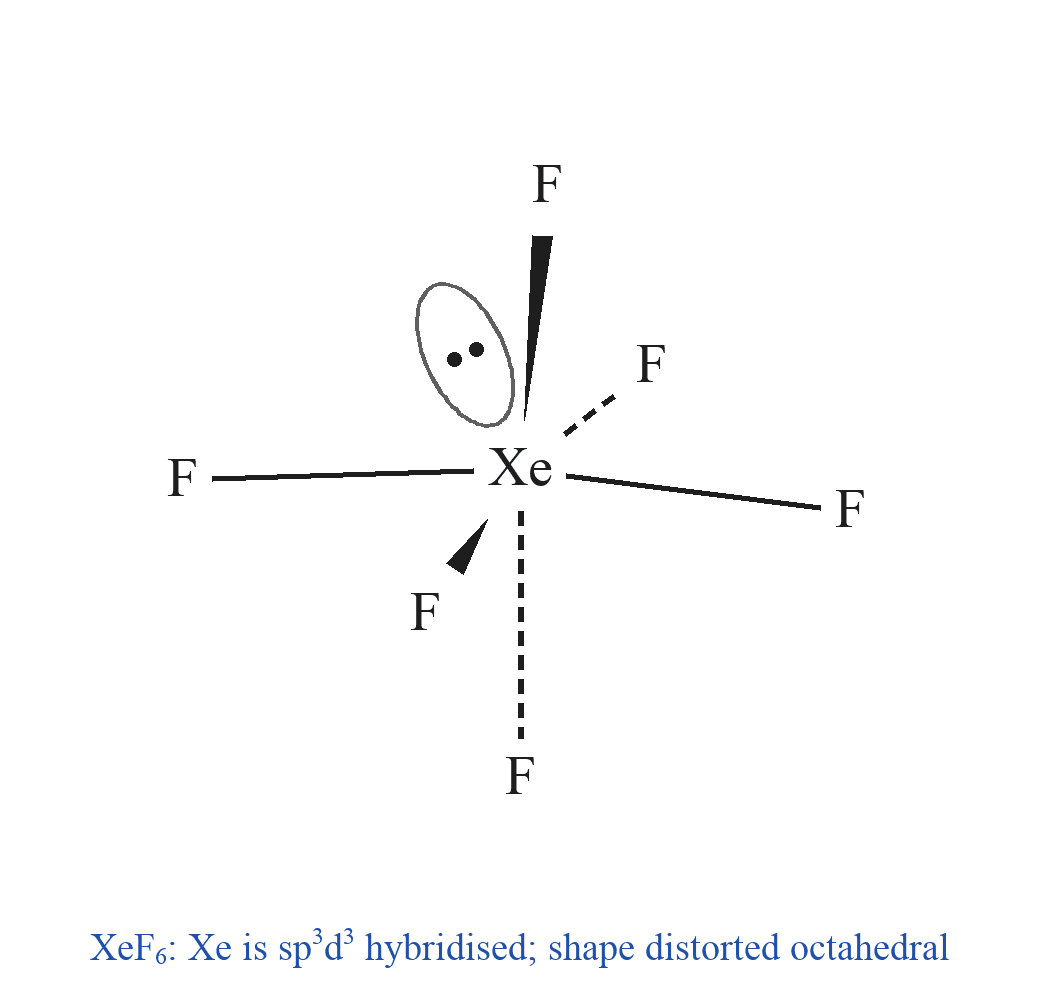
Therefore, (i) iodine is sp³d in IF₃, sp³d² in IF₅ and sp³d³ in IF₇; (ii) in XeF₆ xenon is sp³d³ hybridised and the molecule is a distorted octahedron with one lone pair.
- 101 mark
Question 10
Fill in the blanks by choosing the appropriate word/words from those given in the brackets:
(square pyramidal, electrical, 74; 26, , , chemical, 68, 32, tetrahedral, yellow, white, iodoform, Lucas)
The geometry of molecule is ______ and the hybridisation of Xenon atom in the molecule is ______.
Solve with AIWritten solution
Solution:
Key idea: By VSEPR theory, the number of electron pairs round the central atom gives its hybridisation, and the lone pairs decide the shape.
Step 1 — Count the electron pairs on Xe.
Xenon has 8 valence electrons. The Xe=O double bond uses 2 of them and the four Xe–F bonds use 4, so 2 electrons (1 lone pair) are left. So xenon has 5 bonded atoms and 1 lone pair, which makes 6 electron pairs in all.
Step 2 — Find the hybridisation and shape.
Six electron pairs need six hybrid orbitals, so xenon is hybridised and the pairs point to the corners of an octahedron. The lone pair takes one corner, with the O atom opposite it and the four F atoms round the middle, so the atoms form a square pyramid.
Therefore, the geometry of XeOF₄ is square pyramidal and the hybridisation of xenon is sp³d².
- 115 marks
Question 11
(i) Explain why :
(1) Nitrogen does not form pentahalides
(2) Helium is used for filling weather balloons
(3) ICl is more reactive than
(ii) Draw the structures of the following :
(1)
(2)
Solve with AIWritten solution
Solution:
Key idea: Many p-block properties follow from atomic size, electronegativity and whether d orbitals are available in the valence shell.
Step 1 — (i)(1) Why nitrogen does not form pentahalides.
Nitrogen is in period 2, so its valence shell () has only one 2s and three 2p orbitals and no d orbitals. It can therefore form at most four covalent bonds and cannot expand its octet to five bonds. The nitrogen atom is also very small, so five halogen atoms could not fit round it without strong crowding. Phosphorus () has vacant 3d orbitals and does form .
Step 2 — (i)(2) Why helium is used for filling weather balloons.
Helium is the second lightest gas (much less dense than air), so a balloon filled with it rises. Unlike hydrogen, which is lighter still, helium does not burn, so it is safe to handle.
Note: Hydrogen is cheaper and is still used for many weather balloons; helium is chosen where safety matters most.
Step 3 — (i)(3) Why ICl is more reactive than .
In both atoms are the same, so the bond is non-polar. In ICl chlorine is more electronegative than iodine, so the bond is polar (). The positive iodine end is readily attacked by electron-rich reagents and the bond breaks easily into and , so ICl reacts faster with most substances.
Note: The I–Cl bond is actually stronger than the I–I bond (bond enthalpies about 210 and 150 kJ mol⁻¹), so the higher reactivity comes from the polarity of the bond, not from a weaker bond.
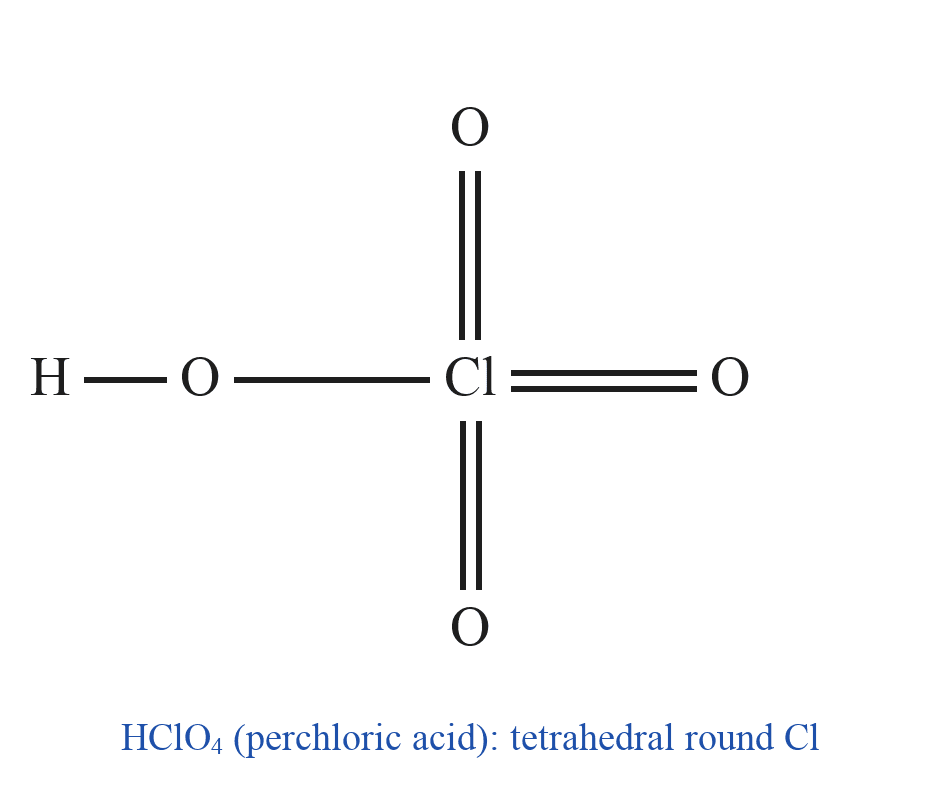
Step 4 — (ii)(1) Structure of .
In perchloric acid chlorine is in the +7 state. It is bonded to one OH group and to three O atoms by Cl=O bonds; the four groups are arranged tetrahedrally round Cl.
Step 5 — (ii)(2) Structure of .
In phosphorous acid phosphorus is in the +3 state. It is bonded to one O atom (P=O), two OH groups and one H atom directly; the four groups are arranged tetrahedrally round P. Only the two O–H hydrogens can ionise, so the acid is dibasic.
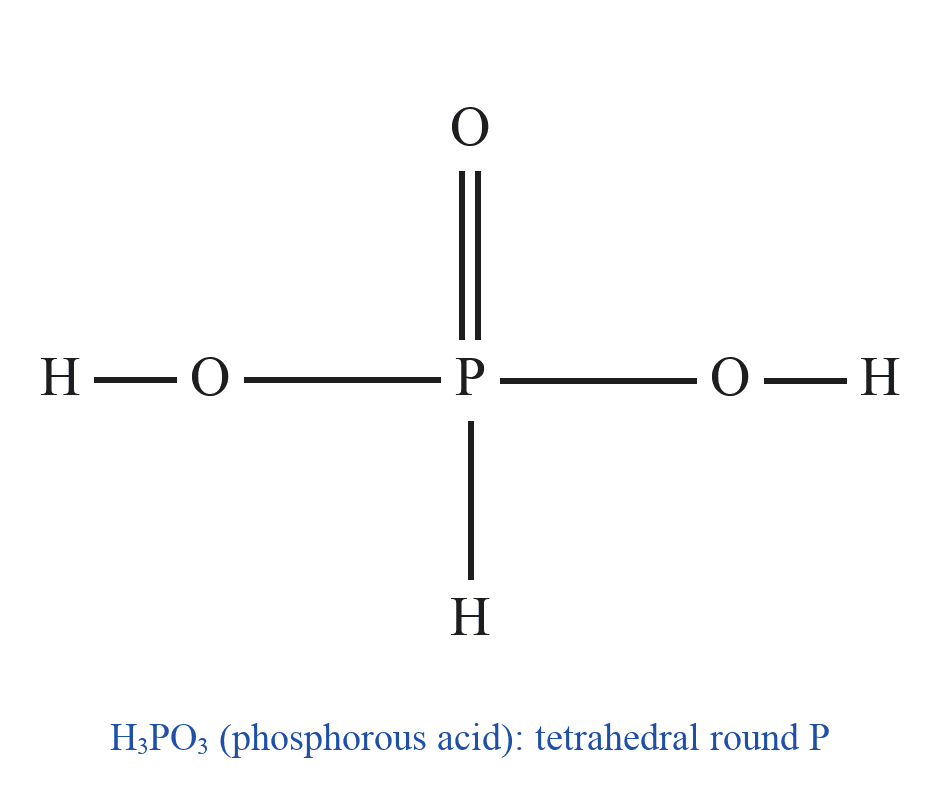
Therefore, (1) N has no d orbitals and cannot exceed four bonds; (2) He is very light and non-inflammable; (3) the polar I–Cl bond makes ICl more reactive than I₂; HClO₄ has three Cl=O and one Cl–OH bond, and H₃PO₃ has one P=O, one P–H and two P–OH bonds.
- 125 marks
Question 12
(i) Explain why :
(1) Mercury loses its meniscus in contact with ozone.
(2) Halogens are coloured and the colour deepens on moving down in the group from fluorine to iodine.
(3) Hydride of sulphur is a gas while hydride of oxygen is a liquid.
(ii) Complete and balance the following reactions :
(1) ______ + ______ + ______ + ______
(2) ______ + ______ + ______
Solve with AIWritten solution
Solution:
Key idea: Ozone is a strong oxidising agent; the colours of halogens come from absorbing visible light; and hydrogen bonding decides whether a small hydride is a liquid or a gas.
Step 1 — (i)(1) Why mercury loses its meniscus with ozone.
Ozone oxidises mercury to mercury(I) oxide.
The oxide dissolves in the mercury and makes it stick to the glass, so mercury no longer forms a convex meniscus and leaves a trail on the glass ("tailing" of mercury).
Step 2 — (i)(2) Why halogens are coloured, with the colour deepening down the group.
Halogen molecules absorb part of the visible light, which excites an outer electron to a higher energy level; we see the complementary colour. Down the group the atoms get bigger and the energy needed for this excitation becomes smaller, so light of lower energy (longer wavelength) is absorbed. Hence the colour deepens: pale yellow, greenish-yellow, red-brown and violet (vapour).
Step 3 — (i)(3) Why the hydride of sulphur is a gas but that of oxygen is a liquid.
Oxygen is small and highly electronegative, so water molecules are held together by strong hydrogen bonds, and a lot of energy is needed to separate them; water is a liquid at room temperature. Sulphur is larger and much less electronegative, so molecules have no appreciable hydrogen bonding and are held only by weak van der Waals forces; is a gas.
Step 4 — (ii)(1) Complete and balance .
Manganese dioxide oxidises the HCl formed from sodium chloride and sulphuric acid to chlorine (Mn: +4 to +2; 2 lose 2 electrons), so 2 NaCl react with 1 .
Step 5 — (ii)(2) Complete and balance .
Sulphur dioxide reduces permanganate (Mn: +7 to +2, gaining 5 electrons) and is oxidised to sulphate (S: +4 to +6, losing 2 electrons), so 2 react with 5 .
Note: Chlorine and sulphur dioxide are toxic gases and mercury vapour is poisonous, so these reactions are done only in a fume cupboard.
Therefore, (1) ozone forms Hg₂O, which makes mercury stick to glass; (2) halogens absorb visible light and the excitation energy falls down the group, so the colour deepens; (3) water has hydrogen bonding but H₂S does not; the equations are 2NaCl + MnO₂ + 2H₂SO₄ → Na₂SO₄ + MnSO₄ + 2H₂O + Cl₂ and 2KMnO₄ + 5SO₂ + 2H₂O → K₂SO₄ + 2MnSO₄ + 2H₂SO₄.
- 131 mark
Question 13
Select the correct alternative from the choice given:
The correct order of increasing acidic strength of the Oxo acids of chlorine is:
Solve with AIAnswer
(A)
- Correct
(B)
(C)
(D)
Answer: (B)
Key idea: For oxoacids of the same element, acid strength increases with the oxidation number of the central atom (the number of O atoms on it), because the negative charge of the anion is spread over more O atoms and the anion becomes more stable.
Step 1 — Find the oxidation number of chlorine in each acid.
Chlorine is +1 in HClO, +3 in , +5 in and +7 in .
Step 2 — Compare the anions.
In the charge is shared by four O atoms, so it is the most stable anion and gives up its proton most easily. In the charge sits on one O atom, so HClO holds its proton most tightly.
Step 3 — Write the order.
Acid strength rises with the number of O atoms: .
Why the others are wrong:
- (A) This order makes HClO the strongest acid, but HClO (Cl in the +1 state) is the weakest of the four.
- (C) This order puts below HClO and below ; both comparisons run against the oxidation-number trend.
- (D) This order makes the strongest acid, but , with chlorine in its highest state (+7), is the strongest.
Therefore, the order of increasing acid strength is HClO < HClO₂ < HClO₃ < HClO₄, so the answer is (B).
- 145 marks
Question 14
(i) Explain why
(1) Fluorine has lower electron affinity than chlorine?
(2) Red phosphorus is less reactive than white phosphorus?
(3) Ozone acts as a powerful oxidizing agent?
(ii) Draw the structure of the following:
(1)
(2)
Solve with AIWritten solution
Solution:
Key idea: Small atomic size, bond strain and the stability of the molecule explain the three properties; VSEPR counting gives the structures.
Step 1 — (i)(1) Why fluorine has a lower electron affinity than chlorine.
Fluorine is a very small atom, so its 2p subshell is compact and already crowded with electrons. An incoming electron is strongly repelled by these electrons, so less energy is released when it is added. Chlorine is larger; the added electron goes into the more spacious 3p subshell, feels less repulsion and more energy is released. So the electron gain enthalpy of chlorine (about −349 kJ mol⁻¹) is more negative than that of fluorine (about −328 kJ mol⁻¹).
Step 2 — (i)(2) Why red phosphorus is less reactive than white phosphorus.
White phosphorus is made of separate tetrahedra in which the P–P–P bond angles are only , so the molecule is strained and its bonds break easily. In red phosphorus the units are joined together into long chains (a polymeric structure), which is much more stable. So red phosphorus is far less reactive (it does not catch fire in air at room temperature, while white phosphorus does).
Step 3 — (i)(3) Why ozone is a powerful oxidising agent.
Ozone is thermodynamically unstable with respect to oxygen and breaks down easily, giving a free oxygen atom that attacks other substances.
Because this "nascent" oxygen is very reactive, ozone oxidises many substances that oxygen cannot attack at room temperature.
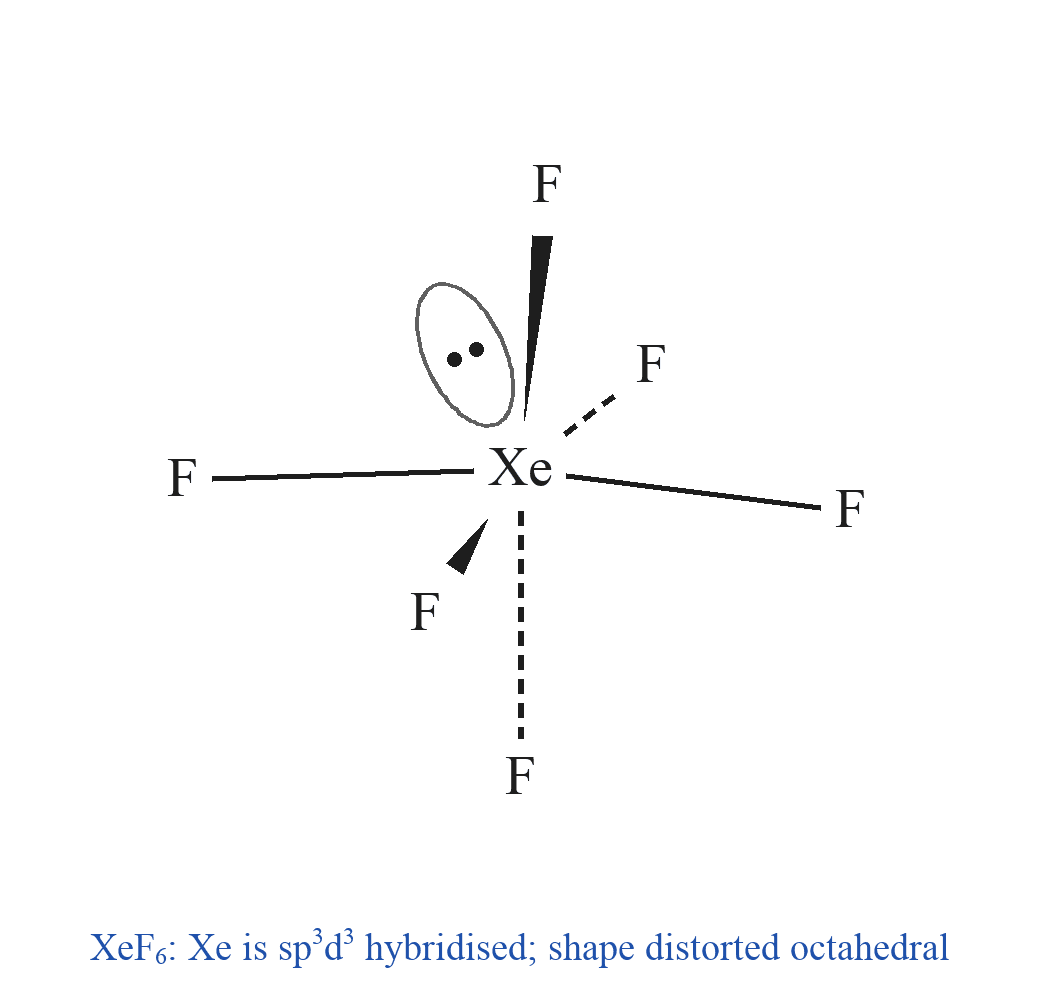
Step 4 — (ii)(1) Count the electron pairs round xenon in .
We count the electron pairs round xenon as before. Xenon has 8 valence electrons. The six F atoms use six of them in single bonds, which leaves 2 electrons. These 2 electrons form 1 lone pair.
Step 5 — (ii)(1) Find the hybridisation of xenon.
To form six bonds, xenon needs six half-filled orbitals, so three 5p electrons move into 5d orbitals in the excited state. One 5s, three 5p and three 5d orbitals mix to give seven hybrid orbitals, so xenon is hybridised.
Step 6 — (ii)(1) Find the geometry of .
Six F atoms would make a regular octahedron, but the lone pair also needs space. It pushes out through the middle of one face of the octahedron and squeezes the F atoms round it apart, so the shape is a distorted octahedron.
Step 7 — (ii)(2) Work out the structure of .
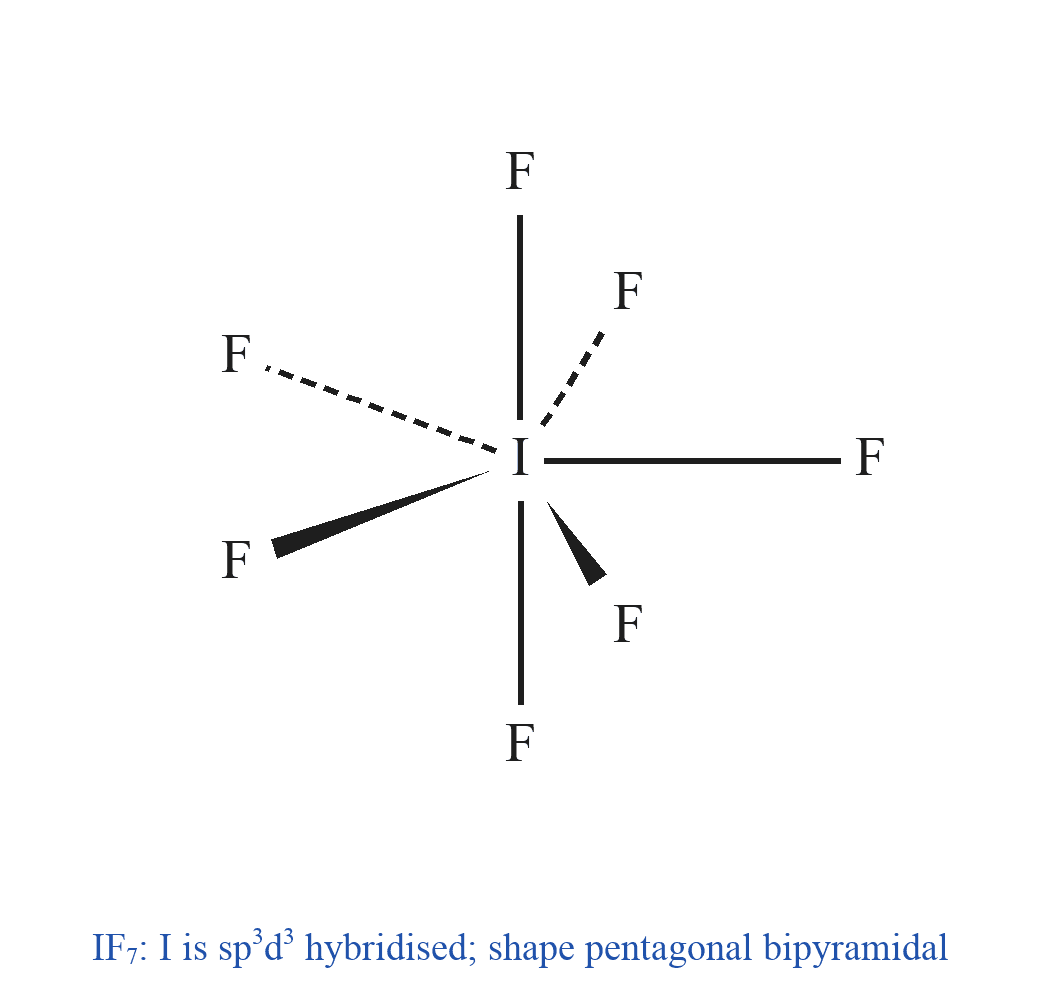
Iodine has 7 valence electrons and all seven form I–F bonds, so there are 7 bond pairs and no lone pair. Seven pairs need seven hybrid orbitals, so iodine is hybridised. Two F atoms sit above and below iodine (axial) and five F atoms lie in a ring round its middle, apart (equatorial): a pentagonal bipyramid.
Note: White phosphorus is poisonous and catches fire in air, so it is stored under water; ozone is a toxic irritant at ground level.
Therefore, (1) F's small, crowded 2p subshell repels the added electron; (2) red P is polymeric and unstrained, white P has strained P₄ units; (3) ozone easily gives nascent oxygen; XeF₆ is distorted octahedral (sp³d³ Xe) and IF₇ is pentagonal bipyramidal (sp³d³ I).
- 155 marks
Question 15
Explain why,
(i) Interhalogen compounds are more reactive than the related elemental halogens?
(iii) Sulphur exhibits tendency for catenation but oxygen does not?
(iii) On being slowly passed through the water forms bubbles, but dissolves?
(a) Complete and balance the following reaction:
(i)
(ii)
Solve with AIWritten solution
Solution:
Key idea: Bond polarity, bond strength and hydrogen bonding explain the three facts; the equations are balanced by matching electrons lost and gained.
Note: The paper labels the three "Explain why" parts (i), (iii), (iii) and the equation part (a); we answer them in the printed order as parts 1, 2 and 3 and then the two equations.
Step 1 — Part 1: Why interhalogen compounds are more reactive than the related halogens.
In an interhalogen such as ClF or ICl the two atoms differ in electronegativity, so the X–X′ bond is polar. The more electronegative end pulls electron density away, and the bond breaks easily into ions in reactions with polar reagents. A halogen molecule (, , ) has a non-polar bond, so it reacts more slowly. Fluorine is the exception, because the F–F bond is unusually weak.
Note: Interhalogen bonds are generally not weaker than the bond in the heavier parent halogen (for example, Cl–F is stronger than Cl–Cl); the extra reactivity comes from their polarity.
Step 2 — Part 2: Why sulphur shows catenation but oxygen does not.
Catenation needs strong bonds between atoms of the same element. Oxygen atoms are very small, so in an O–O single bond the lone pairs on the two atoms are close together and repel each other strongly; the O–O bond is weak (about 140 kJ mol⁻¹). Sulphur atoms are larger, the lone pairs are farther apart, and the S–S bond is much stronger (roughly 225–265 kJ mol⁻¹). So sulphur forms rings and chains such as , while oxygen forms at most short O–O links.
Step 3 — Part 3: Why bubbles through water but dissolves.
Nitrogen is small and highly electronegative, so forms hydrogen bonds with water molecules and dissolves very readily. Phosphorus is larger and only about as electronegative as hydrogen, so cannot form hydrogen bonds with water; it dissolves only very slightly and escapes as bubbles.
Step 4 — Equation (i): with concentrated .
Concentrated sulphuric acid oxidises phosphorus to phosphoric acid (P: 0 to +5, so loses 20 electrons) and is reduced to (S: +6 to +4, gaining 2 electrons), so 10 are needed per .
Step 5 — Equation (ii): silver with dilute nitric acid.
Dilute nitric acid oxidises silver to silver nitrate and is reduced to nitric oxide (N: +5 to +2, gaining 3 electrons; each Ag loses 1), so 3 Ag react with one that is reduced.
Note: White phosphorus is poisonous and catches fire in air, concentrated sulphuric and nitric acids are highly corrosive, and sulphur dioxide and nitric oxide (which turns into brown, toxic in air) are toxic gases, so these reactions are done only in a fume cupboard.
Therefore, interhalogens react faster because their bonds are polar; S–S bonds are strong but O–O bonds are weak; NH₃ hydrogen-bonds with water but PH₃ cannot; P₄ + 10H₂SO₄ → 4H₃PO₄ + 10SO₂ + 4H₂O and 3Ag + 4HNO₃ → 3AgNO₃ + NO + 2H₂O.
- 162 marks
Question 16
Complete and balance the following chemical equations:
(i) ______ + ______
(ii) ______ + ______ + ______
Solve with AIWritten solution
Solution:
Key idea: White phosphorus disproportionates in hot alkali (part goes down to −3, part up to +1), and copper reacts with nitric acid to give a nitrate, an oxide of nitrogen and water.
Step 1 — (i) Phosphorus with sodium hydroxide solution.
When white phosphorus is heated with concentrated NaOH solution in an inert atmosphere (to stop the phosphine catching fire), one P atom of every four is reduced to phosphine (0 to −3) and three are oxidised to sodium hypophosphite (0 to +1).
Step 2 — (ii) Copper with nitric acid.
The products depend on the concentration of the acid. With dilute nitric acid, copper gives nitric oxide.
With concentrated nitric acid, copper gives brown nitrogen dioxide.
Note: White phosphorus is poisonous and catches fire in air, phosphine is a very toxic gas, nitric acid is highly corrosive, and NO and are toxic gases, so these reactions are done only in a fume cupboard.
Therefore, (i) P₄ + 3NaOH + 3H₂O → PH₃ + 3NaH₂PO₂; (ii) 3Cu + 8HNO₃ (dilute) → 3Cu(NO₃)₂ + 2NO + 4H₂O, or Cu + 4HNO₃ (conc.) → Cu(NO₃)₂ + 2NO₂ + 2H₂O.
- 172 marks
Question 17
Draw the structure of xenon tetrafluoride molecule. State the hybridisation of the central atom and the geometry of the molecule.
Solve with AIWritten solution
Solution:
Key idea: VSEPR theory: the number of electron pairs round the central atom gives its hybridisation, and the lone pairs take the positions that keep them farthest apart.
Step 1 — Count the electron pairs round xenon.
Xenon has 8 valence electrons (). Each of the four F atoms uses one of them in a single bond, which leaves 4 electrons. These 4 electrons form 2 lone pairs.
Step 2 — Find the hybridisation.
To form four bonds, xenon needs four half-filled orbitals. In the excited state two 5p electrons move into 5d orbitals, so one 5s, three 5p and two 5d orbitals mix. Six pairs need six hybrid orbitals, so xenon is hybridised.
Step 3 — Find the geometry.
The six orbitals point to the corners of an octahedron. The two lone pairs repel most strongly, so they take two opposite (trans) corners, one above and one below. The four F atoms then lie in one plane round Xe, with F–Xe–F angles of . The arrangement of the atoms is square planar.
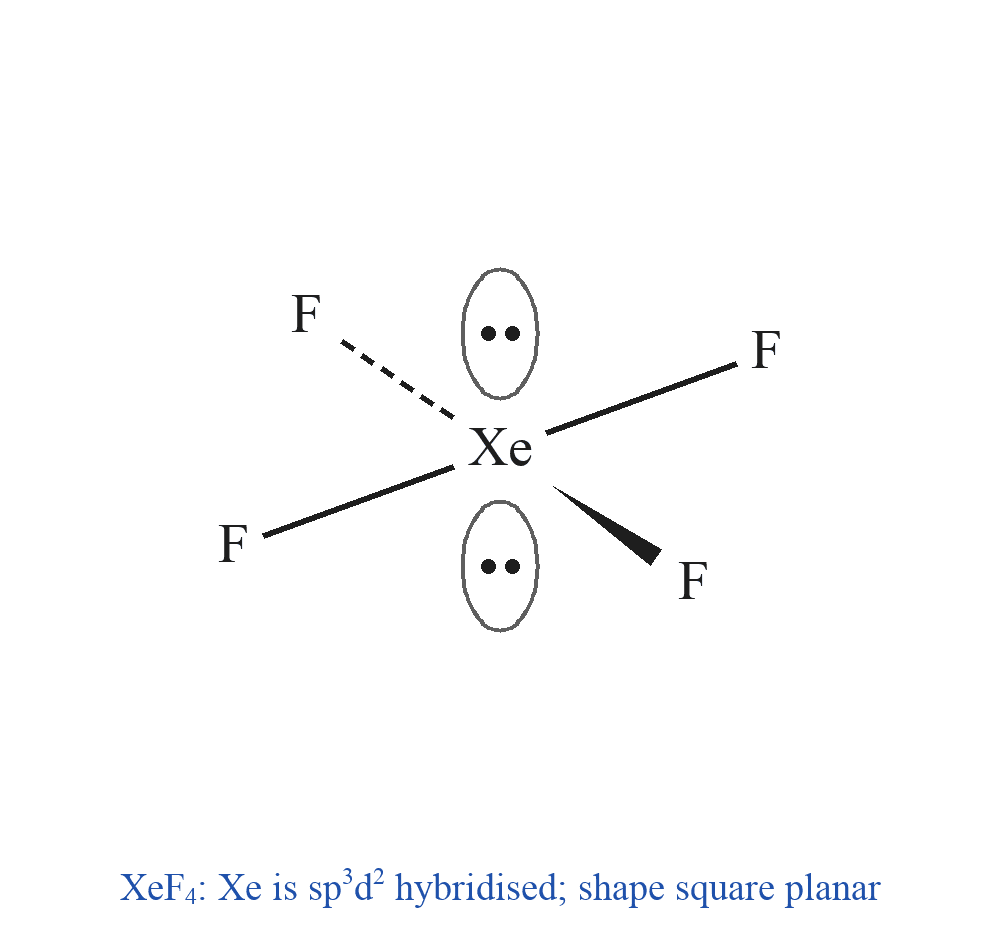
Therefore, in XeF₄ xenon is sp³d² hybridised and the molecule is square planar (two lone pairs above and below the plane).