Solution:
Key idea: Small atomic size, bond strain and the stability of the molecule explain the three properties; VSEPR counting gives the structures.
Step 1 — (i)(1) Why fluorine has a lower electron affinity than chlorine.
Fluorine is a very small atom, so its 2p subshell is compact and already crowded with electrons. An incoming electron is strongly repelled by these electrons, so less energy is released when it is added. Chlorine is larger; the added electron goes into the more spacious 3p subshell, feels less repulsion and more energy is released. So the electron gain enthalpy of chlorine (about −349 kJ mol⁻¹) is more negative than that of fluorine (about −328 kJ mol⁻¹).
Step 2 — (i)(2) Why red phosphorus is less reactive than white phosphorus.
White phosphorus is made of separate P4 tetrahedra in which the P–P–P bond angles are only 60∘, so the molecule is strained and its bonds break easily. In red phosphorus the P4 units are joined together into long chains (a polymeric structure), which is much more stable. So red phosphorus is far less reactive (it does not catch fire in air at room temperature, while white phosphorus does).
Step 3 — (i)(3) Why ozone is a powerful oxidising agent.
Ozone is thermodynamically unstable with respect to oxygen and breaks down easily, giving a free oxygen atom that attacks other substances.
O3→O2+[O]
Because this "nascent" oxygen is very reactive, ozone oxidises many substances that oxygen cannot attack at room temperature.
Step 4 — (ii)(1) Count the electron pairs round xenon in XeF6.
We count the electron pairs round xenon as before. Xenon has 8 valence electrons. The six F atoms use six of them in single bonds, which leaves 2 electrons. These 2 electrons form 1 lone pair.
electron pairs on Xe=6 bond pairs+1 lone pair
electron pairs on Xe=7
Step 5 — (ii)(1) Find the hybridisation of xenon.
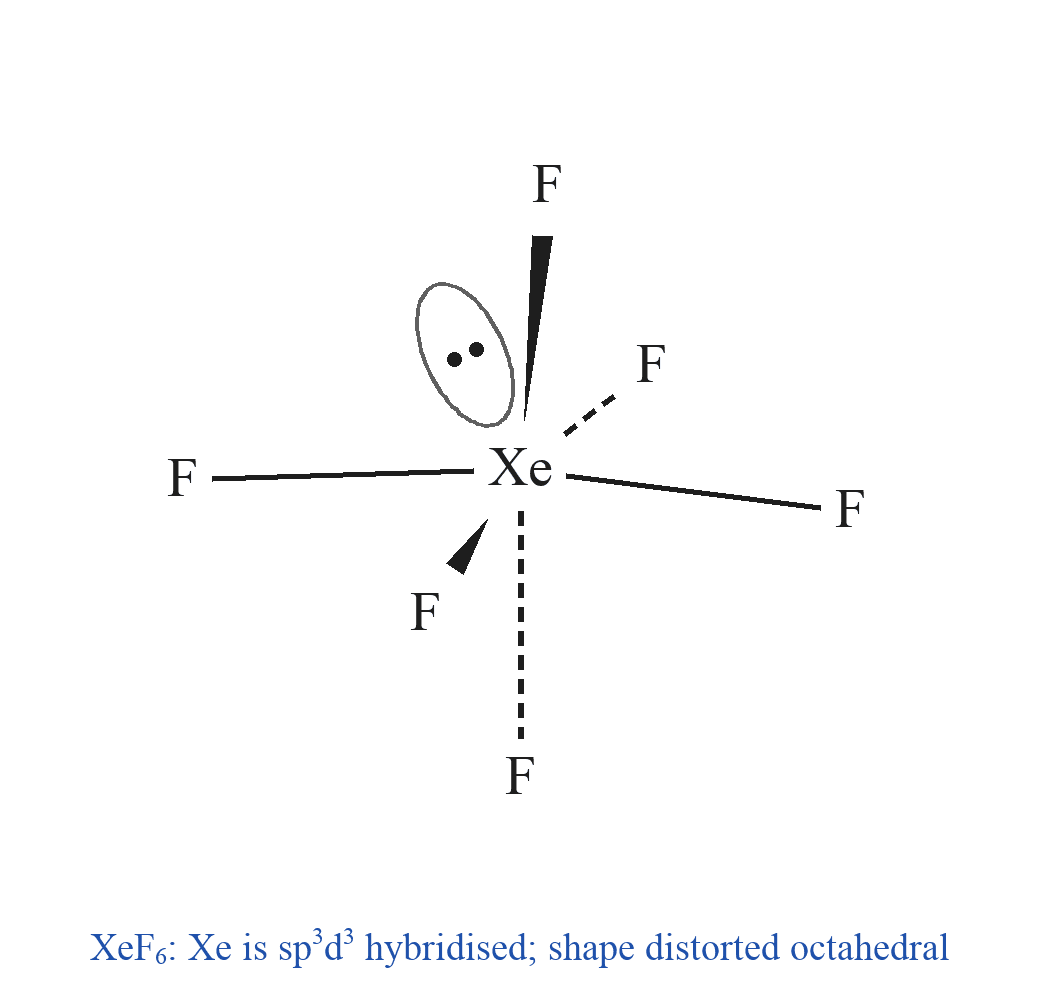
To form six bonds, xenon needs six half-filled orbitals, so three 5p electrons move into 5d orbitals in the excited state. One 5s, three 5p and three 5d orbitals mix to give seven hybrid orbitals, so xenon is sp3d3 hybridised.
Step 6 — (ii)(1) Find the geometry of XeF6.
Six F atoms would make a regular octahedron, but the lone pair also needs space. It pushes out through the middle of one face of the octahedron and squeezes the F atoms round it apart, so the shape is a distorted octahedron.
Step 7 — (ii)(2) Work out the structure of IF7.
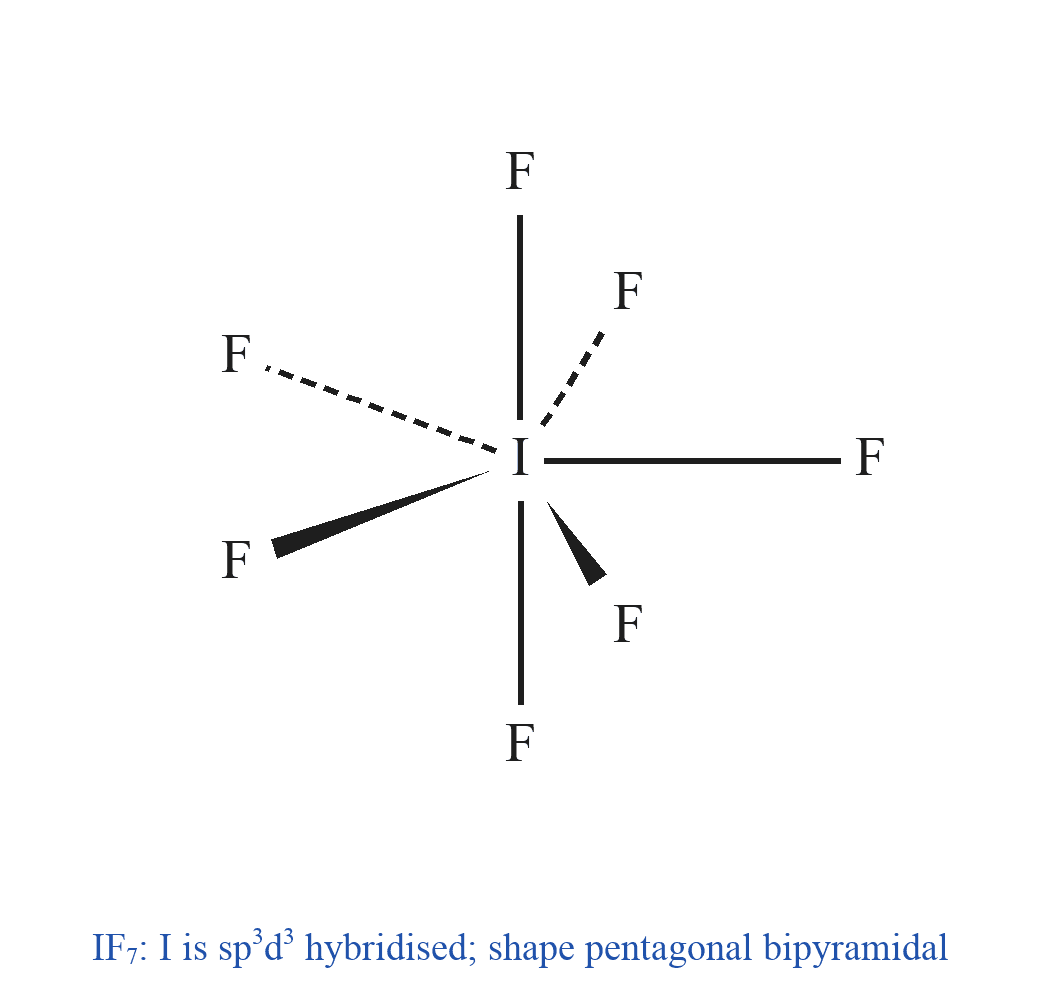
Iodine has 7 valence electrons and all seven form I–F bonds, so there are 7 bond pairs and no lone pair. Seven pairs need seven hybrid orbitals, so iodine is sp3d3 hybridised. Two F atoms sit above and below iodine (axial) and five F atoms lie in a ring round its middle, 72∘ apart (equatorial): a pentagonal bipyramid.
Note: White phosphorus is poisonous and catches fire in air, so it is stored under water; ozone is a toxic irritant at ground level.
Therefore, (1) F's small, crowded 2p subshell repels the added electron; (2) red P is polymeric and unstrained, white P has strained P₄ units; (3) ozone easily gives nascent oxygen; XeF₆ is distorted octahedral (sp³d³ Xe) and IF₇ is pentagonal bipyramidal (sp³d³ I).
