
Question 115 marksAsked 2018Medium
(i) Explain why :
(1) Nitrogen does not form pentahalides
(2) Helium is used for filling weather balloons
(3) ICl is more reactive than
(ii) Draw the structures of the following :
(1)
(2)
Confirming your payment
Sign up now and get 250 free tokens.
Previous Year Questions · Question 11 of 17
(i) Explain why :
(1) Nitrogen does not form pentahalides
(2) Helium is used for filling weather balloons
(3) ICl is more reactive than
(ii) Draw the structures of the following :
(1)
(2)
Solution:
Key idea: Many p-block properties follow from atomic size, electronegativity and whether d orbitals are available in the valence shell.
Step 1 — (i)(1) Why nitrogen does not form pentahalides.
Nitrogen is in period 2, so its valence shell () has only one 2s and three 2p orbitals and no d orbitals. It can therefore form at most four covalent bonds and cannot expand its octet to five bonds. The nitrogen atom is also very small, so five halogen atoms could not fit round it without strong crowding. Phosphorus () has vacant 3d orbitals and does form .
Step 2 — (i)(2) Why helium is used for filling weather balloons.
Helium is the second lightest gas (much less dense than air), so a balloon filled with it rises. Unlike hydrogen, which is lighter still, helium does not burn, so it is safe to handle.
Note: Hydrogen is cheaper and is still used for many weather balloons; helium is chosen where safety matters most.
Step 3 — (i)(3) Why ICl is more reactive than .
In both atoms are the same, so the bond is non-polar. In ICl chlorine is more electronegative than iodine, so the bond is polar (). The positive iodine end is readily attacked by electron-rich reagents and the bond breaks easily into and , so ICl reacts faster with most substances.
Note: The I–Cl bond is actually stronger than the I–I bond (bond enthalpies about 210 and 150 kJ mol⁻¹), so the higher reactivity comes from the polarity of the bond, not from a weaker bond.
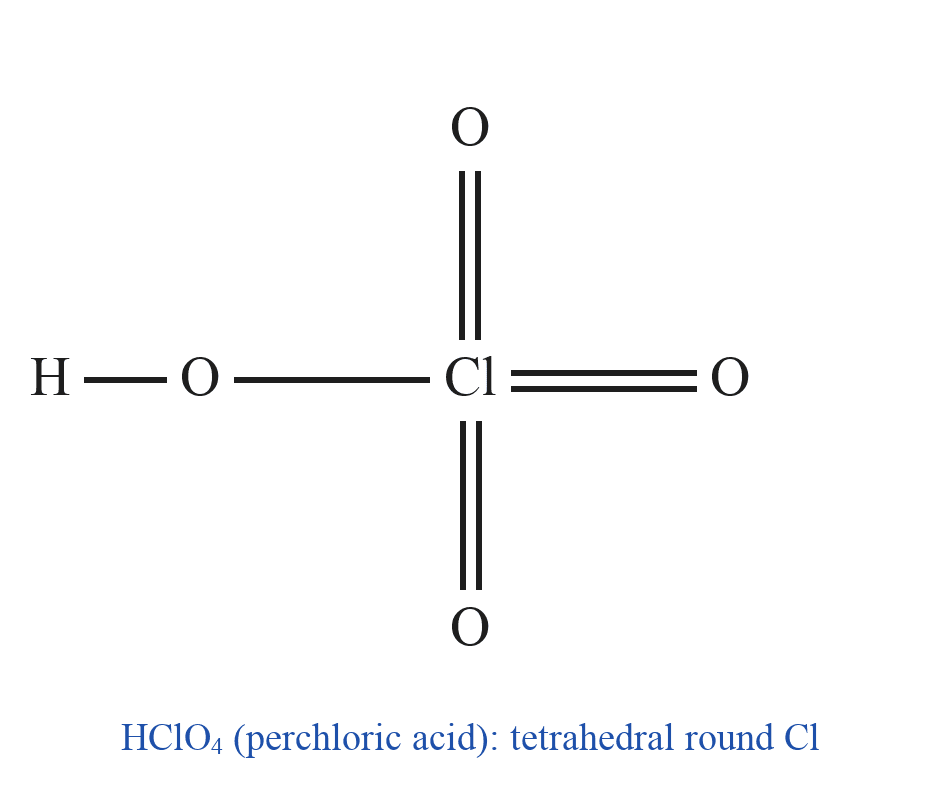
Step 4 — (ii)(1) Structure of .
In perchloric acid chlorine is in the +7 state. It is bonded to one OH group and to three O atoms by Cl=O bonds; the four groups are arranged tetrahedrally round Cl.
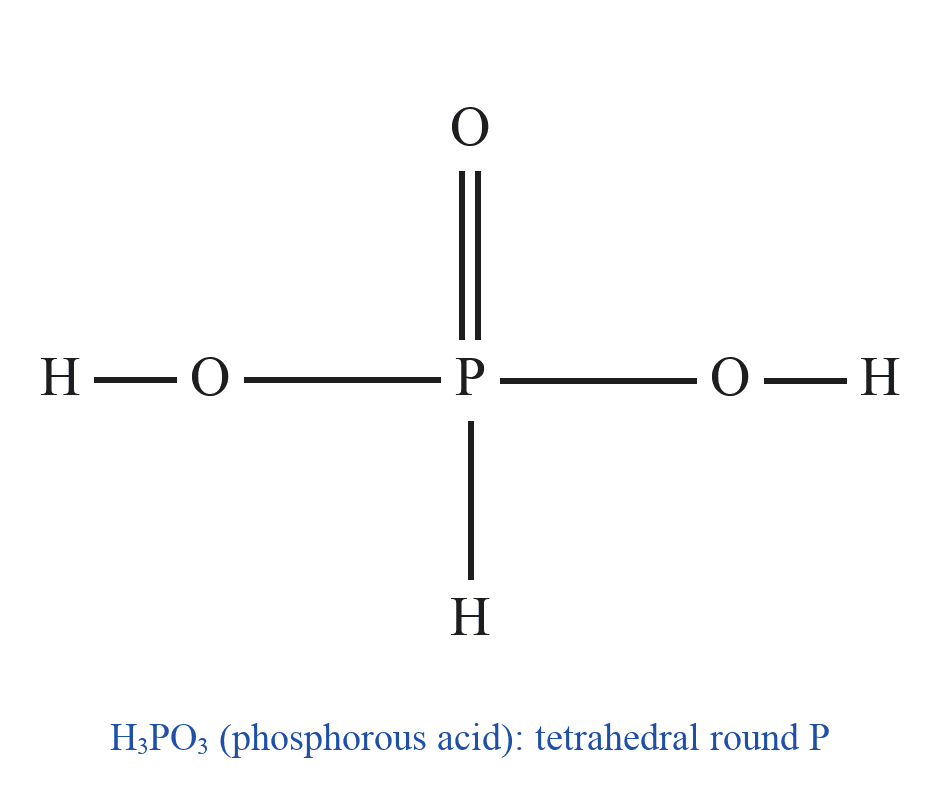
Step 5 — (ii)(2) Structure of .
In phosphorous acid phosphorus is in the +3 state. It is bonded to one O atom (P=O), two OH groups and one H atom directly; the four groups are arranged tetrahedrally round P. Only the two O–H hydrogens can ionise, so the acid is dibasic.
Therefore, (1) N has no d orbitals and cannot exceed four bonds; (2) He is very light and non-inflammable; (3) the polar I–Cl bond makes ICl more reactive than I₂; HClO₄ has three Cl=O and one Cl–OH bond, and H₃PO₃ has one P=O, one P–H and two P–OH bonds.