
Question 93 marksAsked 2017Medium
(i) What are the types of hybridisation of iodine in interhalogen compounds , and , respectively?
(ii) Draw the structure of xenon hexafluoride () molecule and state the hybridisation of the central atom.
Confirming your payment
Sign up now and get 250 free tokens.
Previous Year Questions · Question 9 of 17
(i) What are the types of hybridisation of iodine in interhalogen compounds , and , respectively?
(ii) Draw the structure of xenon hexafluoride () molecule and state the hybridisation of the central atom.
Solution:
Key idea: VSEPR theory: (number of bond pairs + lone pairs) round the central atom gives the hybridisation — 5 pairs , 6 pairs , 7 pairs .
Step 1 — (i) Count the electron pairs on iodine in each interhalogen.
Iodine has 7 valence electrons. Each F atom uses one of them in a single bond; the electrons left over form lone pairs.
| Compound | Bond pairs | Lone pairs | Total pairs | Hybridisation of I | Shape |
|---|---|---|---|---|---|
| 3 | 2 | 5 | T-shaped | ||
| 5 | 1 | 6 | square pyramidal | ||
| 7 | 0 | 7 | pentagonal bipyramidal |
Step 2 — (ii) Count the electron pairs round xenon in .
We now apply the same counting to xenon in . Xenon has 8 valence electrons. The six F atoms use six of them in single bonds, which leaves 2 electrons. These 2 electrons form 1 lone pair.
Step 3 — (ii) Find the hybridisation of xenon.
To form six bonds, xenon needs six half-filled orbitals, so three 5p electrons move into 5d orbitals in the excited state. One 5s, three 5p and three 5d orbitals mix to give seven hybrid orbitals, so xenon is hybridised.
Step 4 — (ii) Find the geometry of .
Six F atoms would make a regular octahedron, but the lone pair also needs space. It pushes out through the middle of one face of the octahedron and squeezes the F atoms round it apart, so the shape is a distorted octahedron.
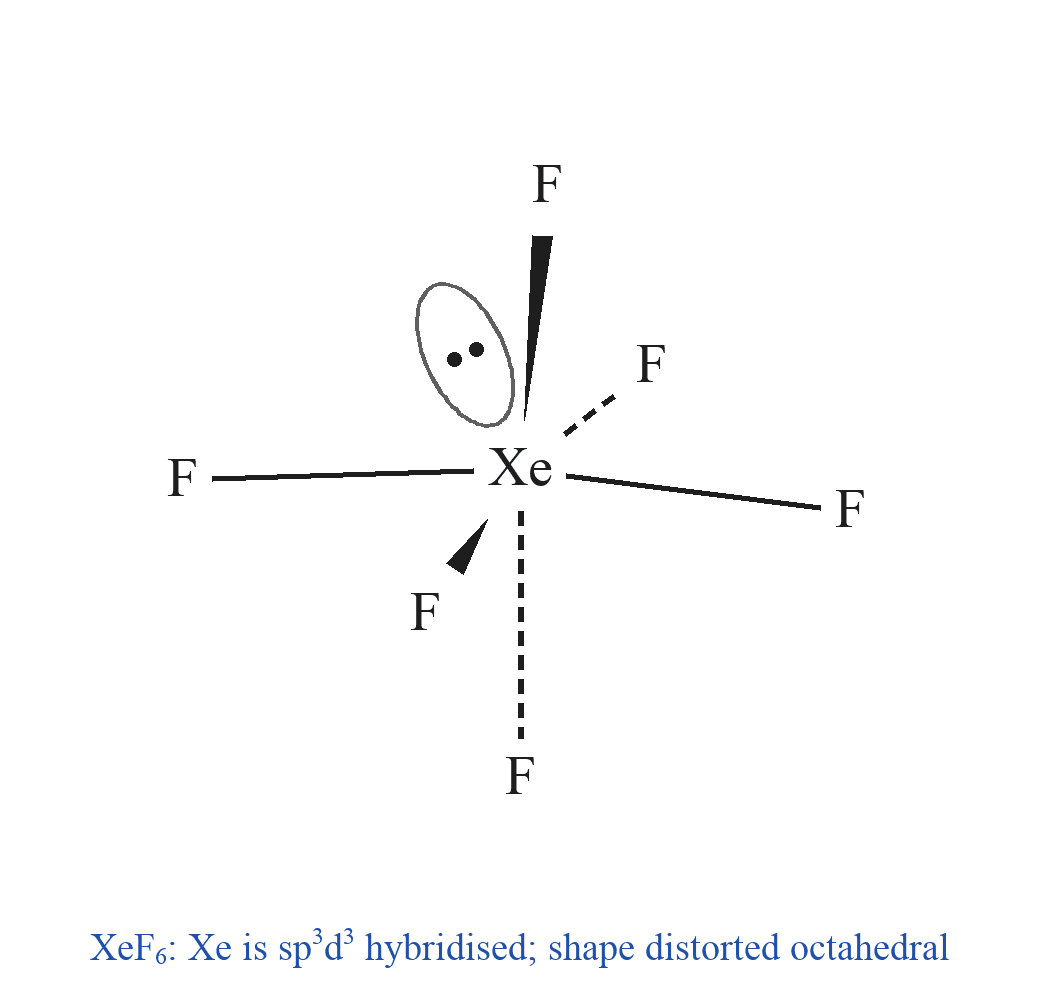
Therefore, (i) iodine is sp³d in IF₃, sp³d² in IF₅ and sp³d³ in IF₇; (ii) in XeF₆ xenon is sp³d³ hybridised and the molecule is a distorted octahedron with one lone pair.