
Opening your dashboard
Class 12 Biology Chapter 10 Human Health and Diseases: Previous Year Questions
39 questions on Chapter 10, each solved step by step. Class 12 Biology, ICSE 2026-27.
39 questions with solutions
1–5 marks · Mixed difficulty
- 14 marks
Question 1
Explain the mechanism of action of T-cells to antigens.
Solve with AIWritten solution
Solution:
Key idea: T-lymphocytes are responsible for cell-mediated immunity (CMI). They do not make antibodies. Instead they recognise antigen that is displayed on the surface of other cells and then either help other immune cells or kill the cell carrying the antigen.
Step 1 — T-cells are formed and made ready.
T-cells arise from stem cells in the bone marrow and mature in the thymus. Each mature T-cell carries a T-cell receptor (TCR) that fits one particular antigen.
Step 2 — The antigen is presented to the T-cell.
A T-cell cannot recognise a free antigen. An antigen-presenting cell (such as a macrophage or dendritic cell) engulfs the pathogen, breaks it down and displays pieces of its antigen on its surface on MHC molecules. Infected body cells and cancer cells also display foreign antigen on MHC molecules.
Step 3 — Helper T-cells are activated.
A helper T-cell (CD4 T-cell) whose receptor fits the presented antigen binds to it and becomes activated. It multiplies and releases chemical messengers called cytokines (interleukins, interferon-gamma). These cytokines stimulate B-cells to multiply and make antibodies, activate cytotoxic T-cells and make macrophages better at killing microbes.
Step 4 — Cytotoxic T-cells kill the antigen-bearing cells.
Cytotoxic (killer) T-cells (CD8 T-cells) recognise body cells that display the foreign antigen, such as virus-infected cells, cancer cells or the cells of a transplanted organ. They attach to the target cell and release perforins, which punch pores in its membrane, and granzymes, which enter through the pores and make the cell destroy itself (apoptosis). This is why T-cells are responsible for graft rejection.
Step 5 — The response is controlled and remembered.
Regulatory (suppressor) T-cells damp down the response once the antigen is cleared, so that the immune system does not attack the body's own tissues. Some activated T-cells remain as memory T-cells, which respond faster and more strongly if the same antigen enters again.
Therefore, T-cells act on antigens by recognising them on antigen-presenting or infected cells, after which helper T-cells release cytokines that activate B-cells, macrophages and killer cells, cytotoxic T-cells destroy the antigen-bearing cells with perforins and granzymes, regulatory T-cells stop the response, and memory T-cells give lasting immunity.
- 24 marks
Question 2
Name the causative organism and preventive measures for each of the following:
(i) Swine flu
(ii) Typhoid
(iii) Filariasis
(iv) Syphilis
Solve with AIWritten solution
Solution:
Key idea: A communicable disease is caused by a pathogen that passes from one person to another. Prevention depends on how the pathogen spreads: through air (droplets), contaminated food and water, insect vectors, or sexual contact.
Step 1 — (i) Swine flu.
Swine flu is caused by the influenza A (H1N1) virus; the strain that caused the 2009 pandemic now circulates as one of the seasonal flu viruses. It spreads through droplets from coughs and sneezes. It is prevented by a yearly influenza vaccine, frequent hand-washing, covering the mouth and nose while coughing or sneezing, wearing a mask in crowded places during an outbreak, and keeping a sick person away from others.
Step 2 — (ii) Typhoid.
Typhoid is caused by the bacterium Salmonella Typhi (Salmonella typhi). It spreads by the faecal–oral route through food and water contaminated with the faeces of patients or carriers. It is prevented by drinking safe (boiled or treated) water, eating freshly cooked food, washing hands with soap after using the toilet and before eating, proper sewage disposal, and typhoid vaccination (the typhoid conjugate vaccine).
Step 3 — (iii) Filariasis.
Filariasis (elephantiasis) is caused by filarial worms, mainly Wuchereria bancrofti (and Brugia malayi, earlier called Wuchereria malayi). It is spread by the bite of an infected female Culex mosquito. It is prevented by controlling mosquitoes (removing stagnant water, using larvicides), sleeping under mosquito nets and using repellents, and by the mass drug administration of anti-filarial tablets to whole communities.
Step 4 — (iv) Syphilis.
Syphilis is caused by the spiral bacterium Treponema pallidum. It spreads mainly through sexual contact, and from an infected mother to her baby. It is prevented by safe sex using condoms, avoiding multiple sexual partners, screening pregnant women and donated blood, and early treatment of patients and their partners with penicillin.
Therefore, swine flu is caused by the influenza A (H1N1) virus, typhoid by Salmonella Typhi, filariasis by Wuchereria bancrofti and syphilis by Treponema pallidum, and each is prevented by blocking its route of spread and, where available, by vaccination.
- 34 marks
Question 3
Mention any four methods involved in the treatment of cancer.
Solve with AIWritten solution
Solution:
Key idea: Cancer is uncontrolled division of cells that invade other tissues. Treatment aims to remove the tumour or to kill or stop the dividing cancer cells while sparing normal cells as far as possible.
Step 1 — Surgery.
The tumour is removed by an operation, together with some surrounding tissue and nearby lymph nodes. It works best when the cancer is found early and has not spread.
Step 2 — Radiotherapy.
The tumour is exposed to high-energy radiation (X-rays, gamma rays or particle beams) aimed at it. The radiation damages the DNA of the dividing cancer cells so that they die, while the surrounding normal tissue is shielded as far as possible.
Step 3 — Chemotherapy.
Drugs that stop cell division or kill rapidly dividing cells are given by mouth or into a vein. Because they also affect normal dividing cells, they cause side effects such as hair loss and anaemia.
Step 4 — Immunotherapy.
The patient's own immune system is helped to destroy the tumour. Biological response modifiers such as alpha-interferon activate the immune system; today monoclonal antibodies, immune checkpoint inhibitors and CAR-T cells (the patient's T-cells modified to attack the cancer) are also used.
Step 5 — Other methods.
Targeted therapy uses drugs that block a particular molecule that the cancer cells need, and hormone therapy blocks hormones that some cancers (breast, prostate) need to grow. Usually two or more methods are combined.
Therefore, four methods of treating cancer are surgery, radiotherapy, chemotherapy and immunotherapy (with targeted and hormone therapy also used).
- 44 marks
Question 4
Explain the structure of a typical antibody molecule.
Solve with AIWritten solution
Solution:
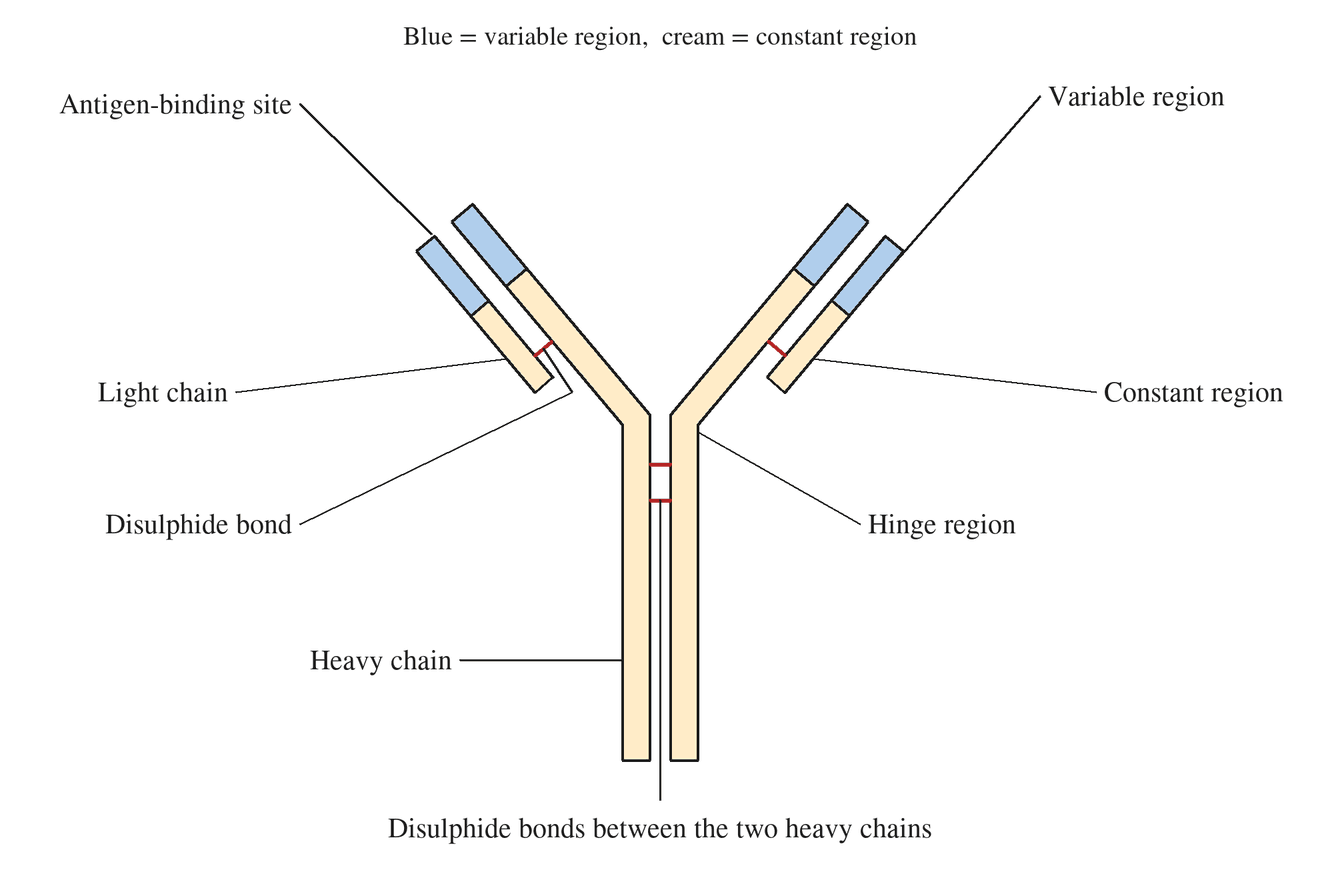
Key idea: An antibody (immunoglobulin) is a protein made by plasma cells (activated B-cells) that binds one specific antigen. A typical antibody such as IgG is a Y-shaped molecule made of four polypeptide chains.
Step 1 — Four polypeptide chains.
The molecule has two identical heavy (H) chains and two identical light (L) chains, so it is written as . The heavy chains are long; the light chains are about half as long.
Step 2 — Disulphide bonds hold them together.
Each light chain is joined to one heavy chain by a disulphide (S–S) bond, and the two heavy chains are joined to each other by one or more disulphide bonds near the middle of the molecule.
Step 3 — The Y shape and the hinge.
The two heavy chains run side by side in the stem of the Y and then separate into the two arms. A light chain lies along the outer side of each arm. The region where the arms meet the stem is the flexible hinge region, which lets the arms move and bind antigens at different distances apart.
Step 4 — Variable and constant regions.
At the tip of each arm, the ends of the heavy and light chains form the variable region, whose amino acid sequence differs from one antibody to another. The rest of each chain is the constant region, which is the same in all antibodies of one class.
Step 5 — Antigen-binding sites.
The variable regions of one heavy chain and one light chain together form an antigen-binding site (paratope) at the tip of each arm. So one antibody molecule has two identical antigen-binding sites and can bind two antigen molecules. The two arms are called the Fab parts (fragment, antigen-binding), and the stem is the Fc part (fragment, crystallisable), which binds to immune cells and to complement.
Therefore, a typical antibody is a Y-shaped H₂L₂ molecule of two heavy and two light chains held by disulphide bonds, with a hinge, constant regions in the stem and arms, and variable regions at the tips forming two antigen-binding sites.
- 51 mark
Question 5
Expand the following abbreviations:
HIV
Solve with AIWritten solution
Solution:
Key idea: HIV is the virus that causes AIDS (Acquired Immuno Deficiency Syndrome).
Step 1 — Expand each letter.
H stands for Human, I for Immunodeficiency and V for Virus.
Therefore, HIV stands for Human Immunodeficiency Virus.
- 62 marks
Question 6
Mention the causative agent and the preventive measures for each of the following:
(i) Gonorrhoea
(ii) Pneumonia.
Solve with AIWritten solution
Solution:
Key idea: Gonorrhoea is a sexually transmitted infection, and pneumonia is an infection of the lungs spread through the air. Each is prevented by blocking its own route of spread.
Step 1 — (i) Gonorrhoea: causative agent.
Gonorrhoea is caused by the bacterium Neisseria gonorrhoeae.
Step 2 — (i) Gonorrhoea: prevention.
It is prevented by safe sex using condoms, avoiding multiple sexual partners or sex with unknown partners, early testing and complete treatment of patients and their sexual partners, and checking pregnant women so that the baby's eyes are not infected at birth.
Step 3 — (ii) Pneumonia: causative agent.
Pneumonia is mainly caused by the bacteria Streptococcus pneumoniae and Haemophilus influenzae (some cases are caused by viruses).
Step 4 — (ii) Pneumonia: prevention.
It spreads through droplets or aerosols from an infected person and by sharing glasses and utensils. It is prevented by avoiding close contact with patients, covering the mouth and nose while coughing or sneezing, washing hands, not sharing utensils, and vaccination of children with the pneumococcal conjugate vaccine (PCV) and the Hib vaccine.
Therefore, gonorrhoea is caused by Neisseria gonorrhoeae and is prevented by safe sex and early treatment, and pneumonia is caused mainly by Streptococcus pneumoniae (and Haemophilus influenzae) and is prevented by avoiding droplet spread and by vaccination.
- 71 mark
Question 7
Answer the following questions briefly and to the point:
Give the biological name of the organism causing typhoid.
Solve with AIWritten solution
Solution:
Key idea: Typhoid is a bacterial infection of the intestine spread through contaminated food and water.
Step 1 — Identify the pathogen.
Typhoid fever is caused by a rod-shaped bacterium of the genus Salmonella.
Step 2 — Give its biological name.
Its name is Salmonella typhi, written today as Salmonella enterica serovar Typhi.
Therefore, typhoid is caused by Salmonella typhi.
- 81 mark
Question 8
Answer the following questions briefly and to the point:
Name the diagnostic test for AIDS.
Solve with AIWritten solution
Solution:
Key idea: AIDS is diagnosed by detecting infection with HIV in the blood, either the antibodies made against the virus or the virus itself.
Step 1 — Name the screening test.
The commonly used test is ELISA (Enzyme Linked Immuno-Sorbent Assay), which detects antibodies against HIV (and, in newer kits, a viral protein as well).
Step 2 — Note how a positive result is confirmed.
A single positive screening result is never taken as final. Current practice (WHO guidelines, 2019) confirms it by testing again with two or three different test kits in sequence, and a nucleic-acid test such as PCR, which detects the viral RNA, is used for infants and for doubtful results. The older Western blot test is no longer recommended for confirmation.
Therefore, the diagnostic test for AIDS is ELISA.
- 92 marks
Question 9
Give one significant difference between each of the following pairs :
(a) Humoral immunity and cell mediated immunity.
(b) Benign tumour and malignant tumour
Solve with AIWritten solution
Solution:
Key idea: Acquired immunity has two arms, humoral and cell-mediated. Tumours are of two kinds, depending on whether the cells stay in one place or invade other tissues.
Step 1 — (a) Humoral and cell-mediated immunity.
Humoral immunity is carried out by antibodies made by B-lymphocytes (plasma cells); the antibodies circulate in the blood and lymph (body fluids) and act mainly against pathogens and toxins outside cells. Cell-mediated immunity is carried out directly by T-lymphocytes, which kill virus-infected cells, cancer cells and the cells of transplanted organs; no antibodies are involved.
Step 2 — (b) Benign and malignant tumours.
A benign tumour stays confined to its original place, usually inside a capsule, and does not spread to other parts of the body. A malignant tumour invades the neighbouring tissues, and its cells spread through the blood or lymph to form new tumours elsewhere (metastasis).
Therefore, (a) humoral immunity works through antibodies made by B-cells in body fluids, whereas cell-mediated immunity works through T-cells acting directly on cells; (b) a benign tumour stays localised without metastasis, whereas a malignant tumour invades tissues and spreads by metastasis.
- 101 mark
Question 10
Answer the following questions briefly to the point.
Name the antibody which is more effective in allergies.
Solve with AIWritten solution
Solution:
Key idea: An allergy is an exaggerated immune response to a harmless substance called an allergen, such as pollen, dust mites or animal fur.
Step 1 — Recall which antibody takes part.
In an allergy, the allergen causes the production of IgE antibodies. IgE binds to mast cells, and when the allergen enters again, the mast cells release histamine and serotonin, which cause sneezing, watery eyes and itching.
Step 2 — Name it.
So the antibody most involved in allergies is immunoglobulin E.
Therefore, IgE is the antibody more effective (most involved) in allergies.
- 112 marks
Question 11
Give one significant difference between primary lymphoid organs and secondary lymphoid organs. Give one examples each.
Solve with AIWritten solution
Solution:
Key idea: Lymphoid organs are the organs where lymphocytes are formed, mature or meet antigens.
Step 1 — State the difference.
Primary lymphoid organs are where immature lymphocytes are formed and mature into antigen-sensitive lymphocytes. Secondary lymphoid organs are where mature lymphocytes meet antigens and multiply to become effector cells.
Step 2 — Give an example of each.
The bone marrow and the thymus are primary lymphoid organs. The spleen, lymph nodes, tonsils, Peyer's patches of the small intestine and the appendix are secondary lymphoid organs.
Therefore, primary lymphoid organs (for example, the thymus) are sites of lymphocyte formation and maturation, whereas secondary lymphoid organs (for example, the spleen) are sites where lymphocytes interact with antigens and multiply.
- 122 marks
Question 12
Explain two characteristics of cancer cells.
Solve with AIWritten solution
Solution:
Key idea: Normal cells divide only when needed and stop when they touch neighbouring cells. Cancer cells have lost these controls.
Step 1 — Loss of contact inhibition and uncontrolled division.
In normal tissue, contact with surrounding cells stops a cell from dividing (contact inhibition). Cancer cells have lost this property, so they keep dividing without control and form a mass of cells called a tumour.
Step 2 — Invasion and metastasis.
Cancer cells of a malignant tumour invade and damage the neighbouring tissues. Some cells break away, travel through the blood or lymph and start new tumours in other parts of the body; this spread is called metastasis.
Therefore, two characteristics of cancer cells are the loss of contact inhibition, which leads to uncontrolled division, and the ability to invade tissues and spread by metastasis.
- 135 marks
Question 13
Draw a labelled diagram to show the life cycle of Plasmodium.
Solve with AIWritten solution
Solution:
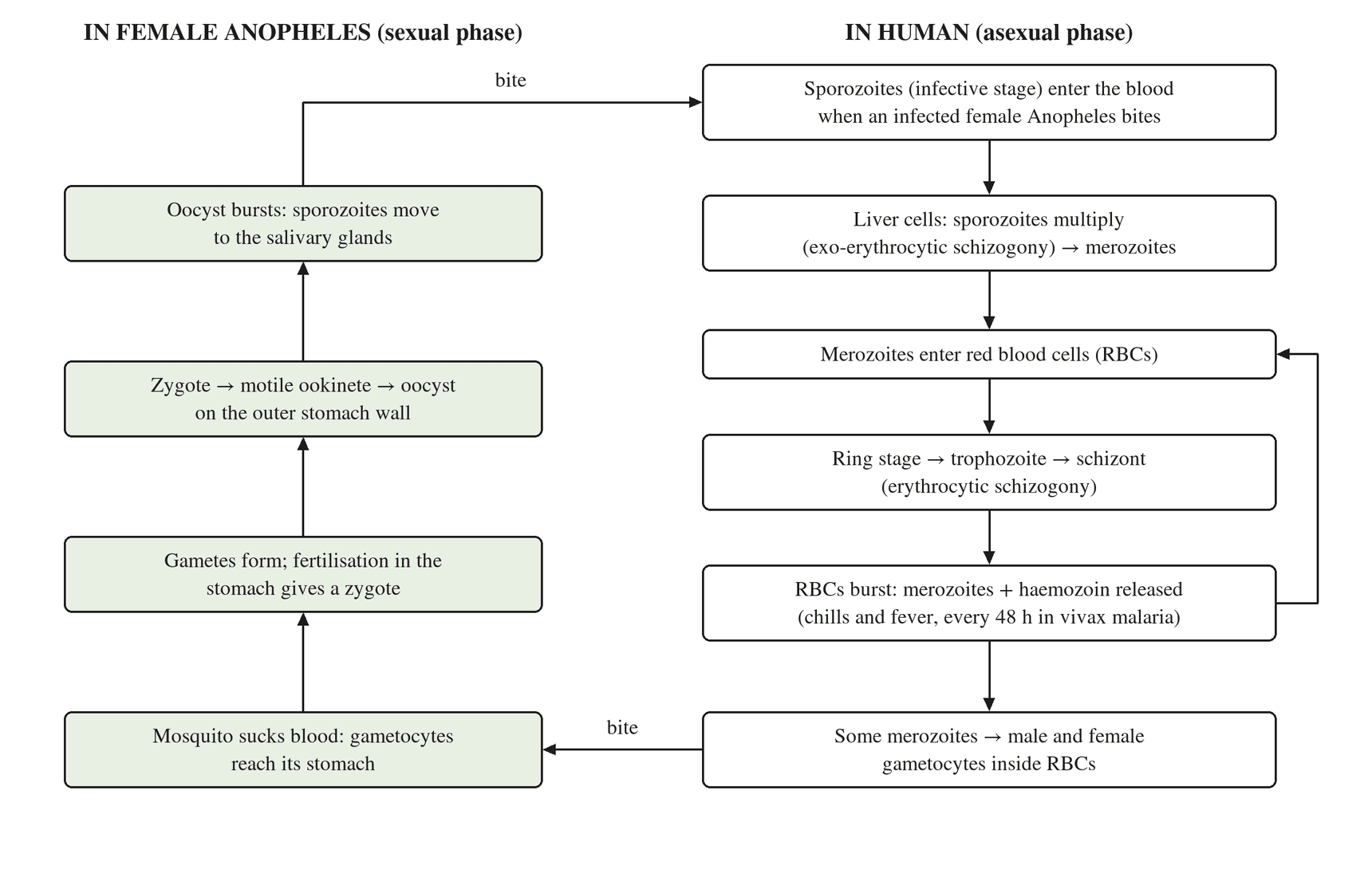
Key idea: Plasmodium, the malarial parasite, completes its life cycle in two hosts: the asexual phase in humans (in liver cells and red blood cells) and the sexual phase in the female Anopheles mosquito, which is also the vector.
Step 1 — Infection of a human.
When an infected female Anopheles mosquito bites a person, it injects sporozoites (the infective stage) with its saliva into the blood.
Step 2 — Multiplication in liver cells.
The sporozoites reach the liver and enter liver cells. There they multiply asexually (exo-erythrocytic schizogony) and form thousands of merozoites, which are released into the blood when the liver cells burst.
Step 3 — Multiplication in red blood cells.
Each merozoite enters a red blood cell (RBC) and grows through the ring stage and the trophozoite stage into a schizont, which divides asexually to form many merozoites. The RBC bursts and releases the merozoites, which attack fresh RBCs. The bursting of RBCs releases a toxic substance called haemozoin, which causes chills followed by high fever that recurs every 48 hours in vivax malaria.
Step 4 — Formation of gametocytes.
Some merozoites inside RBCs develop into male and female gametocytes. These do not develop further in the human body.
Step 5 — Sexual phase in the mosquito.
When a female Anopheles sucks the blood of an infected person, the gametocytes enter its stomach. They form male and female gametes, which fuse (fertilisation) to form a zygote. The zygote becomes a motile ookinete, which bores into the stomach wall and forms an oocyst on its outer surface.
Step 6 — Sporozoites formed and the cycle repeats.
The oocyst divides to form many sporozoites. When it bursts, the sporozoites move to the salivary glands of the mosquito, and they are injected into the next person the mosquito bites.
Therefore, in the life cycle of Plasmodium, sporozoites injected by a female Anopheles multiply in human liver cells and red blood cells to give merozoites and then gametocytes, and the gametocytes taken up by the mosquito form gametes, zygote, ookinete, oocyst and new sporozoites, as shown in the labelled diagram.
- 145 marks
Question 14
Draw a labelled diagram to show replication of HIV in human cells.
Solve with AIWritten solution
Solution:
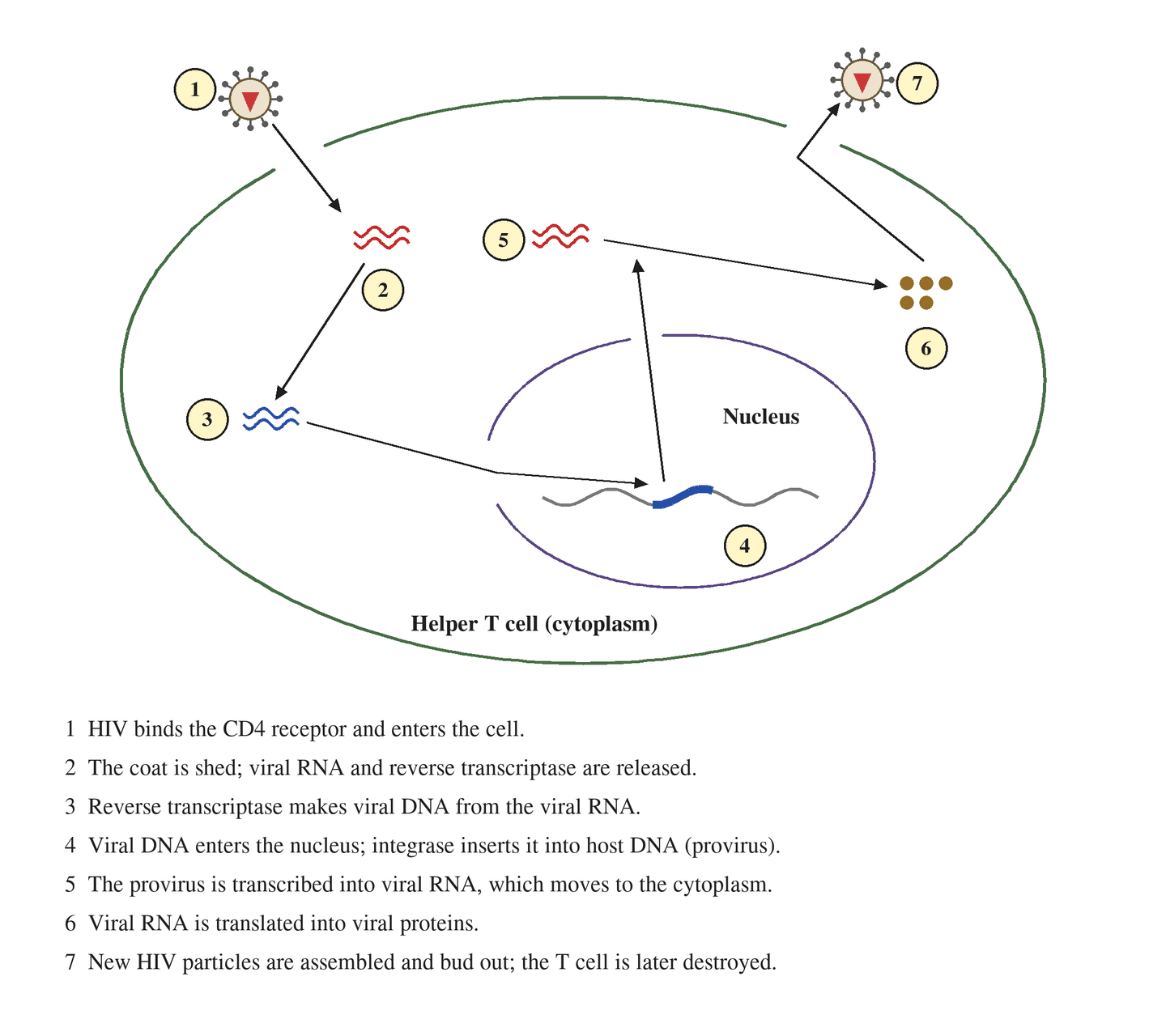
Key idea: HIV is a retrovirus: its genetic material is RNA, which it copies into DNA with the enzyme reverse transcriptase after entering a human cell. It infects mainly helper T-cells (and macrophages), which carry the CD4 receptor.
Step 1 — Attachment and entry (stage 1).
The glycoprotein spikes of HIV bind to the CD4 receptor on a helper T-cell. The virus envelope fuses with the cell membrane and the core enters the cytoplasm.
Step 2 — Release of viral RNA (stage 2).
The protein coat is removed, and the two copies of viral RNA, together with the enzyme reverse transcriptase, are released into the cytoplasm.
Step 3 — Reverse transcription (stage 3).
Reverse transcriptase uses the viral RNA as a template to make a DNA copy, which is then made double-stranded. This flow of information from RNA to DNA is the reverse of normal transcription.
Step 4 — Integration (stage 4).
The viral DNA enters the nucleus, and the enzyme integrase inserts it into the host cell's DNA. The inserted viral DNA is called a provirus.
Step 5 — Transcription and translation (stages 5 and 6).
The host cell's own machinery transcribes the provirus into many copies of viral RNA. These move to the cytoplasm, where some are translated on host ribosomes into viral proteins (coat proteins and enzymes) and others serve as the genome of new viruses.
Step 6 — Assembly and release (stage 7).
New virus particles are assembled and bud out through the cell membrane, taking part of it as their envelope. They infect other helper T-cells. In this way the number of helper T-cells falls steadily, and the immune system becomes weak.
Therefore, HIV replicates by binding to the CD4 receptor and entering a helper T-cell, making DNA from its RNA with reverse transcriptase, integrating this DNA into the host genome as a provirus, using the host cell to make viral RNA and proteins, and releasing new viruses by budding, as shown in the labelled diagram.
- 151 mark
Question 15
Answer the following questions briefly.
Mention the scientific name of a protozoan parasite that causes Amoebiasis.
Solve with AIWritten solution
Solution:
Key idea: Amoebiasis (amoebic dysentery) is an infection of the large intestine caused by a protozoan spread through food and water contaminated with faeces; houseflies carry the cysts.
Step 1 — Identify the parasite.
The parasite is an amoeba that lives in the large intestine and can invade its wall.
Step 2 — Give its scientific name.
It is Entamoeba histolytica.
Therefore, amoebiasis is caused by Entamoeba histolytica.
- 161 mark
Question 16
Answer the following questions briefly.
Name the type of antibody that can be transferred through the placenta.
Solve with AIWritten solution
Solution:
Key idea: A baby gets some ready-made antibodies from its mother. This is natural passive immunity.
Step 1 — Recall which antibody crosses the placenta.
Only one class of antibody is carried across the placenta from the mother's blood to the foetus. The choice is made by a receptor, not by size alone: cells of the placenta carry a special receptor (the neonatal Fc receptor) that binds only this class and actively transports it, while the other classes stay in the mother's blood. This class is also the most abundant antibody in the blood.
Step 2 — Name it.
It is immunoglobulin G. (IgA, by contrast, reaches the baby through colostrum, the first milk.)
Therefore, IgG is the antibody transferred through the placenta.
- 171 mark
Question 17
Answer the following questions briefly.
Assertion: A person who has received a cut from a sharp object and is bleeding needs to be given an anti-tetanus injection.
Reason: Anti-tetanus injection stimulates the production of antibodies for tetanus.
Solve with AIAnswer
(A) Both Assertion and Reason are true, and Reason is the correct explanation of Assertion.
(B) Both Assertion and Reason are true, but Reason is not the correct explanation of Assertion.
- Correct
(C) Assertion is true, but Reason is false.
(D) Both Assertion and Reason are false.
Answer: (C) Assertion is true, but Reason is false.
Key idea: Tetanus is caused by the toxin of the bacterium Clostridium tetani, whose spores enter through wounds. Quick protection after an injury needs ready-made antibodies (antitoxin), which give passive immunity; a vaccine that makes the body produce its own antibodies (active immunity) takes time to work.
Step 1 — Judge the Assertion.
A cut from a sharp object, especially a rusty or dirty one, can carry spores of Clostridium tetani into the wound. Tetanus can be fatal, so the injured person needs an anti-tetanus injection. The Assertion is true.
Step 2 — Judge the Reason.
In the sense used in the chapter, the anti-tetanus injection given after an injury is anti-tetanus serum, which contains preformed antibodies (antitoxin) against the tetanus toxin. It gives immediate passive immunity; it does not stimulate the body to produce antibodies. So the Reason, which says the injection stimulates antibody production, is false.
Note: In clinics, the injection given after a wound is often a booster of tetanus toxoid (a vaccine), which does stimulate antibody production in a person who was vaccinated earlier; a person who was never vaccinated is also given tetanus immunoglobulin, the ready-made antibodies. The question follows the textbook meaning of anti-tetanus serum, so the Reason is taken as false.
Why the others are wrong:
- (A) The Reason is false as stated, so it cannot be the correct explanation of the Assertion.
- (B) This needs both statements to be true, but anti-tetanus serum supplies antibodies instead of making the body produce them.
- (D) The Assertion is true, because a wound can let tetanus spores in and an anti-tetanus injection is needed.
Therefore, the Assertion is true and the Reason is false, option (C).
- 182 marks
Question 18
Answer the following questions briefly.
Expand the following abbreviations:
a. NACO
b. PID
Solve with AIWritten solution
Solution:
Key idea: Both abbreviations come from health topics: NACO from the control of HIV/AIDS in India, and PID from the complications of sexually transmitted infections.
Step 1 — a. Expand NACO.
NACO is the National AIDS Control Organisation, the body under the Ministry of Health and Family Welfare, Government of India, that leads the national programme for the prevention and control of HIV/AIDS.
Step 2 — b. Expand PID.
PID is Pelvic Inflammatory Disease, an infection of the uterus, fallopian tubes and ovaries in women, often a complication of untreated sexually transmitted infections such as gonorrhoea and chlamydia.
Therefore, a. NACO stands for National AIDS Control Organisation and b. PID stands for Pelvic Inflammatory Disease.
- 192 marks
Question 19
Give one difference between the following pairs
i. Sites of maturation of B - Lymphocytes and T - Lymphocytes
ii. Sources of Opioids and cannabinoids
Solve with AIWritten solution
Solution:
Key idea: B- and T-lymphocytes are formed in the bone marrow but mature in different primary lymphoid organs. Opioids and cannabinoids are drugs obtained from different plants.
Step 1 — i. Sites of maturation of B- and T-lymphocytes.
B-lymphocytes mature in the bone marrow itself (in humans and other mammals), whereas T-lymphocytes leave the bone marrow as immature cells and mature in the thymus.
Step 2 — ii. Sources of opioids and cannabinoids.
Opioids (such as morphine and heroin) are obtained from the dried latex of the unripe capsules of the poppy plant, Papaver somniferum. Cannabinoids (such as marijuana, hashish, charas and ganja) are obtained from the inflorescences (and leaves and resin) of the hemp plant, Cannabis sativa.
Therefore, i. B-lymphocytes mature in the bone marrow while T-lymphocytes mature in the thymus, and ii. opioids come from the poppy, Papaver somniferum, while cannabinoids come from the hemp plant, Cannabis sativa.
- 202 marks
Question 20
Riya went to the hospital to meet her sister who was undergoing some treatment. The hospital was crowded with patients suffering from various types of allergies, pneumonia and Ascariasis. Name the disease that Riya is most likely to get infected with. Give one reason for your answer.
Solve with AIWritten solution
Solution:
Key idea: Only infectious (communicable) diseases can pass from one person to another, and each spreads by its own route.
Step 1 — Rule out allergies.
Allergies are an over-reaction of a person's own immune system to an allergen. They are not caused by a pathogen, so they cannot be caught from another person.
Step 2 — Rule out ascariasis.
Ascariasis is caused by the roundworm Ascaris. It spreads only when a person swallows its eggs with food, water or vegetables contaminated with soil or faeces, not by being near a patient.
Step 3 — Identify pneumonia as the risk.
Pneumonia is caused by bacteria such as Streptococcus pneumoniae (and some viruses), which spread through the droplets and aerosols that patients release when they cough, sneeze or talk. In a crowded hospital Riya would breathe the same air as these patients.
Therefore, Riya is most likely to get pneumonia, because it is an airborne infection that spreads through droplets from infected patients, while allergies are not infectious and ascariasis spreads only through contaminated food and water.
- 213 marks
Question 21
The diagram given below shows the life cycle of a malarial parasite. Study it carefully and answer the questions that follow:

(i) Name the hosts in which the asexual phase and sexual phase of the life cycle take place.
(ii) Identify the infective stage labelled 'D'.
(ii) Name the structures labelled 'A' and 'E'.
(iv) Give any one symptom of malaria.
Solve with AIWritten solution
Solution:
Key idea: The malarial parasite, Plasmodium, needs two hosts. Phase 1 in the figure includes the mosquito and the liver; Phase 2 is the repeated cycle in red blood cells.
Note: The paper numbers the third part as (ii) again; it is answered here as the third part.
Step 1 — (i) Name the hosts.
The asexual phase (multiplication in liver cells and red blood cells) takes place in humans, and the sexual phase (formation and fusion of gametes, and formation of sporozoites) takes place in the female Anopheles mosquito. Because the sexual phase occurs in it, the mosquito is the primary (definitive) host, and humans are the secondary (intermediate) host.
Step 2 — (ii) Identify the infective stage D.
Stage D shows the sickle-shaped cells passed from the mosquito into the human. These are the sporozoites, the stage that infects humans.
Step 3 — (iii) Name structures A and E.
A is the liver, made of liver cells (hepatocytes) in which the sporozoites multiply to form merozoites. E is a red blood cell (RBC) containing the trophozoite stage of the parasite in the erythrocytic cycle.
Step 4 — (iv) Give one symptom.
Malaria causes high fever with chills and shivering that comes back at regular intervals (every 48 hours in vivax malaria), along with headache and sweating as the fever falls.
Therefore, (i) the asexual phase occurs in humans and the sexual phase in the female Anopheles mosquito; (ii) D is the sporozoite; (iii) A is the liver and E is a red blood cell; (iv) a symptom is recurring high fever with chills.
- 221 mark
Question 22
Answer the following questions briefly.
In human plasma, five different types of immunoglobulins are found.
Which type of immunoglobulin is responsible for allergic reactions?
Solve with AIWritten solution
Solution:
Key idea: The five immunoglobulins in plasma are IgA, IgD, IgE, IgG and IgM. Each class has a particular role.
Step 1 — Recall the role of each class in allergy.
During an allergic reaction, the allergen causes production of one class of antibody that attaches to mast cells and basophils. When the allergen enters again, it binds to these antibodies and the cells release histamine and serotonin, which cause the symptoms.
Step 2 — Name the class.
This class is immunoglobulin E.
Therefore, IgE is responsible for allergic reactions.
- 231 mark
Question 23
Answer the following questions briefly.
If a person shows the production of interferons in his body, then he is suffering from ______.
Solve with AIAnswer
(A) Malaria
(B) Ring worm
- Correct
(C) Dengue
(D) Typhoid
Answer: (C) Dengue
Key idea: Interferons are proteins released by virus-infected cells. They protect neighbouring cells from viral infection, so their production signals a viral disease.
Step 1 — Identify the kind of pathogen.
In the textbook, interferons are the proteins that virus-infected cells release to protect neighbouring cells from the virus. So their production points to a viral infection.
Step 2 — Check the options.
Dengue is caused by the dengue virus, spread by Aedes mosquitoes. So the person is suffering from dengue.
Note: One interferon, interferon-gamma, is also made by T-cells and natural killer cells in other infections, including malaria. The question uses the textbook meaning of interferons as antiviral proteins, which points to the viral disease.
Why the others are wrong:
- (A) Malaria is caused by the protozoan Plasmodium, not by a virus.
- (B) Ringworm is caused by fungi such as Trichophyton, Microsporum and Epidermophyton.
- (D) Typhoid is caused by the bacterium Salmonella typhi.
Therefore, a person producing interferons is suffering from dengue, option (C).
- 241 mark
Question 24
Answer the following questions briefly.
Assertion: Lymphocytes originate and proliferate in primary lymphoid organs.
Reason: Spleen is a secondary lymphoid organ.
Solve with AIAnswer
(A) Both Assertion and Reason are true and Reason is the correct explanation for Assertion.
- Correct
(B) Both Assertion and Reason are true, but Reason is not the correct explanation for Assertion.
(C) Assertion is true and Reason is false.
(D) Both Assertion and Reason are false.
Answer: (B) Both Assertion and Reason are true, but Reason is not the correct explanation for Assertion.
Key idea: Primary lymphoid organs (bone marrow and thymus) are where lymphocytes are formed and mature. Secondary lymphoid organs (spleen, lymph nodes, tonsils, Peyer's patches, appendix) are where mature lymphocytes meet antigens.
Step 1 — Judge the Assertion.
Lymphocytes originate from stem cells in the bone marrow and multiply and mature in the bone marrow and the thymus, which are primary lymphoid organs. The Assertion is true.
Step 2 — Judge the Reason.
The spleen is a secondary lymphoid organ; it filters blood and is a site where lymphocytes meet blood-borne antigens. The Reason is true.
Step 3 — Decide whether the Reason explains the Assertion.
The Reason only names one secondary lymphoid organ. It says nothing about why lymphocytes are formed in primary lymphoid organs, so it does not explain the Assertion.
Note: The multiplication of lymphocytes after they meet an antigen (to form effector and memory cells) takes place in the secondary lymphoid organs; the Assertion refers to the formation and early multiplication of lymphocytes in the primary organs.
Why the others are wrong:
- (A) Both statements are true, but the spleen being a secondary organ does not explain where lymphocytes originate.
- (C) The Reason is true, since the spleen is indeed a secondary lymphoid organ.
- (D) Both statements are true, so they cannot both be false.
Therefore, both the Assertion and the Reason are true, but the Reason is not the correct explanation, option (B).
- 251 mark
Question 25
Answer the following questions briefly.
Answer the following questions:
(b) Expand the following abbreviation:
NACO
Solve with AIWritten solution
Solution:
Key idea: NACO is the Indian government body that leads the control of HIV/AIDS.
Step 1 — Expand the letters.
N stands for National, A for AIDS, C for Control and O for Organisation. It works under the Ministry of Health and Family Welfare and runs the National AIDS and STD Control Programme.
Therefore, NACO stands for National AIDS Control Organisation.
- 262 marks
Question 26
(i) (a) Write the scientific name of the causative agent of the following diseases.
Filariasis
(i) (b) Write the mode of transmission for the following diseases:
Filariasis
(ii) (a) Write the scientific name of the causative agent of the following diseases:
Typhoid
(ii) (b) Write the mode of transmission for the following diseases:
Typhoid
Solve with AIWritten solution
Solution:
Key idea: Filariasis is a worm disease spread by mosquitoes, while typhoid is a bacterial disease spread through contaminated food and water.
Step 1 — (i) (a) Causative agent of filariasis.
Filariasis is caused by the filarial worm Wuchereria bancrofti (Brugia malayi, earlier called Wuchereria malayi, also causes it).
Step 2 — (i) (b) Mode of transmission of filariasis.
The worms are transmitted to healthy people by the bite of an infected female mosquito, which carries the larvae. Wuchereria bancrofti, the main cause in India, is spread mainly by the female Culex mosquito, while Brugia malayi is spread mainly by Mansonia mosquitoes.
Step 3 — (ii) (a) Causative agent of typhoid.
Typhoid is caused by the bacterium Salmonella typhi (Salmonella enterica serovar Typhi).
Step 4 — (ii) (b) Mode of transmission of typhoid.
It spreads by the faecal–oral route: a person swallows food or water contaminated with the faeces of a patient or a healthy carrier. Houseflies can carry the bacteria to food.
Therefore, filariasis is caused by Wuchereria bancrofti and spread by the bite of the female Culex mosquito, and typhoid is caused by Salmonella typhi and spread through contaminated food and water.
- 273 marks
Question 27
A patient was given an anti-retroviral drug by the doctor.
(i) (a) Which disease was the patient diagnosed with?
(i) (b) Mention any one symptom of HIV disease.
(ii) Give the scientific name of the causative agent of HIV disease
(iii) Which method was used to diagnose HIV disease?
(iv) What is the role of Reverse Transcriptase and Integrase in the life cycle of a retrovirus?
Solve with AIWritten solution
Solution:
Key idea: Anti-retroviral drugs act against retroviruses. The only retrovirus disease in the chapter is infection with HIV, which leads to AIDS.
Step 1 — (i) (a) Name the disease.
An anti-retroviral drug is given to a person infected with the human immunodeficiency virus, so the patient was diagnosed with HIV infection, the disease that leads to AIDS (Acquired Immuno Deficiency Syndrome). AIDS is the late stage of HIV infection, when the immune system has become very weak; anti-retroviral therapy keeps the virus under control and delays or prevents this stage.
Step 2 — (i) (b) Give one symptom.
Because the immune system becomes weak, the patient suffers repeated infections by bacteria, viruses, fungi and protozoa (opportunistic infections), with fever, long-lasting diarrhoea, swollen lymph nodes and weight loss.
Step 3 — (ii) Name the causative agent.
The disease is caused by the Human Immunodeficiency Virus (HIV), mainly HIV-1, an enveloped RNA virus of the retrovirus group (genus Lentivirus).
Step 4 — (iii) Name the diagnostic method.
HIV infection is diagnosed by ELISA (Enzyme Linked Immuno-Sorbent Assay), which detects antibodies against HIV in the blood (newer kits also detect a viral protein). A positive result is confirmed by testing again with different kits, or by a nucleic-acid test such as PCR; the older Western blot is no longer recommended.
Step 5 — (iv) Role of reverse transcriptase and integrase.
Reverse transcriptase uses the viral RNA as a template to make a DNA copy of the viral genome inside the host cell. Integrase then inserts this viral DNA into the DNA of the host cell, where it stays as a provirus and is used by the cell to make new viruses.
Therefore, (i) the patient has HIV infection, which leads to AIDS, with symptoms such as repeated infections and weight loss; (ii) the agent is the Human Immunodeficiency Virus; (iii) it is diagnosed by ELISA; (iv) reverse transcriptase makes DNA from the viral RNA and integrase inserts that DNA into the host genome.
- 281 mark
Question 28
Answer the following questions briefly.
Ryan used a synthetic hair dye to colour his hair. Within a day of dyeing, red rashes appeared on his face causing constant itching.
What condition do these symptoms indicate?
Solve with AIWritten solution
Solution:
Key idea: An allergy is an exaggerated response of the immune system to a substance that is harmless to most people. Chemicals in synthetic hair dyes, especially para-phenylenediamine (PPD), are common allergens.
Step 1 — Read the symptoms.
Red, itchy rashes appeared on the skin where the dye touched, within a day of using it. The dye is the allergen.
Step 2 — Name the condition.
This is an allergy to the hair dye, called allergic contact dermatitis. It is a hypersensitivity reaction of the immune system (in contact dermatitis it is caused mainly by T-cells, which is why the rash appears some hours after contact).
Therefore, the symptoms indicate an allergy (allergic contact dermatitis) to the hair dye.
- 292 marks
Question 29
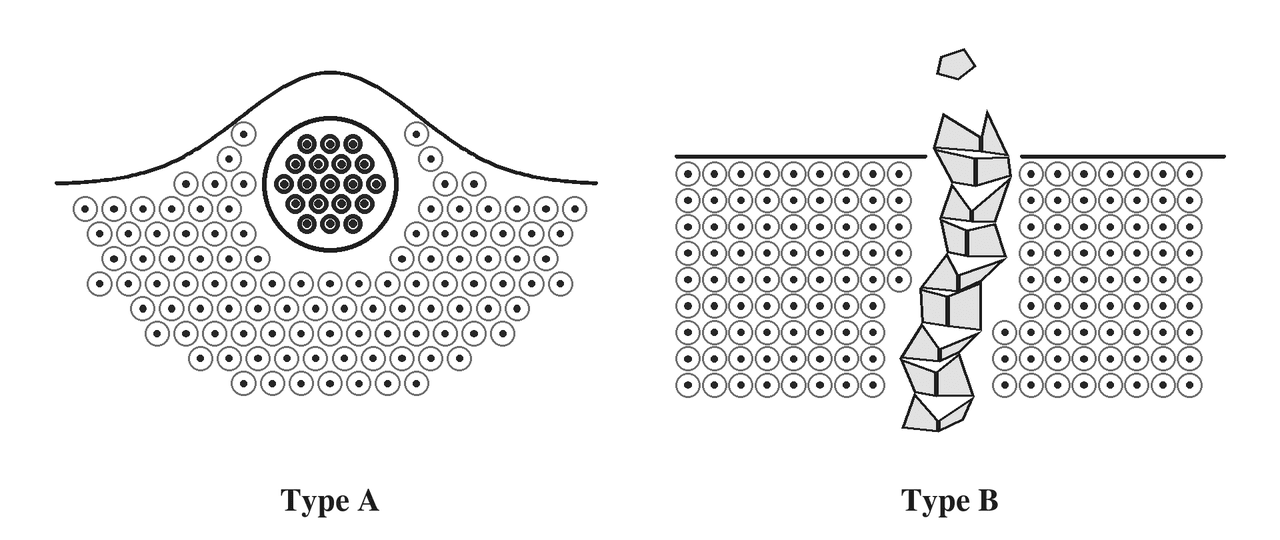
The figure given below shows two different types of tumours, Type A and Type B.
State one characteristic feature of each type.
 Solve with AI
Written solution
Solution:
Key idea: A tumour is a mass of cells formed by abnormal division. It is benign if it stays in one place and malignant if its cells invade other tissues.
Step 1 — Type A.
In Type A the abnormal cells form a compact group enclosed within a boundary (capsule) and the surrounding normal tissue is only pushed up, not invaded. This is a benign tumour: it stays confined to its place of origin and does not spread to other parts of the body.
Step 2 — Type B.
In Type B irregular cells grow through the regular layers of normal cells, break through the surface, and one cell has broken away from the mass. This is a malignant tumour: its cells invade neighbouring tissues and spread to distant sites through the blood or lymph (metastasis).
Therefore, Type A is a benign tumour that stays localised inside a capsule without spreading, and Type B is a malignant tumour that invades surrounding tissue and spreads by metastasis.
- 303 marks
Question 30
Draw a neat flowchart depicting the life cycle of a retrovirus in the infected human cell.
Solve with AIWritten solution
Solution:
Key idea: A retrovirus such as HIV has RNA as its genetic material. Inside a human cell it makes a DNA copy of its RNA with reverse transcriptase and inserts this DNA into the host genome, so the cell itself makes new viruses.
Step 1 — Entry into the host cell.
The virus binds to the CD4 receptor of a helper T-cell (or a macrophage) and enters it; its RNA and the enzyme reverse transcriptase are released into the cytoplasm.
Step 2 — Making and inserting viral DNA.
Reverse transcriptase copies the viral RNA into viral DNA. The viral DNA enters the nucleus, where integrase inserts it into the host DNA as a provirus.
Step 3 — Making new viruses.
The host cell transcribes the provirus into viral RNA, which is translated into viral proteins. New virus particles are assembled, bud out of the cell and infect other helper T-cells. As this repeats, helper T-cells are destroyed and immunity falls.
Step 4 — The flowchart.
The flowchart below shows these steps in order.
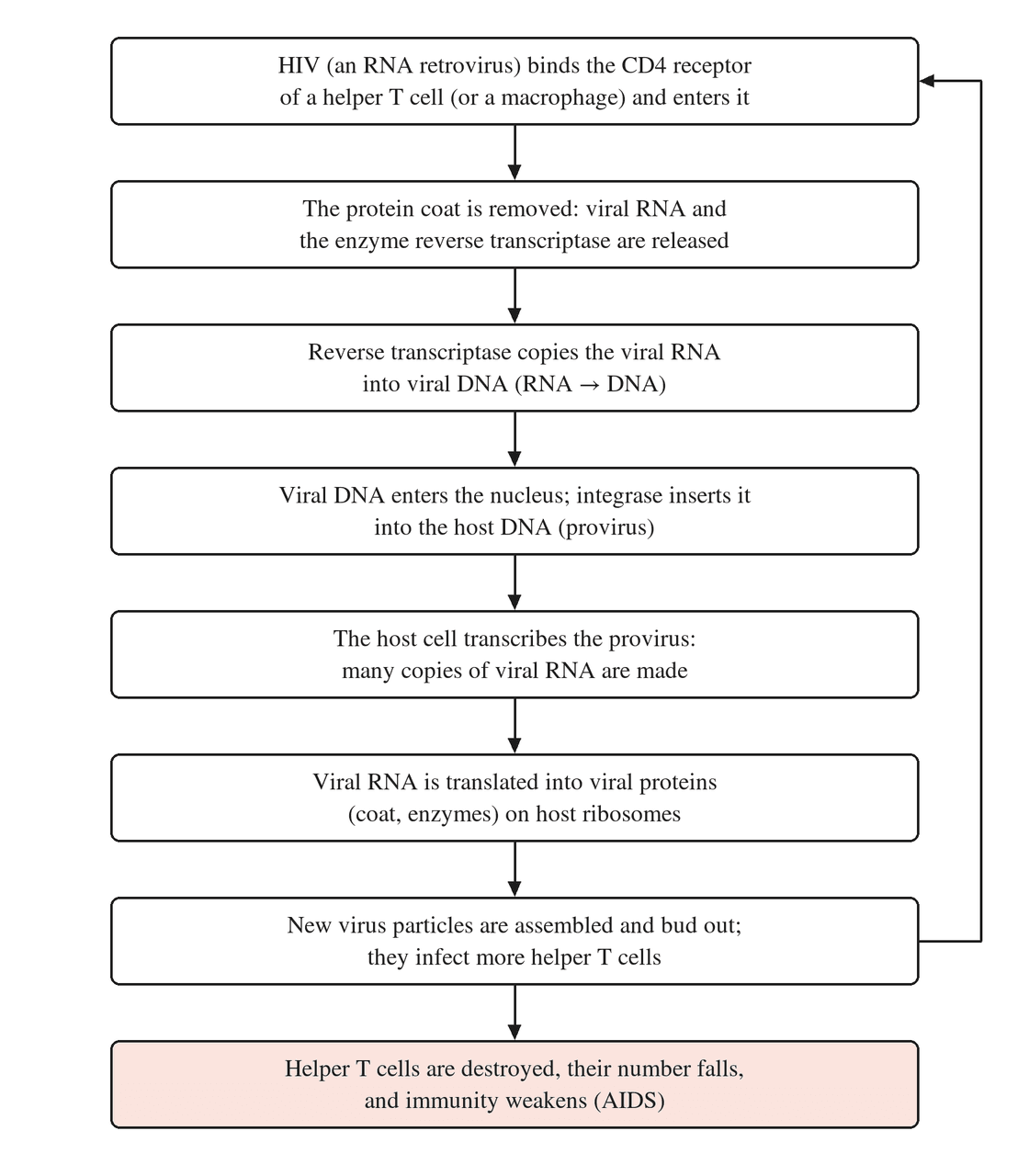
Therefore, the life cycle of a retrovirus runs: entry into a helper T-cell → reverse transcription of viral RNA into DNA → integration as a provirus → transcription and translation to make viral RNA and proteins → assembly and release of new viruses that infect more cells.
- 311 mark
Question 31
Zara is suffering from cough and has bluish lips. Her mucus is mixed with blood.
What is the biological name of the causative organism responsible for Zara's condition?
Solve with AIWritten solution
Solution:
Key idea: Pneumonia is an infection of the alveoli of the lungs, which fill with fluid. In severe cases the blood gets too little oxygen, so the lips and fingernails turn grey to bluish.
Step 1 — Read the symptoms.
Zara has a cough, bluish lips (shortage of oxygen in the blood) and mucus streaked with blood. Bluish lips with a cough point to pneumonia; the rust-coloured, blood-streaked sputum is typical of pneumonia caused by pneumococcus.
Step 2 — Name the organism.
The common bacterial cause of pneumonia is Streptococcus pneumoniae (pneumococcus); Haemophilus influenzae is another.
Therefore, the organism responsible for Zara's condition is Streptococcus pneumoniae.
- 321 mark
Question 32
Observe the relation between the first two words and complete the analogy.
Dengue: Aedes :: Plague: ______
Solve with AIWritten solution
Solution:
Key idea: In the first pair, the disease is linked to its vector: dengue virus is carried by the Aedes mosquito.
Step 1 — Find the relation.
Aedes is the vector that carries dengue from person to person.
Step 2 — Apply it to plague.
Plague is caused by the bacterium Yersinia pestis, which is carried from rats to humans by the bite of the rat flea, Xenopsylla cheopis.
Therefore, Dengue : Aedes :: Plague : Xenopsylla cheopis (the rat flea).
- 331 mark
Question 33
The left hind limb of a person was swollen like elephant's limb. Which one of the following was MOST likely the cause of swelling?
Solve with AIAnswer
(A) Accumulation of uric acid
(B) Blockage of blood vessels
- Correct
(C) Blockage of lymph vessels
(D) Hypertrophy of skeletal muscles
Answer: (C) Blockage of lymph vessels
Key idea: A limb swollen like an elephant's limb is the sign of elephantiasis, the chronic stage of lymphatic filariasis, caused by filarial worms such as Wuchereria bancrofti, spread by the Culex mosquito.
Step 1 — Recall where the worms live.
The adult filarial worms live in the lymphatic vessels and lymph nodes, often of the legs, for many years.
Step 2 — Explain the swelling.
The worms and the inflammation they cause block the lymph vessels. Lymph cannot drain from the tissues, so fluid collects and the limb swells greatly; this is elephantiasis.
Why the others are wrong:
- (A) Accumulation of uric acid crystals in the joints causes gout, with painful swollen joints, not a whole limb swollen like an elephant's.
- (B) A blocked vein can make a leg swell, but that swelling comes on quickly and is usually painful, and a blocked artery makes a limb pale and painful rather than swollen. The huge, long-lasting swelling with thickened skin that makes a limb look like an elephant's comes from blocked lymph vessels, so blood-vessel blockage is not the most likely cause.
- (D) Hypertrophy of skeletal muscles is growth of muscle fibres, for example with exercise, and does not give the soft, puffy swelling of fluid in the tissues.
Therefore, the swelling is most likely caused by blockage of the lymph vessels, option (C).
- 341 mark
Question 34
Name the autoimmune disorder that affects the skeletal muscles in humans.
Solve with AIWritten solution
Solution:
Key idea: In an autoimmune disorder, the immune system attacks the body's own cells or molecules as if they were foreign.
Step 1 — Recall the disorder affecting skeletal muscles.
In one autoimmune disorder, antibodies attack the acetylcholine receptors at the junctions between nerves and skeletal muscles. Nerve impulses then fail to stimulate the muscles properly, causing muscle weakness and rapid fatigue.
Step 2 — Name it.
This disorder is myasthenia gravis.
Therefore, the autoimmune disorder that affects skeletal muscles is myasthenia gravis.
- 351 mark
Question 35
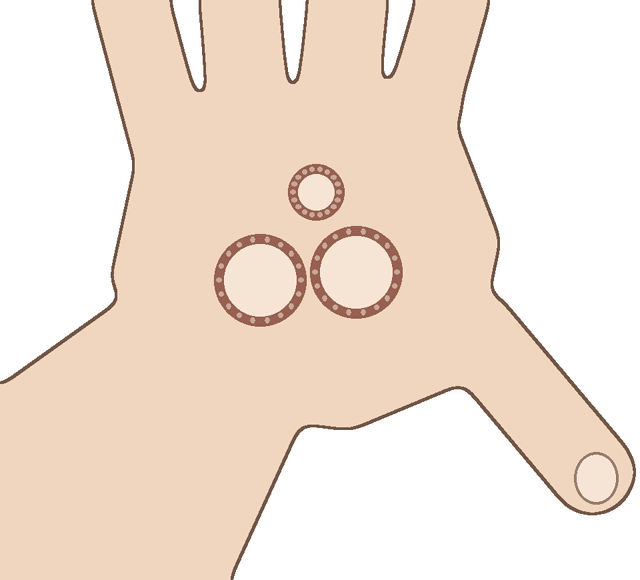
Shama complained of severe itching in certain parts of her body where patches as shown below appeared on her skin. Write the biological name of the causative agent responsible for her condition.
 Solve with AI
Written solution
Solution:
Key idea: Ringworm is a fungal infection of the skin, nails or scalp. It produces itchy, dry, scaly, ring-shaped patches with a raised edge and a clearer centre.
Step 1 — Read the picture.
The patches on Shama's hand are round, with a darker scaly border and a paler middle, and they itch. These are the typical lesions of ringworm, which spreads through contact with infected people or animals and with shared towels or combs, and grows best in warm, moist skin.
Step 2 — Name the causative agent.
Ringworm is caused by fungi of the genera Trichophyton, Microsporum and Epidermophyton. On the skin of the body and hands the most common cause is Trichophyton (for example Trichophyton rubrum).
Therefore, the causative agent of Shama's condition is the ringworm fungus Trichophyton (ringworm can also be caused by Microsporum and Epidermophyton).
- 361 mark
Question 36
Name the chemical messenger that activates Natural Killer T-cells and macrophages.
Solve with AIWritten solution
Solution:
Key idea: Cells of the immune system communicate through small proteins called cytokines. Interferons are cytokines released by virus-infected cells and by activated T-cells.
Step 1 — Recall the messenger.
Interferons activate natural killer (NK) cells and macrophages, which then destroy virus-infected and cancerous cells more strongly. Interferon-gamma, released by T-cells and NK cells, is the main activator of macrophages.
Step 2 — Name it.
So the chemical messenger is a cytokine, the interferon.
Therefore, the chemical messenger that activates natural killer cells and macrophages is the cytokine interferon (especially interferon-gamma).
- 371 mark
Question 37
Give a reason for each of the following:
In HIV infected persons, the immune system is compromised.
Solve with AIWritten solution
Solution:
Key idea: Helper T-cells coordinate the whole immune response: they help B-cells make antibodies and activate cytotoxic T-cells and macrophages.
Step 1 — Identify the cells HIV attacks.
HIV enters helper T-cells (CD4 cells) and macrophages through the CD4 receptor and multiplies inside them. Infected helper T-cells are destroyed, and their number falls steadily over the years.
Step 2 — Explain the result.
With few helper T-cells, B-cells make fewer antibodies and cytotoxic T-cells are not activated, so both humoral and cell-mediated immunity fail. The person then suffers from infections that a healthy body would easily fight off (opportunistic infections).
Therefore, the immune system is compromised in HIV-infected persons because HIV destroys the helper T-cells, which are needed to activate both antibody production and cell-mediated immunity.
- 383 marks
Question 38
The graph given below shows the level of antibodies in the blood after exposure to a pathogen.

(a) What types of responses of the immune system do the peaks A and B represent?
(b) Name the type of antibody that is at the highest level in the week.
Solve with AIWritten solution
Solution:
Key idea: The first meeting with an antigen gives a slow, weak primary immune response. A later meeting with the same antigen gives a fast, strong secondary (anamnestic) response, because memory B- and T-cells were formed the first time.
Step 1 — (a) Read Peak A.
Peak A follows the first infection (week 1). The antibody level rises slowly, reaches a moderate peak about two weeks later (week 3) and falls. This is the primary immune response.
Step 2 — (a) Read Peak B.
Peak B follows the second infection (week 5). The antibody level rises quickly and reaches a much higher peak (about week 7), and it stays higher afterwards. This is the secondary (anamnestic) immune response, produced by memory cells.
Step 3 — (b) Name the antibody at week 7.
Week 7 lies at Peak B, the secondary response. In a primary response IgM is made first, but in a secondary response the antibody produced in by far the largest amount is IgG.
Therefore, (a) Peak A represents the primary immune response and Peak B the secondary (anamnestic) immune response; (b) the antibody at the highest level in the 7th week is IgG.
- 393 marks
Question 39
Plasmodium is a digenetic parasite, completing its life cycle in humans and mosquitoes. In humans, it completes different parts of its life cycle in the liver and RBCs.
Draw a flow chart to outline its erythrocytic cycle in humans.
Solve with AIWritten solution
Solution:
Key idea: The erythrocytic cycle is the asexual multiplication of Plasmodium inside red blood cells (RBCs). Each round ends with the bursting of the RBCs, which causes the regular attacks of chills and fever.
Step 1 — Entry of merozoites.
Merozoites released from infected liver cells enter red blood cells.
Step 2 — Growth inside the RBC.
Inside the RBC the parasite first appears as a ring (signet-ring) stage. It feeds on haemoglobin and grows into a trophozoite, leaving behind the toxic pigment haemozoin.
Step 3 — Schizogony.
The trophozoite becomes a schizont, whose nucleus divides repeatedly (erythrocytic schizogony) to form many merozoites.
Step 4 — Bursting of the RBC.
The RBC bursts and releases the merozoites together with haemozoin. Haemozoin causes chills followed by high fever. The merozoites enter fresh RBCs and the cycle repeats, every 48 hours in vivax malaria.
Step 5 — Gametocytes.
After some cycles, some merozoites develop inside RBCs into male and female gametocytes, which are taken up by a female Anopheles mosquito when it bites.
Step 6 — The flow chart.
The flow chart below shows the cycle.

Therefore, the erythrocytic cycle runs: merozoites enter RBCs → ring stage → trophozoite → schizont → RBC bursts releasing merozoites and haemozoin → merozoites infect fresh RBCs, with some forming gametocytes.