
Question 44 marksAsked 2016Medium
Explain the structure of a typical antibody molecule.
Confirming your payment
Sign up now and get 250 free tokens.
Previous Year Questions · Question 4 of 39
Explain the structure of a typical antibody molecule.
Solution:
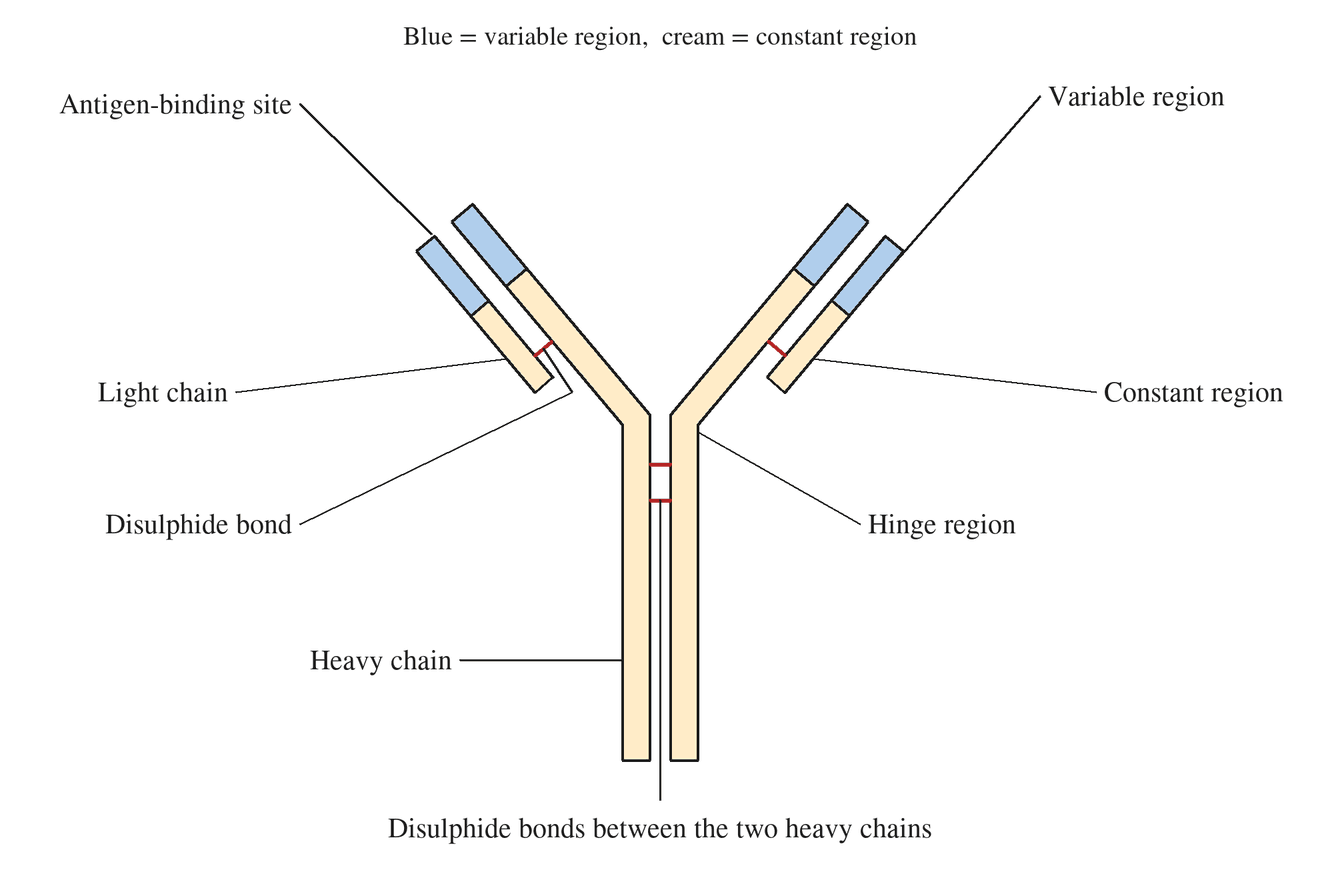
Key idea: An antibody (immunoglobulin) is a protein made by plasma cells (activated B-cells) that binds one specific antigen. A typical antibody such as IgG is a Y-shaped molecule made of four polypeptide chains.
Step 1 — Four polypeptide chains.
The molecule has two identical heavy (H) chains and two identical light (L) chains, so it is written as . The heavy chains are long; the light chains are about half as long.
Step 2 — Disulphide bonds hold them together.
Each light chain is joined to one heavy chain by a disulphide (S–S) bond, and the two heavy chains are joined to each other by one or more disulphide bonds near the middle of the molecule.
Step 3 — The Y shape and the hinge.
The two heavy chains run side by side in the stem of the Y and then separate into the two arms. A light chain lies along the outer side of each arm. The region where the arms meet the stem is the flexible hinge region, which lets the arms move and bind antigens at different distances apart.
Step 4 — Variable and constant regions.
At the tip of each arm, the ends of the heavy and light chains form the variable region, whose amino acid sequence differs from one antibody to another. The rest of each chain is the constant region, which is the same in all antibodies of one class.
Step 5 — Antigen-binding sites.
The variable regions of one heavy chain and one light chain together form an antigen-binding site (paratope) at the tip of each arm. So one antibody molecule has two identical antigen-binding sites and can bind two antigen molecules. The two arms are called the Fab parts (fragment, antigen-binding), and the stem is the Fc part (fragment, crystallisable), which binds to immune cells and to complement.
Therefore, a typical antibody is a Y-shaped H₂L₂ molecule of two heavy and two light chains held by disulphide bonds, with a hinge, constant regions in the stem and arms, and variable regions at the tips forming two antigen-binding sites.