
Question 303 marksAsked 2025Medium
Draw a neat flowchart depicting the life cycle of a retrovirus in the infected human cell.
Confirming your payment
Sign up now and get 250 free tokens.
Previous Year Questions · Question 30 of 39
Draw a neat flowchart depicting the life cycle of a retrovirus in the infected human cell.
Solution:
Key idea: A retrovirus such as HIV has RNA as its genetic material. Inside a human cell it makes a DNA copy of its RNA with reverse transcriptase and inserts this DNA into the host genome, so the cell itself makes new viruses.
Step 1 — Entry into the host cell.
The virus binds to the CD4 receptor of a helper T-cell (or a macrophage) and enters it; its RNA and the enzyme reverse transcriptase are released into the cytoplasm.
Step 2 — Making and inserting viral DNA.
Reverse transcriptase copies the viral RNA into viral DNA. The viral DNA enters the nucleus, where integrase inserts it into the host DNA as a provirus.
Step 3 — Making new viruses.
The host cell transcribes the provirus into viral RNA, which is translated into viral proteins. New virus particles are assembled, bud out of the cell and infect other helper T-cells. As this repeats, helper T-cells are destroyed and immunity falls.
Step 4 — The flowchart.
The flowchart below shows these steps in order.
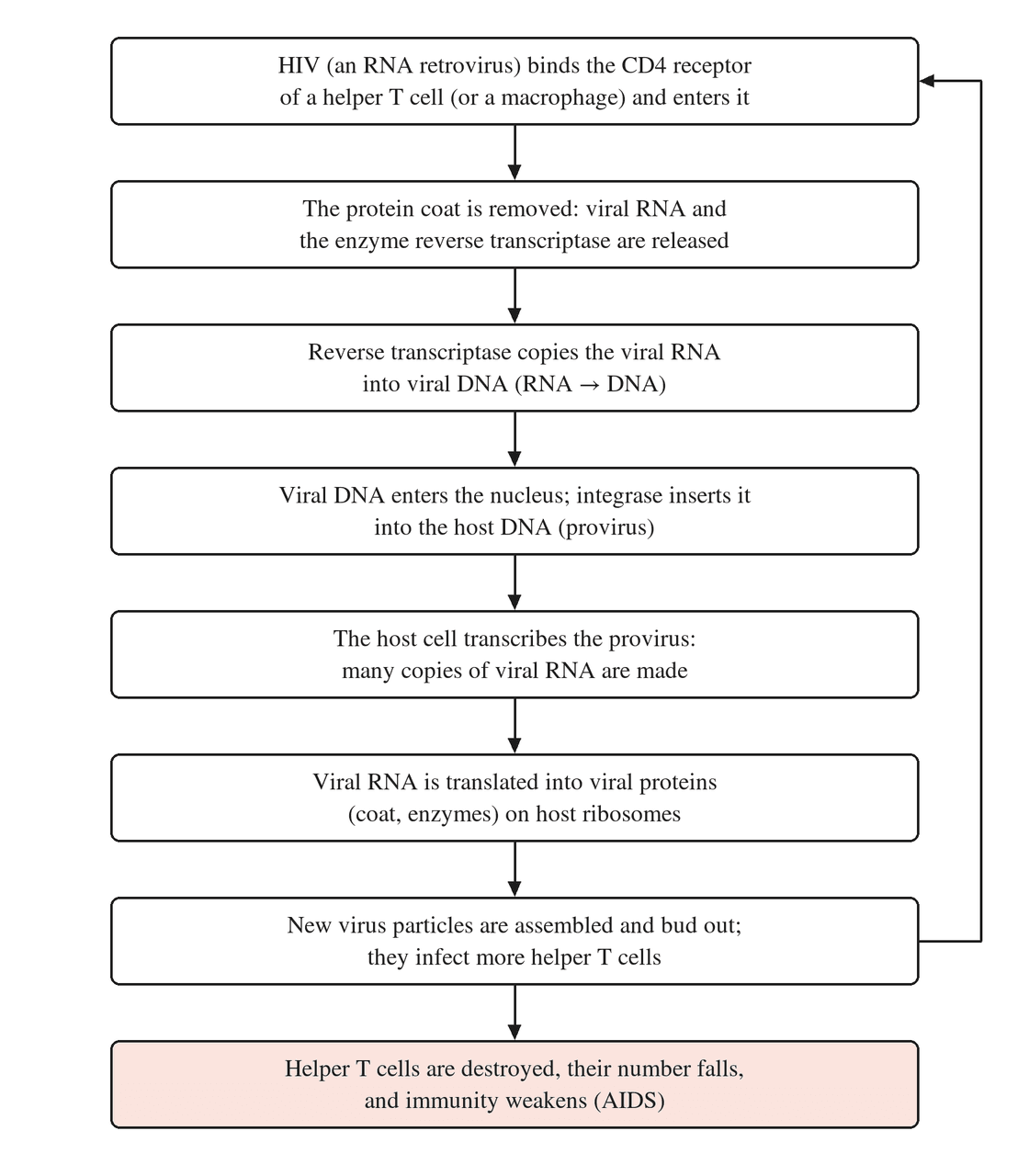
Therefore, the life cycle of a retrovirus runs: entry into a helper T-cell → reverse transcription of viral RNA into DNA → integration as a provirus → transcription and translation to make viral RNA and proteins → assembly and release of new viruses that infect more cells.