
Question 145 marksAsked 2020Medium
Draw a labelled diagram to show replication of HIV in human cells.
Confirming your payment
Sign up now and get 250 free tokens.
Previous Year Questions · Question 14 of 39
Draw a labelled diagram to show replication of HIV in human cells.
Solution:
Key idea: HIV is a retrovirus: its genetic material is RNA, which it copies into DNA with the enzyme reverse transcriptase after entering a human cell. It infects mainly helper T-cells (and macrophages), which carry the CD4 receptor.
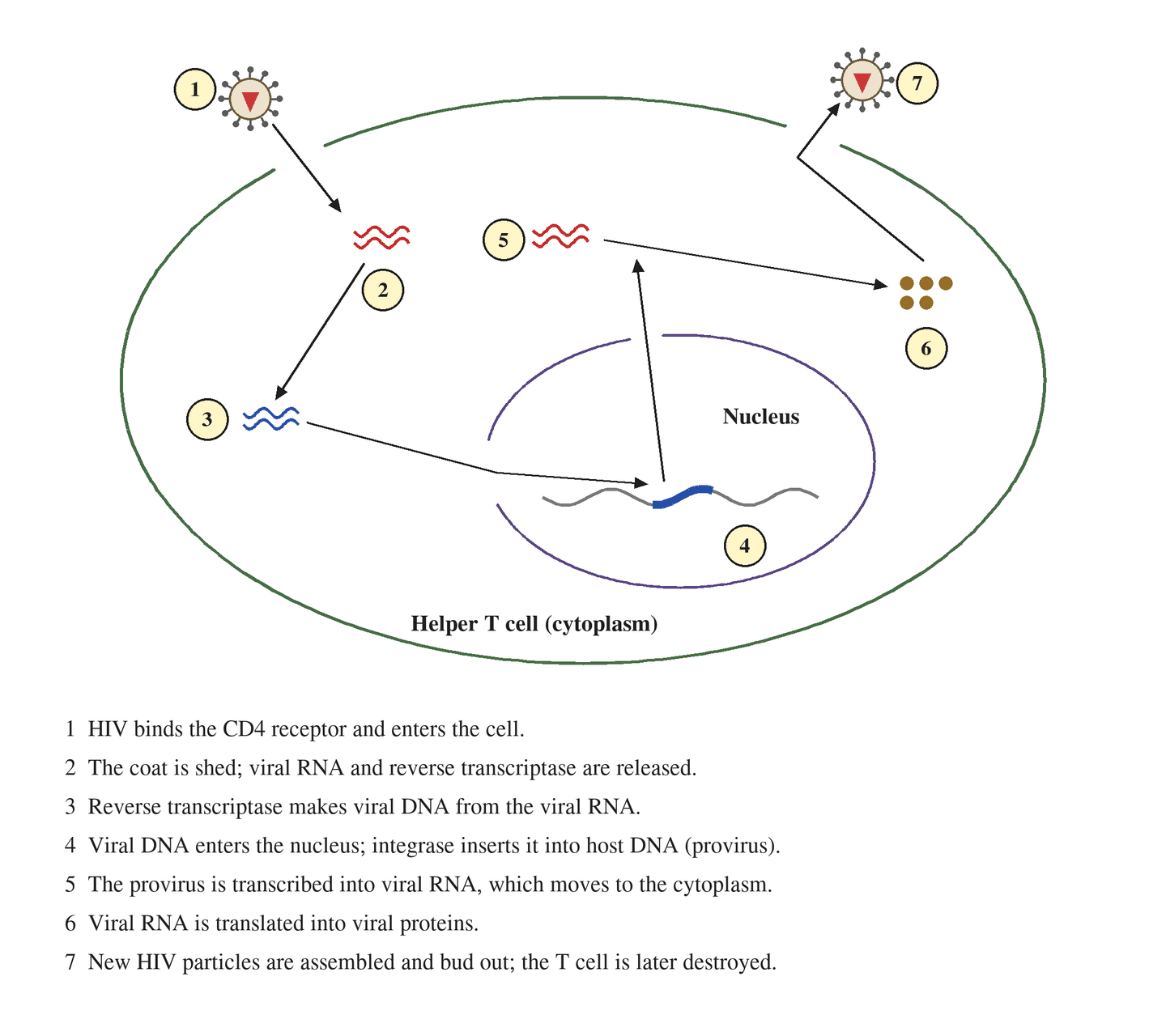
Step 1 — Attachment and entry (stage 1).
The glycoprotein spikes of HIV bind to the CD4 receptor on a helper T-cell. The virus envelope fuses with the cell membrane and the core enters the cytoplasm.
Step 2 — Release of viral RNA (stage 2).
The protein coat is removed, and the two copies of viral RNA, together with the enzyme reverse transcriptase, are released into the cytoplasm.
Step 3 — Reverse transcription (stage 3).
Reverse transcriptase uses the viral RNA as a template to make a DNA copy, which is then made double-stranded. This flow of information from RNA to DNA is the reverse of normal transcription.
Step 4 — Integration (stage 4).
The viral DNA enters the nucleus, and the enzyme integrase inserts it into the host cell's DNA. The inserted viral DNA is called a provirus.
Step 5 — Transcription and translation (stages 5 and 6).
The host cell's own machinery transcribes the provirus into many copies of viral RNA. These move to the cytoplasm, where some are translated on host ribosomes into viral proteins (coat proteins and enzymes) and others serve as the genome of new viruses.
Step 6 — Assembly and release (stage 7).
New virus particles are assembled and bud out through the cell membrane, taking part of it as their envelope. They infect other helper T-cells. In this way the number of helper T-cells falls steadily, and the immune system becomes weak.
Therefore, HIV replicates by binding to the CD4 receptor and entering a helper T-cell, making DNA from its RNA with reverse transcriptase, integrating this DNA into the host genome as a provirus, using the host cell to make viral RNA and proteins, and releasing new viruses by budding, as shown in the labelled diagram.