
Opening your dashboard
Class 9 Physics Chapter 8: Propagation of Sound Waves Solutions
92 textbook questions with step-by-step answers, free to read, for ICSE 2026-27.
Get talked through Ch 8, not just shown the answer
Reading a finished solution is not the same as being able to do it. The AI tutor takes one question at a time and works it with you, in your own words, until you can.
- Ask it out loud, in your own words
- It gives you the next step, not the answer
- Stuck on part (ii)? Start there
92 questions with solutions
1–5 marks · Mixed difficulty
The first 56 solutions are on this page. This chapter is a long one, so the rest open on their own page to keep this one quick to load.
- 11 mark
Question 1
The waves carry ........... energy of the vibrating particles with them so as to produce a sensation of hearing in our ears.
Solve with AIAnswer
(A) light
(B) chemical
- Correct
(C) mechanical
(D) nuclear
Answer: (C) mechanical
Concept: Sound is a form of energy that produces the sensation of hearing. It is produced by a vibrating body: the body moves to and fro about its mean position and passes this disturbance on to the medium around it.
Step 1 — See what the wave carries.
A sound wave is passed on by the vibrations of the particles of the medium. Each vibrating particle has kinetic and potential energy, that is, mechanical energy, and it hands this energy on to the next particle.
Step 2 — See how we hear.
When the wave reaches our ear, this mechanical energy makes the ear drum vibrate in the same way, and we get the sensation of hearing.
Watch out: Sound needs a medium because it carries the mechanical energy of vibrating particles; light energy needs no medium.
Why the other options are wrong:
- (A) light: Light energy is carried by light waves (electromagnetic waves), not by the vibrations of particles.
- (B) chemical: Chemical energy is stored in the bonds of substances; a sound wave does not carry it.
- (D) nuclear: Nuclear energy is stored in the nucleus of an atom; it has nothing to do with a sound wave.
Therefore, sound waves carry the mechanical energy of the vibrating particles, option (C).
- 21 mark
Question 2
Identify the correct statements :
(i) A material medium is necessary for the propagation of sound from one place to another.
(ii) The medium must have inertia.
(iii) The medium must be inelastic.
(iv) The medium must be frictionless.
Solve with AIAnswer
(A) (i) and (ii)
(B) (i), (ii) and (iii)
- Correct
(C) (i), (ii) and (iv)
(D) (ii), (iii) and (iv)
Answer: (C) statements 1, 2 and 4
Concept: For sound to travel, the medium must be elastic (a displaced particle comes back to its mean position), must have inertia (its particles can store and pass on mechanical energy) and should be (nearly) frictionless (little energy is lost on the way).
Step 1 — Judge statement 1.
Sound is passed on by the particles of a medium, and there are no particles in vacuum. So a material medium is necessary; statement 1 is true.
Step 2 — Judge statement 2.
The particles must have inertia so that they can store mechanical energy and pass it on to the next particles. Statement 2 is true.
Step 3 — Judge statement 3.
The medium must be elastic, not inelastic, so that a displaced particle comes back to its mean position and keeps vibrating. Statement 3 is false.
Step 4 — Judge statement 4.
The book requires the medium to be frictionless, so that no energy is lost as the sound passes through it. Statement 4 is true as the book states it.
Watch out: Statement 3 says INelastic; an inelastic medium could not carry vibrations at all.
Note: no real medium is perfectly frictionless; sound still travels through air and water while losing a little energy. The book's condition means that the loss should be small.
Why the other options are wrong:
- (A) statements 1 and 2: This leaves out statement 4, which the book also counts as true.
- (B) statements 1, 2 and 3: This includes statement 3, which is false: the medium must be elastic.
- (D) statements 2, 3 and 4: This includes statement 3, which is false, and leaves out statement 1, which is true.
Therefore, the correct statements are 1, 2 and 4, option (C).
- 31 mark
Question 3
The correct statement is :
Solve with AIAnswer
(A) Sound and light both require medium for propagation
(B) Sound can travel in vacuum, but light cannot
- Correct
(C) Sound needs medium, but light does not need medium for its propagation
(D) Sound and light both can travel in vacuum.
Answer: (C) Sound needs medium, but light does not need medium for its propagation
Concept: Sound is a mechanical wave: it is passed on from particle to particle of a material medium, so it needs a medium (solid, liquid or gas) and cannot travel through vacuum. Light is an electromagnetic wave and needs no medium.
Step 1 — Decide about sound.
Sound is passed on by the vibrations of particles, so it needs a material medium and cannot travel through vacuum.
Step 2 — Decide about light.
Light needs no medium. Sunlight reaches us through the vacuum of space between the sun and the earth's atmosphere.
Watch out: The bell-jar experiment shows sound dying away in vacuum, while we can still see the bell through the jar.
Why the other options are wrong:
- (A) Sound and light both require medium for propagation: Light does not need a medium; it travels through vacuum.
- (B) Sound can travel in vacuum, but light cannot: It is the other way round: light travels in vacuum and sound does not.
- (D) Sound and light both can travel in vacuum: Sound cannot travel in vacuum.
Therefore, sound needs a medium but light does not, option (C).
- 41 mark
Question 4
Sound in air propagates in form of :
Solve with AIAnswer
- Correct
(A) longitudinal wave
(B) transverse wave
(C) both longitudinal and transverse waves
(D) neither longitudinal nor transverse wave.
Answer: (A) longitudinal wave
Concept: Waves are named by the direction in which the particles vibrate. In a longitudinal wave the particles vibrate along the direction of travel, forming compressions and rarefactions; it can travel in solids, liquids and gases. In a transverse wave the particles vibrate perpendicular to the direction of travel, forming crests and troughs; it can travel only in solids and on the surface of a liquid.
Step 1 — See how the air layers move.
When a sound passes through air, the layers of air move to and fro along the direction in which the sound travels, forming compressions and rarefactions.
Step 2 — Name the wave.
A wave whose particles vibrate along its direction of travel is a longitudinal wave.
Watch out: A gas cannot resist a sideways (shearing) push, so a transverse wave cannot travel through air.
Why the other options are wrong:
- (B) transverse wave: Transverse waves cannot travel through a gas such as air.
- (C) both longitudinal and transverse waves: Only the longitudinal kind travels through air, so 'both' is wrong.
- (D) neither longitudinal nor transverse wave: Sound in air is a wave, and it is a longitudinal one.
Therefore, sound travels in air as a longitudinal wave, option (A).
- 51 mark
Question 5
The S.I. unit of wavelength is :
Solve with AIAnswer
- Correct
(A) metre
(B) hertz
(C) second
(D) m/s
Answer: (A) metre
Concept: A wave is described by: its amplitude , the greatest displacement of a particle on either side of its mean position (unit m); its time period , the time for one vibration (unit s); its frequency , the number of vibrations in one second (unit Hz); its wavelength λ, the distance the wave travels in one time period (unit m); and its wave velocity , the distance it travels in one second (unit m s).
Step 1 — See what kind of quantity it is.
The wavelength is the distance travelled by the wave in one time period, so it is a length.
Step 2 — Give its S.I. unit.
The S.I. unit of length is the metre, so the wavelength is measured in metres (m).
Why the other options are wrong:
- (B) hertz: The hertz is the unit of frequency.
- (C) second: The second is the unit of time period.
- (D) m/s: m/s is the unit of wave velocity.
Therefore, the S.I. unit of wavelength is the metre, option (A).
- 61 mark
Question 6
The position of maximum upward displacement of medium particles in a transverse wave is known as :
Solve with AIAnswer
(A) trough
(B) compression
(C) rarefaction
- Correct
(D) crest
Answer: (D) crest
Concept: Waves are named by the direction in which the particles vibrate. In a longitudinal wave the particles vibrate along the direction of travel, forming compressions and rarefactions; it can travel in solids, liquids and gases. In a transverse wave the particles vibrate perpendicular to the direction of travel, forming crests and troughs; it can travel only in solids and on the surface of a liquid.
Step 1 — Recall the parts of a transverse wave.
A transverse wave is made of crests and troughs, because its particles move up and down across the direction of travel.
Step 2 — Pick the upward one.
The position of maximum upward displacement is a crest; the position of maximum downward displacement is a trough.
Watch out: Compressions and rarefactions belong to longitudinal waves, not transverse waves.
Why the other options are wrong:
- (A) trough: A trough is the position of maximum downward displacement.
- (B) compression: A compression is a region of crowded particles in a longitudinal wave.
- (C) rarefaction: A rarefaction is a region of spread-out particles in a longitudinal wave.
Therefore, the position of maximum upward displacement is a crest, option (D).
- 71 mark
Question 7
The wave in which the particles of a medium vibrate about their mean position in a direction ............ to the direction of propogation of the wave is called transverse wave.
Solve with AIAnswer
(A) parallel
(B) similar
- Correct
(C) perpendicular
(D) none of the above
Answer: (C) perpendicular
Concept: Waves are named by the direction in which the particles vibrate. In a longitudinal wave the particles vibrate along the direction of travel, forming compressions and rarefactions; it can travel in solids, liquids and gases. In a transverse wave the particles vibrate perpendicular to the direction of travel, forming crests and troughs; it can travel only in solids and on the surface of a liquid.
Step 1 — Recall the definition.
In a transverse wave the particles move up and down while the wave moves forward. So they vibrate at right angles, that is perpendicular, to the direction of propagation.
Step 2 — Check with an example.
Ripples on water: a floating leaf bobs up and down while the ripples spread sideways along the surface.
Watch out: Vibration ALONG the direction of travel gives a longitudinal wave, not a transverse one.
Why the other options are wrong:
- (A) parallel: Vibration parallel to the direction of propagation gives a longitudinal wave.
- (B) similar: 'Similar' direction also means along the direction of travel, which again describes a longitudinal wave.
- (D) none of the above: This is wrong because 'perpendicular', option (C), completes the sentence correctly.
Therefore, in a transverse wave the particles vibrate perpendicular to the direction of propagation, option (C).
- 81 mark
Question 8
In a longitudal wave, the distance between two consecutive ........... is equal to .................. wavelength(s).
Solve with AIAnswer
- Correct
(A) compressions, one
(B) compressions, two
(C) crests, one
(D) crests, two
Answer: (A) compressions, one
Concept: Waves are named by the direction in which the particles vibrate. In a longitudinal wave the particles vibrate along the direction of travel, forming compressions and rarefactions; it can travel in solids, liquids and gases. In a transverse wave the particles vibrate perpendicular to the direction of travel, forming crests and troughs; it can travel only in solids and on the surface of a liquid.
Step 1 — Name the parts of a longitudinal wave.
A longitudinal wave is made of compressions and rarefactions; crests and troughs belong to transverse waves.
Step 2 — Measure one wave.
One complete wave contains one compression and one rarefaction. So the distance from one compression to the next is one wavelength λ.
Watch out: The distance from a compression to the NEXT rarefaction is only half a wavelength.
Why the other options are wrong:
- (B) compressions, two: Two consecutive compressions are one wavelength apart, not two.
- (C) crests, one: Crests belong to transverse waves, not longitudinal waves.
- (D) crests, two: Crests belong to transverse waves, and consecutive crests are one wavelength apart, not two.
Therefore, two consecutive compressions are one wavelength apart, option (A).
- 91 mark
Question 9
Transverse waves can be produced inside :
Solve with AIAnswer
- Correct
(A) solids
(B) liquids
(C) gases
(D) both (b) and (c)
Answer: (A) solids
Concept: Waves are named by the direction in which the particles vibrate. In a longitudinal wave the particles vibrate along the direction of travel, forming compressions and rarefactions; it can travel in solids, liquids and gases. In a transverse wave the particles vibrate perpendicular to the direction of travel, forming crests and troughs; it can travel only in solids and on the surface of a liquid.
Step 1 — See what a transverse wave needs.
In a transverse wave each layer of the medium drags the next layer sideways. This needs a medium that resists a sideways (shearing) push, that is, a rigid medium.
Step 2 — Test the three states.
Solids resist a sideways push, so transverse waves can be produced inside them. Liquids and gases flow under a sideways push, so transverse waves cannot be produced inside them (only on the surface of a liquid).
Watch out: Ripples are transverse waves on the SURFACE of water; they do not travel through the inside of the liquid.
Why the other options are wrong:
- (B) liquids: A transverse wave cannot be produced inside a liquid.
- (C) gases: A transverse wave cannot be produced inside a gas.
- (D) both (b) and (c): Neither liquids nor gases carry transverse waves inside them.
Therefore, transverse waves can be produced inside solids, option (A).
- 101 mark
Question 10
Longitudinal waves can be produced in :
Solve with AIAnswer
(A) solids
(B) liquids
(C) gases
- Correct
(D) All of the above
Answer: (D) All of the above
Concept: Waves are named by the direction in which the particles vibrate. In a longitudinal wave the particles vibrate along the direction of travel, forming compressions and rarefactions; it can travel in solids, liquids and gases. In a transverse wave the particles vibrate perpendicular to the direction of travel, forming crests and troughs; it can travel only in solids and on the surface of a liquid.
Step 1 — See what a longitudinal wave needs.
A longitudinal wave consists of compressions and rarefactions, so the medium only needs to be squeezed and to spring back.
Step 2 — Test the three states.
Solids, liquids and gases can all be compressed a little and all expand back. So longitudinal waves can be produced in all three, which is why sound travels through all of them.
Why the other options are wrong:
- (A) solids: Solids carry longitudinal waves, but so do liquids and gases.
- (B) liquids: Liquids carry longitudinal waves, but so do solids and gases.
- (C) gases: Gases carry longitudinal waves, but so do solids and liquids.
Therefore, longitudinal waves can be produced in solids, liquids and gases, option (D).
- 111 mark
Question 11
The maximum displacement of the medium particle on either side of its mean position is called ....... of the wave.
Solve with AIAnswer
(A) frequency
(B) time period
(C) wavelength
- Correct
(D) amplitude
Answer: (D) amplitude
Concept: A wave is described by: its amplitude , the greatest displacement of a particle on either side of its mean position (unit m); its time period , the time for one vibration (unit s); its frequency , the number of vibrations in one second (unit Hz); its wavelength λ, the distance the wave travels in one time period (unit m); and its wave velocity , the distance it travels in one second (unit m s).
Step 1 — Match the definition.
The maximum displacement of a particle of the medium on either side of its mean position is the amplitude of the wave. It is written and measured in metres.
Why the other options are wrong:
- (A) frequency: Frequency is the number of vibrations in one second.
- (B) time period: Time period is the time taken for one vibration.
- (C) wavelength: Wavelength is the distance travelled by the wave in one time period.
Therefore, the maximum displacement on either side of the mean position is the amplitude, option (D).
- 121 mark
Question 12
The number of vibrations made by a particle of a medium in one second is called ....... of the wave.
Solve with AIAnswer
- Correct
(A) frequency
(B) time period
(C) wavelength
(D) wave velocity
Answer: (A) frequency
Concept: A wave is described by: its amplitude , the greatest displacement of a particle on either side of its mean position (unit m); its time period , the time for one vibration (unit s); its frequency , the number of vibrations in one second (unit Hz); its wavelength λ, the distance the wave travels in one time period (unit m); and its wave velocity , the distance it travels in one second (unit m s).
Step 1 — Match the definition.
The number of vibrations made by a particle of the medium in one second is the frequency of the wave. Its unit is the hertz (Hz).
Why the other options are wrong:
- (B) time period: Time period is the time taken for ONE vibration, not the number of vibrations in a second.
- (C) wavelength: Wavelength is a distance, not a number of vibrations.
- (D) wave velocity: Wave velocity is the distance travelled by the wave in one second.
Therefore, the number of vibrations in one second is the frequency, option (A).
- 131 mark
Question 13
The time taken by a particle of a medium to complete its one vibration is called :
Solve with AIAnswer
(A) frequency
- Correct
(B) time period
(C) wave velocity
(D) amplitude
Answer: (B) time period
Concept: A wave is described by: its amplitude , the greatest displacement of a particle on either side of its mean position (unit m); its time period , the time for one vibration (unit s); its frequency , the number of vibrations in one second (unit Hz); its wavelength λ, the distance the wave travels in one time period (unit m); and its wave velocity , the distance it travels in one second (unit m s).
Step 1 — Match the definition.
The time taken by a particle of the medium to complete one vibration is the time period of the wave. Its S.I. unit is the second (s).
Why the other options are wrong:
- (A) frequency: Frequency is the number of vibrations in one second; it is the reciprocal of the time period.
- (C) wave velocity: Wave velocity is the distance travelled by the wave in one second.
- (D) amplitude: Amplitude is the maximum displacement of a particle from its mean position.
Therefore, the time for one vibration is the time period, option (B).
- 141 mark
Question 14
At compressions, the density and pressure of a medium is ..........., while at rarefactions the density and pressure of a medium is ...........
Solve with AIAnswer
(A) minimum, minimum
(B) minimum, maximum
(C) maximum, maximum
- Correct
(D) maximum, minimum
Answer: (D) maximum, minimum
Concept: Waves are named by the direction in which the particles vibrate. In a longitudinal wave the particles vibrate along the direction of travel, forming compressions and rarefactions; it can travel in solids, liquids and gases. In a transverse wave the particles vibrate perpendicular to the direction of travel, forming crests and troughs; it can travel only in solids and on the surface of a liquid.
Step 1 — Think about a compression.
At a compression the layers of the medium are crowded together, so more matter is packed into the same space. The density and the pressure there are maximum.
Step 2 — Think about a rarefaction.
At a rarefaction the layers are spread apart, so the density and the pressure there are minimum.
Why the other options are wrong:
- (A) minimum, minimum: The density and pressure are maximum, not minimum, at a compression.
- (B) minimum, maximum: This swaps the two: the compression is the crowded (maximum) region.
- (C) maximum, maximum: The density and pressure are minimum, not maximum, at a rarefaction.
Therefore, density and pressure are maximum at compressions and minimum at rarefactions, option (D).
- 151 mark
Question 15
The correct relation between wavelength, wave velocity and frequency is :
Solve with AIAnswer
(A)
- Correct
(B)
(C)
(D)
Answer: (B)
Concept: In one time period the wave moves forward by one wavelength λ, so its speed is λ divided by . Since , the wave equation is , that is, wave velocity is frequency times wavelength.
Step 1 — Use the meaning of wavelength.
In one time period the wave moves forward by one wavelength λ. Speed is distance divided by time, so
Step 2 — Replace the time period by the frequency.
The frequency is the reciprocal of the time period, . So dividing by is the same as multiplying by .
Watch out: Check a relation with units: Hz × m gives m s, the unit of velocity.
Why the other options are wrong:
- (A) : A frequency cannot be subtracted from a velocity; the two have different units.
- (C) : This would make λ have the unit Hz × m s, which is not a length.
- (D) : This would make have the unit m s, which is not a frequency.
Therefore, the correct relation is , option (B).
- 161 mark
Question 16
Wave velocity is also defined as the ............ with which ............ is transferred from one place to another place by wave motion.
Solve with AIAnswer
- Correct
(A) speed, energy
(B) speed, compression
(C) speed, rarefaction
(D) velocity, pressure
Answer: (A) speed, energy
Concept: In wave motion the particles of the medium only vibrate about their mean positions; they do not travel with the wave. What moves forward is the disturbance, and with it the energy.
Step 1 — See what a wave transfers.
A wave does not carry the particles of the medium from place to place; it carries the energy of the disturbance.
Step 2 — Complete the definition.
So the wave velocity is the speed with which energy is transferred from one place to another by wave motion.
Why the other options are wrong:
- (B) speed, compression: Compressions do move forward, but they are only the form of the disturbance; the definition is about the energy the wave transfers.
- (C) speed, rarefaction: Rarefactions also move forward, but the definition is about the energy the wave transfers.
- (D) velocity, pressure: A wave does not transfer pressure from place to place; the definition is about energy.
Therefore, wave velocity is the speed with which energy is transferred by wave motion, option (A).
- 171 mark
Question 17
For sound to travel through medium, it need not :
Solve with AIAnswer
- Correct
(A) be rigid
(B) be elastic
(C) possess inertia
(D) be frictionless
Answer: (A) be rigid
Concept: For sound to travel, the medium must be elastic (a displaced particle comes back to its mean position), must have inertia (its particles can store and pass on mechanical energy) and should be (nearly) frictionless (little energy is lost on the way).
Step 1 — List what the medium must have.
The book's conditions are: the medium must be elastic, must have inertia, and should be frictionless.
Step 2 — Test rigidity.
Rigidity is not on the list. Air and water are not rigid at all, yet sound travels very well through them. So the medium need not be rigid.
Watch out: The phrase 'need not' asks for the property that is NOT required.
Why the other options are wrong:
- (B) be elastic: Elasticity is required, so that displaced particles come back and keep vibrating.
- (C) possess inertia: Inertia is required, so that particles can store and pass on mechanical energy.
- (D) be frictionless: The book requires the medium to be frictionless, so that little energy is lost.
Therefore, a medium for sound need not be rigid, option (A).
- 181 mark
Question 18
The speed of sound in air is not affected by change in :
Solve with AIAnswer
(A) temperature
(B) moisture
- Correct
(C) pressure
(D) density
Answer: (C) pressure
Concept: For a gas the elasticity is (Laplace), so the speed of sound is , where is the ratio of the two specific heats, the pressure and the density. At a fixed temperature is constant, so pressure has no effect; a higher temperature or more moisture lowers the density and raises the speed.
Step 1 — Write the formula.
The speed of sound in a gas is
Step 2 — Change the pressure at a fixed temperature.
By Boyle's law, if the pressure is doubled at a fixed temperature, the volume halves and the density doubles too. So does not change, and neither does .
Watch out: Pressure does appear in the formula, but it cancels with the density, which changes in the same ratio.
Why the other options are wrong:
- (A) temperature: A rise in temperature lowers the density of air and increases the speed.
- (B) moisture: Moisture lowers the density of air and increases the speed.
- (D) density: A change in density (at the same pressure) changes the speed; denser air carries sound more slowly.
Therefore, the speed of sound in air is not affected by a change in pressure, option (C).
- 191 mark
Question 19
The speed of sound in a gas is given by :
Solve with AIAnswer
(A)
- Correct
(B)
(C)
(D)
Answer: (B)
Concept: The speed of sound in a medium is , where is the elasticity and the density of the medium. The more elastic the medium, the faster sound travels; the denser it is (for the same elasticity), the slower.
Step 1 — Start from the general formula.
For any medium the speed of sound is the square root of elasticity over density.
Step 2 — Put in the elasticity of a gas.
Laplace showed that sound travels through a gas so quickly that the heat of the compressions cannot escape, so the elasticity of the gas is .
Step 3 — Check with air.
For air at 0 °C, with , Pa and kg m, this gives about 331 m s, as found by experiment. (Newton's formula without gave only about 280 m s.)
Watch out: multiplies the pressure in the numerator; the density is in the denominator.
Why the other options are wrong:
- (A) : This puts under the pressure; it gives far too small a speed.
- (C) : This turns the fraction upside down, so a denser gas would carry sound faster, which is wrong.
- (D) : This multiplies by the density, so a denser gas would again carry sound faster, which is wrong.
Therefore, the speed of sound in a gas is , option (B).
- 201 mark
Question 20
The speed of sound in air at 0°C is nearly :
Solve with AIAnswer
(A) 1450 m s
(B) 450 m s
(C) 5100 m s
- Correct
(D) 330 m s
Answer: (D) 330 m s
Concept: The speed of sound depends on the medium: it is greatest in solids, less in liquids and least in gases. Typical values are about 5100 m s in steel, 1450 m s in water and 330 m s in air at 0 °C. Light travels much faster, at about m s.
Step 1 — Recall the value.
The speed of sound in air at 0 °C is nearly 330 m s (about 332 m s by careful measurement).
Why the other options are wrong:
- (A) 1450 m s: About 1450 m s is the speed of sound in water.
- (B) 450 m s: 450 m s is much faster than sound in air at 0 °C; air would have to be at several hundred degrees Celsius.
- (C) 5100 m s: About 5100 m s is the speed of sound in steel.
Therefore, the speed of sound in air at 0 °C is nearly 330 m s, option (D).
- 211 mark
Question 21
The speed of sound in a gas is related to temperature (in Kelvin) as :
Solve with AIAnswer
(A) directly proportional to temperature.
- Correct
(B) directly proportional to the square root of temperature.
(C) inversely proportional to temperature.
(D) inversely proportional to the square root of temperature.
Answer: (B) directly proportional to the square root of temperature
Concept: For a gas the elasticity is (Laplace), so the speed of sound is , where is the ratio of the two specific heats, the pressure and the density. At a fixed temperature is constant, so pressure has no effect; a higher temperature or more moisture lowers the density and raises the speed.
Step 1 — See why temperature matters.
When a gas is heated at constant pressure it expands, so its density falls and sound travels faster in it.
Step 2 — State the exact relation.
The speed is proportional to the square root of the kelvin temperature .
Step 3 — Check with an example.
If the kelvin temperature becomes 4 times, the speed becomes times as large.
Watch out: Use the KELVIN temperature; doubling the Celsius temperature does not double .
Why the other options are wrong:
- (A) directly proportional to temperature: The speed grows more slowly than ; it grows as .
- (C) inversely proportional to temperature: The speed increases with temperature; it does not decrease.
- (D) inversely proportional to the square root of temperature: The speed increases with temperature; it does not decrease.
Therefore, the speed of sound is directly proportional to the square root of the kelvin temperature, option (B).
- 221 mark
Question 22
Factors affecting the speed of sound are :
Solve with AIAnswer
(A) temperature
(B) density
(C) pressure
- Correct
(D) only (a) and (b)
Answer: (D) only (a) and (b)
Concept: For a gas the elasticity is (Laplace), so the speed of sound is , where is the ratio of the two specific heats, the pressure and the density. At a fixed temperature is constant, so pressure has no effect; a higher temperature or more moisture lowers the density and raises the speed.
Step 1 — Test temperature.
Heating air lowers its density, so the speed increases. Temperature is a factor.
Step 2 — Test density.
A denser gas (at the same pressure) carries sound more slowly. Density is a factor.
Step 3 — Test pressure.
At a fixed temperature, a change of pressure changes the density in the same ratio, so stays the same. Pressure is not a factor.
Why the other options are wrong:
- (A) temperature: Temperature is a factor, but so is density.
- (B) density: Density is a factor, but so is temperature.
- (C) pressure: Pressure alone does not change the speed of sound at a fixed temperature.
Therefore, the factors are temperature and density only, option (D).
- 231 mark
Question 23
The speed of light in air is :
Solve with AIAnswer
- Correct
(A) m s
(B) 330 m s
(C) 5100 m s
(D) m s
Answer: (A) m s
Concept: The speed of sound depends on the medium: it is greatest in solids, less in liquids and least in gases. Typical values are about 5100 m s in steel, 1450 m s in water and 330 m s in air at 0 °C. Light travels much faster, at about m s.
Step 1 — Recall the value.
Light travels in vacuum, and almost as fast in air, at about m s, nearly a million times faster than sound.
Watch out: Check the unit: is the same speed written in centimetres per second.
Why the other options are wrong:
- (B) 330 m s: 330 m s is the speed of sound in air.
- (C) 5100 m s: About 5100 m s is the speed of sound in steel.
- (D) m s: is the speed of light in cm s, not in m s.
Therefore, the speed of light in air is m s, option (A).
- 241 mark
Question 24
What causes sound ?
Solve with AIWritten solution
Solution:
Concept: Sound is a form of energy that produces the sensation of hearing. It is produced by a vibrating body: the body moves to and fro about its mean position and passes this disturbance on to the medium around it.
Step 1 — State the cause.
Sound is caused by the vibrations of a body. The body moves rapidly to and fro about its mean position and disturbs the medium around it.
Step 2 — Give examples.
The prongs of a struck tuning fork, a plucked guitar string and a beaten drum skin all vibrate and produce sound. When the vibrations stop, the sound stops.
Therefore, sound is caused by the vibrations of a body.
- 251 mark
Question 25
Complete the following sentence : Sound is produced by a ............ body.
Solve with AIWritten solution
Solution:
Concept: Sound is a form of energy that produces the sensation of hearing. It is produced by a vibrating body: the body moves to and fro about its mean position and passes this disturbance on to the medium around it.
Step 1 — Recall the source of sound.
Every sound comes from a body that is moving to and fro rapidly, that is, a body that is vibrating. A bell rings only while it vibrates; touching it to stop the vibration stops the sound.
Therefore, sound is produced by a vibrating body.
- 262 marks
Question 26
There is no atmosphere on moon. Can you hear other people on the moon's surface ?
Solve with AIWritten solution
Solution:
Concept: Sound is a mechanical wave: it is passed on from particle to particle of a material medium, so it needs a medium (solid, liquid or gas) and cannot travel through vacuum. Light is an electromagnetic wave and needs no medium.
Step 1 — Recall what sound needs.
Sound travels only by the vibrations of the particles of a material medium (solid, liquid or gas).
Step 2 — Apply it to the moon.
The moon has no atmosphere, so there is no air between two people standing on its surface. Nothing can carry the vibrations from one person's mouth to the other person's ear.
Step 3 — See how astronauts talk.
Astronauts talk by radio, which uses electromagnetic waves; these travel through vacuum.
Therefore, no, we cannot hear other people directly on the moon's surface, because there is no air to carry the sound.
- 271 mark
Question 27
Choose the correct word/words to complete the following sentence :
When sound travels in a medium ...... (the particles of the medium, the source, the disturbance, the medium) travels in form of a wave.
Solve with AIWritten solution
Solution:
Concept: In wave motion the particles of the medium only vibrate about their mean positions; they do not travel with the wave. What moves forward is the disturbance, and with it the energy.
Step 1 — Rule out the particles.
The particles of the medium only vibrate about their mean positions; they do not travel with the wave.
Step 2 — Rule out the source and the medium.
The source stays where it is, and the medium as a whole does not move either.
Step 3 — Pick what moves.
What travels forward, from layer to layer, is the disturbance.
Therefore, when sound travels in a medium the disturbance travels in form of a wave.
- 281 mark
Question 28
Name the two kinds of waves in form of which sound travels in a medium.
Solve with AIWritten solution
Solution:
Concept: Waves are named by the direction in which the particles vibrate. In a longitudinal wave the particles vibrate along the direction of travel, forming compressions and rarefactions; it can travel in solids, liquids and gases. In a transverse wave the particles vibrate perpendicular to the direction of travel, forming crests and troughs; it can travel only in solids and on the surface of a liquid.
Step 1 — Name the first kind.
In a longitudinal wave the particles vibrate along the direction of the wave. Sound travels in this form through air, liquids and solids.
Step 2 — Name the second kind.
In a transverse wave the particles vibrate perpendicular to the direction of the wave. Sound can travel in this form only in solids and on the surface of liquids.
Therefore, sound travels in a medium as (1) longitudinal waves and (2) transverse waves.
- 292 marks
Question 29
What is a longitudinal wave ? In which medium: solid, liquid or gas, can it be produced ?
Solve with AIWritten solution
Solution:
Concept: Waves are named by the direction in which the particles vibrate. In a longitudinal wave the particles vibrate along the direction of travel, forming compressions and rarefactions; it can travel in solids, liquids and gases. In a transverse wave the particles vibrate perpendicular to the direction of travel, forming crests and troughs; it can travel only in solids and on the surface of a liquid.
Step 1 — Define the wave.
A longitudinal wave is a wave in which the particles of the medium vibrate about their mean positions in the direction of propagation of the wave.
Step 2 — Describe its parts.
It is made of compressions, where the particles are crowded together, and rarefactions, where they are spread apart. Sound in air is an example.
Step 3 — Name the media.
Every medium can be compressed and can expand back, so a longitudinal wave can be produced in solids, liquids and gases.
Therefore, a longitudinal wave has its particles vibrating along its direction of travel, and it can be produced in solids, liquids and gases.
- 302 marks
Question 30
What is a transverse wave ? In which medium: solid, liquid or gas, can it be produced ?
Solve with AIWritten solution
Solution:
Concept: Waves are named by the direction in which the particles vibrate. In a longitudinal wave the particles vibrate along the direction of travel, forming compressions and rarefactions; it can travel in solids, liquids and gases. In a transverse wave the particles vibrate perpendicular to the direction of travel, forming crests and troughs; it can travel only in solids and on the surface of a liquid.
Step 1 — Define the wave.
A transverse wave is a wave in which the particles of the medium vibrate about their mean positions perpendicular to the direction of propagation of the wave.
Step 2 — Describe its parts.
It is made of crests (positions of maximum upward displacement) and troughs (positions of maximum downward displacement). Ripples on water are an example.
Step 3 — Name the media.
Each layer must drag the next one sideways, which needs a medium that resists a sideways push. So a transverse wave can be produced in solids and on the surface of liquids, but not inside liquids or in gases.
Therefore, a transverse wave has its particles vibrating perpendicular to its direction of travel, and it can be produced only in solids and on the surface of liquids.
- 312 marks
Question 31
Define the term amplitude of a wave. Write its S.I. unit.
Solve with AIWritten solution
Solution:
Concept: A wave is described by: its amplitude , the greatest displacement of a particle on either side of its mean position (unit m); its time period , the time for one vibration (unit s); its frequency , the number of vibrations in one second (unit Hz); its wavelength λ, the distance the wave travels in one time period (unit m); and its wave velocity , the distance it travels in one second (unit m s).
Step 1 — Define amplitude.
When a wave passes through a medium, the maximum displacement of a particle of the medium on either side of its mean position is called the amplitude of the wave. It is denoted by .
Step 2 — Give its unit.
The amplitude is a displacement, that is, a length, so its S.I. unit is the metre.
Therefore, amplitude is the maximum displacement of a particle on either side of its mean position; its S.I. unit is the metre (m).
- 321 mark
Question 32
How is the frequency of a wave related to its time period ?
Solve with AIWritten solution
Solution:
Concept: One vibration takes a time , so in one second a particle makes vibrations. The frequency is therefore the reciprocal of the time period: .
Step 1 — Count vibrations in one second.
A particle takes a time for one vibration, so in one second it makes vibrations. That number is the frequency.
Step 2 — Check with an example.
If s, the particle makes 2 vibrations every second, so Hz.
Therefore, the frequency of a wave is the reciprocal of its time period, .
- 331 mark
Question 33
Arrange the speed of sound in gases , solids and liquids in an ascending order.
Solve with AIWritten solution
Solution:
Concept: The speed of sound depends on the medium: it is greatest in solids, less in liquids and least in gases. Typical values are about 5100 m s in steel, 1450 m s in water and 330 m s in air at 0 °C. Light travels much faster, at about m s.
Step 1 — Compare the media.
Solids are far more elastic than liquids, and liquids far more than gases, so sound travels fastest in solids and slowest in gases.
Step 2 — Check with values.
Steel carries sound at about 5100 m s, water at about 1450 m s and air at about 330 m s.
Step 3 — Write the ascending order.
Ascending means from the smallest to the largest.
Therefore, in ascending order the speeds are .
- 342 marks
Question 34
State the speed of (i) light and (ii) sound in air ?
Solve with AIWritten solution
Solution:
Concept: The speed of sound depends on the medium: it is greatest in solids, less in liquids and least in gases. Typical values are about 5100 m s in steel, 1450 m s in water and 330 m s in air at 0 °C. Light travels much faster, at about m s.
Step 1 — State the speed of light.
Light travels in air at about m s.
Step 2 — State the speed of sound.
Sound travels in air at about 330 m s at 0 °C (a little more in warmer air).
Therefore, (i) light travels in air at m s and (ii) sound at about 330 m s.
- 352 marks
Question 35
Answer the following :
(a) Can sound travel in vacuum ?
(b) How does the speed of sound differ in different media ?
Solve with AIWritten solution
Solution:
Concept: Sound is a mechanical wave: it is passed on from particle to particle of a material medium, so it needs a medium (solid, liquid or gas) and cannot travel through vacuum. Light is an electromagnetic wave and needs no medium.
Step 1 — (a) Decide about vacuum.
Sound is passed on by the vibrating particles of a medium, and vacuum has no particles. So sound cannot travel in vacuum; the bell-jar experiment shows this.
Step 2 — (b) Compare the media.
The speed of sound is greatest in solids, less in liquids and least in gases, because solids are the most elastic. For example, it is about 5100 m s in steel, 1450 m s in water and 330 m s in air.
Therefore, (a) sound cannot travel in vacuum, and (b) it travels fastest in solids, slower in liquids and slowest in gases.
- 362 marks
Question 36
Flash of lightning reaches us earlier than the sound of thunder. Explain the reason.
Solve with AIWritten solution
Solution:
Concept: The speed of sound depends on the medium: it is greatest in solids, less in liquids and least in gases. Typical values are about 5100 m s in steel, 1450 m s in water and 330 m s in air at 0 °C. Light travels much faster, at about m s.
Step 1 — Note that both start together.
The flash and the thunder are produced at the same instant by the same lightning discharge.
Step 2 — Compare the speeds.
Light travels at m s, but sound only at about 330 m s. Over 1 km, light takes about three millionths of a second, while sound takes about 3 s.
Step 3 — Conclude.
So the light reaches us almost at once, and the sound arrives a few seconds later.
Therefore, we see the lightning before we hear the thunder because light travels much faster than sound.
- 371 mark
Question 37
How does the speed of sound in air vary with temperature?
Solve with AIWritten solution
Solution:
Concept: For a gas the elasticity is (Laplace), so the speed of sound is , where is the ratio of the two specific heats, the pressure and the density. At a fixed temperature is constant, so pressure has no effect; a higher temperature or more moisture lowers the density and raises the speed.
Step 1 — Say which way it changes.
When air is heated its density falls, so the speed of sound in it increases.
Step 2 — Give the size of the change.
Near room temperature the speed rises by about 0.61 m s for each 1 °C rise in temperature, where is the speed at 0 °C and the temperature in °C.
Step 3 — State the exact rule.
More exactly, the speed is proportional to the square root of the kelvin temperature, .
Therefore, the speed of sound in air increases with temperature, by about 0.61 m s per °C.
- 382 marks
Question 38
Complete the following sentences :
(a) Sound cannot travel through ..............; it requires a ................................
(b) When sound travels in a medium, the particles of medium ............. but the disturbance ..................
(c) A longitudinal wave is composed of compression and .....................
(d) A transverse wave is composed of crest and .....................
(e) Wave velocity = ..................... × wavelength.
Solve with AIWritten solution
Solution:
Concept: In wave motion the particles of the medium only vibrate about their mean positions; they do not travel with the wave. What moves forward is the disturbance, and with it the energy.
Step 1 — (a) Medium.
Sound needs particles to pass on its vibrations.
Step 2 — (b) Particles and disturbance.
The particles only vibrate about their mean positions, while the disturbance travels forward.
Step 3 — (c) and (d) Parts of the waves.
A longitudinal wave has compressions and rarefactions; a transverse wave has crests and troughs.
Step 4 — (e) Wave equation.
In one time period the wave moves one wavelength, so the wave velocity is the frequency times the wavelength.
Step 5 — Write the completed sentences.
(a) Sound cannot travel through vacuum; it requires a material medium.
(b) When sound travels in a medium, the particles of medium do not move from their places (they only vibrate) but the disturbance moves forward.
(c) A longitudinal wave is composed of compression and rarefaction.
(d) A transverse wave is composed of crest and trough.
(e) Wave velocity = frequency × wavelength.
Therefore, the missing words are: (a) vacuum, material medium; (b) do not move, moves forward; (c) rarefaction; (d) trough; (e) frequency.
- 393 marks
Question 39
State three characteristics of the medium required for the propagation of sound ?
Solve with AIWritten solution
Solution:
Concept: For sound to travel, the medium must be elastic (a displaced particle comes back to its mean position), must have inertia (its particles can store and pass on mechanical energy) and should be (nearly) frictionless (little energy is lost on the way).
Step 1 — See how sound travels.
Sound travels by each particle of the medium vibrating and passing its energy on to the next particle. The medium must let this happen.
Step 2 — First property: elasticity.
The medium must be elastic, so that a particle pushed to one side comes back to its mean position and can keep vibrating about it.
Step 3 — Second property: inertia.
The medium must have inertia, so that its particles can store mechanical energy and pass it on to the next particles.
Step 4 — Third property: little friction.
The medium should be frictionless, so that hardly any energy is lost as the sound passes through it.
Watch out: The medium must be elastic, not rigid; air and water are not rigid but carry sound well.
Note: no real medium is perfectly frictionless; air and water lose a little of the sound energy as heat, so the book's condition means that the loss should be small.
Therefore, the medium must be elastic, must have inertia and should be (nearly) frictionless.
- 403 marks
Question 40
Explain with an example, the propagation of sound in a medium.
Solve with AIWritten solution
Solution:
Concept: In wave motion the particles of the medium only vibrate about their mean positions; they do not travel with the wave. What moves forward is the disturbance, and with it the energy.
Step 1 — Set up the example.
Fix the lower end of a thin metal strip, pull its upper end to one side and let go. The strip vibrates to the right and left, and a sound is heard.
Step 2 — Strip moves to the right.
The strip pushes the layers of air in front of it closer together, so the air there is squeezed. This crowded region is a compression (C). These layers push the next layers, so the compression moves forward.
Step 3 — Strip moves to the left.
The strip leaves a region of low pressure on its right, and the air layers there spread apart. This region is a rarefaction (R), and it moves forward behind the compression.
Step 4 — Repeat the vibrations.
As the strip keeps vibrating, compressions and rarefactions are formed one after the other and travel through the air with a definite speed. One to-and-fro motion of the strip sends out one compression and one rarefaction, that is, one wave.
Step 5 — See what the air itself does.
Each layer of air only vibrates to and fro about its own mean position, because air is elastic; it does not travel with the wave. Only the disturbance and its energy move ahead and finally reach our ear.
Step 6 — Name the wave.
The air layers vibrate along the direction in which the wave travels, so sound travels in air as a longitudinal wave.
Watch out: The air near the strip does not flow to our ear; only the pattern of compressions and rarefactions travels.
Therefore, a vibrating body sends out compressions and rarefactions that travel through the medium as a longitudinal wave, while each particle only vibrates about its mean position.
- 413 marks
Question 41
Explain the meaning of terms compression and rarefaction in relation to a longitudinal wave.
Solve with AIWritten solution
Solution:
Concept: Waves are named by the direction in which the particles vibrate. In a longitudinal wave the particles vibrate along the direction of travel, forming compressions and rarefactions; it can travel in solids, liquids and gases. In a transverse wave the particles vibrate perpendicular to the direction of travel, forming crests and troughs; it can travel only in solids and on the surface of a liquid.
Step 1 — Look at the layers.
The figure shows the layers of air in a longitudinal sound wave. In some regions the layers are crowded together; in others they are spread apart.
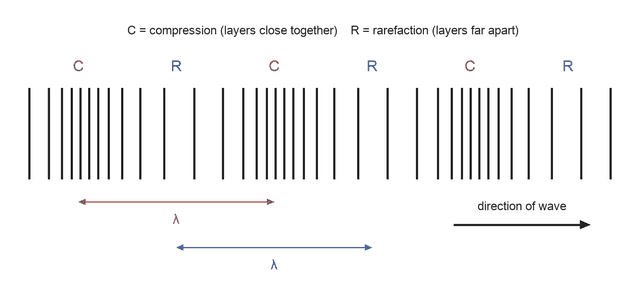
Step 2 — Define a compression.
A compression (C) is a region of a longitudinal wave where the particles (layers) of the medium are closer together than normal. There the density and the pressure of the medium are maximum.
Step 3 — Define a rarefaction.
A rarefaction (R) is a region of a longitudinal wave where the particles (layers) of the medium are farther apart than normal. There the density and the pressure of the medium are minimum.
Step 4 — Relate them to the wavelength.
Compressions and rarefactions are formed one after the other and both move forward with the wave. The distance between two consecutive compressions, or two consecutive rarefactions, is one wavelength λ.
Watch out: A compression is a region of HIGH density and pressure, not a region where particles stop moving.
Therefore, a compression is a region of crowded particles (maximum density and pressure), and a rarefaction is a region of spread-out particles (minimum density and pressure).
- 422 marks
Question 42
What do you mean by the term frequency of a wave ? State its S.I. unit.
Solve with AIWritten solution
Solution:
Concept: A wave is described by: its amplitude , the greatest displacement of a particle on either side of its mean position (unit m); its time period , the time for one vibration (unit s); its frequency , the number of vibrations in one second (unit Hz); its wavelength λ, the distance the wave travels in one time period (unit m); and its wave velocity , the distance it travels in one second (unit m s).
Step 1 — Define frequency.
The frequency of a wave is the number of vibrations made by a particle of the medium in one second. It is also the number of waves passing a point in one second. It is written (or , ).
Step 2 — Say what fixes it.
The particles are made to vibrate by the source, so the frequency of a wave equals the frequency of its source. It does not depend on the amplitude or on the medium, and it is the reciprocal of the time period, .
Step 3 — Give its unit.
Frequency is a number per second, so its S.I. unit is the hertz (Hz), which is the same as s.
Therefore, frequency is the number of vibrations made by a particle in one second; its S.I. unit is the hertz (Hz).
- 432 marks
Question 43
Define the term wave velocity. Write its S.I. unit.
Solve with AIWritten solution
Solution:
Concept: In one time period the wave moves forward by one wavelength λ, so its speed is λ divided by . Since , the wave equation is , that is, wave velocity is frequency times wavelength.
Step 1 — Define wave velocity.
The wave velocity is the distance travelled by a wave in one second. It is the speed with which energy is transferred from one place to another by the wave.
Step 2 — Separate it from particle velocity.
It is not the speed of a single particle, which only vibrates about its mean position. It is written , and .
Step 3 — Give its unit.
It is a distance per unit time, so its S.I. unit is the metre per second.
Therefore, wave velocity is the distance travelled by a wave in one second; its S.I. unit is m s.
- 443 marks
Question 44
Draw displacement-time graph of a wave and show on it the amplitude and time period of wave.
Solve with AIWritten solution
Solution:
Concept: A displacement-time graph shows how the displacement of one particle of the medium changes with time as the wave passes it. The particle moves up and down about its mean position, so the graph is a sine-shaped curve about the time axis.
Step 1 — Draw the axes.
Take the time along the x-axis and the displacement of the particle along the y-axis. The time axis is the particle's mean position.
Step 2 — Draw the curve.
Draw a smooth sine-shaped curve that rises to a crest, falls through the axis to a trough, and repeats.
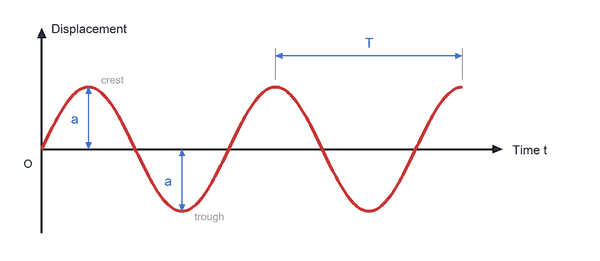
Step 3 — Mark the amplitude.
The amplitude is the height of a crest above the time axis, or the depth of a trough below it: the greatest displacement of the particle on either side of its mean position.
Step 4 — Mark the time period.
The time period is the time for one complete vibration. On the graph it is the time between two consecutive crests (or two consecutive troughs).
Watch out: The time period is measured from a crest to the NEXT crest; from a crest to the next trough is only half of T.
Therefore, on the displacement-time graph the amplitude a is the height of a crest above the time axis, and the time period T is the time between two consecutive crests.
- 453 marks
Question 45
Draw a displacement-distance graph of a wave and mark on it, the amplitude of wave by the letter a and wavelength of wave by the letter λ.
Solve with AIWritten solution
Solution:
Concept: A displacement-distance graph is a snapshot of the wave: it shows the displacements of all the particles along the wave at one instant. It is a sine-shaped curve about the distance axis.
Step 1 — Draw the axes.
Take the distance along the direction of the wave on the x-axis and the displacement of the particles on the y-axis. The distance axis is the mean position of the particles.
Step 2 — Draw the curve.
Draw a smooth sine-shaped curve with crests above the axis and troughs below it.
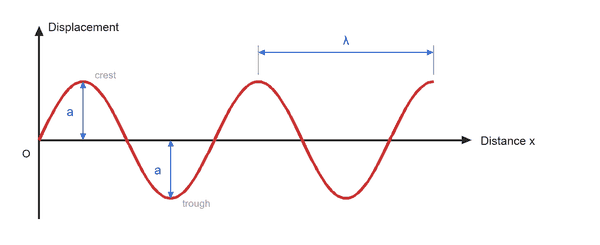
Step 3 — Mark the amplitude.
The amplitude is the height of a crest above the distance axis, or the depth of a trough below it.
Step 4 — Mark the wavelength.
The wavelength λ is the distance between two consecutive crests (or two consecutive troughs), that is, the distance the wave travels in one time period.
Watch out: On this graph the horizontal distance between crests is the wavelength; on a displacement-time graph the same gap would be the time period.
Therefore, on the displacement-distance graph the amplitude a is the height of a crest above the axis, and the wavelength λ is the distance between two consecutive crests.
- 462 marks
Question 46
State two properties of the medium on which the speed of sound in it depends.
Solve with AIWritten solution
Solution:
Concept: The speed of sound in a medium is , where is the elasticity and the density of the medium. The more elastic the medium, the faster sound travels; the denser it is (for the same elasticity), the slower.
Step 1 — Write the formula.
The speed of sound in a medium is
Step 2 — First property: elasticity.
The speed depends on the elasticity of the medium: the more elastic the medium, the greater the speed. This is why sound is fastest in solids.
Step 3 — Second property: density.
The speed depends on the density of the medium: for the same elasticity, a denser medium carries sound more slowly, since .
Watch out: Steel is denser than air but carries sound much faster, because its elasticity is far greater; compare elasticity before density.
Therefore, the speed of sound in a medium depends on its elasticity and its density.
- 472 marks
Question 47
Compare approximately the speed of sound in air, water and steel.
Solve with AIWritten solution
Solution:
Concept: The speed of sound depends on the medium: it is greatest in solids, less in liquids and least in gases. Typical values are about 5100 m s in steel, 1450 m s in water and 330 m s in air at 0 °C. Light travels much faster, at about m s.
Step 1 — Write the speeds.
Take the speed of sound as about 330 m s in air, 1450 m s in water and 5100 m s in steel.
Step 2 — Divide each by the speed in air.
Dividing by 330 shows how many times faster each medium carries sound.
Step 3 — Write the ratio.
Rounding to whole numbers, the ratio is
Therefore, is approximately 1 : 4 : 15; sound is about 4 times faster in water and about 15 times faster in steel than in air.
- 482 marks
Question 48
If you place your ear close to an iron railing which is struck some distance away, you hear the sound twice. Explain why ?
Solve with AIWritten solution
Solution:
Concept: The speed of sound depends on the medium: it is greatest in solids, less in liquids and least in gases. Typical values are about 5100 m s in steel, 1450 m s in water and 330 m s in air at 0 °C. Light travels much faster, at about m s.
Step 1 — Find the two paths.
When the railing is struck, the sound reaches your ear along two paths at the same time: through the iron railing and through the air.
Step 2 — Compare the speeds.
Iron is far more elastic than air, so sound travels much faster in it, about 5000 m s against about 330 m s in air.
Step 3 — Order the arrivals.
So the sound through the iron reaches the ear first, and the sound through the air arrives a little later.
Therefore, the sound is heard twice: first through the iron railing and then through the air.
- 493 marks
Question 49
The sound of an explosion on the surface of a lake is heard by a boat man 100 m away and by a diver 100 m below the point of explosion.
(a) Who would hear the sound first : boat man or diver?
(b) Give a reason for your answer in part (i).
(c) If sound takes time t to reach the boat man, how much time approximately does it take to reach the diver ?
Solve with AIWritten solution
Solution:
Concept: The speed of sound depends on the medium: it is greatest in solids, less in liquids and least in gases. Typical values are about 5100 m s in steel, 1450 m s in water and 330 m s in air at 0 °C. Light travels much faster, at about m s.
Step 1 — (a) Decide who hears first.
Both are 100 m from the explosion. The boat man receives the sound through air, the diver through water. The diver hears it first.
Step 2 — (b) Give the reason.
Sound travels faster in water (about 1450 m s) than in air (about 330 m s), so it covers the same 100 m in less time through water.
Step 3 — (c) Compare the times.
For the same distance, the time is inversely proportional to the speed, so the time ratio is the inverse of the speed ratio.
Step 4 — Round as the question asks.
Water carries sound roughly 4 times as fast as air, so the time is roughly a quarter.
Watch out: A faster speed means a SHORTER time, so the diver's time is t divided by about 4, not t multiplied by 4.
Note: part (b) refers to "part (i)" as printed; it means part (a).
Therefore, (a) the diver hears it first, (b) because sound travels faster in water than in air, and (c) it reaches the diver after about t/4 (more exactly about 0.23 t).
- 502 marks
Question 50
How does the speed of sound change with change in (i) amplitude and (ii) wavelength, of sound wave ?
Solve with AIWritten solution
Solution:
Concept: The speed of sound depends only on the medium (its elasticity, density and temperature), not on the properties of the wave itself.
Step 1 — (i) Amplitude.
A larger amplitude makes a louder sound, but the medium is the same, so the speed does not change. A shout and a whisper travel equally fast.
Step 2 — (ii) Wavelength.
If the wavelength changes, the frequency changes in the opposite way, so their product stays the same. The speed does not change; high and low notes of a band reach us together.
Therefore, the speed of sound does not change with either (i) the amplitude or (ii) the wavelength.
- 512 marks
Question 51
In which medium the speed of sound is more : humid air or dry air ? Give a reason to your answer.
Solve with AIWritten solution
Solution:
Concept: For a gas the elasticity is (Laplace), so the speed of sound is , where is the ratio of the two specific heats, the pressure and the density. At a fixed temperature is constant, so pressure has no effect; a higher temperature or more moisture lowers the density and raises the speed.
Step 1 — Compare the densities.
Water vapour is lighter than dry air: at the same temperature and pressure its density is only about of that of dry air. So adding moisture lowers the density of the air.
Step 2 — Use the formula.
At a fixed temperature the speed varies as , so a smaller density gives a greater speed.
Watch out: Humid air feels 'heavy', but it is actually LESS dense than dry air at the same temperature and pressure.
Therefore, the speed of sound is more in humid air, because moist air has a lower density than dry air.
- 525 marks
Question 52
(a) What is sound ? How is it produced ?
(b) Describe a simple experiment which demonstrates that the sound produced by a tuning fork is due to vibrations of its arms.
Solve with AIWritten solution
Solution:
Concept: Sound is a form of energy that produces the sensation of hearing. It is produced by a vibrating body: the body moves to and fro about its mean position and passes this disturbance on to the medium around it.
Step 1 — (a) What sound is.
Sound is a form of energy that produces the sensation of hearing in our ears. It reaches us as waves formed by the vibrations of the particles of a medium such as air, and these waves carry mechanical energy to our ear drum.
Step 2 — (a) How sound is produced.
Sound is produced when a body vibrates. Mechanical energy is needed to start the vibrations, and the vibrating body passes them on to the medium around it. When the body stops vibrating, the sound stops. A plucked sitar string, a beaten drum and the air column in a whistle are examples.
Step 3 — (b) Set up the experiment.
Hang a light table tennis ball by a thread from a stand so that it hangs freely. Strike one prong of a tuning fork on a rubber pad, so that it gives out a sound.
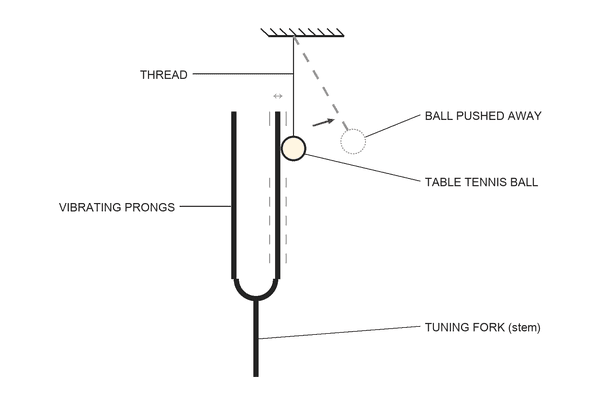
Step 4 — (b) Bring the fork to the ball.
Bring a vibrating prong gently up to the ball so that it just touches it.
Step 5 — (b) Observe.
The ball is pushed away again and again, as long as the fork's sound is heard. When the sound dies away, the ball stays at rest against the prong.
Step 6 — (b) Conclude.
The prongs move to and fro too quickly and too little to be seen, but they kick the ball away. So the prongs vibrate while the fork sounds, and the sound is due to these vibrations.
Watch out: Touch the ball GENTLY with the prong; a hard push would move the ball even with a silent fork.
Another simple check: dip the prongs of a sounding fork into water in a beaker; the water splashes.
Therefore, sound is a form of energy produced by vibrating bodies, and the jumping table tennis ball shows that the sound of a tuning fork is due to the vibrations of its prongs.
- 535 marks
Question 53
Describe in brief, with the aid of a labelled diagram, an experiment to demonstrate that a material medium is necessary for the propagation of sound.
Solve with AIWritten solution
Solution:
Concept: If a sounding bell becomes silent when the air round it is removed, even though it keeps ringing, then the air (a material medium) is what carries the sound.
Step 1 — Set up the apparatus.
An electric bell is hung inside an airtight glass bell jar through an airtight cork. The jar stands on a base plate connected to a vacuum pump. The bell is connected through the cork to a battery and a key outside.
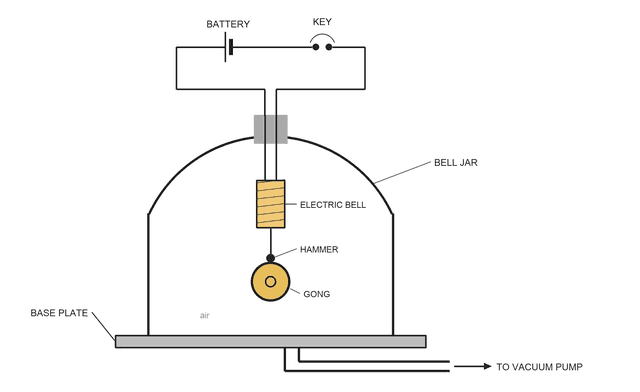
Step 2 — Ring the bell.
Press the key to complete the circuit. The hammer strikes the gong again and again, and the sound of the bell is heard clearly.
Step 3 — Remove the air.
Keeping the key pressed, start the vacuum pump so that it draws the air out of the jar gradually.
Step 4 — Observe.
The sound grows fainter as the air is removed, and when nearly all the air has been drawn out it can hardly be heard. Yet the hammer is still seen striking the gong, so the gong is still vibrating.
Step 5 — Explain.
With air in the jar, the vibrations of the gong travel through the air to the glass wall, which passes them on to the air outside. With the air removed, there is almost nothing to carry the vibrations to the wall, so very little sound comes out.
Watch out: The bell keeps vibrating all the time; it is the CARRYING of the sound that stops, not its production.
Note: a faint sound may still be heard because no pump makes a perfect vacuum and some vibration passes along the wires and the cork; this is why the bell is hung from a soft, airtight cork.
Therefore, sound needs a material medium for its propagation and cannot travel through vacuum.
- 544 marks
Question 54
Describe an experiment to show that in wave motion, only energy is transferred, but particles of medium do not leave their positions.
Solve with AIWritten solution
Solution:
Concept: In wave motion the particles of the medium only vibrate about their mean positions; they do not travel with the wave. What moves forward is the disturbance, and with it the energy.
Step 1 — Set up.
Take a pond (or a large tub) of still water, and place a small piece of cork on the water surface some distance from the middle.
Step 2 — Make a wave.
Drop a stone into the water at a point away from the cork. A disturbance is produced where the stone strikes, and it spreads outwards on the surface as circular ripples.
Step 3 — Observe the cork.
When the ripples reach the cork, the cork does not move ahead with them. It only moves up and down at its own place, while the ripples keep spreading.
Step 4 — Explain.
The water particles where the stone strikes start vibrating up and down. Each particle passes its energy to the next one and returns to its mean position. So the disturbance moves ahead, but each particle, and the cork floating on it, only vibrates about its own mean position.
Step 5 — See that energy travels.
The cork, which was at rest, starts moving up and down when the ripples reach it. So the wave has brought energy to it.
Watch out: A strong wind or current can drift the cork; do the experiment in still water so that only the wave acts.
Therefore, in wave motion only energy (the disturbance) is transferred, while the particles of the medium only vibrate about their mean positions and do not leave them.
- 555 marks
Question 55
How do the following factors affect, if at all, the speed of sound in air :
(i) frequency of sound, (ii) temperature of air, (iii) pressure of air, (iv) moisture in air ?
Solve with AIWritten solution
Solution:
Concept: For a gas the elasticity is (Laplace), so the speed of sound is , where is the ratio of the two specific heats, the pressure and the density. At a fixed temperature is constant, so pressure has no effect; a higher temperature or more moisture lowers the density and raises the speed.
Step 1 — (i) Frequency of sound.
Sounds of all frequencies travel with the same speed in a given medium. If the frequency changes, the wavelength changes so that stays the same. No effect.
Step 2 — (ii) Temperature of air.
On heating, air expands and its density falls, so the speed increases. The speed is proportional to the square root of the kelvin temperature, and near room temperature it rises by about 0.61 m s for each 1 °C rise.
Step 3 — (iii) Pressure of air.
If the pressure is increased at a fixed temperature, the density increases in the same ratio (Boyle's law), so stays constant. No effect.
Step 4 — (iv) Moisture in air.
Water vapour is lighter than dry air (about of its density), so moist air has a lower density. Since , the speed increases with moisture.
Watch out: Pressure appears in the formula, but it has no effect at a fixed temperature, because the density changes in the same ratio.
Therefore, (i) frequency has no effect, (ii) the speed increases with temperature, (iii) pressure has no effect, and (iv) the speed increases with moisture.
- 564 marks
Question 56
How are the wave velocity V, frequency f and wavelength λ of a wave related ? Derive the relationship.
Solve with AIWritten solution
Solution:
Concept: In one time period the wave moves forward by one wavelength λ, so its speed is λ divided by . Since , the wave equation is , that is, wave velocity is frequency times wavelength.
Step 1 — Name the quantities.
Let a wave have velocity , time period , frequency and wavelength λ.
Step 2 — Use the meaning of wavelength.
By definition, λ is the distance travelled by the wave in one time period . Distance is speed multiplied by time, so
Step 3 — Bring in the frequency.
The time period is the reciprocal of the frequency.
Step 4 — Substitute.
Putting this value of into the equation of Step 2 gives
Step 5 — Rearrange.
Multiplying both sides by gives the relation.
Therefore, wave velocity = frequency × wavelength, that is, .
- 574 marks
Question 57
Describe a simple experiment to determine the speed of sound in air. What approximation is made in the method described by you ?
- 584 marks
Question 58
The heart of a man beats 75 times a minute. What is its (a) frequency and (b) time period ?
- 593 marks
Question 59
The time period of a simple pendulum is 2 s. Find its frequency.
- 603 marks
Question 60
The separation between two consecutive crests in a transverse wave is 100 m. If wave velocity is 20 m s, find the frequency of wave.
- 613 marks
Question 61
A longitudinal wave travels at a speed of 0.3 m s and the frequency of wave is 20 Hz. Find the separation between the two consecutive compressions.
- 623 marks
Question 62
A source of wave produces 40 crests and 40 troughs in 0.4 s. What is the frequency of the wave ?
- 633 marks
Question 63
An observer A fires a gun and another observer B at a distance 1650 m away from A hears its sound. If the speed of sound is 330 m s, find the time when B will hear the sound after firing by A.
- 643 marks
Question 64
The time interval between a lightning flash and the first sound of thunder is 5 s. If the speed of sound in air is 330 m s, find the distance of flash from the observer.
- 653 marks
Question 65
A boy fires a gun and another boy at a distance hears the sound of fire 2.5 s after seeing the flash. If speed of sound in air is 340 m s, find the distance between the boys.
- 664 marks
Question 66
An observer sitting in line of two tanks, watches the flashes of two tanks firing at each other at the same time, but he hears the sounds of two shots 2 s and 3.5 s after seeing the flashes. If distance between the two tanks is 510 m, find the speed of sound.
- 674 marks
Question 67
How long will sound take to travel in (a) an iron rail and (b) air, both 3.3 km in length ? Take speed of sound in air to be 330 m s and in iron to be 5280 m s.
- 684 marks
Question 68
Assuming the speed of sound in air equal to 340 m s and in water equal to 1360 m s, find the time taken to travel a distance 1700 m by sound in (i) air and (ii) water.
- 691 mark
Question 69
The audible frequency range of sound is :
- 701 mark
Question 70
A man can hear a sound of frequency :
- 711 mark
Question 71
The human ear is most sensitive in the range of ................ where it can hear a feeble sound.
- 721 mark
Question 72
The speed of ultrasound in air is :
- 731 mark
Question 73
Echo-cardiography is used to obtain the image of :
- 741 mark
Question 74
Elephants produce ......... sound :
- 751 mark
Question 75
......... can hear the highest frequency range of sound.
- 761 mark
Question 76
Choose the correct statement :
- 771 mark
Question 77
The sound of frequency less than 20 Hz is called :
- 781 mark
Question 78
The properties of ultrasound that make it useful are :
- 791 mark
Question 79
Sonar makes use of :
- 801 mark
Question 80
What do you mean by the audible range of frequency?
- 811 mark
Question 81
What is the audible range of frequency for humans ?
- 821 mark
Question 82
For which range of frequencies are the human ears most sensitive ?
- 831 mark
Question 83
Which has a higher frequency – ultrasonic sound or infrasonic sound ?
- 842 marks
Question 84
Complete the following sentences :
(a) An average person can hear sounds of frequencies in the range ........... to ............
(b) Ultrasound is of frequency ...........
(c) Infrasonic sound is of frequency ..............
(d) Bats can produce and hear ........... sound.
(e) Elephants produce ............. sound.
- 852 marks
Question 85
Name the sounds of the frequencies given below:
(a) 10 Hz (b) 100 Hz (c) 1000 Hz (d) 40 kHz
- 861 mark
Question 86
What is ultrasound ?
- 871 mark
Question 87
State the approximate speed of ultrasound in air.
- 882 marks
Question 88
Can you hear the sound produced due to vibrations of a seconds' pendulum ? Give reason.
- 892 marks
Question 89
State two properties of ultrasound that make it useful to us.
- 902 marks
Question 90
State two applications of ultrasound.
- 914 marks
Question 91
Differentiate between infrasonic, sonic, ultrasonic and supersonic sounds.
- 924 marks
Question 92
Explain how do bats locate the obstacles and prey in their way.
What Class 9 Physics Ch 8 covers
The sections of the chapter, in the order the book takes them. Every question above comes from one of these.
- 01Sound and Its Production from Vibrations
- 02Sound Propagation Requires a Material Medium
- 03Propagation of Sound in a Medium
- 04Some Terms Related to Wave Motion
- 05Relationship Between Wavelength, Wave Velocity and Frequency
- 06Speed of Sound in Different Media
More ways to study this chapter
The same chapter asked three other ways. Practise it, revise it, and see what the board has set on Ch 8 before.
Class 9 Physics Ch 8 questions students ask
How many questions are there in Class 9 Physics Ch 8?
92 questions. Every one is solved step by step on this page.
Are these Class 9 Physics solutions free?
Yes. Every question and its full working is free to read, with no account needed.
Can I download the Class 9 Physics Ch 8 solutions as a PDF?
There is no PDF to download. Every solution is on this page instead, which means it is searchable, always the current syllabus, and readable on a phone. Use your browser's print option if you want it on paper.