
Question 413 marksEasy
Explain the meaning of terms compression and rarefaction in relation to a longitudinal wave.
Confirming your payment
Sign up now and get 250 free tokens.
Propagation of Sound Waves · Question 41 of 92
Explain the meaning of terms compression and rarefaction in relation to a longitudinal wave.
Solution:
Concept: Waves are named by the direction in which the particles vibrate. In a longitudinal wave the particles vibrate along the direction of travel, forming compressions and rarefactions; it can travel in solids, liquids and gases. In a transverse wave the particles vibrate perpendicular to the direction of travel, forming crests and troughs; it can travel only in solids and on the surface of a liquid.
Step 1 — Look at the layers.
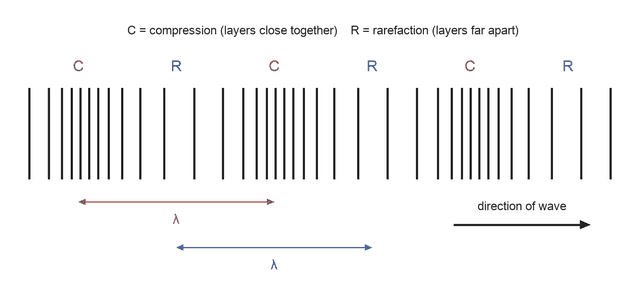
The figure shows the layers of air in a longitudinal sound wave. In some regions the layers are crowded together; in others they are spread apart.
Step 2 — Define a compression.
A compression (C) is a region of a longitudinal wave where the particles (layers) of the medium are closer together than normal. There the density and the pressure of the medium are maximum.
Step 3 — Define a rarefaction.
A rarefaction (R) is a region of a longitudinal wave where the particles (layers) of the medium are farther apart than normal. There the density and the pressure of the medium are minimum.
Step 4 — Relate them to the wavelength.
Compressions and rarefactions are formed one after the other and both move forward with the wave. The distance between two consecutive compressions, or two consecutive rarefactions, is one wavelength λ.
Watch out: A compression is a region of HIGH density and pressure, not a region where particles stop moving.
Therefore, a compression is a region of crowded particles (maximum density and pressure), and a rarefaction is a region of spread-out particles (minimum density and pressure).