
Question 525 marksMedium
(a) What is sound ? How is it produced ?
(b) Describe a simple experiment which demonstrates that the sound produced by a tuning fork is due to vibrations of its arms.
Confirming your payment
Sign up now and get 250 free tokens.
Propagation of Sound Waves · Question 52 of 92
(a) What is sound ? How is it produced ?
(b) Describe a simple experiment which demonstrates that the sound produced by a tuning fork is due to vibrations of its arms.
Solution:
Concept: Sound is a form of energy that produces the sensation of hearing. It is produced by a vibrating body: the body moves to and fro about its mean position and passes this disturbance on to the medium around it.
Step 1 — (a) What sound is.
Sound is a form of energy that produces the sensation of hearing in our ears. It reaches us as waves formed by the vibrations of the particles of a medium such as air, and these waves carry mechanical energy to our ear drum.
Step 2 — (a) How sound is produced.
Sound is produced when a body vibrates. Mechanical energy is needed to start the vibrations, and the vibrating body passes them on to the medium around it. When the body stops vibrating, the sound stops. A plucked sitar string, a beaten drum and the air column in a whistle are examples.
Step 3 — (b) Set up the experiment.
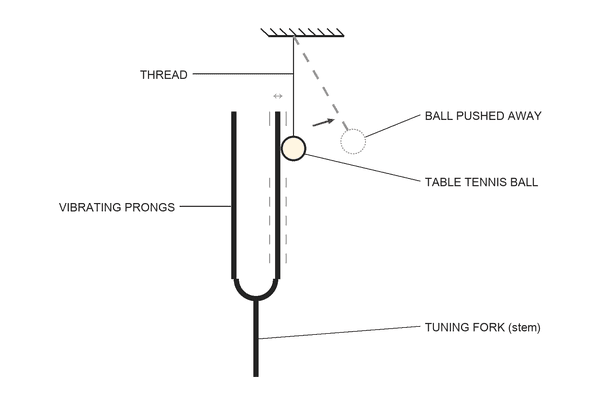
Hang a light table tennis ball by a thread from a stand so that it hangs freely. Strike one prong of a tuning fork on a rubber pad, so that it gives out a sound.
Step 4 — (b) Bring the fork to the ball.
Bring a vibrating prong gently up to the ball so that it just touches it.
Step 5 — (b) Observe.
The ball is pushed away again and again, as long as the fork's sound is heard. When the sound dies away, the ball stays at rest against the prong.
Step 6 — (b) Conclude.
The prongs move to and fro too quickly and too little to be seen, but they kick the ball away. So the prongs vibrate while the fork sounds, and the sound is due to these vibrations.
Watch out: Touch the ball GENTLY with the prong; a hard push would move the ball even with a silent fork.
Another simple check: dip the prongs of a sounding fork into water in a beaker; the water splashes.
Therefore, sound is a form of energy produced by vibrating bodies, and the jumping table tennis ball shows that the sound of a tuning fork is due to the vibrations of its prongs.