
Opening your dashboard
Class 9 Physics Chapter 8 Propagation of Sound Waves: Competency-Based Questions (CBQ)
40 questions on Chapter 8, each worked through on its own page with the AI tutor. Class 9 Physics, ICSE 2026-27.
40 questions
1–4 marks · Mixed difficulty
- 11 mark
Question 1
Competency: Analysis
A tiny sensor records how one particle of air in front of a loudspeaker is displaced from its mean position as a steady note is played. The graph obtained is shown below.

Which pair gives the amplitude and the frequency of the wave correctly ?
- 21 mark
Question 2
Competency: Application & Analysis
A plumber strikes one end of a straight, empty steel pipe with a hammer. The pipe is 510 m long. His helper presses an ear against the other end of the pipe and hears two sounds, one after the other. The speed of sound is 340 m s in air and 5100 m s in steel. The time interval between the two sounds is :
- 31 mark
Question 3
Competency: Understanding & Application
Two astronauts are working outside a space station when their radio sets fail. They find that they still cannot hear each other even when they shout from a metre apart, but they can hear each other faintly when they press their helmets together. Which explanation is correct ?
- 41 mark
Question 4
Competency: Application
The box of an electronic 'rat repeller' says that it sends out sound waves of wavelength 0.66 cm in air. The speed of sound in air is 330 m s. Can the people living in the house hear this sound ?
- 51 mark
Question 5
Competency: Understanding
Assertion (A): In still air, the sound of a cracker burst 1 km away reaches a listener sooner on a hot summer afternoon than on a cold winter night.
Reason (R): The speed of sound in air increases with the rise in temperature of the air.
- 61 mark
Question 6
Competency: Analysis
Assertion (A): When a drum is beaten in a hall, a dust particle floating in the air near the drum is carried by the sound wave all the way to a listener at the back of the hall.
Reason (R): A sound wave carries energy from one place to another through the vibrations of the particles of the medium.
- 72 marks
Question 7
Competency: Application
At a swimming gala, the same music is played through a loudspeaker in the air and through a second loudspeaker fixed under the water. Both loudspeakers give out a note of frequency 500 Hz. The speed of sound is 340 m s in air and 1450 m s in water.
(a) Calculate the wavelength of this note in air and in water.
(b) A swimmer hears the note first with her head above the water and then with her head under it. Which of the three quantities, speed, frequency and wavelength, is the same for her in both cases ? Give a reason.
- 82 marks
Question 8
Competency: Analysis & Application
A student clamps a hacksaw blade to the edge of a table so that a part of it hangs free. She pulls the free end down, lets it go and records what she observes for three different free lengths.
Free length of the blade Number of vibrations in 10 s Sound heard 30 cm 50 none 20 cm 110 none 6 cm too fast to count a low hum (a) Calculate the frequency of vibration of the blade for the free lengths of 30 cm and 20 cm.
(b) The blade vibrates in all three cases. Explain why she hears a sound only with the free length of 6 cm. What will happen to the hum if she touches the vibrating blade firmly with a finger, and why ?
- 92 marks
Question 9
Competency: Evaluation & Application
A trekking group camps high up on a mountain. At the camp the air pressure is only 0.6 times the pressure at sea level and the temperature of the air is −10 °C. Riya says, "Sound travels more slowly here than it does at 0 °C at sea level, because the air pressure here is so low."
(a) Judge Riya's statement: is her conclusion correct, and is her reason correct ? Justify your answer.
(b) Calculate the speed of sound at the camp. (Speed of sound in air at 0 °C = 330 m s; it changes by 0.61 m s for each 1 °C change in temperature.)
- 102 marks
Question 10
Competency: Analysis & Application
A loudspeaker at one end of a long tube of air plays a steady note. Small pressure sensors along the tube show that, at one instant, the pressure of the air is greatest at distances of 0.10 m, 0.95 m and 1.80 m from the loudspeaker, and at no other point between them. (Speed of sound in air = 340 m s)
(a) What name is given to the regions where the pressure is greatest ? Find the wavelength of the sound.
(b) Find the frequency and the time period of the note.
- 114 marks
Question 11
Competency: Analysis & Evaluation
Case study: On a morning with no wind, the students of a school measure the speed of sound along a long, straight road. One student fires a starting pistol. Another student, at a measured distance, starts a stop-watch on seeing the smoke of the pistol and stops it on hearing the sound. For each distance the measurement is repeated several times and the mean time is taken. Their results are plotted in the graph below. (A person takes about 0.2 s to react when starting or stopping a stop-watch.)
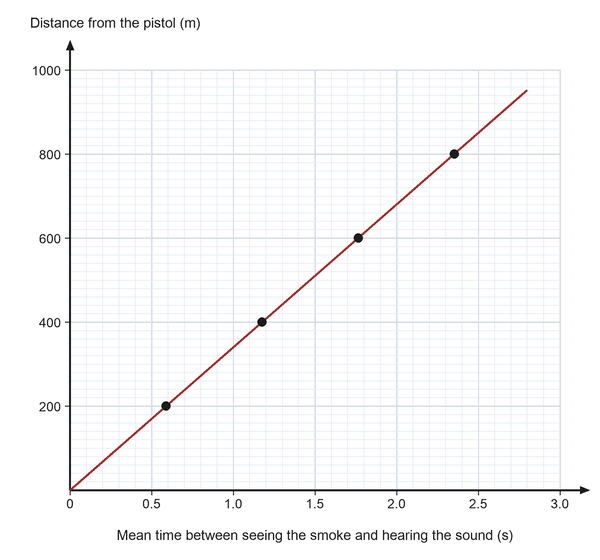
(a) What does the straight line through the origin tell you about the speed of sound over these distances ? Use the graph to find this speed.
(b) The speed of sound in air is 330 m s at 0 °C and rises by 0.61 m s for each 1 °C rise in temperature. Estimate the temperature of the air that morning.
(c) One student says, "Walking 800 m down the road is a waste of effort. Standing just 50 m from the pistol will give an equally good result." Judge this suggestion, supporting your answer with a calculation.
- 124 marks
Question 12
Competency: Application & Analysis
Case study: In a shipyard, a solid steel propeller shaft is checked for hidden cracks without cutting it. A probe pressed against one flat end of the shaft sends a short pulse of ultrasound of frequency 2 MHz ( Hz) along the length of the shaft. The same probe receives any ultrasound that is reflected back. The screen of the tester is shown below: T is the pulse sent in, and P and Q are two reflected pulses. The speed of sound in steel is 5100 m s. (1 ms = s)
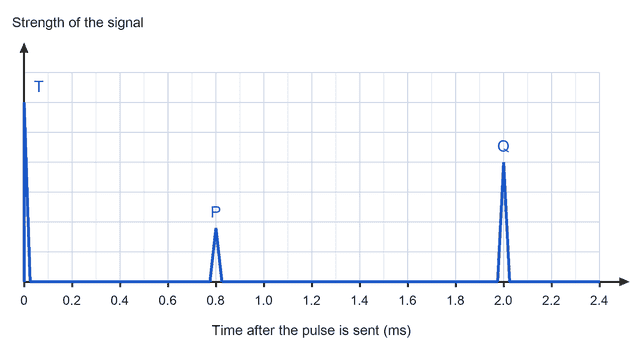
(a) Pulse Q is the reflection from the far end of the shaft. Calculate the length of the shaft.
(b) What does pulse P tell the engineer ? Calculate how far from the probe it was produced.
(c) Calculate the wavelength of this ultrasound in steel. A trainee suggests using an audible sound of frequency 1000 Hz instead. Find its wavelength in steel, and explain why the ultrasound is the better choice for finding a small crack.
- 134 marks
Question 13
Competency: Analysis & Evaluation
Case study: An electric bell is hung inside a bell jar that stands on the plate of a vacuum pump. The bell is kept ringing while the pump slowly removes the air from the jar. A sound meter kept just outside the jar shows how loud the sound is. The readings are given below.
Pressure of the air left in the jar (cm of Hg) 76 50 25 10 2 Reading of the sound meter (units) 80 62 40 22 9 All through the experiment the hammer of the bell can be seen striking the gong just as before.
(a) Describe the pattern in the readings. What conclusion about the propagation of sound do they lead to ?
(b) At the last reading the meter still shows 9 units. Arjun says, "This proves that a little sound can travel through a vacuum." Judge his statement and give two reasons why some sound is still received outside.
(c) The hammer is seen clearly at every stage, even when the bell can hardly be heard. What does this show about light ?
- 144 marks
Question 14
Competency: Analysis & Application
The table gives the approximate range of frequencies that some animals and human beings can hear.
Listener Lowest frequency heard Highest frequency heard Human being 20 Hz 20 kHz Elephant 16 Hz 12 kHz Dog 65 Hz 50 kHz Cat 45 Hz 60 kHz Bat 2 kHz 100 kHz Three sources send out sound in air, where the speed of sound is 340 m s. The wavelengths of the three sounds are : P – 20 m, Q – 0.68 m, R – 0.85 cm.
(a) Calculate the frequency of each sound and state whether it is infrasonic, sonic (audible) or ultrasonic.
(b) For each sound, name the listeners in the table that can hear it.
(c) A watchman wants a whistle that calls his dog but cannot be heard by people. In what range must its frequency lie ? Would the cats in the neighbourhood hear it ?
- 154 marks
Question 15
Competency: Application & Creation
A students' science club wants to make a 'smart walking stick' that warns a visually impaired person of an obstacle ahead. The club has a small ultrasound transmitter, an ultrasound receiver, an electronic timer that can measure very short time intervals, and a buzzer. (Speed of sound in air = 340 m s)
(a) Design the stick: describe where you would fix the transmitter and the receiver, and how the stick would find the distance of an obstacle.
(b) The buzzer has to sound whenever an obstacle is nearer than 1.7 m. For what readings of the timer should the buzzer be switched on ? Show your calculation.
(c) Give two reasons for using ultrasound and not audible sound in the stick. Then state one weakness of your design and suggest how it could be improved.
- 161 mark
Question 16
Competency: Analysis
A long glass tube is filled with air at 0 °C, and a loudspeaker at one end sends a steady note into it. The figure shows how the air is spread along a part of the tube at one instant, each vertical line standing for a thin layer of air. P, Q, R and S mark the centres of four successive compressions, and the distance from P to S is 0.99 m. The air in the tube is then warmed to 30 °C, while the loudspeaker keeps playing the same note. The speed of sound in air is at 0 °C and increases by for each 1 °C rise in temperature. (Hypothetical data.)
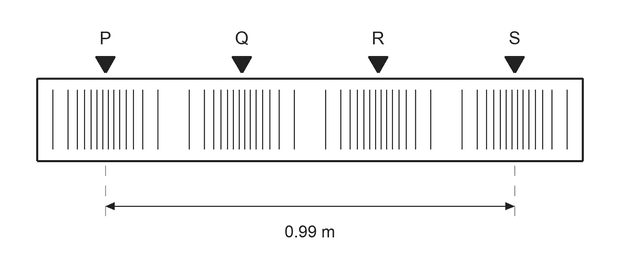
What is the distance between the centres of the first and the fourth compressions in the warm air?
- 171 mark
Question 17
Competency: Application
A small fishing float on a lake rises and falls 12 times in 6.0 s as the waves of a passing motorboat go by. The distance between two successive crests of these waves is 0.6 m. (Hypothetical data.)
What is the speed of the waves on the water?
- 181 mark
Question 18
Competency: Application
A jet plane flies at a steady speed of . Near the ground the air is at 30 °C, and high up, where the plane later cruises, the air is at −50 °C. The speed of sound in air is at 0 °C and changes by for each 1 °C change in temperature. A plane is supersonic at a place when its speed is greater than the speed of sound in the air at that place. (Hypothetical data.)
Which statement about the plane is correct?
- 191 mark
Question 19
Competency: Analysis
A student finds that, at the same temperature and the same pressure, sound travels in a gas G at exactly half of its speed in air. Treat both gases as having the same value of . (Hypothetical data.)
How does the density of gas G compare with the density of air?
- 201 mark
Question 20
Competency: Understanding
Assertion (A): Tiny parts of a watch are cleaned better in an ultrasonic cleaning bath than by shaking them in the same liquid by hand.
Reason (R): Ultrasound sent into the cleaning solution makes the solution vibrate at a very high frequency.
- 211 mark
Question 21
Competency: Evaluation
Anita sprinkles a few grains of rice on the stretched skin of a tabla and strikes the skin gently. The grains jump up and down, and a sound is heard. She then touches the skin with her palm. The grains at once stop jumping and the sound stops.
Which conclusion is best supported by these observations?
- 221 mark
Question 22
Competency: Analysis
A fishing boat stays at one place, and its fish-finder sends short pulses of ultrasound straight down into the sea. The echo from a shoal of fish returns 0.40 s after a pulse is sent. Exactly 40 s later, the echo from the same shoal returns 0.36 s after its pulse. The speed of sound in sea water is . (Hypothetical data.)
At what average speed is the shoal rising towards the surface?
- 231 mark
Question 23
Competency: Analysis
Two sound waves, P and Q, travel at the same time through the same room, so they are in the same air. The graphs show the displacement of the air particles from their mean positions at one instant, plotted against distance, for the two waves.
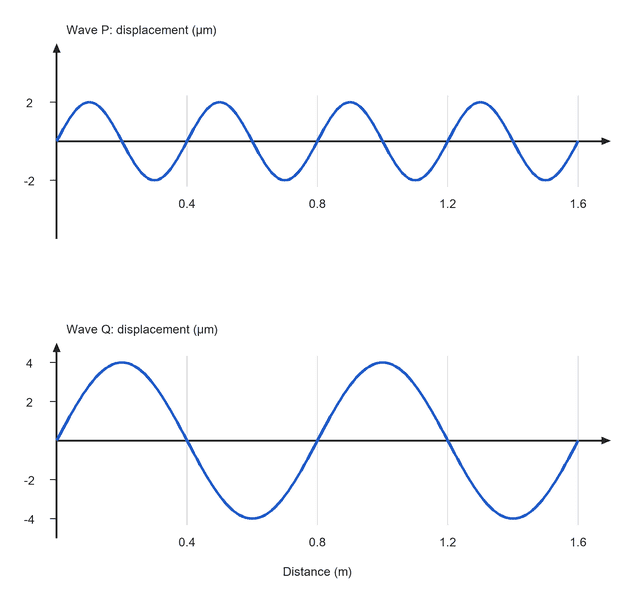
Which statement compares the two waves correctly?
- 241 mark
Question 24
Competency: Evaluation
Assertion (A): Sound waves cannot reach the Earth from the Sun, but light waves can.
Reason (R): Light waves are longitudinal waves and sound waves in air are transverse waves.
- 251 mark
Question 25
Competency: Application
A drummer plays a loud beat on a stage. A listener stands 700 m away on the ground in the line of the stage. In still air the speed of sound is . On one day a wind of blows from the drummer towards the listener. On another day the wind blows at the same speed from the listener towards the drummer. (Hypothetical data.)
By how much earlier does the beat reach the listener on the first day than on the second day?
- 262 marks
Question 26
Competency: Application
A honey bee beats its wings 220 times in one second. A butterfly takes 0.125 s for one complete up-and-down beat of its wings. (Hypothetical data.)
(a) Find the frequency of the butterfly's wing beats, and the number of wing beats the bee makes in the time the butterfly makes one.
(b) We hear a buzz from the wings of the bee, but the wings of the butterfly seem silent. Explain why, and name the kind of sound that the butterfly's wings give out.
- 272 marks
Question 27
Competency: Application
In echo-cardiography a doctor presses a probe on the chest of a patient. The probe sends short pulses of ultrasound towards the heart and receives the pulses reflected from it. A pulse reflected from the back wall of a chamber of the heart returns to the probe s after it was sent. Take the speed of ultrasound in the soft tissue of the body as . (Hypothetical data.)
(a) How far from the probe is the back wall of the chamber?
(b) Before the test, the doctor spreads a layer of gel between the probe and the skin. Explain why the gel is needed, using a property of ultrasound.
- 282 marks
Question 28
Competency: Application
Two students hold the ends of a long rope that is 12.0 m long and stretched tight. One student moves her end up and down 2.5 times in every second, and transverse waves travel along the rope. A photograph shows that neighbouring crests on the rope are 2.4 m apart. (Hypothetical data.)
(a) Find the speed of the waves on the rope, and the time a crest takes to travel from her end to the other end.
(b) She now moves her end up and down twice as fast, with the rope held as tight as before. State what happens to the speed and to the wavelength of the waves, and give a reason.
- 292 marks
Question 29
Competency: Understanding
At night Kabir puts his ringing alarm clock under a thick blanket. The sound that reaches him becomes much fainter, although the blanket is a material and the clock is still ringing.
(a) Explain why the thick blanket cuts down the sound so much.
(b) Name one more property that a medium must have for sound to travel through it, and say what this property does when a vibrating metal strip sends a disturbance into the air.
- 302 marks
Question 30
Competency: Evaluation
Ritu's grandmother says: "After you see a lightning flash, count the seconds before you hear the thunder, and divide the count by 3. The answer is the distance of the lightning in kilometres."
(a) Take the speed of sound in air as . Show why the rule works well.
(b) On a very hot day, at 40 °C, the speed of sound in air is , and the gap between a flash and its thunder is 12 s. Find by what percentage the distance given by the rule differs from the true distance, and say whether the rule is a good guide.
- 312 marks
Question 31
Competency: Analysis
A railway worker strikes a long straight steel rail with a hammer. An inspector at the other end of the rail, with his ear close to the rail, hears the sound twice. The two sounds are 1.5 s apart. Take the speed of sound as in steel and in air. (Hypothetical data.)
(a) Which sound is heard first? Give a reason.
(b) Find the distance between the worker and the inspector.
- 323 marks
Question 32
Competency: Analysis
Two students make a 'string telephone' from two paper cups joined by a thin nylon thread 8 m long, stretched tight. Meera speaks into the open end of one cup, and Arun, who holds the other cup to his ear, hears her voice clearly. (Hypothetical data.)
(a) Trace the path of Meera's voice from her mouth to Arun's ear, naming the medium in each stage.
(b) The telephone stops working when the thread is slack, and also when a third student pinches the tight thread. Explain each case.
(c) Would the telephone work if both cups and the whole thread were inside a chamber from which all the air had been pumped out? Give a reason.
- 333 marks
Question 33
Competency: Analysis
The graph shows how the speed of sound in dry air changes with the temperature of the air.
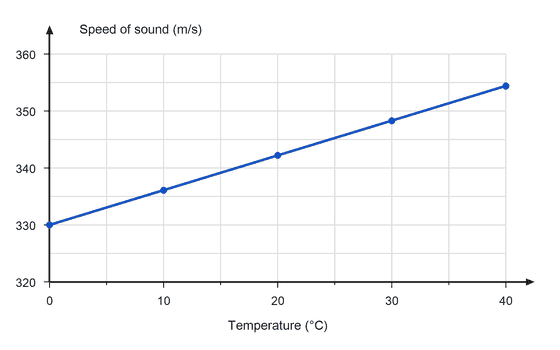
(a) Read from the graph the speed of sound at 25 °C and at 35 °C.
(b) Find the slope of the line, using the points at 0 °C and 40 °C, and say what it means.
(c) Sana extends the straight line to lower temperatures and says that the speed of sound in air would fall to zero at about −541 °C. Show how she gets this value, and give one reason why her conclusion is wrong.
- 343 marks
Question 34
Competency: Evaluation
Sneha writes the following table for some media at 0 °C. The densities are approximate.
Medium Speed of sound (m s) Density (kg m) Hydrogen 1270 0.09 Air 330 1.29 Carbon dioxide 260 1.98 Alcohol 1210 800 Water 1450 1000 Steel 5100 7800 She says: "Sound travels faster in a denser medium, because the particles are packed closer and pass the disturbance on more quickly."
(a) Use two pairs of media from the table to show that her statement is not true in general.
(b) State the two properties of the medium on which the speed of sound depends, and write the relation between them and the speed. Why is the speed so large in steel in spite of its large density?
(c) Rewrite Sneha's statement correctly.
- 353 marks
Question 35
Competency: Application
A tuning fork of frequency 256 Hz is struck and held in air, in which the speed of sound is . (Hypothetical data.)
(a) Find the time period of the vibrations of the prong of the fork.
(b) How far does the sound travel in the time the prong makes one complete vibration?
(c) How far from the fork is the first compression when the prong has completed 100 vibrations, and how many compressions have left the fork by then?
- 363 marks
Question 36
Competency: Analysis
A firework is burst 3.4 km from Vinay. He sees the flash and hears the bang 10.0 s later. Take the speed of sound in air as and the speed of light as . (Hypothetical data.)
(a) Find the time taken by the sound, and the time taken by the light, to reach Vinay.
(b) What fraction of the 10.0 s gap is the time taken by the light? Explain what this tells you about the usual assumption made in this kind of calculation.
(c) Vinay's friend suggests measuring the speed of light in the same way with a stop-watch over this distance. Is that possible? Give a reason.
- 374 marks
Question 37
Competency: Analysis
Case study: A sound engineer tests a loudspeaker that sends a steady note into a long hall. A recorder gives two graphs for the air particles in front of the loudspeaker. Graph 1 is a snapshot taken at one instant: it shows how far the particles are displaced from their mean positions at different distances from the loudspeaker. Graph 2 shows how one particle of the air is displaced as time passes. Both graphs belong to the same note. (Hypothetical data.)


(a) Read from the graphs the amplitude of the wave, its wavelength and its time period.
(b) Find the frequency of the note and the speed of the wave in the hall.
(c) A listener sits 51 m from the loudspeaker. How long does the note take to reach her, and how many complete waves lie between her and the loudspeaker at any instant?
- 384 marks
Question 38
Competency: Analysis
Case study: One evening in the monsoon, Nisha stands on her terrace and watches a thunderstorm come straight towards her house. After each lightning flash she notes the time that passes before she hears its thunder. She records this every 2 minutes, from the first flash she notes. Her results are in the table. Take the speed of sound in air as and assume that each flash occurs at the position of the storm at that time. (Hypothetical data.)
Time of observation (minutes) 0 2 4 6 Gap between flash and thunder (s) 12 9 6 3 (a) Find the distance of the storm from the house at each observation.
(b) Find the speed at which the storm is coming towards the house, in m s and in km h.
(c) If the storm keeps coming at the same speed along the same line, at what time will it be over the house? Give one reason why this prediction may be wrong.
- 394 marks
Question 39
Competency: Analysis
Case study: In a cricket stadium the spectators in one long row make a 'wave'. Each spectator stands up and sits down again, one after another along the row, so that the movement seems to run along the row. The seats are 0.5 m apart. The table gives the time at which the spectator in each of some seats stands up, measured from the moment the spectator in seat 1 stands. Each spectator stands up once in every 4.0 s while the wave is being repeated. (Hypothetical data.)
Seat number 1 6 11 16 21 Time at which the spectator stands (s) 0.0 0.5 1.0 1.5 2.0 (a) Use the table to find the speed with which the wave runs along the row.
(b) Find the frequency and the wavelength of the wave, and the number of seats in one wavelength.
(c) Is this wave transverse or longitudinal? State what travels along the row and what does not. How is a sound wave in air similar to this wave, and how is it different?
- 404 marks
Question 40
Competency: Creativity
Case study: Nandini's science club wants to build a 'sound thermometer' for the weather corner of the school. A small speaker at one end of a straight, level 100 m path sends out a very short click. A microphone at the other end of the path stops an electronic timer that was started with the click. The club will read the temperature of the air from the time shown by the timer. The speed of sound in air is at 0 °C and increases by for each 1 °C rise in temperature. (Hypothetical design.)
(a) Find the time that the timer should show, in milliseconds (ms), at 0 °C, 20 °C and 40 °C.
(b) The club wants to mark a scale in which each 1 °C can be told apart. About how much does the reading change for a 1 °C change in temperature? What is the smallest time the timer must be able to resolve?
(c) Name two conditions that would spoil the readings of this thermometer, and suggest one change to the design that removes one of them.