
Opening your dashboard
Class 9 Maths Chapter 27: Graphical Solution Solutions
50 textbook questions with step-by-step answers, free to read, for ICSE 2026-27.
Get talked through Ch 27, not just shown the answer
Reading a finished solution is not the same as being able to do it. The AI tutor takes one question at a time and works it with you, in your own words, until you can.
- Ask it out loud, in your own words
- It gives you the next step, not the answer
- Stuck on part (ii)? Start there
50 questions with solutions
1–3 marks · Mixed difficulty
The first 14 solutions are on this page. This chapter is a long one, so the rest open on their own page to keep this one quick to load.
- 11 mark
Question 1
Point lies on the line ; the value of is :
Solve with AIAnswer
- Correct
(A) 10
(B) −6
(C) −10
(D) 6
Answer: (A) 10
Concept: A point lies on a line exactly when its co-ordinates satisfy the line's equation.
Step 1 — Put the point into the equation.
A point lies on a line when its co-ordinates satisfy the equation. So we substitute and into the equation, , and solve for .
Watch out: means , so with it is 8, not 4.
Why the other options are wrong:
- (B) −6: With , the left side is , not 2. This value comes from subtracting 8 from 2 instead of adding it.
- (C) −10: With , the left side is , not 2.
- (D) 6: With , the left side is , not 2. This value comes from adding only 4, forgetting to multiply 4 by .
Therefore, the value of is 10, option (A).
- 21 mark
Question 2
The line passes through the point (5, 2); the value of is :
Solve with AIAnswer
(A) 1
- Correct
(B) 2
(C) −2
(D) −1
Answer: (B) 2
Concept: A point lies on a line exactly when its co-ordinates satisfy the line's equation.
Step 1 — Put the point into the equation.
The point (5, 2) is on the line, so its co-ordinates satisfy ; we put and .
Watch out: Put and , not the other way round: the first number of a point is always its -co-ordinate.
Why the other options are wrong:
- (A) 1: With , the value of at the point is , not 2.
- (C) −2: With , the value of at the point is , not 2.
- (D) −1: With , the value of at the point is , not 2.
Therefore, the value of is 2, option (B).
- 31 mark
Question 3
The line intersects -axis at point P. The co-ordinates of point P are:
Solve with AIAnswer
(A) (0, 2)
(B) (0, −2)
- Correct
(C) (2, 0)
(D) (−2, 0)
Answer: (C) (2, 0)
Concept: A line meets the -axis at the point where , and meets the -axis at the point where .
Step 1 — Use the fact that y = 0 on the x-axis.
Every point of the -axis has ordinate 0, so at P we put into the equation, , and solve for .
Step 2 — Write the point.
The abscissa is 2 and the ordinate is 0, so P is the point (2, 0).
Watch out: On the -axis it is that is zero, so the point has the form , not .
Why the other options are wrong:
- (A) (0, 2): (0, 2) has abscissa 0, so it is on the -axis, not the -axis. It is not even on the line: .
- (B) (0, −2): (0, −2) has abscissa 0, so it is on the -axis, not the -axis. It is not on the line either: .
- (D) (−2, 0): (−2, 0) is on the -axis but not on the line: .
Therefore, P is the point (2, 0), option (C).
- 41 mark
Question 4
The line intersects -axis at point A. The co-ordinates of point A are :
Solve with AIAnswer
(A) (−5, 0)
(B) (5, 0)
(C) (0, 5)
- Correct
(D) (0, −5)
Answer: (D) (0, −5)
Concept: A line meets the -axis at the point where , and meets the -axis at the point where .
Step 1 — Use the fact that x = 0 on the y-axis.
Every point of the -axis has abscissa 0, so at A we put into the equation, , and solve for .
Step 2 — Write the point.
The abscissa is 0 and the ordinate is −5, so A is the point (0, −5).
Watch out: Dividing 20 by −4 gives −5; keep the minus sign.
Why the other options are wrong:
- (A) (−5, 0): (−5, 0) has ordinate 0, so it is on the -axis, not the -axis. It is not on the line either: .
- (B) (5, 0): (5, 0) has ordinate 0, so it is on the -axis, not the -axis. It is not on the line either: .
- (C) (0, 5): (0, 5) is on the -axis but not on the line: . The sign of has been lost.
Therefore, A is the point (0, −5), option (D).
- 51 mark
Question 5
The point (0, 0) lies on :
Solve with AIAnswer
(A) -axis
(B) -axis
(C) -axis or -axis
- Correct
(D) -axis and -axis
Answer: (D) -axis and -axis
Concept: Every point of the -axis has ordinate 0 (the -axis is ), and every point of the -axis has abscissa 0 (the -axis is ).
Step 1 — Test the x-axis.
The -axis is the line . The point (0, 0) has ordinate 0, so it lies on the -axis.
Step 2 — Test the y-axis.
The -axis is the line . The point (0, 0) has abscissa 0, so it lies on the -axis too.
Step 3 — Conclude.
(0, 0) is the origin O, the point where the two axes cross, so it lies on both of them.
Why the other options are wrong:
- (A) -axis: (0, 0) does lie on the -axis, but this choice leaves out the -axis, which it also lies on.
- (B) -axis: (0, 0) does lie on the -axis, but this choice leaves out the -axis, which it also lies on.
- (C) -axis or -axis: 'Or' says the point lies on one axis or the other; the origin lies on both at once, which only (D) states.
Therefore, the point (0, 0) lies on the -axis and the -axis, option (D).
- 63 marks
Question 6
Draw the graph for each equation, given below :
Solve with AIWritten solution
Solution:
Concept: An equation of the form says that the abscissa (-co-ordinate) of every point is , whatever the ordinate is. All such points lie on a straight line parallel to the -axis, units from it (to the right when is positive, to the left when is negative).
Given: The equation .
Step 1 — Understand the equation.
The equation has no in it. So is 5 for every point of the graph, whatever is.
Step 2 — Make a table of values.
We choose any three values of ; the abscissa is 5 each time.
Step 3 — Plot and join.
We plot (5, −2), (5, 0) and (5, 2) and join them with a ruler. The line is vertical, 5 units to the right of the -axis, and it crosses the -axis at (5, 0).
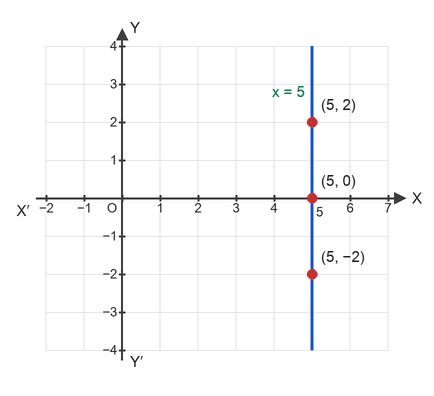
Watch out: is a vertical line (parallel to the -axis), not a horizontal one; a horizontal line has an equation such as .
Therefore, the graph of is the straight line through (5, −2), (5, 0) and (5, 2): parallel to the -axis and 5 units to its right.
- 73 marks
Question 7
Draw the graph for each equation, given below :
Solve with AIWritten solution
Solution:
Concept: An equation of the form says that the abscissa (-co-ordinate) of every point is , whatever the ordinate is. All such points lie on a straight line parallel to the -axis, units from it (to the right when is positive, to the left when is negative).
Given: The equation .
Step 1 — Write the equation simply.
We subtract 5 from both sides to see what must be.
Step 2 — Make a table of values.
There is no in the equation, so is −5 whatever is. We choose three values of .
Step 3 — Plot and join.
We plot (−5, −2), (−5, 0) and (−5, 2) and join them. The line is vertical, 5 units to the left of the -axis.
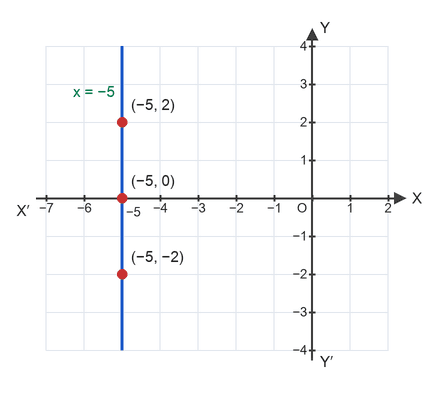
Watch out: Moving 5 to the other side changes its sign, so , and the line is to the LEFT of the -axis.
Therefore, the graph of is the vertical straight line through (−5, −2), (−5, 0) and (−5, 2): parallel to the -axis and 5 units to its left.
- 83 marks
Question 8
Draw the graph for each equation, given below :
Solve with AIWritten solution
Solution:
Concept: An equation of the form says that the ordinate (-co-ordinate) of every point is , whatever the abscissa is. All such points lie on a straight line parallel to the -axis, units from it (above it when is positive, below it when is negative).
Given: The equation .
Step 1 — Understand the equation.
The equation has no in it. So is 7 for every point of the graph, whatever is.
Step 2 — Make a table of values.
We choose any three values of ; the ordinate is 7 each time.
Step 3 — Plot and join.
We plot (−3, 7), (0, 7) and (3, 7) and join them. The line is horizontal, 7 units above the -axis, and it crosses the -axis at (0, 7).
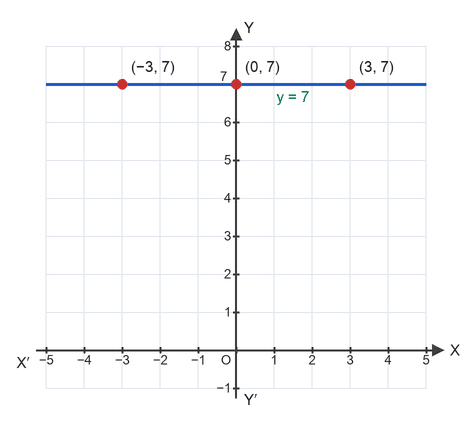
Watch out: is a horizontal line (parallel to the -axis), not a vertical one; a vertical line has an equation such as .
Therefore, the graph of is the straight line through (−3, 7), (0, 7) and (3, 7): parallel to the -axis and 7 units above it.
- 93 marks
Question 9
Draw the graph for each equation, given below :
Solve with AIWritten solution
Solution:
Concept: An equation of the form says that the ordinate (-co-ordinate) of every point is , whatever the abscissa is. All such points lie on a straight line parallel to the -axis, units from it (above it when is positive, below it when is negative).
Given: The equation .
Step 1 — Write the equation simply.
We subtract 7 from both sides to see what must be.
Step 2 — Make a table of values.
There is no in the equation, so is −7 whatever is. We choose three values of .
Step 3 — Plot and join.
We plot (−3, −7), (0, −7) and (3, −7) and join them. The line is horizontal, 7 units below the -axis.
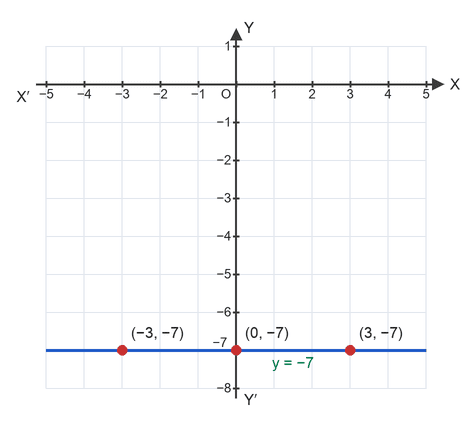
Watch out: Moving 7 to the other side changes its sign, so , and the line is BELOW the -axis.
Therefore, the graph of is the horizontal straight line through (−3, −7), (0, −7) and (3, −7): parallel to the -axis and 7 units below it.
- 103 marks
Question 10
Draw the graph for each equation, given below :
Solve with AIWritten solution
Solution:
Concept: The graph of a linear equation in and (such as ) is a straight line. A point lies on the line exactly when its co-ordinates satisfy the equation. So we find three such points, plot them and join them with a ruler: two points fix the line, and the third is a check.
Given: The equation .
Step 1 — Make y the subject.
We take to the other side and divide by 3, so that each can be worked out from .
Step 2 — Work out the points.
We choose values of that are multiples of 3, so that every is a whole number. For example, when :
The other two points of the table are found in the same way.
Step 3 — Plot and join.
We plot (−3, 2), (0, 0) and (3, −2) and join them. The line passes through the origin.

Watch out: An equation with no constant term is satisfied by (0, 0), so its line always passes through the origin. Use two other points as well to fix the line.
Therefore, the graph of is the straight line through (−3, 2), (0, 0) and (3, −2).
- 113 marks
Question 11
Draw the graph for each equation, given below :
Solve with AIWritten solution
Solution:
Concept: The graph of a linear equation in and (such as ) is a straight line. A point lies on the line exactly when its co-ordinates satisfy the equation. So we find three such points, plot them and join them with a ruler: two points fix the line, and the third is a check.
Given: The equation .
Step 1 — Make y the subject.
We take to the other side and divide by 2.
Step 2 — Work out the points.
We choose even values of , so that every is a whole number. For example, when :
The other two points of the table are found in the same way.
Step 3 — Plot and join.
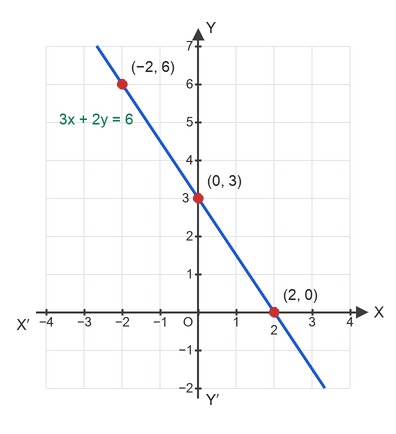
We plot (−2, 6), (0, 3) and (2, 0) and join them.
Watch out: : two minus signs multiply to give a plus.
Therefore, the graph of is the straight line through (−2, 6), (0, 3) and (2, 0).
- 123 marks
Question 12
Draw the graph for each equation, given below :
Solve with AIWritten solution
Solution:
Concept: The graph of a linear equation in and (such as ) is a straight line. A point lies on the line exactly when its co-ordinates satisfy the equation. So we find three such points, plot them and join them with a ruler: two points fix the line, and the third is a check.
Given: The equation .
Step 1 — Make y the subject.
We take to the other side and divide by 5.
Step 2 — Work out the points.
We choose values of that make a multiple of 5, so that every is whole. For example, when :
The other two points of the table are found in the same way.
Step 3 — Plot and join.
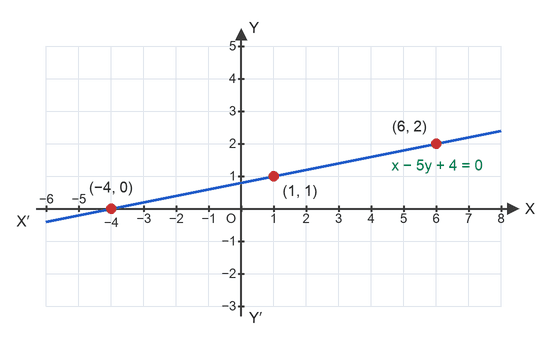
We plot (−4, 0), (1, 1) and (6, 2) and join them.
Watch out: Pick -values that give whole-number -values; points with awkward fractions are hard to plot accurately.
Therefore, the graph of is the straight line through (−4, 0), (1, 1) and (6, 2).
- 133 marks
Question 13
Draw the graph for each equation, given below :
Solve with AIWritten solution
Solution:
Concept: The graph of a linear equation in and (such as ) is a straight line. A point lies on the line exactly when its co-ordinates satisfy the equation. So we find three such points, plot them and join them with a ruler: two points fix the line, and the third is a check.
Given: The equation .
Step 1 — Make y the subject.
We take and 5 to the other side.
Step 2 — Work out the points.
Every whole number gives a whole number . For example, when :
The other two points of the table are found in the same way.
Step 3 — Plot and join.
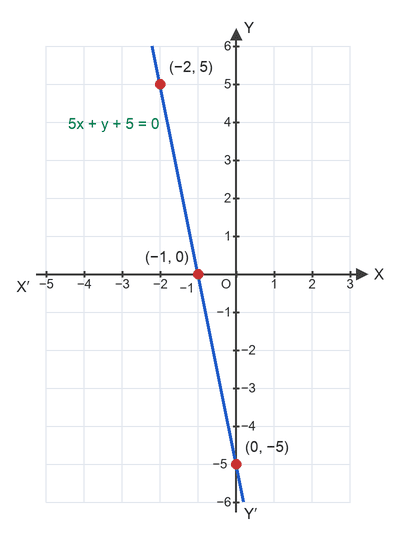
We plot (−2, 5), (−1, 0) and (0, −5) and join them. The line is steep: changes by 5 for each step of 1 in .
Watch out: , so the value of at this point is .
Therefore, the graph of is the straight line through (−2, 5), (−1, 0) and (0, −5).
- 143 marks
Question 14
Draw the graph for each equation given below; hence find the co-ordinates of the points where the graph drawn meets the co-ordinate axes :
Solve with AIWritten solution
Solution:
Concept: The graph of a linear equation in and (such as ) is a straight line. A point lies on the line exactly when its co-ordinates satisfy the equation. So we find three such points, plot them and join them with a ruler: two points fix the line, and the third is a check.
A line meets the -axis at the point where , and meets the -axis at the point where .
Given: The equation .
Step 1 — Clear the fractions.
The LCM of 3 and 5 is 15, so we multiply every term by 15.
Step 2 — Find where it meets the x-axis.
On the -axis , so we put .
Step 3 — Find where it meets the y-axis.
On the -axis , so we put .
Step 4 — Find a third point as a check.
We put .
Step 5 — Plot and join.
We plot (3, 0), (0, 5) and (6, −5) and join them. The line crosses the axes exactly at the two points found in Steps 2 and 3.

Watch out: On the -axis it is that is zero, and on the -axis it is that is zero.
Therefore, the line meets the -axis at (3, 0) and the -axis at (0, 5).
- 153 marks
Question 15
Draw the graph for each equation given below; hence find the co-ordinates of the points where the graph drawn meets the co-ordinate axes :
- 163 marks
Question 16
Draw the graph of the straight line given by the equation
Calculate the area of the triangle formed by the line drawn and the co-ordinate axes.
- 173 marks
Question 17
Draw the graph of the equation
From the graph, find :
(i) , the value of , when
(ii) , the value of , when .
- 183 marks
Question 18
Draw the graph of the equation
From the graph, find :
(i) , the value of , when
(ii) , the value of , when
- 193 marks
Question 19
Use the table given below to draw the graph.
The table :
−5 −1 3 13 −2 2 5 7 From your graph, find the values of '' and ''.
State a linear relation between the variables and .
- 203 marks
Question 20
Draw the graph obtained from the table below :
3 −5 5 −1 −1 2 3 4 0 Use the graph to find the values of , and . State a linear relation between the variables and .
- 213 marks
Question 21
A straight line passes through the points (2, 4) and (5, −2). Taking 1 cm = 1 unit; mark these points on a graph paper and draw the straight line through these points. If points (, −4) and (3, ) lie on the line drawn; find the values of and .
- 223 marks
Question 22
Draw the graph (straight line) given by equation . If the straight line drawn passes through the points (, −5) and (6, ); find the values of and .
- 231 mark
Question 23
The point of intersection of lines and is :
- 241 mark
Question 24
For line , if , the value of is :
- 251 mark
Question 25
A point that lies on the line can be taken as :
- 261 mark
Question 26
The line :
- 271 mark
Question 27
The lines and cut each other at point :
- 283 marks
Question 28
Solve, graphically, the following pairs of equations :
- 293 marks
Question 29
Solve, graphically, the following pairs of equations :
- 303 marks
Question 30
Solve, graphically, the following pairs of equations :
- 313 marks
Question 31
Solve, graphically, the following pairs of equations :
- 323 marks
Question 32
Solve graphically the simultaneous equations given below. Take the scale as 2 cm = 1 unit on both the axes.
- 333 marks
Question 33
Use graph paper for this question. Draw the graph of and on the same axes. Use 2 cm = 1 unit on both axes and plot only 3 points per line.
Write down the co-ordinates of the point of intersection of the two lines.
- 343 marks
Question 34
Use graph paper for this question. Take 2 cm = 2 units on -axis and 2 cm = 1 unit on -axis.
Solve graphically the following equations :
;
(Plot only three points per line)
- 353 marks
Question 35
Use graph paper for this question. Take 2 cm = 1 unit on both the axes.
(i) Draw the graphs of and . Plot only three points per line.
(ii) Write down the co-ordinates of the point of intersection of the lines.
(iii) Measure and record the distance of the point of intersection of the lines from the origin in cm.
- 363 marks
Question 36
The sides of a triangle are given by the equations ; and .
Find, graphically :
(i) the area of triangle;
(ii) the co-ordinates of the vertices of the triangle.
- 373 marks
Question 37
By drawing a graph for each of the equations ; and on the same graph paper; show that the lines given by these equations are concurrent (i.e. they pass through the same point).
Take 2 cm = 1 unit on both the axes.
- 383 marks
Question 38
Using a scale of 1 cm to 1 unit for both the axes, draw the graphs of the following equations : , .
From the graph find :
(i) the co-ordinates of the point where the two lines intersect;
(ii) the area of the triangle between the lines and the -axis.
- 393 marks
Question 39
The cost of manufacturing articles is ₹ (50 + 3). The selling price of articles is ₹ 4.
On a graph sheet, with the same axes, and taking suitable scales draw two graphs, first for the cost of manufacturing against no. of articles and the second for the selling price against number of articles.
Use your graph to determine :
(i) No. of articles to be manufactured and sold to break even (no profit and no loss),
(ii) The profit or loss made when (a) 30 (b) 60 articles are manufactured and sold.
- 403 marks
Question 40
Find the distance of point (8, −4) from -axis.
- 413 marks
Question 41
Three vertices of a parallelogram ABCD are A(−5, −1), B(3, −1) and C(1, −6). Use graphical method to find the co-ordinates of fourth vertex D.
- 423 marks
Question 42
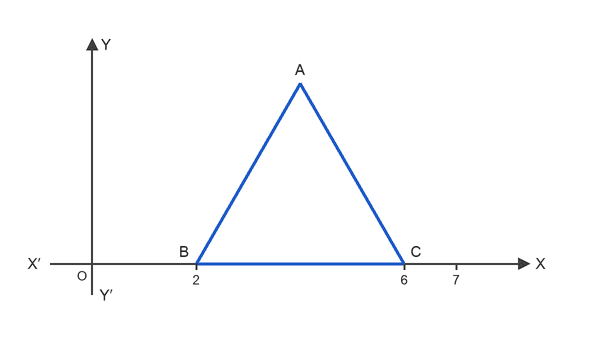
In the given figure, ABC is an equilateral triangle. Find the co-ordinates of A.
- 433 marks
Question 43
Draw the graph of . Use the graph drawn to find the area of triangle formed by the line drawn and the co-ordinate axes.
- 443 marks
Question 44
Use the graphical method to find the value of , if :
lies on the straight line
- 453 marks
Question 45
Use the graphical method to find the value of , if :
lies on the straight line
- 463 marks
Question 46
Find graphically, the vertices of the triangle whose sides have the equations ; and respectively. Take 1 cm = 1 unit on both the axes.
- 473 marks
Question 47
Using the same axes of co-ordinates and the same unit, solve graphically :
and .
(Take at least 3 points for each line drawn).
- 483 marks
Question 48
Solve graphically, the following equations.
; .
Take 2 cm = 1 unit on each axis.
Also, find the area of the triangle formed by the lines and the -axis.
- 493 marks
Question 49
Use the graphical method to find the value of '' for which the expressions and are equal.
- 503 marks
Question 50
The course of an enemy submarine, as plotted on rectangular co-ordinate axes, gives the equation . On the same axes, a destroyer's course is indicated by the graph . Use the graphical method to find the point at which the paths of the submarine and the destroyer intersect.
What Class 9 Maths Ch 27 covers
The sections of the chapter, in the order the book takes them. Every question above comes from one of these.
- 01Graphs of Linear Equations in Two Variables
- 02Solution of Simultaneous Linear Equations Graphically
More ways to study this chapter
The same chapter asked three other ways. Practise it, revise it, and see what the board has set on Ch 27 before.
Class 9 Maths Ch 27 questions students ask
How many questions are there in Class 9 Maths Ch 27?
50 questions. Every one is solved step by step on this page.
Are these Class 9 Maths solutions free?
Yes. Every question and its full working is free to read, with no account needed.
Can I download the Class 9 Maths Ch 27 solutions as a PDF?
There is no PDF to download. Every solution is on this page instead, which means it is searchable, always the current syllabus, and readable on a phone. Use your browser's print option if you want it on paper.