
Question 363 marksMedium
The sides of a triangle are given by the equations ; and .
Find, graphically :
(i) the area of triangle;
(ii) the co-ordinates of the vertices of the triangle.
Confirming your payment
Sign up now and get 250 free tokens.
Graphical Solution · Question 36 of 50
The sides of a triangle are given by the equations ; and .
Find, graphically :
(i) the area of triangle;
(ii) the co-ordinates of the vertices of the triangle.
Solution:
Concept: Each side of the triangle is a straight line. Two sides meet at a vertex, so each vertex is the point where two of the lines cross; the three lines taken in pairs give the three vertices.
Area of a triangle , where the height is the perpendicular distance of the third vertex from the base.
Step 1 — Table for y − 2 = 0.
The first equation, , is the horizontal line with ordinate 2; we choose three values of .
Step 2 — Table for y + 1 = 3(x − 2).
We make the subject.
That is the value at ; and are done the same way.
Step 3 — Table for x + 2y = 0.
We make the subject.
That is the value at ; and are done the same way.
Step 4 — Draw the lines and read the vertices.
We draw all three lines on the same axes. Taken in pairs, they cross at (−4, 2), (3, 2) and (2, −1); these are the vertices of the shaded triangle.
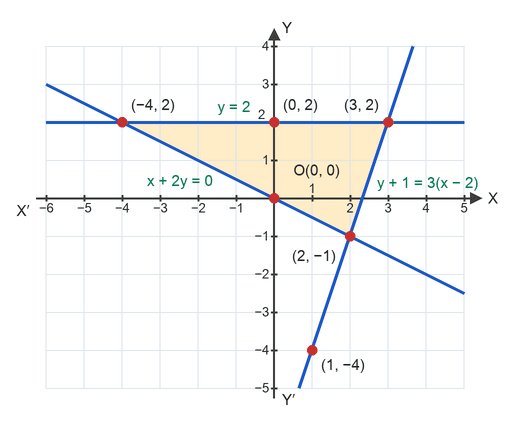
Step 5 — Check the vertices.
The vertices (−4, 2) and (3, 2) have ordinate 2, so they lie on ; we check each vertex in the slanting lines through it; on the left side must be 0, and on the value of must equal the ordinate:
Step 6 — Find the area.
The side from (−4, 2) to (3, 2) lies on , so it is horizontal; we take it as the base. The height is the vertical distance of (2, −1) from the line .
Watch out: The height is measured straight down from the base line to the opposite vertex, not along a slanting side.
Therefore, (i) the area of the triangle is 10.5 sq. units; (ii) its vertices are (−4, 2), (3, 2) and (2, −1).